Spousal Sponsorship Processing Time 2026 | What to Expect
By Narek Mirzoyan, Regulated Canadian Immigration Consultant (RCIC #R1005184). Verify on the CICC public register.
Last practitioner review by Narek Mirzoyan, RCIC #R1005184: June 17, 2026.
Current official sources checked: October 11, 2026.
Spousal sponsorship processing time in 2026 depends on the sponsored person's residence and destination. IRCC's September 3 figures are 18 or 26 months outside Quebec. Quebec estimates are 33 or 32 months, respectively. These figures apply to applicants living outside or inside Canada. They guide planning, but do not promise a decision date.
For Quebec-bound files, filing an undertaking before its sponsor letter or qualifying AOR date becomes eligible causes MIFI to return it.
For the complete application framework, read the spousal sponsorship Canada guide. This article focuses on timing, Quebec intake, delay causes and available follow-up steps.
TL;DR
IRCC publishes four forward-looking estimates based on residence and Quebec destination. Processing runs from receipt of a complete application until the decision. Acknowledgement of Receipt (AOR) confirms completeness, but does not reset the clock. IRCC gives no fixed timetable for each internal stage. A delayed-file review should start with the record, not an assumed deadline.
Table of Contents
What IRCC's 2026 processing time really says
IRCC's figures estimate the wait for someone applying now, rather than promise a decision date. Expected intake, inventory and processing capacity shape them. IRCC says it updates these figures monthly, so use the category matching residence and Quebec destination.
| Sponsored person's situation | IRCC estimate published September 3, 2026 |
|---|---|
| Living outside Canada, destination outside Quebec | About 18 months |
| Living in Canada, destination outside Quebec | About 26 months |
| Living outside Canada, destination Quebec | About 33 months |
| Living in Canada, destination Quebec | About 32 months |
The figures are not maximums or service guarantees. A published change also does not alter an individual file by the same amount. Check IRCC's current processing-time tool before relying on any figure.
Narek Mirzoyan identifies timing as one of the most common spousal-sponsorship consultation questions. His answer is not one number.
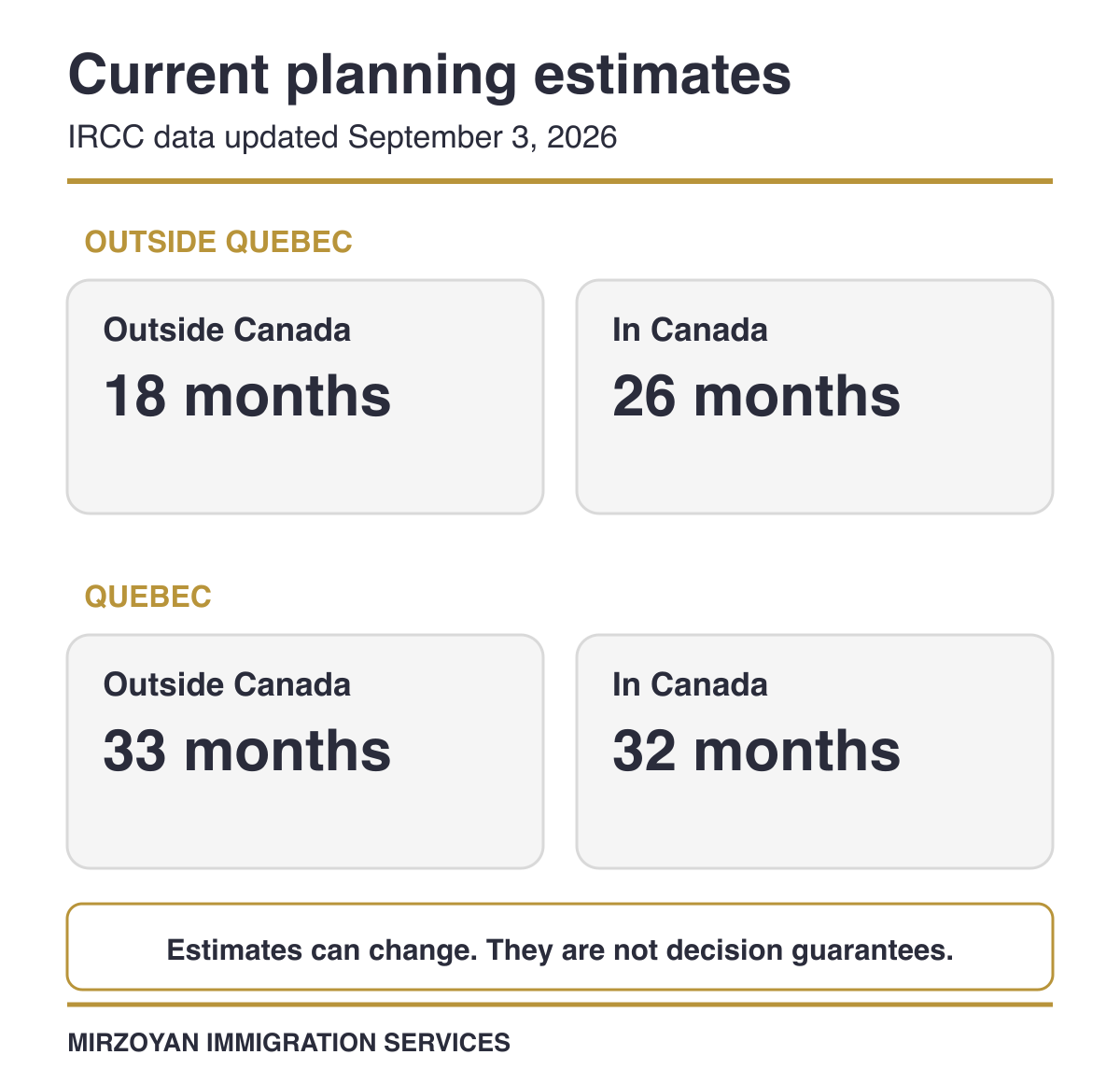
IRCC's September 3, 2026 forward-looking estimates for new complete applications. These figures can change and are not promised decision dates.
What starts the spousal sponsorship processing clock
IRCC says processing starts when it receives a complete application. For an online package, that can be the submission date. Missing forms, signatures, documents or fees can cause a return.
AOR follows IRCC's completeness check. It provides the application number and supports access to status tools. It does not create a later start date.
IRCC explains this sequence in its after-you-apply guidance. The related AOR guide explains what the notice does.
A current spousal sponsorship document checklist can reduce return risk. It cannot guarantee that IRCC will accept or approve the file.
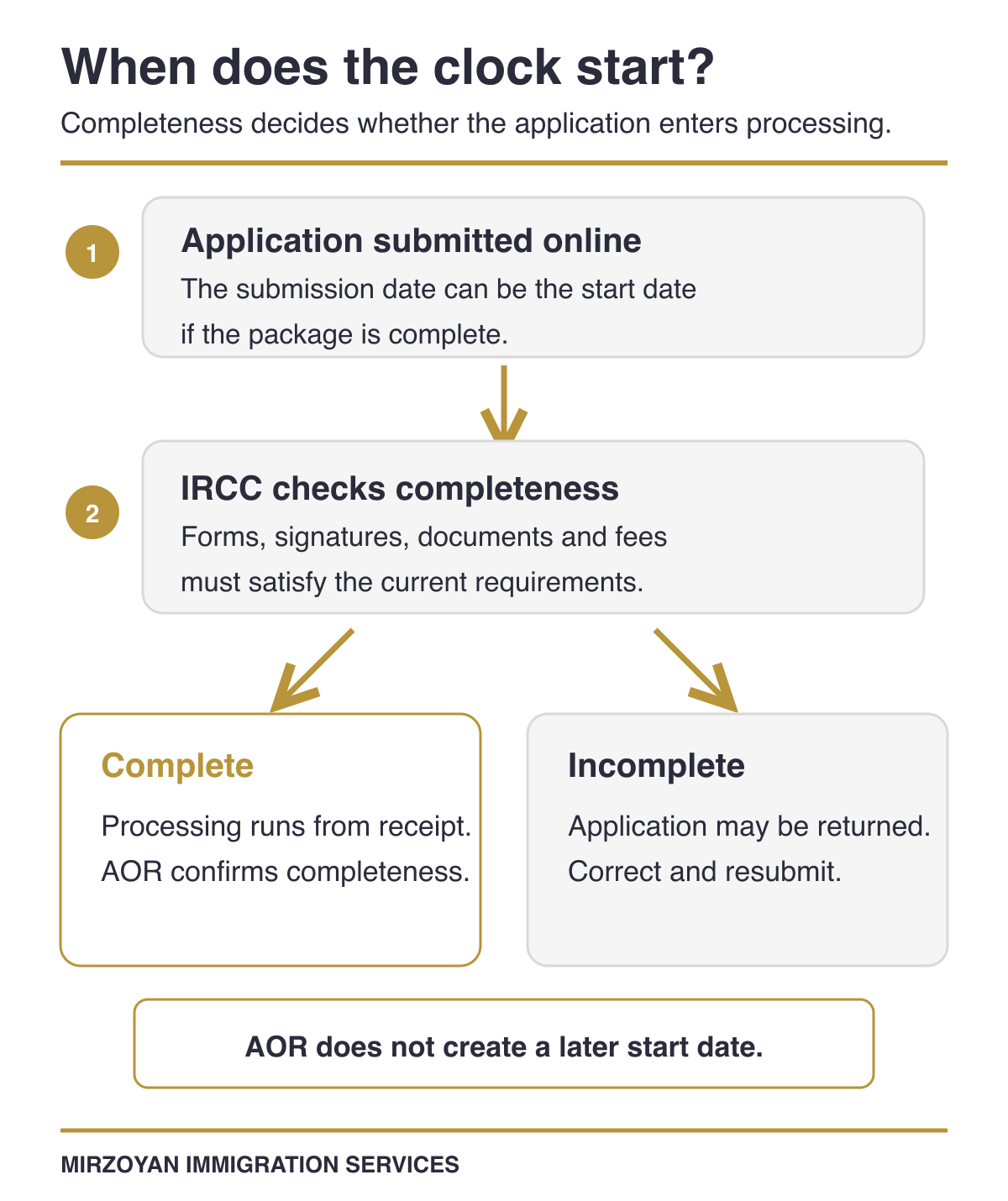
IRCC counts from receipt of a complete application. AOR confirms the completeness check; it does not create a later start date.
Stage-by-stage spousal sponsorship timeline
IRCC does not publish reliable duration bands for each internal stage. The useful timeline follows notices and required actions from completeness through decision. Several reviews may overlap, so one status line cannot reliably predict the next request.
Submission and completeness check. A complete package enters processing. An incomplete package may be returned.
Biometrics, if required. IRCC sends instructions and normally allows 30 days.
Medical examination, if required. The applicant follows the instructions and uses a panel physician.
Eligibility and admissibility review. Sponsor, relationship and applicant checks may overlap.
Further evidence or interview, if required. The request sets the method and deadline.
Decision and confirmation. The notice explains approval steps or available recourse after refusal.
Narek Mirzoyan recommends one file tracker instead of repeated portal checks. It should record the application number, notices, responses, receipts and deadlines.
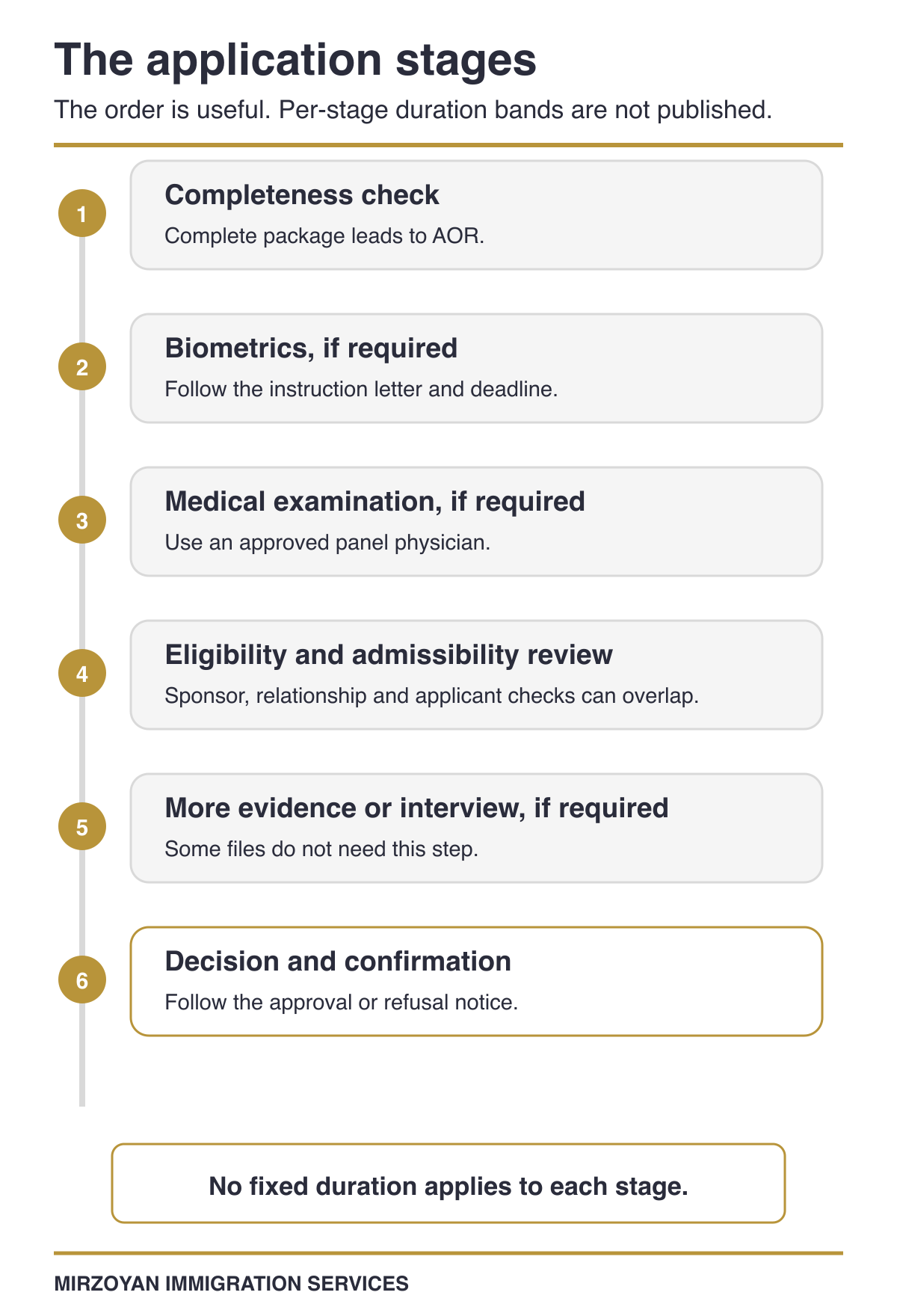
IRCC does not publish a fixed duration for each stage. Follow the actual request and deadline in the file.
The silent stretch between AOR and decision
A quiet account does not prove that processing stopped. Eligibility, background, security and document checks may continue without a new public line.
No universal silent period is automatically normal. First check every request, response receipt and contact detail. Then compare the file with the correct current estimate. A missed letter needs action; an unchanged status line may not.
Why inland and outland timelines differ
The public tool groups files by residence and Quebec destination. Those labels do not fully define the legal application class.
Class affects travel, temporary status and appeal rights. A person living in Canada may apply through the Family Class in some circumstances. Residence alone therefore cannot decide recourse after refusal.
The IRCC open-work-permit rules can cover some Family Class applicants living in Canada. General conditions include AOR, co-residence and qualifying status. A narrow exception applies when qualifying status expires within two weeks.
The inland versus outland sponsorship guide covers the full class choice. The shortest estimate may not fit the couple's circumstances.
Quebec spousal sponsorship is a separate process
Quebec adds an undertaking step to the federal permanent residence process. MIFI assesses that undertaking, while IRCC decides permanent residence. The current intake runs from July 2, 2026 to June 30, 2028. Its spouse and partner cap is 13,300 applications. The overall family-undertaking cap is 15,700.
MIFI stages intake by the date on an IRCC sponsor-eligibility letter. A qualifying sponsor-addressed AOR may apply instead for the Spouse or Common-Law Partner in Canada class. If both exist, MIFI uses the AOR date.
On October 11, documents dated by January 31, 2025 qualified. The next scheduled opening is November 1 for documents dated by June 30, 2025. Early applications are inadmissible and returned.
Check the Quebec intake schedule immediately before filing. The 32- and 33-month federal estimates remain planning figures.
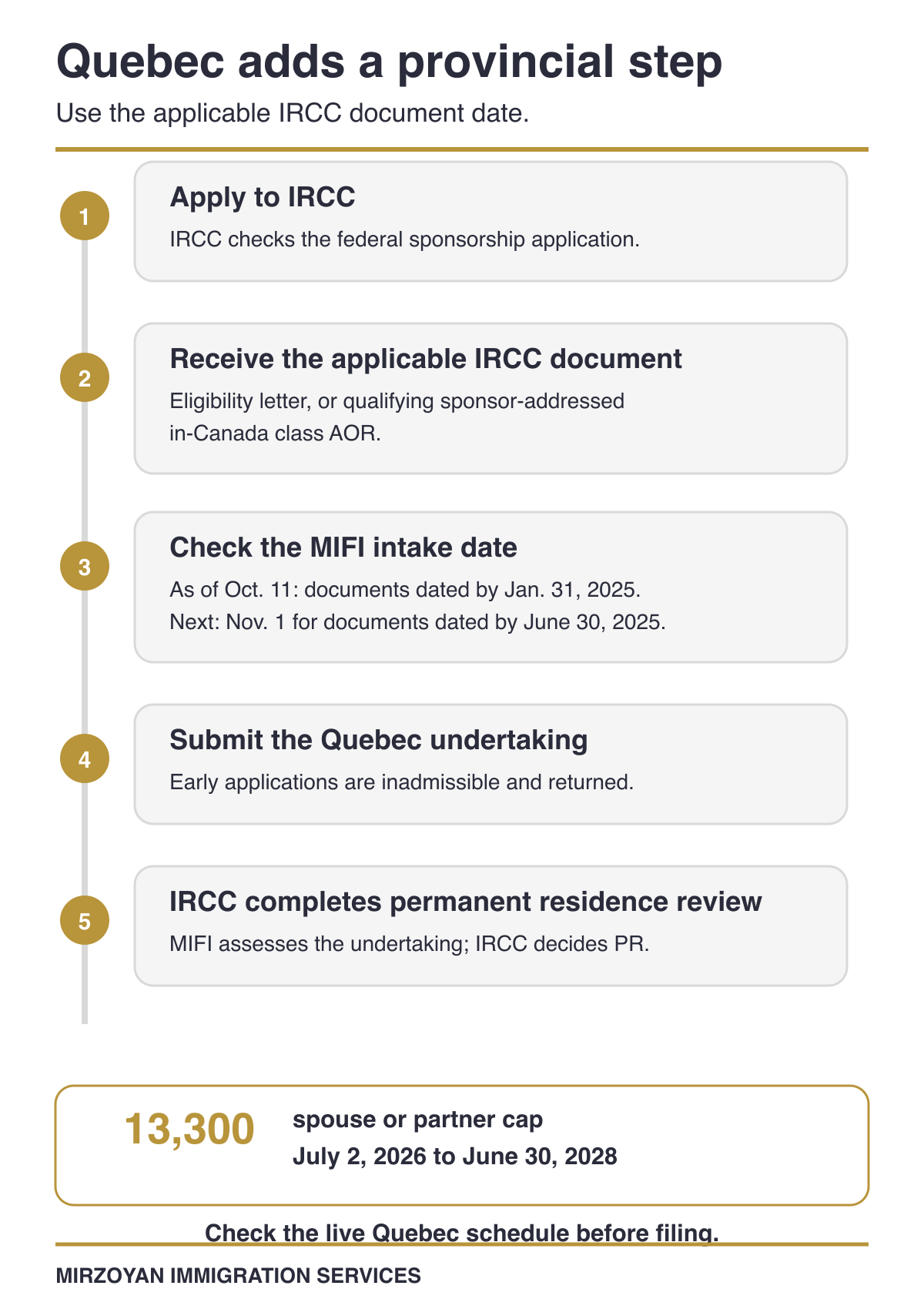
Quebec undertaking intake uses the IRCC sponsor-eligibility letter date or a qualifying sponsor-addressed in-Canada class AOR date. Check the live MIFI schedule before filing.
What can push a file beyond the estimate
A file can pass the estimate because of a return, missed deadline, inconsistent record, added evidence request, interview or admissibility review. No single issue carries a fixed delay. The file history and any outstanding request show what needs attention.
Common delay causes include:
an incomplete package returned by IRCC;
a missed biometrics, medical or document deadline;
identity, address or civil-status records that conflict;
police certificates or background records from several countries;
sponsor eligibility questions about an undertaking or support default;
gaps in the genuine-relationship evidence;
an interview, document request or fairness letter; and
criminal, medical, security or misrepresentation concerns.
No fixed delay applies to any one issue. A returned package can change the effective starting point. An outstanding request can pause progress until IRCC receives a complete response. The requested evidence and response quality shape the effect.
Narek Mirzoyan identifies returned packages and inconsistent relationship chronologies as recurring delay causes. The spousal sponsorship fees guide can help prevent a fee-related return.
A filed application needs a chronology-based review when correspondence, deadlines or status updates no longer align.
The Internal Logic of an IRCC Officer
An officer must connect the forms, civil records and relationship evidence into one consistent account. The sponsor must qualify. The applicant must fit the claimed category and remain admissible.
The genuineness rule asks two separate questions. The relationship must be genuine. It also cannot have been entered primarily for immigration status.
More pages do not repair a conflicting chronology. Dates for addresses, marriages, divorces, travel and cohabitation should agree across the package.
Red Flags & Procedural Fairness Letters (PFL)
A procedural fairness letter identifies a concern that could lead to refusal. It differs from a routine request for an updated document.
One pattern is an address history showing cohabitation while leases and bank records show separate homes. Another is a marriage date that conflicts with a prior divorce certificate. A third is an unexplained communication gap during a claimed period of continuous partnership.
The response should address the stated concern with relevant evidence. The letter's deadline controls. No universal response period is safe to assume.
Steps to take when a file is delayed
Use these steps in order. The file's facts determine whether later steps are appropriate.
Read the file record. Confirm the category, estimate, requests, responses and current contact details.
Use IRCC's status tools and web form. Keep the enquiry confirmation and any reply.
Consider an MP enquiry. A constituency office may request information. It cannot direct the outcome.
Consider an ATIP request. Case notes may identify completed checks or an outstanding review.
Get advice about mandamus. This Federal Court remedy is fact-specific and has no automatic month threshold.
The Federal Court's immigration practice guidelines explain that mandamus seeks a decision. It does not seek a particular result.
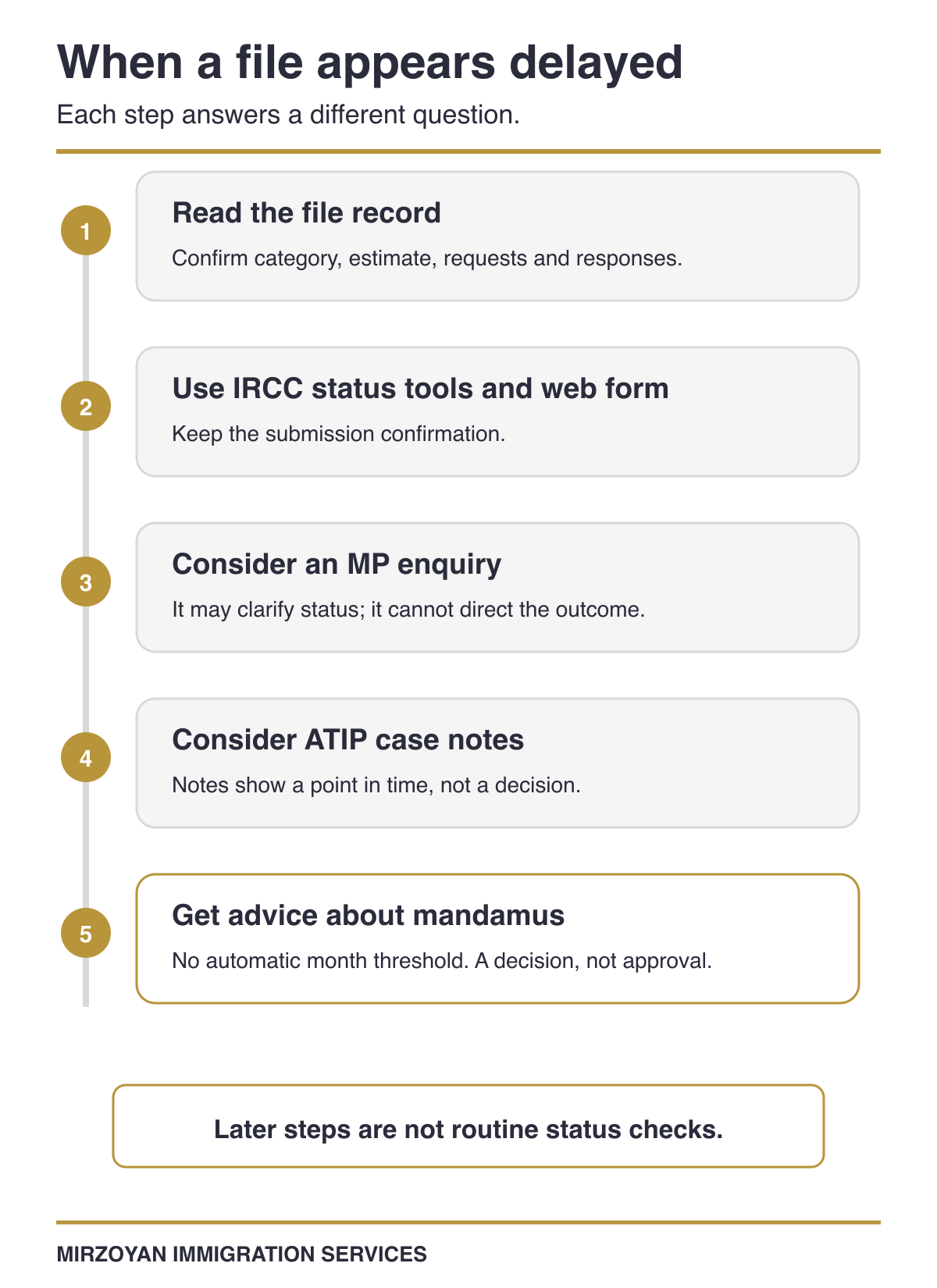
Start with the record and IRCC channels. MP enquiries, ATIP notes and mandamus have different purposes and do not guarantee approval.
Strategic Trade-off Matrix
| Dimension | Spouse or Common-Law Partner in Canada class | Family Class |
|---|---|---|
| Processing trajectory | The tool currently shows 26 months outside Quebec for applicants living in Canada. | The tool currently shows 18 months outside Quebec for applicants living abroad. Residence and class can differ. |
| Strategic risk | The couple must live together in Canada. Travel can create residence and re-entry concerns. | This route can suit an applicant living abroad. Canadian temporary status still needs separate management after entry. |
| Appeal rights | A refusal does not carry the sponsor appeal created for a Family Class application. | A sponsor may appeal under IRPA section 63(1), subject to statutory limits. |
| Financial timeline | An open work permit may be available if the current conditions are met. | No Canadian work authorization follows while abroad. Some applicants living in Canada may qualify under the same OWP policy. |
The Family Class appeal provision ties appeal rights to class, not residence. The spousal sponsorship appeal guide explains the next-stage issues.
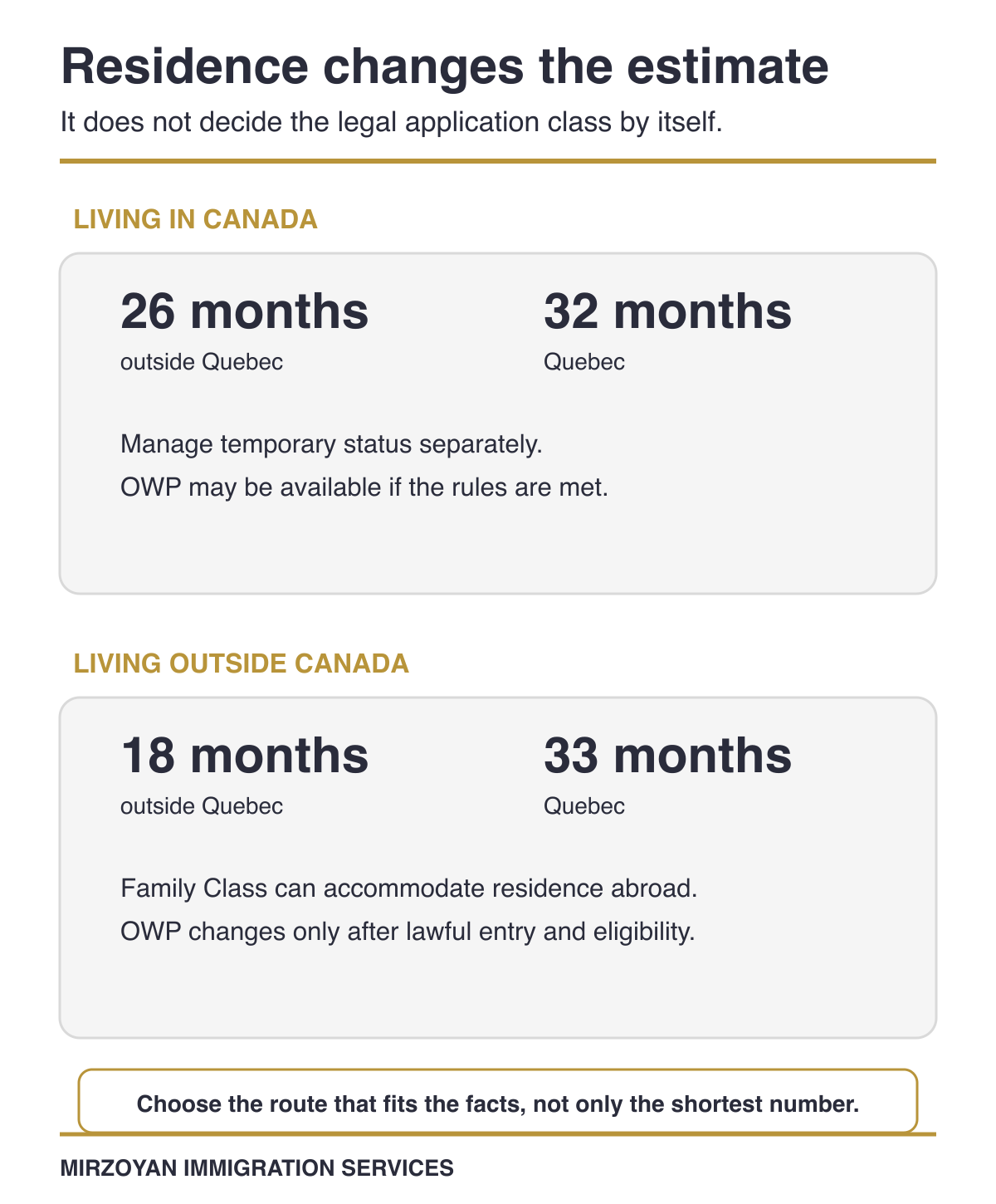
Residence affects the published estimate, but the application class must fit the couple's actual circumstances.
How professional help can clarify a delayed file
Straightforward files may be managed with current government instructions. Help becomes useful when the route, Quebec date or file history is unclear. It can also help after a document request or fairness letter.
One on One Advisory connects the applicant directly with Narek Mirzoyan, RCIC #R1005184. The review can reconcile dates, identify missing records and explain a notice's scope. It cannot guarantee approval or make IRCC process a file faster.
The spousal sponsorship service explains the available work and service limits.
Choose a focused spousal sponsorship consultation when the file needs a clear evidence or follow-up plan.
Key Takeaways
IRCC's September estimates are 18 months outside Canada and 26 months inside Canada, outside Quebec.
Quebec estimates are 33 months outside Canada and 32 months inside Canada.
Processing starts when IRCC receives a complete application. AOR confirms completeness.
IRCC does not publish reliable duration bands for each internal stage.
Residence and legal application class are related, but not interchangeable.
Mirzoyan Immigration Services can review the chronology, correspondence and available next steps.
FAQ
What is the processing time for spousal sponsorship in Canada in 2026?
As of September 3, 2026, IRCC estimates 18 months for applicants living outside Canada and 26 months inside Canada, outside Quebec. Quebec estimates are 33 and 32 months, respectively. These figures start with a complete application and remain planning estimates, rather than promised decision dates.
Why is spousal sponsorship taking so long?
A file may take longer after a returned incomplete package, missed request or inconsistent relationship chronology. Added background checks, an interview or Quebec's undertaking process can also extend it. IRCC's current estimate reflects inventory and expected admissions. No issue has a fixed extra duration, so check outstanding requests before assuming the file has stalled.
What is stage 1 approval spousal sponsorship?
Stage 1 approval is an informal label, usually referring to sponsor eligibility or approval in principle in an in-Canada file. It is not permanent residence approval and does not start a new processing clock. Relationship, medical, criminality, security and other admissibility reviews may remain, so rely on the actual IRCC notice rather than the label.
How long does inland spousal sponsorship take?
IRCC's September 3, 2026 estimate is 26 months for a spouse or partner living in Canada, outside Quebec. The Quebec estimate is 32 months. These are forward-looking figures for someone applying now. IRCC does not publish reliable duration bands for each internal stage, and a returned package or missed request can extend the file.
How long does it take to get aor for inland spousal sponsorship in 2026?
IRCC does not publish a reliable 2026 AOR timeline for inland spousal sponsorship. AOR follows the completeness check and confirms the application number; it does not start a later clock. Missing forms, signatures, documents or fees can cause a return instead. Watch the actual account and email, rather than relying on a fixed week range.
Conclusion
The useful timeline combines the correct current estimate with the couple's own file record. Complete evidence and timely responses protect the factors applicants can control. Published figures can still change with inventory and capacity.
Mirzoyan Immigration Services reviews planned applications and delayed files across Canada. Service is available in person, online, or by phone.
Review the route, evidence and next step before another deadline passes.
This article provides general information, not legal advice. Immigration rules and processing times can change. Check current government instructions before acting.