OINP Complete Guide
By Narek Mirzoyan, RCIC # R1005184 · CICC public register
Last reviewed by Narek Mirzoyan, RCIC # R1005184, on October 11, 2026. Official sources checked October 11, 2026.
OINP Complete Guide explains Ontario’s current nomination pathways and how they connect to your Canadian permanent residence application. The Ontario Immigrant Nominee Program (OINP) now accepts new registrations through the Ontario Workforce Priority stream. Its Expression of Interest (EOI) portal opened on August 4, 2026.
If you registered under a former stream, your submission records determine which requirements you need to check. Ontario announced that registrations without invitations would be withdrawn. But applications submitted after an invitation remain subject to the eligibility rules in force when submitted.
After nomination, Immigration, Refugees and Citizenship Canada (IRCC) decides your separate application for permanent residence.
What Changed in OINP in 2026?
Ontario replaced eight OINP streams with Ontario Workforce Priority on June 25, 2026. Its Expression of Interest portal opened on August 4, 2026. Your next step depends on whether you registered under a former stream or submitted an application after an invitation.
So before using an older checklist, confirm the stream and stage shown in your records. Use the invitation and submission confirmation to identify the application Ontario actually received and the date you filed it.
Old Registrations and Submitted Applications Follow Different Rules
Ontario announced that former-stream EOIs and job offers without an invitation would be automatically withdrawn. For that situation, a new Ontario Workforce Priority registration is needed if you still qualify. And an employer already registered in the portal can keep using that account for the new process. But the job-offer route requires a new offer to start your new registration.
Applications submitted after an invitation under a former stream continue under the eligibility rules in effect when submitted. Keep the invitation and submission confirmation together so you can establish which application Ontario is assessing.
But an invitation alone does not establish that the application was submitted within its filing period. Without submission confirmation, check your account messages and ask OINP to clarify your file’s status before making changes.
How PNP, OINP, and OWP Fit Together
The Provincial Nominee Program (PNP) is the federal immigration framework through which participating provinces and territories nominate candidates. OINP is Ontario’s programme within that framework. Ontario Workforce Priority (OWP) is the current stream for new OINP registrations.
These overlapping names can be confusing when you are trying to work out where your application belongs. Your Ontario pathway determines the provincial requirements, while your nomination route determines the next federal steps.
But qualifying for OWP does not automatically qualify you for the separate federal Express Entry system. You can meet Ontario’s criteria and still need to use the non-Express Entry PNP process. So identify your Ontario pathway before choosing between the two federal application systems. Use the nomination route to choose the federal document checklist, then prepare the evidence that checklist requires.
Which Ontario Workforce Priority Pathway Fits Your Situation?
Ontario Workforce Priority covers two job-offer pathways and an exception for eligible self-employed physicians. For a job-offer pathway, your occupation’s classification determines which applicant requirements you must check. The National Occupational Classification (NOC) groups occupations by their duties and requirements.
Its Training, Education, Experience and Responsibilities (TEER) category separates the two job-offer pathways. So match your actual work to the current Ontario criteria, because a familiar job title does not establish eligibility.
TEER 0–3 Job-Offer Pathway
A qualifying Ontario employer must support your permanent, full-time job offer in a TEER 0–3 occupation. Your work experience, education, language results and any required licence must satisfy the applicable OWP requirements. But Ontario provides alternatives for certain requirements, so a general checklist can overlook the rule for your occupation.
The usual language threshold is Canadian Language Benchmark (CLB) 6 in each ability, with specified exceptions. Ontario’s pathway rules explain the applicable alternatives and exceptions.
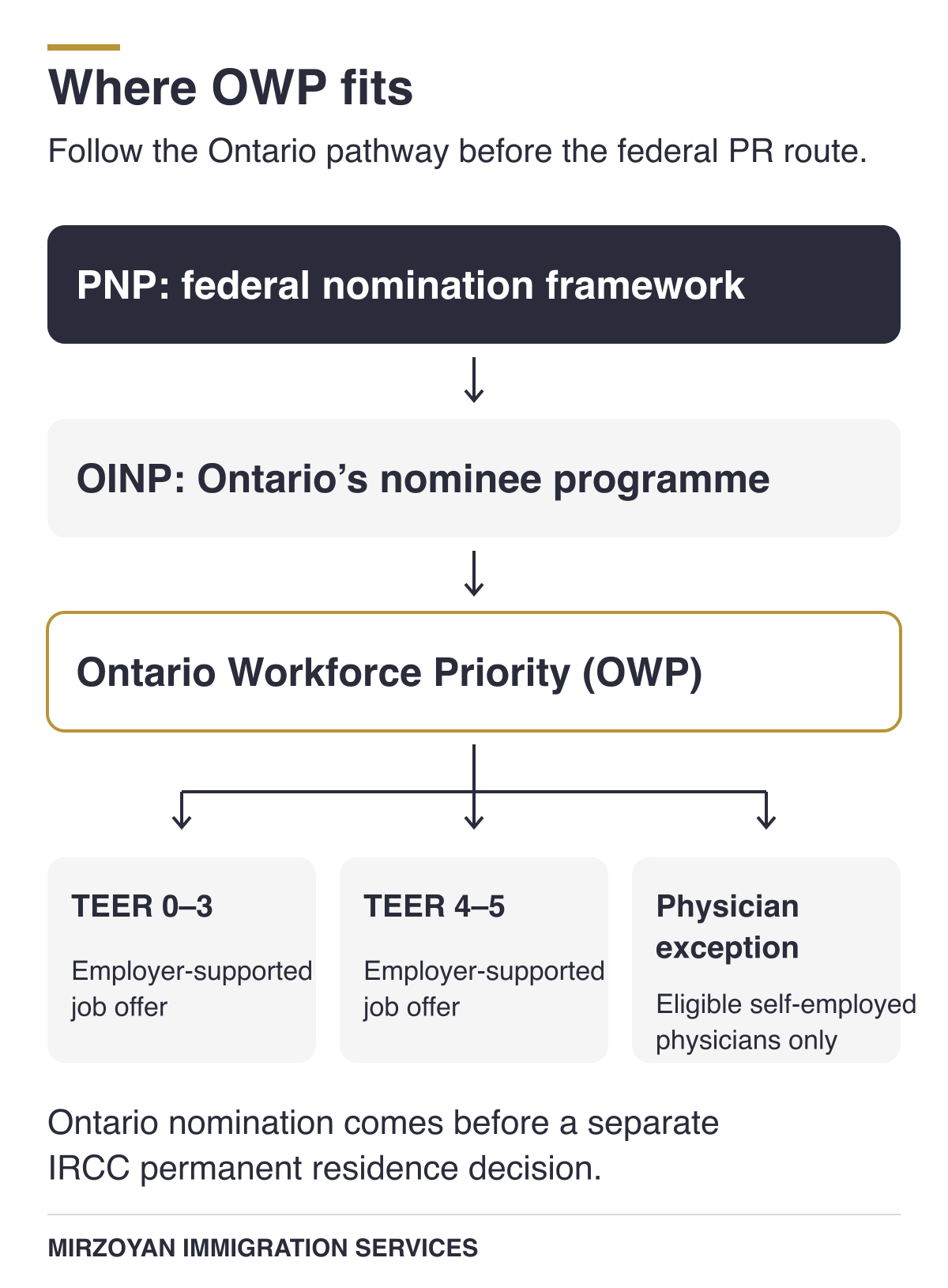
Ontario Workforce Priority is the current OINP stream for new registrations. It includes TEER 0–3 and TEER 4–5 job-offer pathways plus a specific self-employed physician exception.
Before choosing this route, compare your duties and experience dates with the requirements for your specific occupation. If you rely on a licensing alternative, confirm that your occupation permits it and that your licence remains valid.
And graduating in Ontario does not by itself replace the employer-supported job offer needed for this pathway. This pathway may also permit an Express Entry nomination, provided you meet the separate federal requirements.
TEER 4–5 Job-Offer Pathway
The TEER 4–5 pathway requires a qualifying Ontario job offer and a different applicant checklist. Ontario generally requires nine months of cumulative experience in the offered position within the previous two years. The language threshold is CLB 4 in each ability, and the education requirement is secondary school or its equivalent.
Check the complete Ontario requirements before relying on those three headline conditions. But your employer must also qualify, regardless of how long you have worked in the offered position.
Only experience you have already completed can count toward the applicable Ontario work-experience requirement. If your records include breaks or changes in duties, map those periods before deciding that you have enough experience. This OWP pathway leads to the non-Express Entry PNP route after nomination. And an Express Entry profile created for another purpose does not change the federal route attached to this pathway.
Self-Employed Physician Pathway
Eligible self-employed physicians can pursue OWP without an employer-supported job offer. Ontario requires an Ontario Health Insurance Plan (OHIP) billing number and an eligible provincial medical registration certificate. Eligible certificate classes include independent practice, academic practice and provisional registration at the College of Physicians and Surgeons of Ontario.
You must also be a member in good standing under Ontario’s physician requirements. But a postgraduate education licence does not qualify for this particular self-employed physician exception. Ontario explains the physician criteria and registration process separately from the job-offer pathways.
If you qualify, contact OINP to begin EOI registration through the process for self-employed physicians. Ontario states that the other listed applicant requirements and employer requirements do not apply to this exception.
But the exception does not waive the separate federal requirements if you choose an Express Entry nomination. So if you hold a postgraduate licence, check whether an eligible employed position supports a job-offer application.
How the Employer-Led OINP Process Works
Your employer starts the OWP job-offer process, and an invitation later requires separate submissions from both of you.
But preparing your documents alone cannot complete the employer’s position application or supply the business evidence. Agree on who will handle each submission before the first portal entry starts the registration deadline. The steps below follow Ontario’s current application process. Eligible self-employed physicians use the separate registration route described above.
The Employer Submits the Position First
1. Your employer registers the business and submits the job offer through the Employer Portal.
Ontario then provides a job-offer ID for your EOI registration. This step applies even if you already work for that employer. But a signed employment letter alone does not create the portal record or the ID you need. Confirm that the employer can provide the required business information before starting the process.
The offer also supplies information that flows into your EOI, including the occupation and wage. So review those details against your employment contract and the duties you actually perform in the position. An incorrect NOC or wage can affect both your eligibility and the points recorded in your EOI. Ontario explains that changing these employer-supplied fields requires a replacement offer and EOI.
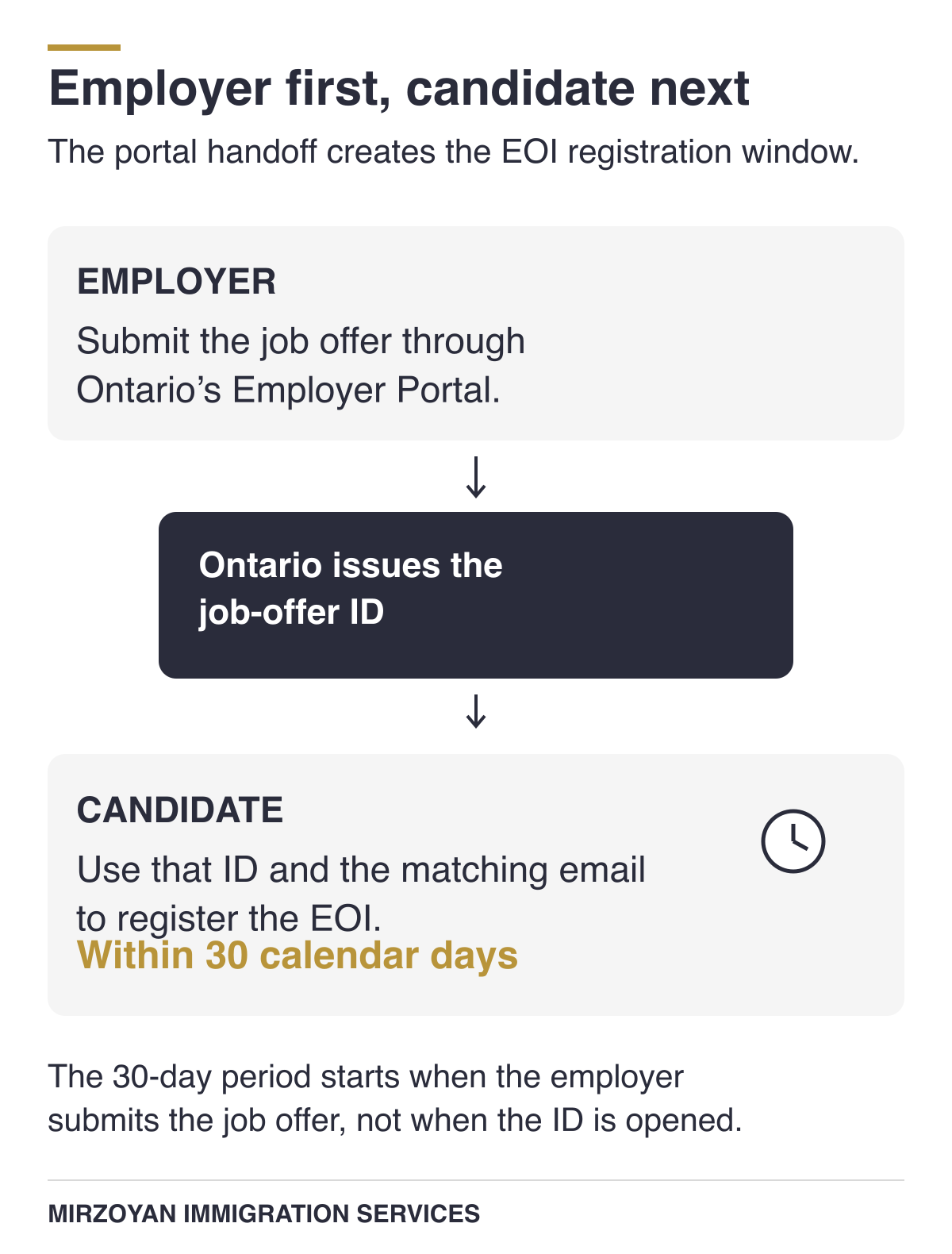
For a job-offer pathway, the employer submits first. The candidate then uses the job-offer ID and matching email to register an EOI within 30 calendar days.
The Candidate Registers an EOI Within 30 Days
2. Register your EOI within 30 calendar days of the employer submitting the job offer.
Use the job-offer ID and the same email address supplied for you in the employer’s submission. EOI registration is free and records your interest in applying. And registration does not mean Ontario has assessed your documents or approved your eligibility for nomination. You still need an Ontario invitation before the nomination application becomes available for you to submit.
So save your submitted registration and identify the documents supporting each factor for which you claimed points. If the 30-day window expires, the employer must submit another job offer to restart registration.
Ontario says an EOI remains valid for up to 12 months, unless you receive an invitation or it is removed earlier. And keep relevant information current while waiting, because the original registration is not a permanent place in the pool.
An Invitation Starts Two Linked Filing Clocks
3. An Ontario invitation starts a 14-day employer deadline and a 17-day applicant deadline.
Both periods run from the invitation date, and both use calendar days. Your employer must first submit the application for approval of the employment position. You can prepare your application during that period, but must wait for the employer’s submission before sending it. But your 17-day filing period does not restart on the date your employer finishes their application.
Waiting for an employer’s submission can feel stressful when your own deadline is approaching at the same time. So prepare the documents and agree on submission responsibilities with your employer before an invitation arrives. If the employer misses the deadline, Ontario withdraws the job offer and removes the associated EOI. Eligible self-employed physicians have the 17-day application deadline without depending on the employer’s 14-day step.
Ontario Reviews the Position and Candidate Together
4. Ontario assesses the employer’s position application and your nomination application as linked files.
Approval of the employment position is necessary for your nomination through a job-offer pathway. But your qualifications cannot make up for an employer’s failure to meet the applicable business requirements. And a qualifying employer cannot replace missing evidence that you meet the requirements of your own pathway. Read the stream requirements for both parties before treating either application as ready.
Start by comparing the NOC, wage, duties and work location recorded in the two linked submissions. Mirzoyan Immigration Services can review those fields against the employment agreement and reference letters before filing.
If two records describe different duties, resolve the underlying facts and explain any genuine change. Simply rewording a letter to match the selected occupation leaves any difference in the actual work unresolved.
Nomination Starts the Federal Stage
5. If Ontario nominates you, use that nomination for the appropriate federal permanent residence application.
But the nomination certificate records an Ontario decision and does not itself grant permanent resident status. Read the certificate and nomination letter for the route, conditions and expiry date. Ontario directs nominees to apply for PR within six months and before the certificate expires. So enter the federal filing requirements in your calendar as soon as you receive the nomination package.
For Express Entry, accepting the nomination and receiving a federal invitation come before submitting the PR application. For the non-Express Entry route, nomination allows you to prepare the application through IRCC’s PR Portal. Neither federal route turns the provincial nomination certificate into authorization to work in Canada. And keep your immigration status and work authorization under separate review throughout the federal application stage.
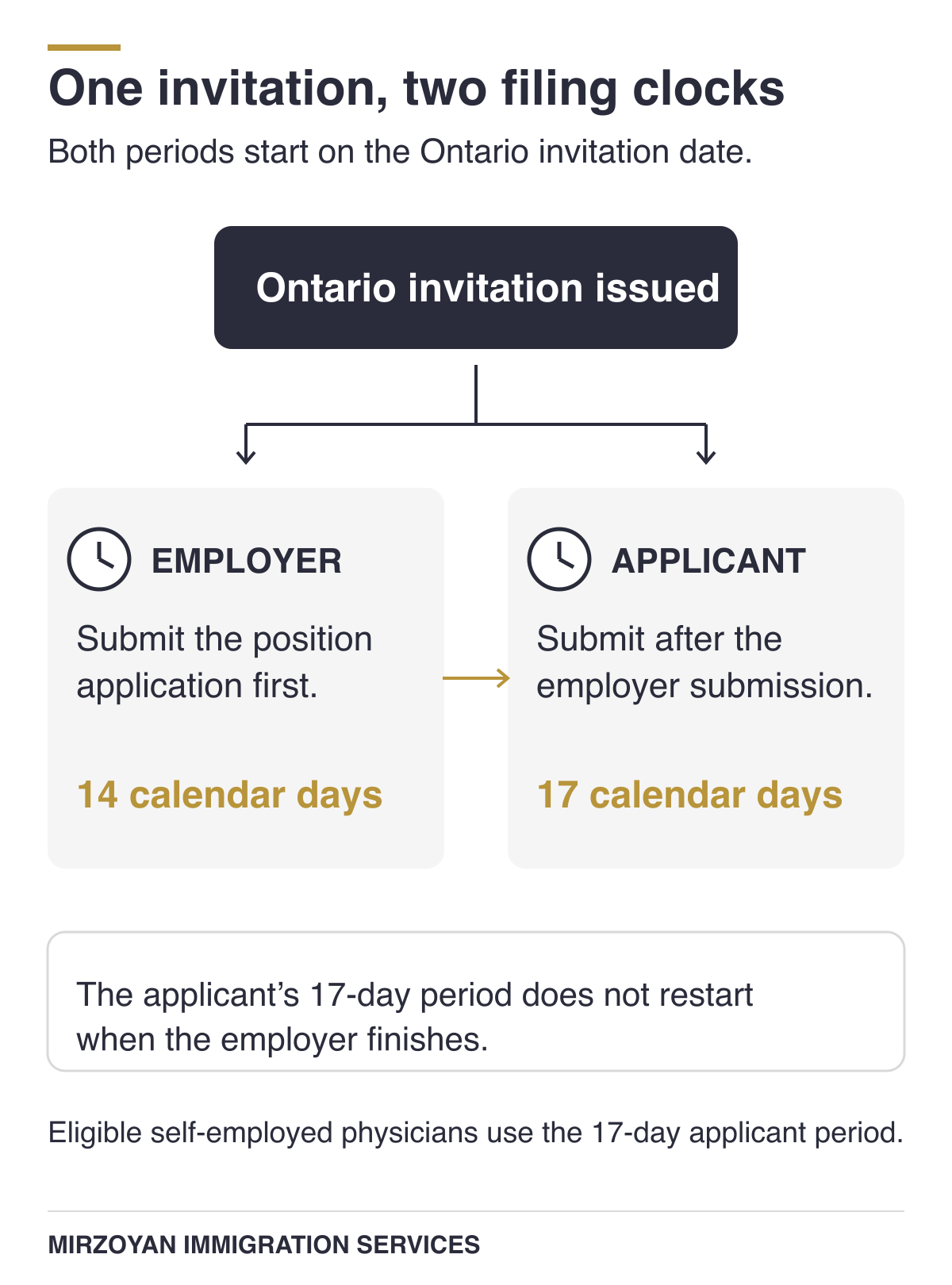
One Ontario invitation starts both job-offer filing periods: 14 calendar days for the employer and 17 calendar days for the applicant. The employer submits first.
| Who acts | Action | Trigger | Deadline |
|---|---|---|---|
| Employer | Submit the job offer | Eligible employer and position prepared | This starts the candidate’s registration clock |
| Candidate | Register the EOI | Employer submits the job offer | Within 30 calendar days of that submission |
| Employer | Apply for position approval | Ontario issues an invitation | Within 14 calendar days of the invitation |
| Candidate | Submit application and pay | Same Ontario invitation; employer application submitted first | Within 17 calendar days of the invitation |
| Nominee | Complete the required federal steps | Ontario issues the nomination | Before certificate expiry; separate Express Entry acceptance and invitation deadlines also apply |
Deadline source: Ontario’s application process. Check the dates in your own invitation and account.
Your employer’s portal record and your documents need to describe the same position. An OINP consultation with Mirzoyan Immigration Services can identify differences needing attention before the 14-day and 17-day filing periods begin.
Eligibility Is Not the Same as EOI Ranking
Eligibility determines whether you meet OWP’s requirements; EOI points determine how your registration ranks under Ontario’s scoring system. But a high EOI score does not repair a requirement you have not met under your pathway. Ontario also requires evidence for each scoring factor you claimed.
Keep the supporting documents beside your score calculation so each claimed factor can be checked before registration. Neither an eligible registration nor a competitive score guarantees an invitation.
So check eligibility first, then make a separate record of the points you claimed and their supporting documents. For example, an education credential may support eligibility without establishing every education-related scoring factor.
And a location score must follow the applicable work-location rule, regardless of which address would produce more points. If your documents support fewer points than expected, correct the registration before relying on the higher total. Save the version used for your registration so an eventual invitation can be checked against the right facts.
Express Entry and Non-Express Entry After Nomination
An Express Entry nomination requires a federal invitation before your PR application; a non-Express Entry nomination uses the PR Portal. The two routes share a provincial nomination requirement, but they are not interchangeable filing options for every candidate.
Who Can Elect an Express Entry Nomination
OWP applicants in TEER 0–3 occupations and eligible self-employed physicians may choose an Express Entry nomination.
But Ontario eligibility alone is insufficient: you must also qualify for a federal programme managed through Express Entry. Those programmes are the Canadian Experience Class, Federal Skilled Worker Program and Federal Skilled Trades Program. Check federal eligibility separately from the Ontario pathway. The experience or language evidence that satisfies Ontario may not meet the requirements of your chosen federal programme.
Ontario requires a valid Express Entry profile during the relevant provincial application and nomination stages. So track the profile’s expiry alongside your language results and the other time-sensitive documents supporting your application. If it expires, follow Ontario’s profile-update or nomination-transfer instructions promptly.
And do not assume a replacement profile automatically reconnects to the nomination recorded in your Ontario file. The broader Express Entry guide explains the federal system in more detail.
What an Accepted Nomination Adds
An accepted Express Entry nomination adds 600 points under the Comprehensive Ranking System (CRS), subject to its additional-points limit.
But Ontario’s EOI score and your federal CRS score serve different purposes at different stages of the process. You have 30 calendar days to accept or decline the nomination in your Express Entry account. Accepting the nomination improves your ranking; you must still receive an invitation and submit the federal application. IRCC explains the nomination acceptance and invitation sequence.
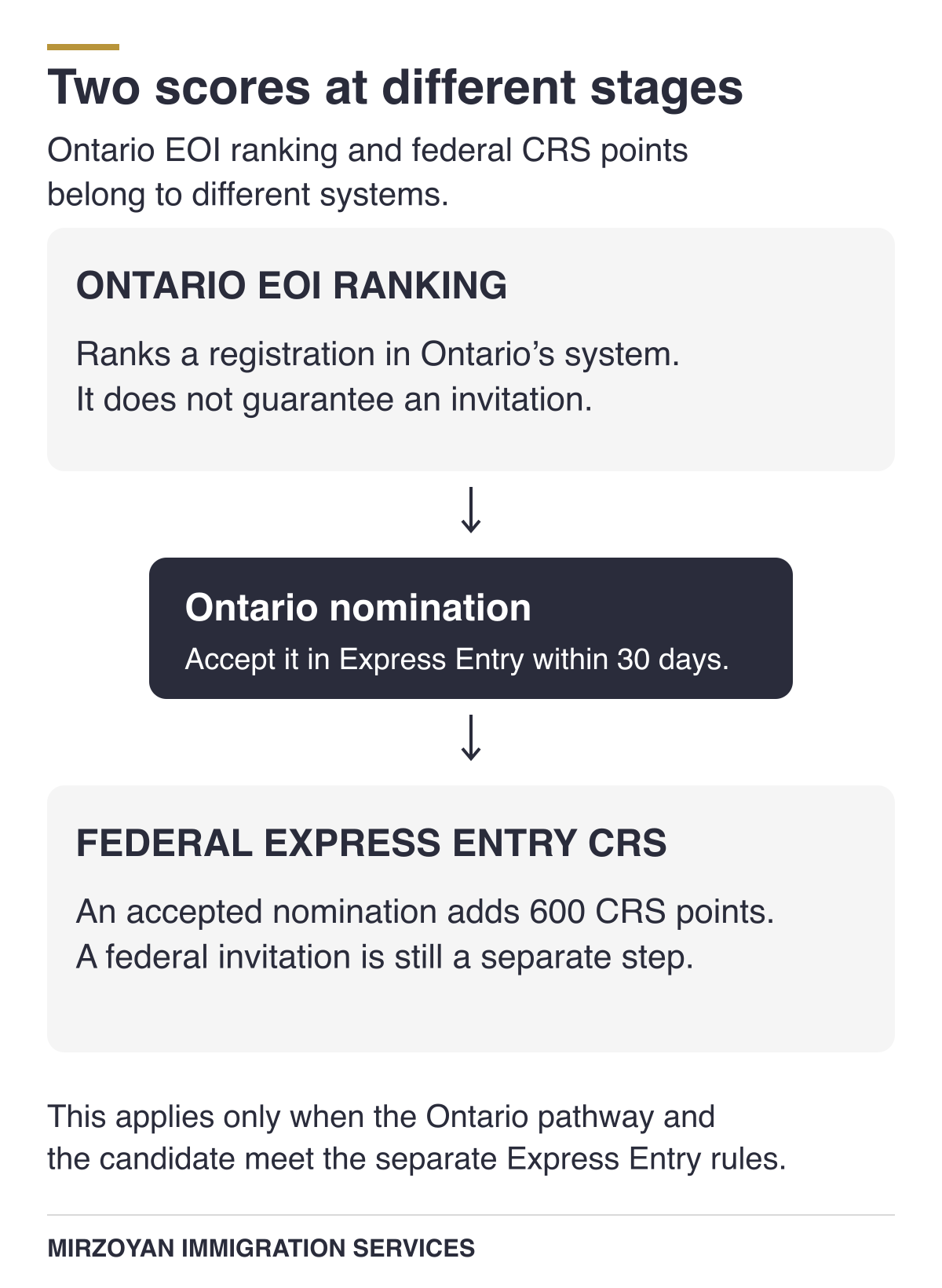
Ontario EOI ranking belongs to the provincial selection stage. For an eligible Express Entry nomination, acceptance adds 600 CRS points, but a federal invitation remains separate.
Once IRCC issues an invitation to apply, the federal application has its own 60-day submission period. So check the federal invitation message before choosing a filing date based on the earlier Ontario deadline. Prepare the federal evidence while waiting, particularly documents involving other people or issuing authorities. And the additional points do not remove the need for a complete application or the applicable admissibility checks.
When the Non-Express Entry PNP Route Applies
The non-Express Entry process is the federal route for OWP nominees whose nominations do not use Express Entry.
That includes the TEER 4–5 job-offer pathway. It also serves eligible OWP applicants who do not choose an Express Entry nomination. But your nomination still needs to support the particular federal route through which you submit your application. Follow IRCC’s non-Express Entry application instructions once Ontario nominates you.
The good news is that this route does not require an Express Entry invitation before you can apply federally. But it still requires the applicable forms, documents, fees and federal assessment.
If your Express Entry eligibility changes after nomination, contact Ontario about the route before submitting through a different system. Ontario provides instructions for nominees who become ineligible for Express Entry. So document the route change and Ontario’s instructions before starting an application in the other federal system.
Strategic Trade-off Matrix
Compare the routes only after confirming which ones your pathway and federal eligibility permit.
Express Entry adds a profile-maintenance requirement and a federal invitation before you can submit the PR application. But both routes still require an Ontario nomination followed by an IRCC decision on permanent residence. Neither route provides a general exemption from document checks or nomination conditions. So use the comparison to identify the remaining requirements before choosing a route your circumstances permit.
| Decision factor | Express Entry nomination route | Non-Express Entry PNP route |
|---|---|---|
| Route eligibility | Eligible OWP TEER 0–3 applicants or self-employed physicians who also qualify for Express Entry | OWP nominees applying outside Express Entry, including TEER 4–5 applicants |
| Profile dependency | A valid federal profile and continuing Express Entry eligibility require attention | No Express Entry profile requirement for this route |
| Submission sequence | Nomination acceptance, federal invitation, then PR application | Provincial nomination, then PR application through the PR Portal |
| Evidence implications | Ontario evidence plus the federal programme and Express Entry application requirements | Ontario evidence plus the federal non-Express Entry PNP application requirements |
| Strategic risk | Profile expiry or changed federal eligibility can disrupt the nomination and filing sequence | Avoiding Express Entry does not remove nomination conditions, completeness checks or admissibility requirements |
| Appeal/recourse posture | Ontario refusal: current process allows an internal-review request within 30 calendar days; federal decisions require separate advice | The same Ontario internal-review process applies; choosing this route does not create broader review rights |
| Financial timeline | Ontario application fee at provincial filing; federal fees at the applicable federal stages; other document costs may arise earlier | Ontario application fee at provincial filing; separate federal fees and document costs remain |
| Processing trajectory | Ontario assessment is followed by the Express Entry federal sequence; no total processing promise | Ontario assessment is followed by non-Express Entry federal processing; no total processing promise |
Sources: Ontario application and review procedures, IRCC Express Entry PNP, and IRCC non-Express Entry PNP.
The Internal Logic of an IRCC Officer
Ontario decides whether your file meets its nomination criteria; IRCC decides the federal permanent residence application. The federal regulations assign the province responsibility for assessing economic establishment and intention to reside in the nominating province. But IRCC still checks the federal requirements and admissibility conditions applicable to your permanent residence application.
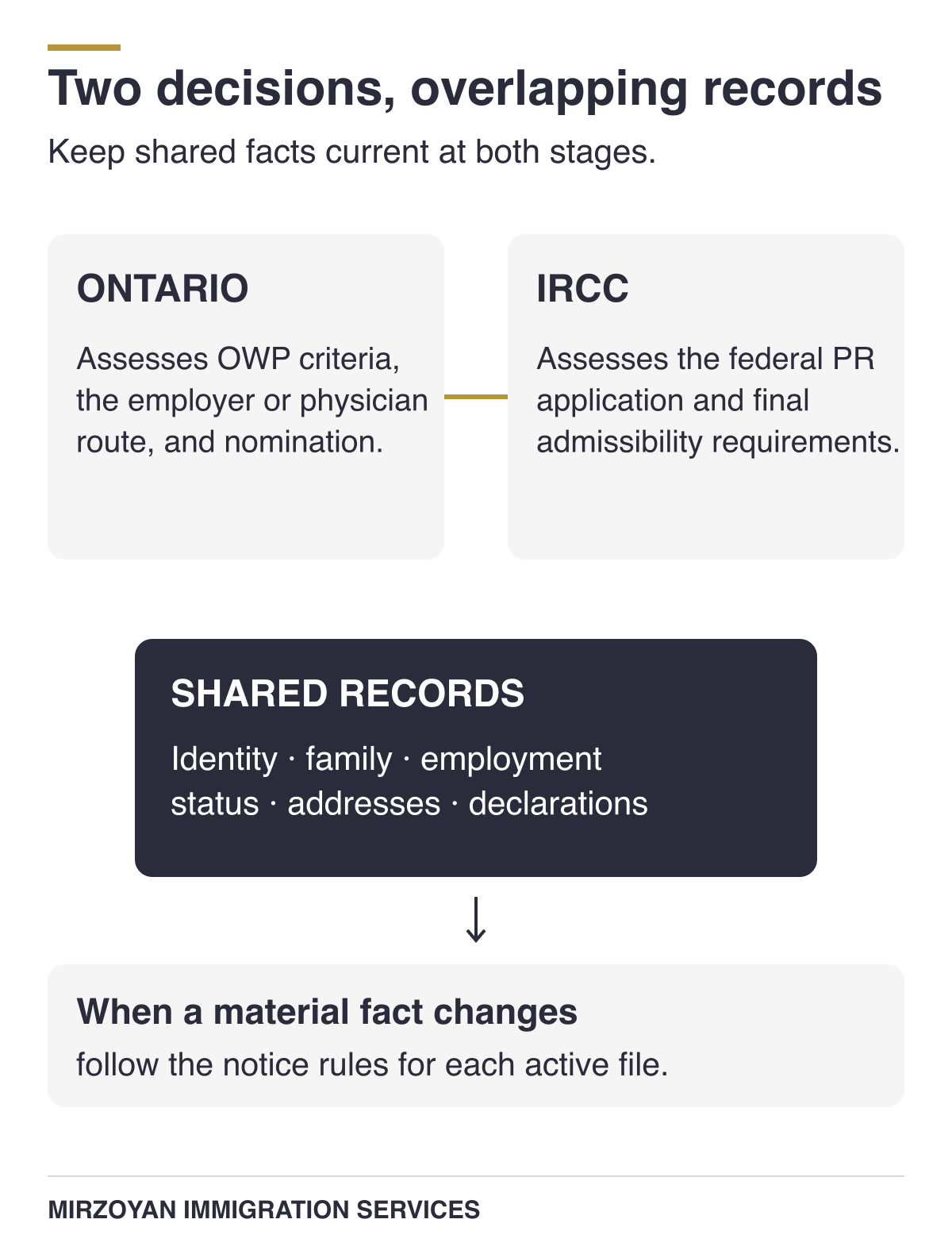
Ontario decides nomination and IRCC decides permanent residence. Identity, family, employment and status records can overlap, so follow the update instructions for each active file.
An Ontario approval therefore leaves a separate federal application and decision for you to complete. Use each authority’s instructions to identify the evidence it needs, including any updates since the Ontario application.
Consistency Across the Provincial and Federal Records
Your Ontario and federal applications describe overlapping facts, but you prepare them at different points in time.
Your identity, work history, family details and immigration status may appear in both records. Compare them before the federal submission, including any information that changed after Ontario assessed your application. But an unexplained difference makes the sequence harder to understand, even when the underlying change is legitimate. So keep the date of each change beside the document that supports the updated information.
For example, if your passport changes after nomination, preserve the old identification record and provide the new details where required. If your family circumstances change, check the reporting requirements for each authority. Ontario’s change-reporting instructions and IRCC’s application-update instructions should guide the notifications. And keep separate submission confirmations when the change needs to be reported to both Ontario and IRCC.
Red Flags & Procedural Fairness Letters (PFL)
A procedural fairness letter gives you an opportunity to address identified concerns before a decision. IRCC’s procedural fairness guidance explains the importance of a meaningful opportunity to respond. But a missing document does not always lead to a fairness letter.
An incomplete application, an eligibility refusal and a concern requiring a response can follow different procedures. So read the notice, identify which authority sent it and answer the stated concern within the given deadline.
The Job Offer and Candidate Evidence Describe Different Work
A NOC description that conflicts with your reference letters leaves the offered position and your experience describing different work. Compare the NOC duties, wage, hours, location and permanence of the position across the relevant records. Ontario requires a qualifying offer and evidence supporting the applicant’s pathway.
A reference letter describing a different role therefore needs attention before submission. But a more favourable job title will not resolve a difference between the claimed occupation and your duties.
If your role changed during employment, separate the periods and document what changed. And ask for accurate employment records that identify the duties and dates belonging to each period. Mirzoyan Immigration Services reviews for NOC consistency. A dated explanation helps distinguish a genuine promotion from two records that describe the same period differently.
An EOI Factor Cannot Be Proved After Invitation
Ontario requires you to substantiate the factors for which you claimed EOI points. But the invitation does not let you claim points first and establish the qualifying facts afterwards. A language result, credential or earnings record must support the particular factor being claimed.
Ontario’s scoring rules and applicant checklist identify the relevant evidence. So check both the document itself and the period or attribute it is meant to establish.
For example, a salary stated in an offer does not replace the tax record used for the separate earnings-history factor. Place that tax record beside the earnings-history entry before deciding which points your EOI can support.
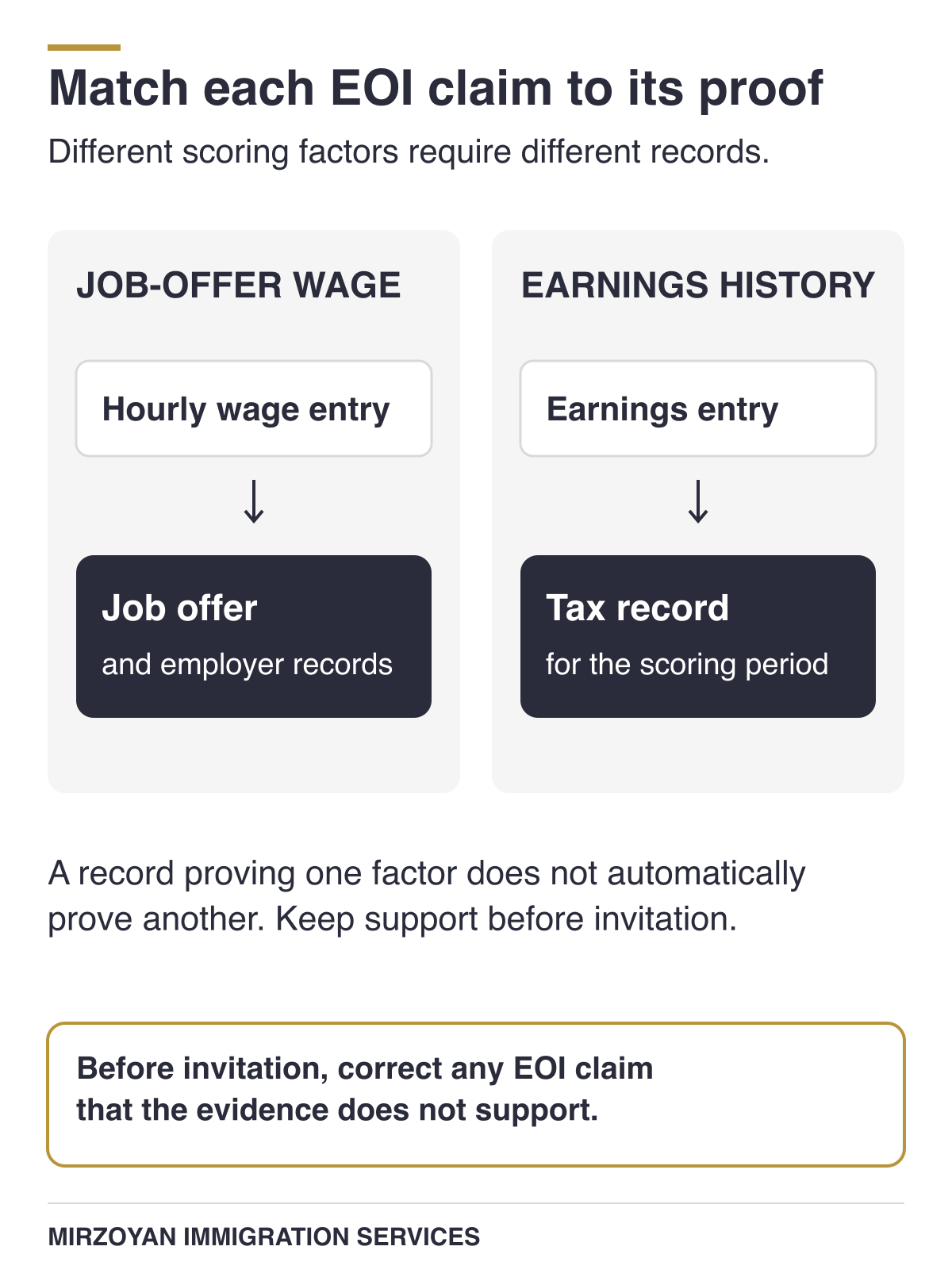
A job-offer wage claim and an earnings-history claim rely on different records. Keep evidence for every OINP EOI factor before relying on the score.
If a document does not establish the claim, resolve the gap rather than assuming an explanatory note will substitute for it. After invitation, obtain advice about a material discrepancy before submitting an application that repeats it.
A Post-Nomination Change Is Missing From One Record
A nomination does not freeze your employment, family or immigration history at the approval date. Ontario requires nominees to continue meeting their conditions and report relevant changes. And IRCC requires relevant updates to a federal application already in progress, even after an acknowledgement arrives.
So review a job change or new Express Entry profile even if the original provincial application was accurate. Follow Ontario’s post-nomination and profile-change instructions rather than assuming the nomination transfers automatically.
If you receive a replacement Express Entry profile, Ontario allows a request to transfer an existing nomination with supporting records. An expired profile therefore needs prompt attention, but does not automatically require a new EOI and nomination application.
Keep copies of the request and the response so the federal submission reflects the confirmed position. But for an employment change, seek direction before relying on the original nomination conditions to cover your new role.
OINP Fees, Filing Deadlines, and Current Updates
OINP costs and deadlines belong to specific stages, so record the trigger beside each amount or date. A registration deadline starts before you have an invitation, while the federal filing requirements follow nomination. And your employer has a separate deadline that directly affects when you can submit your application.
Keep Ontario application costs separate from federal fees and any professional fees when preparing your budget. Check the current Ontario process page and your account messages before taking action.
Current Ontario Application Fees
Ontario charges no fee to register an EOI. The OWP application fee is $1,500 for a job offer outside the Greater Toronto Area (GTA). It is $2,000 for a job offer inside the GTA. For this purpose, the GTA includes Toronto and the regional municipalities of Durham, Halton, Peel and York.
Self-employed physicians pay according to their Ontario practice location, under the same regional fee structure.
But those amounts cover only the Ontario application, rather than every cost involved in obtaining permanent residence. Federal application costs and any required tests, assessments or document services are separate. Ontario generally refunds an incomplete application or a withdrawal made before processing begins.
However, an unsuccessful application after processing begins does not receive the same refund treatment as an incomplete return. So confirm the current fee and refund conditions before deciding to pay or withdraw the Ontario application.
Which Filing Deadline Applies to You?
Start with the event that created the deadline, rather than the number of days you remember. The employer’s job-offer submission starts your 30-day EOI registration window. An Ontario invitation starts the employer’s 14-day position application deadline and your 17-day application deadline.
And these periods use calendar days, so weekends are included when calculating the time available to file. Keep each party’s submission confirmation with the invitation so you can identify which filing steps are complete.
After an Express Entry nomination, a separate 30-day period applies to accepting or declining it. A later federal invitation starts the 60-day PR application period. But the certificate’s expiry still matters alongside the separate acceptance and federal invitation deadlines in your account.
The official application process explains these separate stages. So record the event that starts each period beside its expiry date and the person responsible for acting.
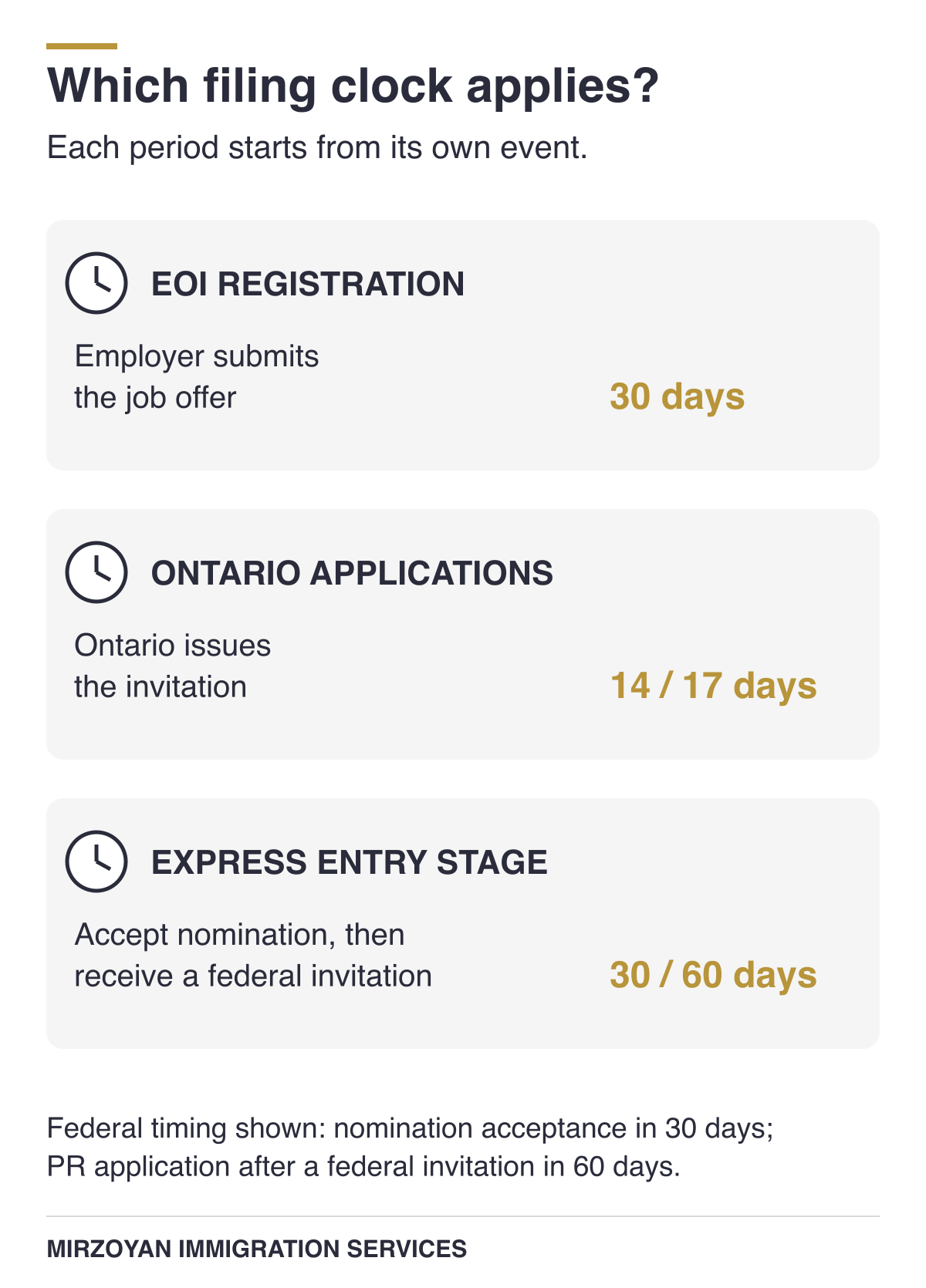
OINP registration, Ontario applications and eligible Express Entry steps use separate clocks. Read the actual invitation, nomination and federal notice for the dates that govern your file.
Where to Check Processing Times and Draw Results
Use Ontario’s 2026 programme updates for dated announcements and current programme changes. A former stream’s draw score cannot establish the score needed for an OWP invitation. And a historic processing estimate does not establish how long Ontario will take to assess a new OWP application.
Ontario’s assessment and IRCC’s federal assessment are separate periods, even when published figures appear beside each other. A total timeline must also account for the period you spend waiting in the EOI pool before an invitation.
This guide does not assign an OWP invitation cutoff, invitation probability or processing-time promise. When reviewing an update, check the named stream, date and candidate group before applying it to your situation.
Use current government information when planning, and keep your status plan separate from the hoped-for decision date. But a previous draw describes only that selection round, so avoid treating its score as a future threshold.
What Happens After Ontario Nominates You
After nomination, you need to preserve the conditions Ontario approved while preparing and maintaining your federal application. Read the nomination package before submitting federally or changing the circumstances on which Ontario nominated you.
Keep Nomination Conditions Current
Ontario’s nomination conditions continue until your permanent residence application is approved or refused.
Job-offer nominees must pay particular attention to the approved position and any employment changes. Read your nomination letter together with Ontario’s conditions and reporting requirements. If duties, wages, hours or employment change, establish what Ontario requires before relying on the nomination. And keep the employer’s evidence of the change with the notification you sent and the response you received.
A nomination also does not extend your temporary status or work authorization. Ontario may issue an eligible nominee a work-permit support letter, but the letter itself is not a work permit. But the self-employed physician pathway does not provide the Ontario support letter issued to eligible job-offer nominees.
Review your work permit options separately if your current authorization is approaching expiry. Any bridging open work permit assessment must consider its own eligibility conditions.
File Through the Correct Federal Route
Your nomination documents should identify the federal route your application will follow.
For Express Entry, confirm that the nomination is attached to the correct profile and accepted within the required period. And you must receive a federal invitation before submitting the permanent residence application through the Express Entry system. For non-Express Entry, follow the PR Portal instructions for provincial nominees. Keep the nomination certificate valid for the required filing stage.
If the certificate is close to expiring, contact Ontario before assuming that an extension will be available. But Ontario considers certificate extensions only in specified circumstances, so a request does not guarantee extra filing time. Save the federal submission confirmation and match it to the nomination used. Readers needing help with the Express Entry stage can review Express Entry application services.
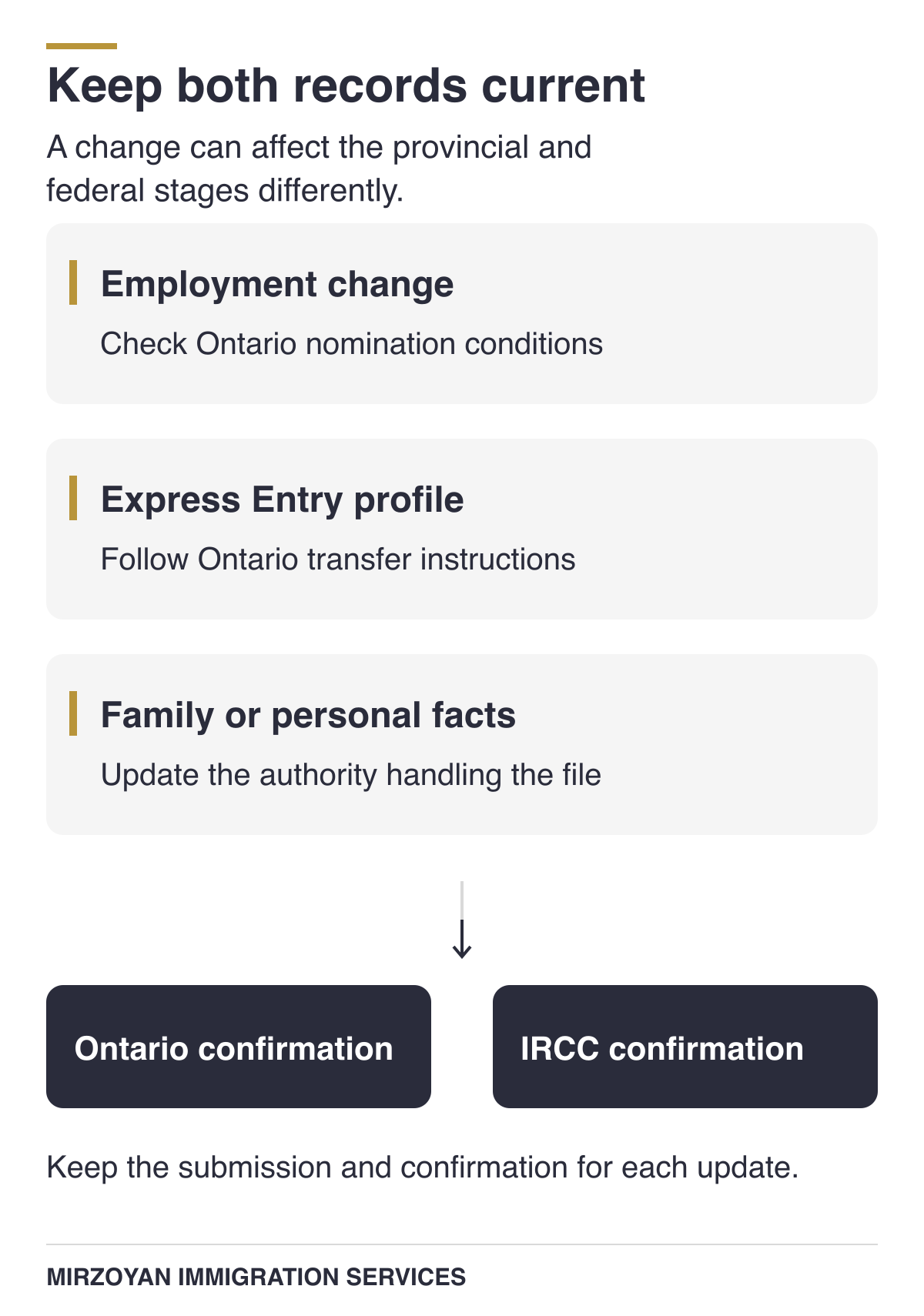
Employment, Express Entry profile and family changes may require different provincial and federal updates. Keep separate submission confirmations for each authority.
IRCC Makes the Permanent Residence Decision
IRCC assesses the federal application and makes the permanent residence decision.
But provincial approval does not remove the medical, criminal or security admissibility requirements affecting the federal decision. Federal processing can also involve requests for documents, updated information or an interview. So follow the instructions issued for your file and retain proof that each response was submitted. IRCC’s after-application guidance explains the next steps for non-Express Entry nominees.
Continue checking account messages even after the application is acknowledged. If your circumstances change, identify which provincial and federal records need updating. Once approved, follow IRCC’s instructions to complete the permanent residence process. And keep the final federal confirmation distinct from Ontario’s nomination letter when documenting your immigration status.
When Professional OINP Help Is Useful
Professional help is useful when your file depends on resolving conflicting records or coordinating the employer’s and applicant’s submissions. Examples include uncertain NOC duties, an unsupported EOI factor, a changed job or an approaching filing deadline. A document review can identify which record needs correction or explanation before you repeat the information federally. If your records are clear and consistent, Ontario’s official instructions can help you prepare your own application. But representation cannot guarantee an invitation, nomination, faster processing or the final grant of permanent residence.
Mirzoyan Immigration Services offers OINP immigration services for applicants who need that coordination and individual advice. The One on One Advisory framework gives you direct access to the licensed consultant handling your questions. Client communications are answered by Narek Mirzoyan, RCIC # R1005184, or Vahe Mirzoyan, RCIC # R514223. Intake staff, assistants and call routing do not replace that direct consultant access. For an OINP file, this allows questions about employer records and candidate evidence to reach the consultant reviewing their relationship.
Bring the job offer, relevant employment records and any portal messages to the consultation. And if you already have an invitation or nomination, include the full document with its filing deadline. Review the firm’s fee information and confirm the work covered before retaining representation.
Key Takeaways
New OINP registrations use Ontario Workforce Priority, with two job-offer pathways and an eligible self-employed physician exception.
Most applicants need their employer to submit a job offer before EOI registration; qualifying self-employed physicians follow separate instructions.
Eligibility, EOI ranking, invitation, nomination and permanent residence are separate stages, with different evidence and decisions.
Express Entry is available only through an eligible OWP pathway when the candidate also meets the federal requirements.
Mirzoyan Immigration Services provides direct licensed advice on linked employer records, candidate evidence and OINP filing responsibilities.
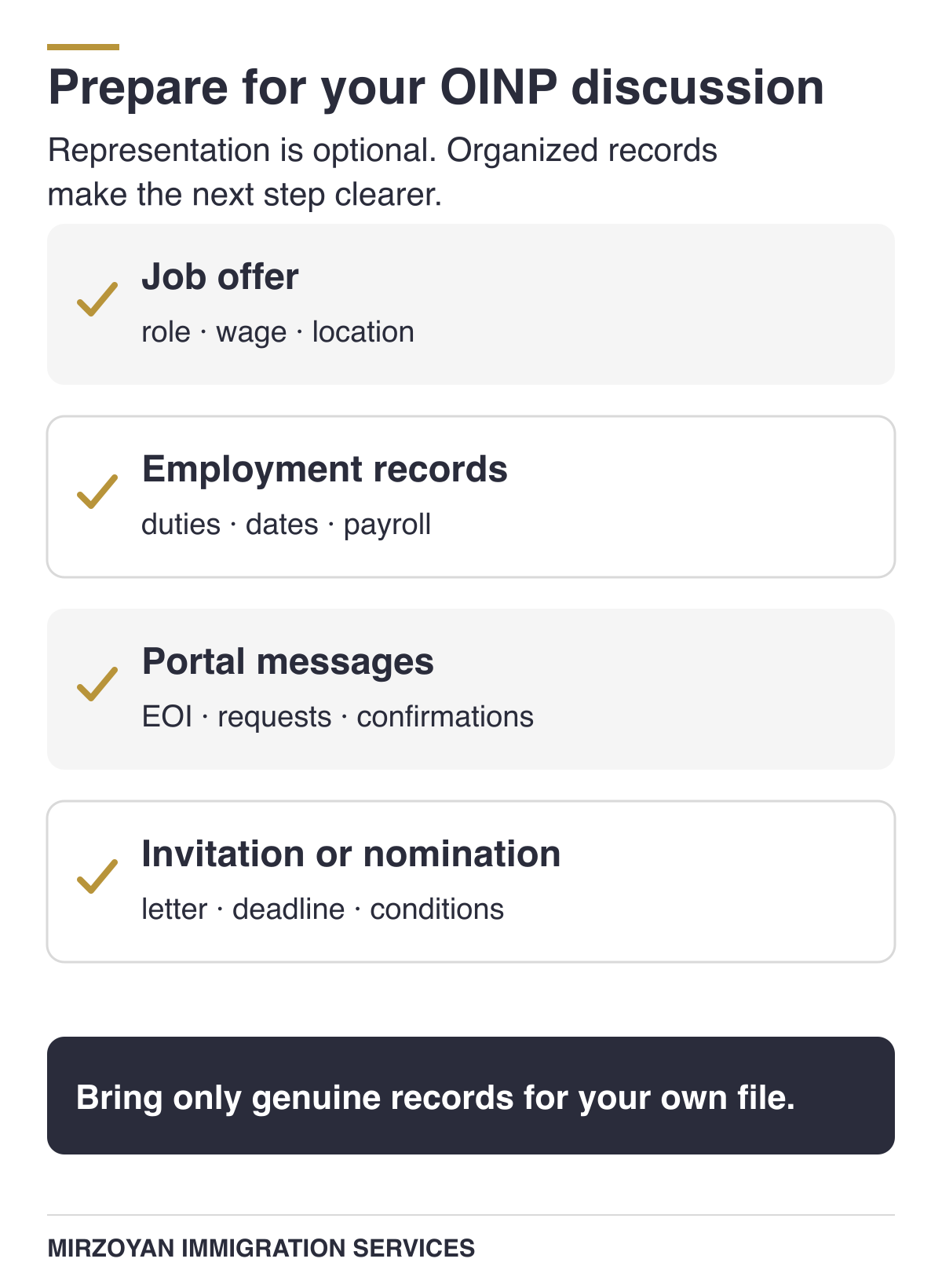
A job offer, employment evidence, portal messages and any invitation or nomination help establish the OINP stage and the next filing decision. Representation is optional.
Frequently Asked Questions
What is OINP and who is eligible?
OINP is the Ontario Immigrant Nominee Program, through which Ontario nominates candidates for Canadian permanent residence. New registrations use Ontario Workforce Priority. Eligibility depends on the applicable job-offer pathway or the exception for qualifying self-employed physicians. Most applicants need an eligible Ontario employer and job offer. Ontario’s current stream criteria explain the applicant and employer requirements.
How to get PR through OINP?
For a job-offer pathway, register your EOI using the ID created by your employer’s portal submission. If invited, your employer has 14 calendar days and you have 17, both measured from that invitation. You submit after your employer. Nomination then leads to a separate federal PR application. Eligible self-employed physicians use a different registration process without an employer. Follow Ontario’s application instructions for your route.
Can I apply directly to OINP?
You can pursue OINP without hiring a representative, but you cannot skip its registration and invitation stages. For a job-offer pathway, the employer must first submit the position through the Employer Portal. You then register an EOI using the job-offer ID. A nomination application follows only after an invitation. Eligible self-employed physicians use Ontario’s separate registration instructions.
What are the new OINP rules?
Ontario replaced eight streams with Ontario Workforce Priority on June 25, 2026, and opened its EOI portal on August 4. New registrations follow the current pathway requirements and application process. Former registrations without invitations and applications already submitted after invitations receive different transition treatment. Check Ontario’s 2026 updates alongside your own invitation and submission records before deciding what applies.
Can I apply for OINP without a job offer?
Eligible self-employed physicians can use Ontario Workforce Priority without an employer-supported job offer. They must meet Ontario’s specific professional registration and OHIP billing requirements. This exception does not extend to self-employed professionals generally. Other new OWP applicants need a qualifying job offer and employer participation. Review the physician exception rather than relying on advice about closed OINP streams.
Your Next OINP Step
If you are still checking your options, start with Ontario’s current requirements and collect the records that establish your position. Bring your job offer, employment records and any Ontario invitation to an OINP consultation with Mirzoyan Immigration Services. The discussion can focus on your pathway, documents needing explanation and who must act before the next filing deadline.
This article provides general information and does not constitute legal or immigration advice. Programme requirements and procedures can change, and individual circumstances affect eligibility and application strategy. For advice about your own records, deadlines or immigration options, book a consultation with a licensed immigration consultant.