Super Visa Income Requirement: Two Methods Explained
By Narek Mirzoyan, RCIC # R1005184
Last reviewed by Narek Mirzoyan, RCIC # R1005184, on 2026-10-11.
The Super Visa income requirement depends on your family size. If you are inviting one parent and have no spouse, children or earlier commitments to count, the minimum is $38,002. That is the two-person row in IRCC's income table, not the $30,526 figure at the top. And since March 31, 2026, you have two ways to reach it. Method 1 uses your income from either of the last two tax years. Method 2 lets your parent's income cover the gap once your own income reaches 75%.
IRCC's instructions call these Option 1 and Option 2; this guide uses Method 1 and Method 2. For the rest of the program rules, see the Super Visa complete guide.
Before you do any arithmetic, check the count. Say your invitation letter mentions your spouse and two children. But if your income calculation counts only you and your parent, the two documents contradict each other. Fixing the count can move you to a higher row, and that is better discovered now than by an officer.
TL;DR
Count your family size first, then find your minimum in IRCC's table. For a host inviting one parent, with no one else to count, that is $38,002. Method 1 needs the full amount in one of your two most recent tax years. Method 2 needs you (and a co-signing spouse, if any) to reach 75%, with your parent's continuing income covering the rest. Either way, your income must stay at the required level until IRCC decides.
Table of Contents
The current Super Visa income table
IRCC sets the Super Visa minimum by family size, using the table below. You need at least the amount on your row, counting everyone the rules require. For a host inviting a parent, the lowest row that can apply is family size two. The figures match IRCC's financial-support page, which displays the table as updated July 29, 2025. They were checked again on October 11, 2026.
| Family size | Minimum income (CAD) |
|---|---|
| 1 | $30,526 |
| 2 | $38,002 |
| 3 | $46,720 |
| 4 | $56,724 |
| 5 | $64,336 |
| 6 | $72,560 |
| 7 | $80,784 |
| Each person over 7 | Add $8,224 |
Why the one-person row doesn't fit a Super Visa
The $30,526 row describes a family of one. A Super Visa count always starts at two, because it includes you and the parent you are inviting. So the lowest figure that can apply to you is $38,002. Add a spouse or one dependent child, and you move to family size three at $46,720. If you have seen $30,526 quoted as the Super Visa income, it is the right number for the wrong household.
Don't use the sponsorship table by mistake
Search for parent income requirements and you will often land on a different table. That one belongs to the Parents and Grandparents Program, which sponsors a parent for permanent residence. It uses higher figures and asks for three tax years in a row. For two people, its 2024 figure is $47,549, against $38,002 for a Super Visa. What this means is simple: if a number looks too high, check which program it came from before you worry. For where permanent sponsorship stands today, see the Parents and Grandparents Program status page.
Who counts in your family size
Family size covers more than the people living with you. IRCC counts you, your spouse or partner, your dependent children, each applying parent, and anyone you are still committed to supporting. That last group includes people from earlier Super Visa invitations and from sponsorship undertakings that are still running.
Your household and the parents you are inviting
Start with the people at home: you, your spouse or common-law partner, and your dependent children. IRCC's list also includes your spouse's dependent children and, in some cases, a spouse you have separated from. Dependent children count regardless of custody or child support arrangements. That can feel unfair when a child lives with an ex-partner. But the count follows legal ties, not who lives under your roof.
Then add every parent or grandparent applying under your invitation. If both of your parents are applying, both count. And one missed person changes both your row in the table and the 75% figure under Method 2. Before choosing an income method, Narek Mirzoyan, an RCIC at Mirzoyan Immigration Services, rebuilds this family-size list.
Earlier Super Visa invitations
People covered by an earlier Super Visa invitation can still count. IRCC includes anyone under a previous invitation letter that is still applicable, even if that person is outside Canada. Say you invited your father two years ago and are now inviting your grandmother. Before you write the new total, confirm whether that first letter still applies. If your spouse or partner is co-signing this time, their earlier invitations need the same check. Theirs can add people to your count too.
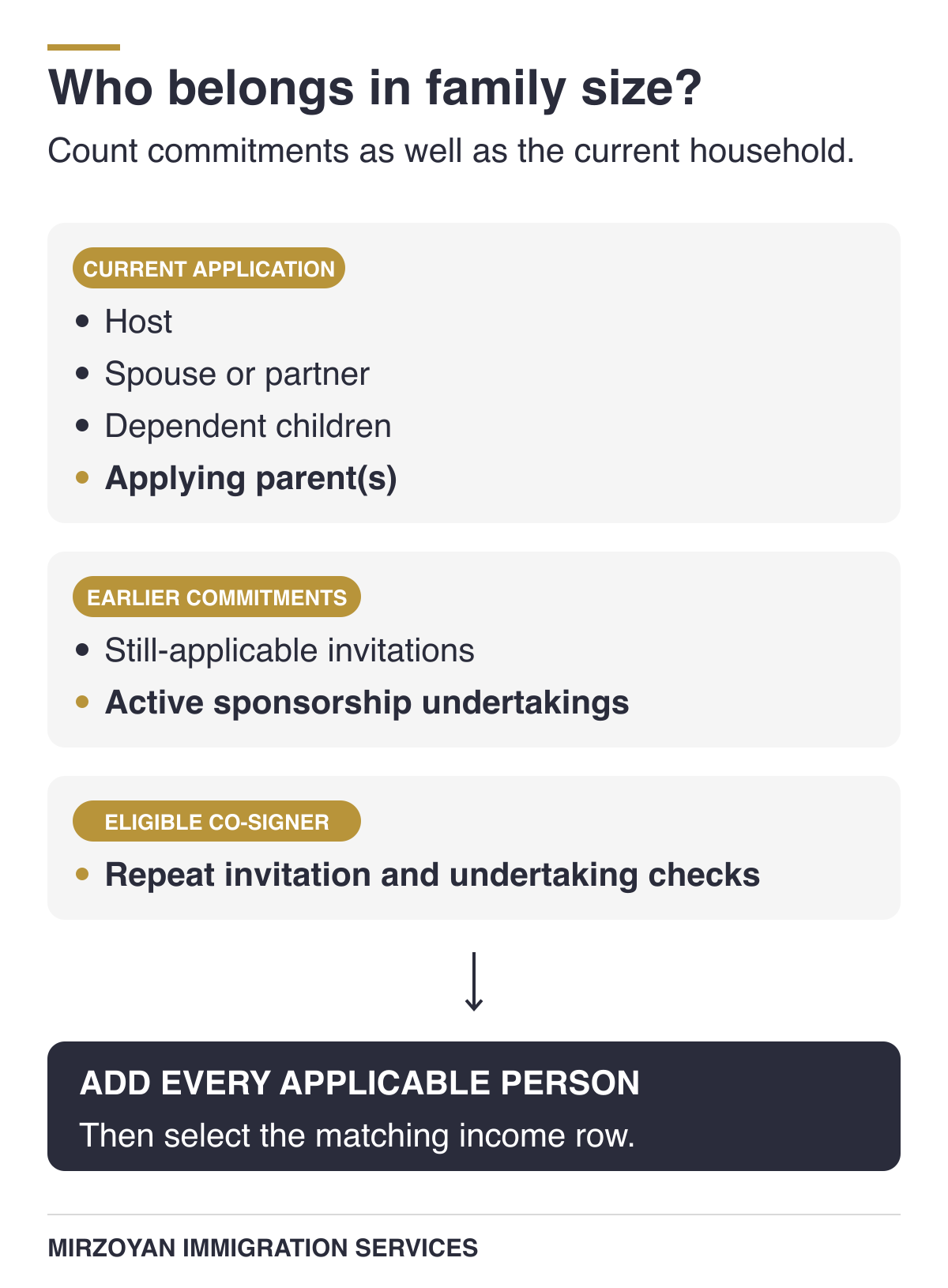
Count the people in this application first, then earlier commitments, then a co-signer's commitments. Only then pick your row in the table.
Sponsorship undertakings that are still running
A sponsorship undertaking is your written promise to support someone you sponsored for permanent residence. While it lasts, that person counts in your Super Visa family size, wherever they live. Outside Quebec, it lasts 20 years for a sponsored parent or grandparent and three years for a spouse or partner. Quebec sets its own lengths. Suppose you sponsored your father for permanent residence in 2019 and now want your grandmother to visit on a Super Visa. Your father still counts, even in another city, because the undertaking you gave for him is still running. If your spouse is co-signing, check their undertakings too, because theirs count in the same way.
Use this count before you look at the table:
Every parent or grandparent applying.
You, plus your spouse or common-law partner.
Your dependent children and your spouse's dependent children.
Anyone covered by an earlier invitation that still applies.
Anyone covered by a sponsorship undertaking that is still running.
The same two checks for a co-signing spouse.
A worked example: one host, one parent
Illustrative example, not legal or financial advice. A single host with no children invites one parent. There are no earlier invitations or undertakings to count.
Applying parent: 1
Host: 1
Spouse or partner: 0
Dependent children: 0
Earlier invitations or undertakings: 0
Family size: 2
Minimum income: $38,002
Now change one fact. If the same host has a dependent child, family size becomes three and the minimum rises to $46,720. That holds even if the child lives with the other parent. What matters is whether the child meets IRCC's definition of a dependent child.
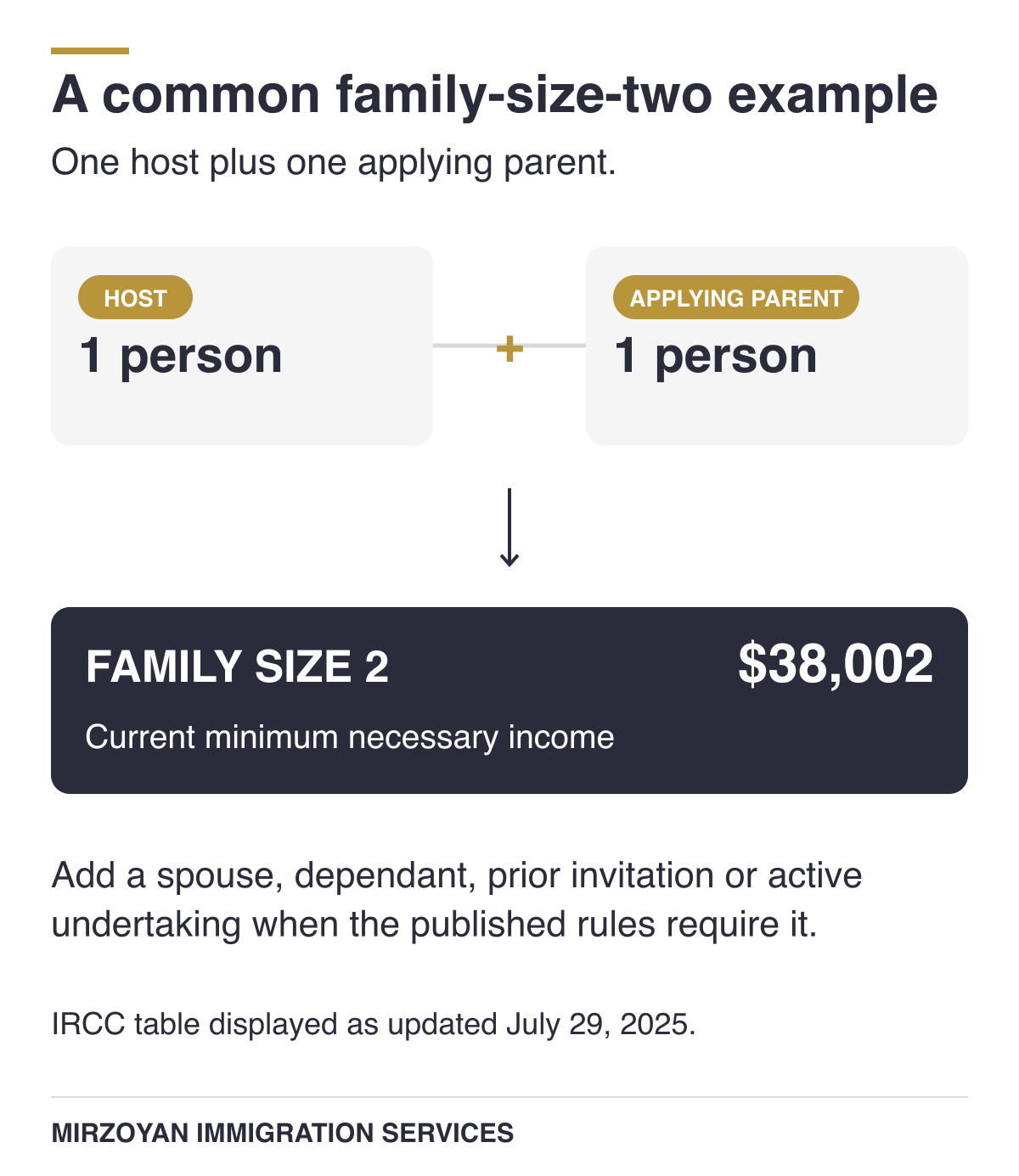
A host and one parent, with no one else to count, make a family of two. The minimum for that row is $38,002.
Strategic Trade-off Matrix
Both methods use the same minimum from the same table. What changes is whose income counts, which period it covers and what you have to prove. Neither method is better in general. The right one is the one your records can prove. IRCC's March 2026 notice introduced both, and the 2026 Ministerial Instructions set out the legal conditions.
| Decision factor | Method 1 | Method 2 |
|---|---|---|
| Best fit | Your income, plus a co-signing spouse's, met the full minimum in at least one of the last two tax years | Your income reaches at least 75%, and your parent has steady income such as a pension |
| Strategic risk | Relying on a tax year that falls short of the full minimum | Falling below 75% on your side, or parent income that cannot be shown to continue |
| Appeal rights | No difference between the methods; your options after a refusal are the same | Same as Method 1 |
| Financial timeline | Full minimum in one of the two tax years just before you apply | 75% in your last tax year or past 12 months, plus your parent's income over the 12 months before you apply |
| Processing trajectory | The same Super Visa application and processing | The same, with your parent's income records added |
Method 1: the full amount in one of the last two tax years
Method 1 asks whether your income met the full minimum in either of the two tax years just before you apply. If your spouse or common-law partner co-signs, their income is added to yours. You only need one year to qualify. But two short years cannot be added together or averaged into one. Your proof is the Notice of Assessment (NOA) for that year, the summary CRA sends after processing your tax return. A raise since then does not change what that NOA shows, so a strong employer letter cannot rescue a weak tax year.
Method 2: 75% from you, the rest from your parent
Method 2 starts with your side of the file. You, plus a co-signing spouse if you have one, must reach at least 75% of the minimum. IRCC asks for your NOA for the last tax year first. If it is unavailable, IRCC lists other proof instead. That includes T4 slips, 12 months of pay stubs and an employer letter showing your job and salary. The Ministerial Instructions describe those alternatives as records of your Canadian income over the 12 months before you apply.
Only once your side reaches 75% can your parent's income cover the rest. Your parent's income is measured over the 12 months before you apply, and it must keep coming while they are in Canada. But savings in a bank account do not count as income on their own. And the proof must show the currency the income is paid in. One rule applies to both methods: your income must stay at the required level until IRCC decides.
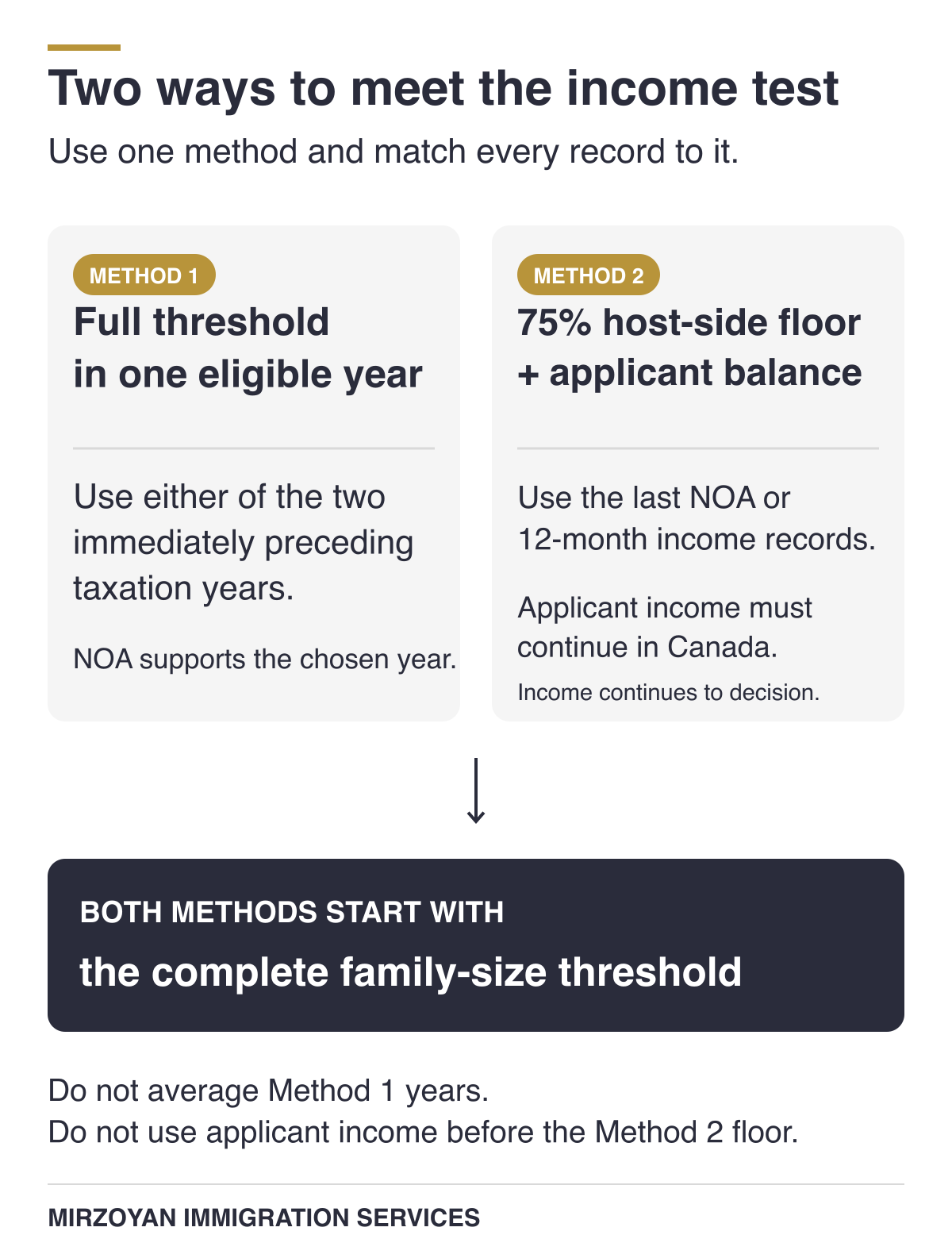
Method 1 needs the full minimum in one of the last two tax years. Method 2 needs 75% from your side before your parent's continuing income can fill the gap.
How the 75% calculation works
Method 2 is easy to get wrong if you add everyone's income together first. Do the steps in order instead, so each figure stays tied to the person who earns it.
Step one: check your share against 75%
Take the minimum for your full family size and multiply it by 0.75.
Illustrative example, not legal or financial advice. For a family of three, the minimum is $46,720, so your side needs at least $35,040.
Compare that figure with income you can prove for one period. Use the period your proof covers: the last tax year on your NOA, or the 12 months in your other records. If your side comes to $34,500, Method 2 is closed, however much your parent earns. Your parent's pension cannot make up a shortfall below the 75% mark.
Step two: work out what is left
Suppose your side shows $38,000, which clears $35,040. Subtract it from the full minimum: $46,720 minus $38,000 leaves $8,720. That $8,720 is the only part your parent's income has to cover. If your parent has $10,000 a year in continuing pension income, the combined $48,000 meets the minimum. But meeting the income test does not decide the whole application, which has other requirements, including medical insurance and a medical exam. Keep your figures and your parent's figures in separate columns, so each number points back to its own document.
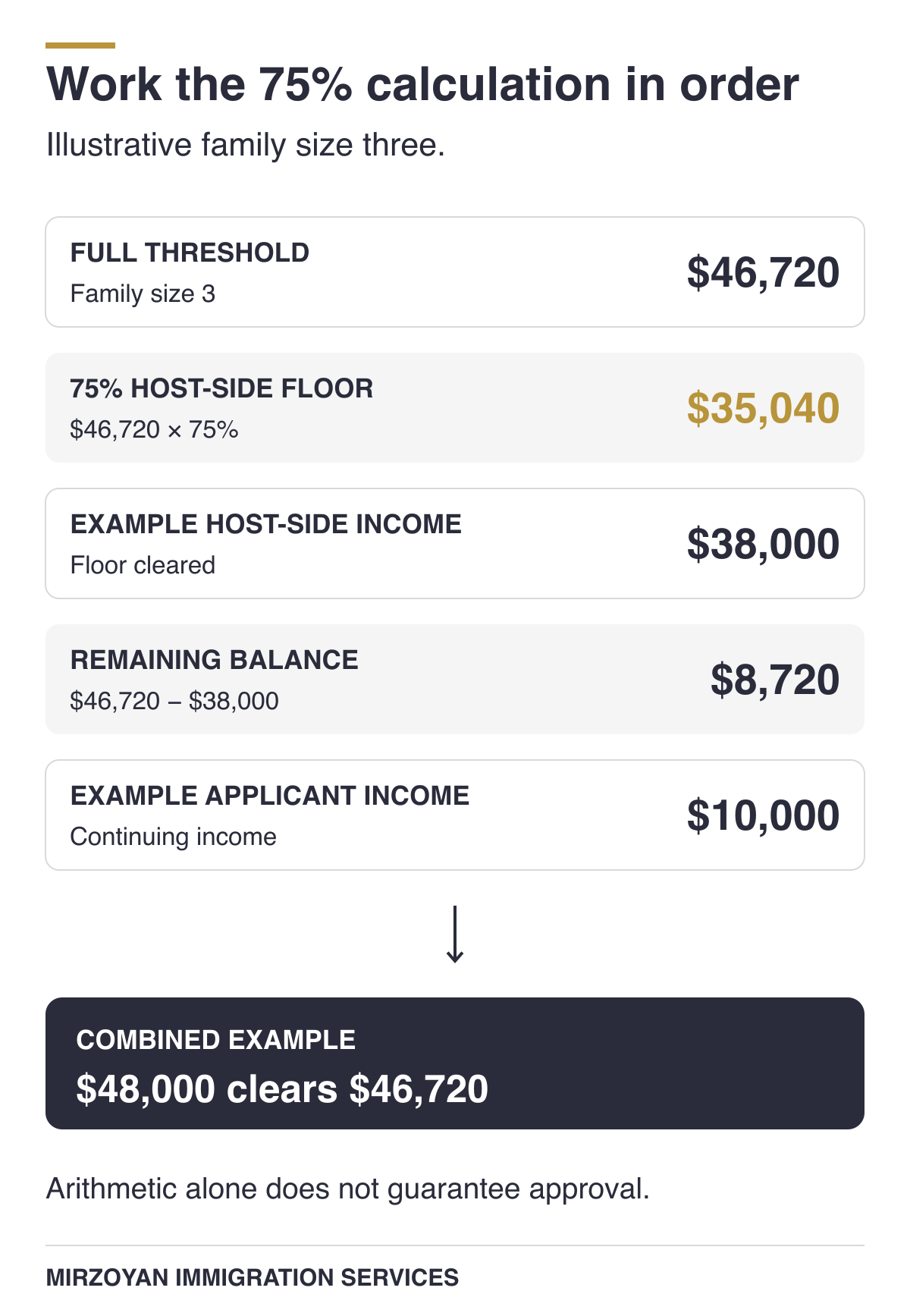
For a family of three, your side must reach $35,040. Your parent's continuing income then covers the remaining $8,720.
Step three: show the parent's income will continue
IRCC asks for two things in your parent's income records. The first is proof that the income will continue while they are in Canada. The second is the currency it is paid in. A pension statement showing only last year's total may not answer either question. But a statement or letter confirming the ongoing monthly payment and its currency is far stronger. IRCC's list also accepts pay stubs, an employer letter, bank statements showing regular deposits, and rental or investment records. Do not present savings as income unless a real income source sits behind them.
Not sure your numbers add up? Mirzoyan Immigration Services can check your family size and the 75% calculation before you file. See what the Super Visa consultation service covers.
Who can co-sign for a Super Visa?
Your spouse or common-law partner is the only person who can co-sign. They must meet the same conditions as you, except being the parent's child or grandchild. That means living in Canada, being 18 or over, and holding citizenship, permanent residence or registered Indian status. Their income is then added to yours. IRCC's forms and documents page sets out the co-signer role.
A co-signer is not the same as a contributing parent
It is tempting to call the visiting parent a co-signer when their pension is helping. But the two roles are different, and mixing them up can make your documents disagree. A co-signer is part of your side of the calculation and shares the support promise with you. A parent contributes only under Method 2, after your side has reached 75%. The proof differs too: a co-signer supplies tax records, while a parent needs records showing continuing income and its currency. Call each person by the right role in the invitation letter and in the calculation.
Can siblings or other relatives pool income as co-signers?
No. Siblings, adult children, friends and other relatives cannot co-sign, however willing they are to help. IRCC limits co-signing to the host's spouse or common-law partner. If a brother earns more than you, he could act as the host instead. But then the whole calculation starts again with his family size and his income. You cannot combine two siblings' incomes to reach one minimum. Decide who will be the host before anything else is drafted.
Make your income records tell one story
Every income document in your file should support the same calculation: the same family size, method, period, people and amounts. Yet genuine records can still tell different stories, and that is where careful families get stuck. The cause can be as ordinary as a raise, a commission cheque or a new job that nobody explained. Narek Mirzoyan at Mirzoyan Immigration Services lays the chosen NOA or 12-month records beside current pay records. He then decides whether the file needs a written explanation.
Match your records to the method you chose
Method 1 rests on the NOA for whichever of the two tax years qualifies. Method 2 rests on your last NOA, or on records covering the 12 months before you apply. One easy slip is pairing a 2025 NOA with arithmetic based on this year's pay stubs. Write down the method and the period at the top of your working calculation. Then make every total in the invitation letter and supporting documents match it.
When your current salary doesn't match your NOA
Your employer letter and your NOA can show different numbers, and both can be true. A raise, a commission, fewer hours or a new job will all do it. But the fix is not to choose the more flattering number. Under Method 1, and when you rely on your NOA under Method 2, the NOA figure is the one that counts. A current letter supports it but does not replace it. Date every current record clearly, so nobody mistakes this year's pay for last year's assessed income.
Income from outside Canada
If your parent's pension or salary is paid abroad, keep the original currency visible on every document. IRCC does not publish a set conversion method on its financial-support page. So show the Canadian-dollar figure you used, with the exchange rate and the date you took it from. Exchange rates move, and an amount that cleared the minimum in spring may not clear it by filing day. Recheck the conversion close to the date you apply.
The invitation letter has to use the same count
Your invitation letter names the people you plan to support. Your income calculation must count those people plus everyone else the rules require, including earlier commitments. If the letter mentions a spouse and the calculation leaves them out, an officer reading both will see the gap. And a promise to pay a monthly amount does not replace the income test either. However generous the letter is, the minimum still has to be met.
Run this check before you file:
Your full family size and the matching minimum.
The method you are using.
The tax year or 12-month period behind your figures.
Each person's role: host, co-signer or contributing parent.
A dated document behind every amount.
Proof of continuing income and its currency, if your parent contributes.
An invitation letter that counts the same people, including earlier commitments.
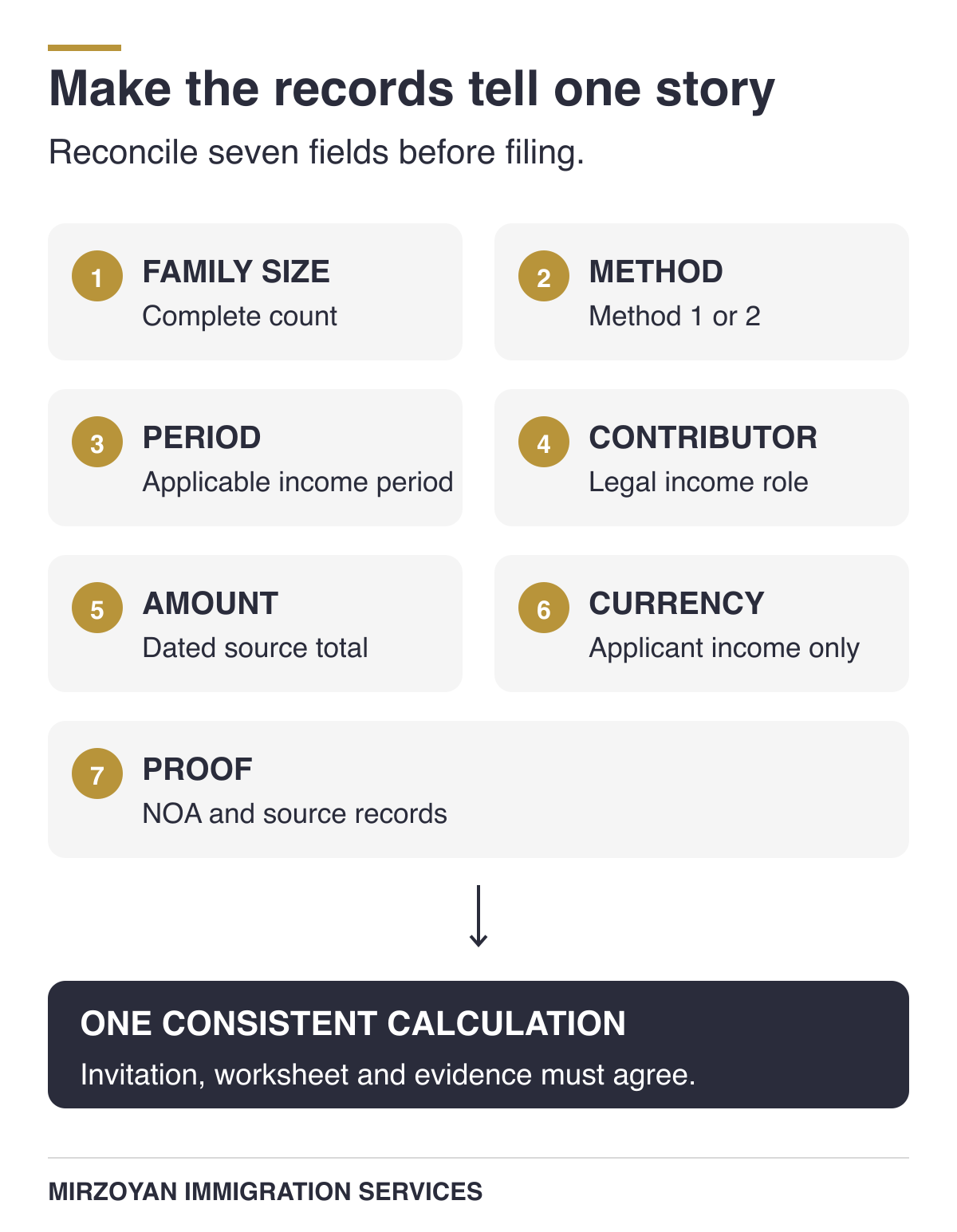
Seven details should agree across the file: family size, method, period, each person's role, amounts, currency and proof.
The Internal Logic of an IRCC Officer
An officer checking your income has to connect six things. They are the people counted, the method, the income period, the contributors, the amounts and the proof. A gap in any link can leave the minimum unproven, even when the arithmetic works. IRCC does not publish the order an officer works in. But its rules make each link necessary.
Who, which method, which year
The count comes first because every other figure depends on it. A calculation can be perfect for a family of three and still be wrong if the invitation describes four people. The fix then is a new count and a new calculation, not a note defending the lower row. Once the count is settled, the method and period decide which documents matter. IRCC's worked examples show how commitments outside your home change the count, so use its categories rather than your own.
Differences need a dated explanation
A short, dated note can explain a difference that would otherwise look like an error. Tie each figure to its document and period. Your NOA reflects your assessed income for the year, while a current letter may show base salary only. Say that plainly, and attach the records that back it up. Do not ask one document to prove a period it doesn't cover. A pay stub shows what you earn now; your NOA shows what CRA assessed for a past year.
Red Flags & Procedural Fairness Letters (PFL)
A Procedural Fairness Letter (PFL) sets out a concern IRCC has with your file. It gives you a chance to respond before a decision is made. But not every problem produces one, so the safest time to fix these is before you file. And if you do receive one, it is a chance to explain, not a refusal.
Leaving out someone you are still committed to
Leaving out a person covered by an earlier invitation or a running undertaking puts you on the wrong row. Every figure built on that row is then wrong too. And correcting only the invitation letter does not solve it. The income calculation and supporting statements need the same complete number, because the Ministerial Instructions include these commitments in your family. A material omission like this may prompt a PFL.
Parent income with no currency or no future
Under Method 2, a bank balance shows money on one date. But it does not show that income will keep arriving while your parent is in Canada. A statement without a currency leaves the officer to work out its value. Either gap can leave the Method 2 calculation unsupported and may prompt a PFL. The fix depends on the source. A pension needs a statement confirming ongoing payments and their currency; rental income needs the lease and rent records.
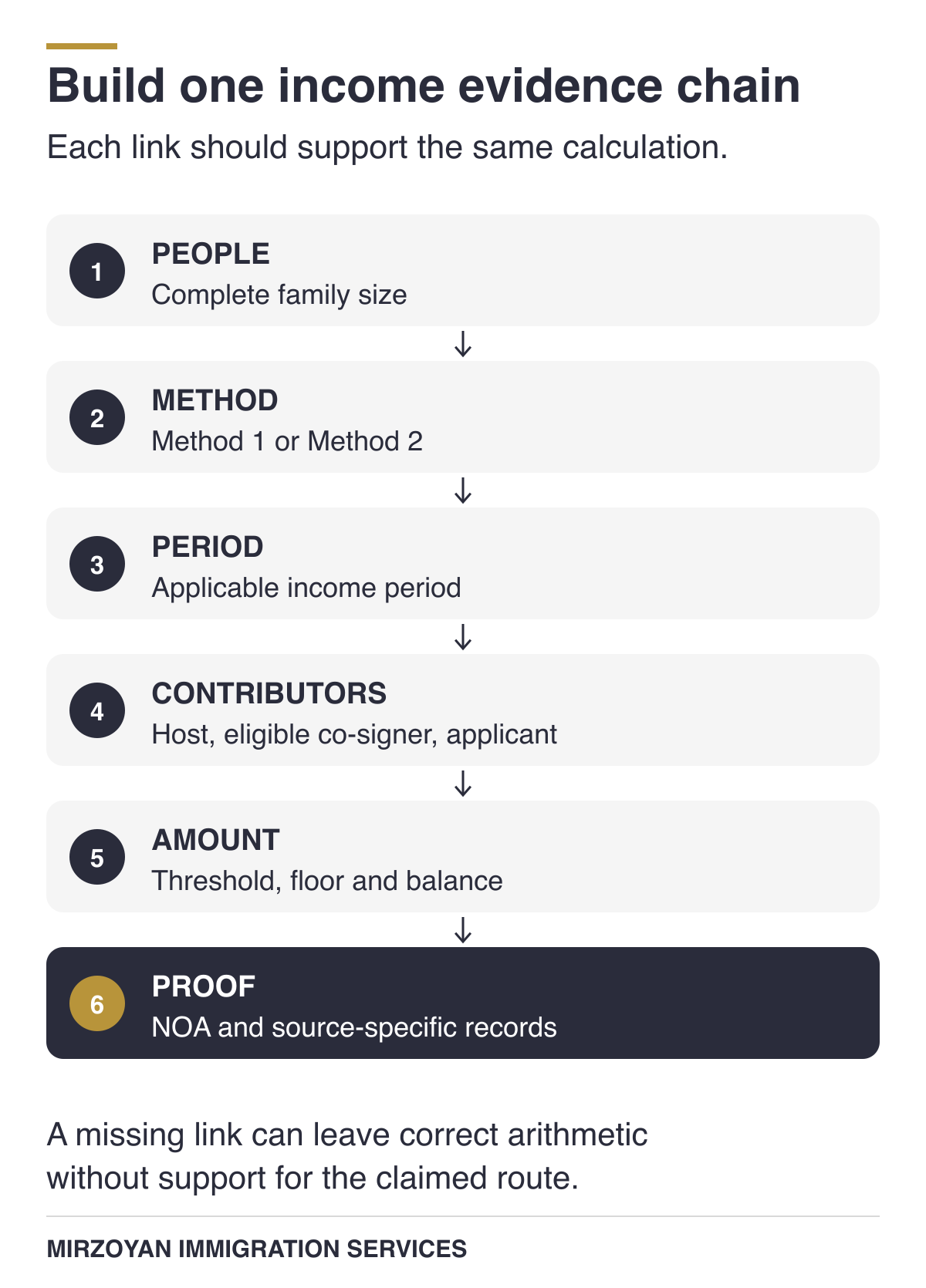
Each link, from the people counted to the proof, has to support the same calculation. One missing link can leave correct arithmetic unsupported.
A tax year and a pay stub that disagree
Your NOA and a current employer letter may show different amounts for honest reasons. The file should say which reason applies: commission, a change from base salary, or a new job. Left unexplained, a material difference may prompt a PFL. The simplest protection is a dated note, written before filing, that points to the records behind each figure. Nobody can promise how an officer will read it, but an explained difference is easier to assess than a silent one.
What happens when income falls short?
If your income is short, check the other tax year under Method 1, then test Method 2. Only when neither works is the income test truly unmet, and more documents will not change that. Being a few thousand dollars short is stressful, especially with a parent waiting to book flights. But it is not always the end of the road. The good news is that the 2026 rules gave hosts a second way to qualify.
Try the other tax year
Method 1 lets you use either of your two most recent tax years. If last year fell short but the year before cleared the minimum, use the earlier year's NOA. You only need one qualifying year. Adding two short years together does not create one. If neither year reaches the full amount on its own, move on to Method 2.
Can your parent's income make up a shortfall below 75%?
No. Your parent's income can only cover what is left after your side reaches 75%. If your side reaches 74%, even a large pension will not help, because Method 2 never starts. But before you give up, recount your family size. An error in the count can work both ways, and a correct count sometimes lands you on a lower row. Then test both methods again with the corrected figure.
Missing proof is not the same as missing income
Two different problems can look alike. In the first, your income meets the minimum but a document is missing, such as the NOA for the year you need. In the second, every document is in order but the income is simply too low. The first is fixed by finding or replacing the record. But the second needs a method that genuinely works, not a creative label such as a sibling's income or a parent's savings. Work out which problem you have before you gather more paperwork.
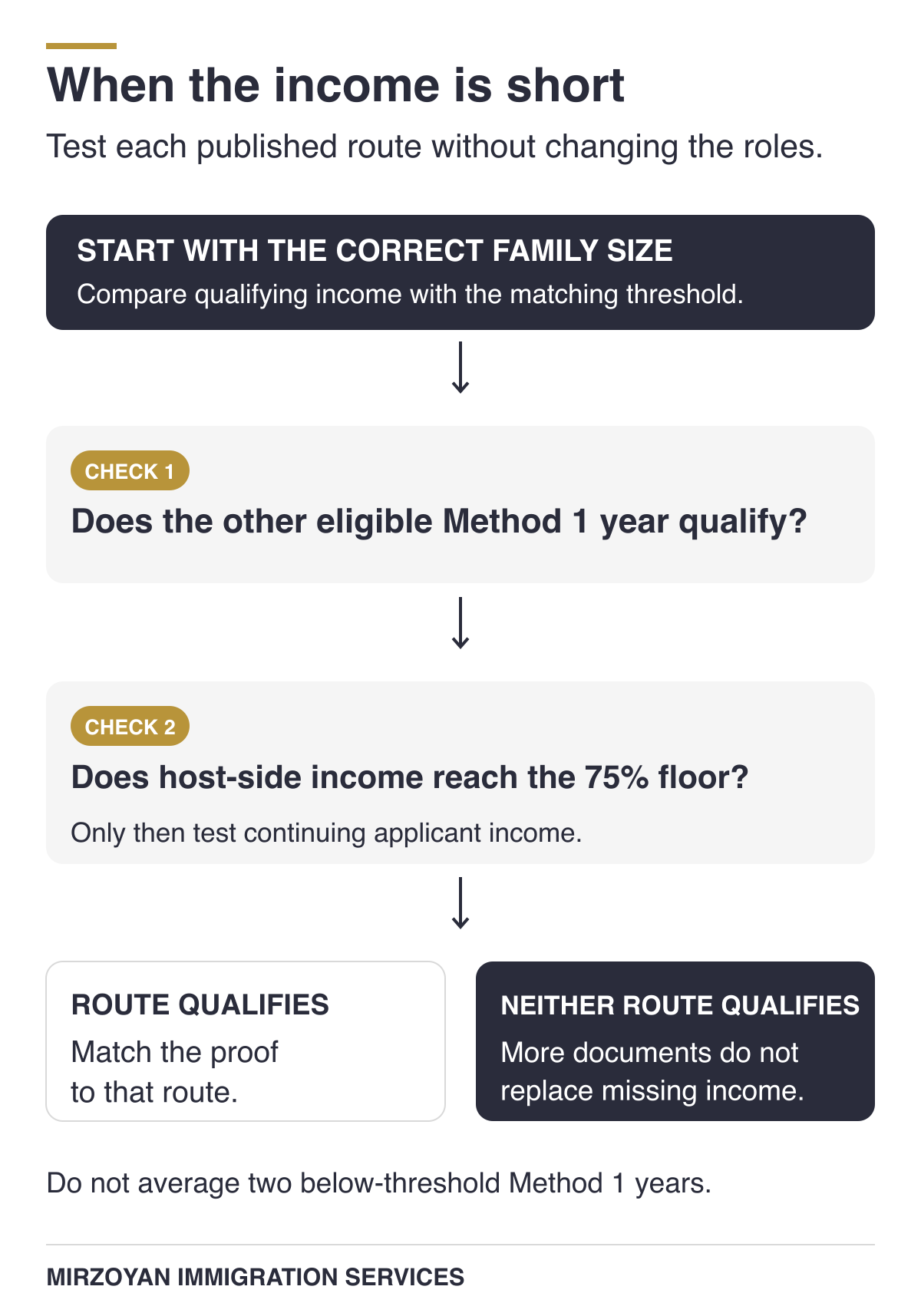
Start with the correct family size, test the other Method 1 year, then test the 75% mark under Method 2. If neither route works, more documents will not replace missing income.
When it makes sense to have the numbers checked
Plenty of families can prepare this part using IRCC's instructions. That is especially true when one tax year clearly clears the minimum and the household is simple. But help is worth considering when something complicates the count or the proof. That might be an earlier invitation, a running sponsorship undertaking, a recent job change, a foreign pension or a missing NOA. Mirzoyan Immigration Services can work out which method fits your records, rebuild the family-size count and trace each amount to its document. And that review separates a missing document from a real shortfall before the invitation letter is final.
Under One on One Advisory, your questions are answered directly by Narek Mirzoyan (RCIC # R1005184) or Vahe Mirzoyan (RCIC # R514223). Not by an intake coordinator, an assistant or a call centre. The licensed consultant who reviews your income file is the one who replies to your messages. Before deciding, you can read how a licensed immigration consultant can help and review the fee schedule. A consultation cannot guarantee approval or speed up IRCC processing. For what the service includes, see the Super Visa consultation service.
Key Takeaways
The $30,526 row never applies to a Super Visa, because you and your parent always make a family of at least two.
Earlier invitations and running sponsorship undertakings can add people to your count, even if those people live elsewhere.
A raise or a strong employer letter cannot rescue a tax year that fell short under Method 1.
Co-signing is limited to your spouse or common-law partner. Your parent's income counts only under Method 2, after your side reaches 75%.
Mirzoyan Immigration Services can check your family-size count, method and records before you file.
Frequently Asked Questions
How much income is required for a Super Visa?
For a host inviting one parent, with no one else to count, the minimum is $38,002. The figure rises with family size: $46,720 for three people. IRCC's table starts at $30,526, but that row is for one person. A Super Visa count always includes you and your parent. You can qualify on either of the last two tax years, or reach 75% and add your parent's continuing income.
What counts as proof of income for a Super Visa?
Proof of Super Visa income depends on the method. Under Method 1 (the full minimum in one tax year), it is your Notice of Assessment (NOA) for that year. Under Method 2 (the 75% option), IRCC asks for your last NOA first. If it is unavailable, Canadian-income records such as T4 slips, 12 months of pay stubs or an employer letter can stand in. A contributing parent's records must show the income's currency and that it will continue in Canada.
How is family size calculated?
Super Visa family size counts every applying parent or grandparent, the host, the host's spouse or common-law partner, and their dependent children. It also includes anyone covered by an earlier Super Visa invitation that still applies, or a sponsorship undertaking still in effect. A co-signing spouse's earlier invitations and undertakings count too, even for people living elsewhere.
Can the applying parent or grandparent's income count?
A parent's or grandparent's income can count only under Method 2 (IRCC's Option 2). The host and any co-signing spouse must first reach 75% of the minimum, and the parent's income covers the rest. That income is measured over the 12 months before the application is filed. The records must show its currency and that it will continue in Canada. Savings alone do not count as income.
Who may co-sign the financial support requirement?
Only the host's spouse or common-law partner is allowed to co-sign a Super Visa invitation. Siblings, adult children, friends and other relatives cannot, however willing they are to help. The co-signer has to be living in Canada, aged 18 or over, and a citizen, permanent resident or registered Indian. Their income is then added to the host's for the calculation.
Conclusion
Work in this order: count everyone, find your row, then choose the method your records can prove. Method 1 suits a host whose income cleared the full minimum in one recent tax year. Method 2 suits a host who reaches 75% and has a parent with steady, documented income. But a prior invitation, a running undertaking or a foreign pension can change the count or the proof. Not sure which method your records support? Mirzoyan Immigration Services can check your count and calculation with you before you file.
Disclaimer
This article is general information about the Super Visa income requirement. It is not legal, immigration or financial advice. Every family's situation differs, and IRCC can change its instructions, so get advice on your own facts before you file.