Express Entry Canada 2026: Complete Guide for Applicants
Last updated: May 16, 2026 | Written by Narek Mirzoyan RCIC#R1005184 |
Table of Contents
Key Takeaways
TL;DR
What Is Express Entry?
Who Qualifies for Express Entry?
The Three Federal Programs at a Glance
How the Express Entry System Works: Step by Step
How Much Does Express Entry Cost in 2026?
What's New in Express Entry for 2026?
What Is a Provincial Nomination Through Express Entry?
Common Reasons Applications Are Refused
Frequently Asked Questions
Key Takeaways
Express Entry is IRCC’s selection portal/system, not a standalone program. You must qualify to apply through one of three programs: CEC, FSW, or FST.
You create a profile to enter the pool of candidates, IRCC ranks you on the Comprehensive Ranking System (CRS), and draws invite the highest-scoring candidates.
After an Invitation to Apply (ITA), you have 60 days to file a complete Electronic Application for Permanent Residence (e-APR). Most complete applications are processed by IRCC within six (6) months.
Category-based draws in 2026 reward candidates in French-language streams, healthcare, STEM, trades, education occupations, transport, physicians with Canadian work experience, Senior Managers with Canadian work experiences, Researchers with Canadian work experience and skilled military recruits.
The Mirzoyan Immigration team reviews applicants’ Express Entry profiles before submission. Eligibility errors and CRS miscalculations at profile stage can cost you an ITA or a refused e-APR.

TL;DR
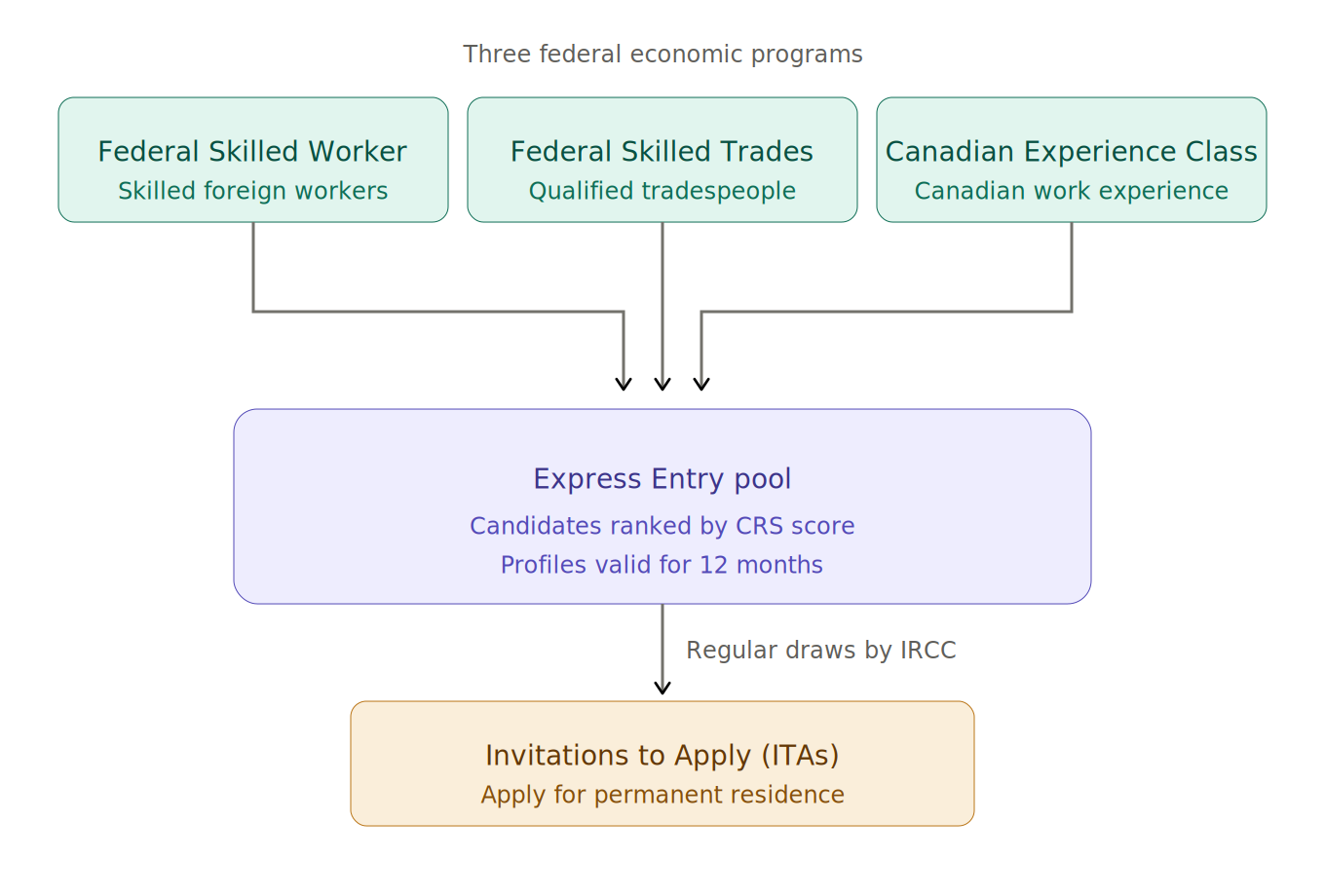
Express Entry is Canada's online candidate selection system for managing three federal PR programs. Those programs include the Federal Skilled Worker Program, the Federal Skilled Trades Program, and the Canadian Experience Class. Once you complete your EE profile, and you meet the requirement for one of the programs, you enter the pool of candidates and IRCC ranks you using their Comprehensive Ranking System (CRS). You receive an ITA when your score meets the draw cut-off. Once invited, you have 60 days to submit your e-APR. IRCC aims to process most applications within six (6) months.
What Is Express Entry?
This system was launched in January 2015 and replaced the old paper-based federal application which was already in place for years. Before Express Entry, a complete skilled-worker application could sit in backlog for years, sometimes up to ten (10) years. The pool model at the time of its launch was revolutionary and modernized the Canadian immigration landscape. It allowed IRCC to select applicants based on merit and capacity, and not with the date of initial submission.
Express Entry is not a program. You apply through Express Entry to one of the three underlying programs. Eligibility for each program is distinct. One profile can make you eligible for multiple streams at the same time.
Who Qualifies for Express Entry?
You qualify for Express Entry if you meet the rules of at least one of three (3) federal programs: FSW, FST, or CEC. Each program has a distinct criteria for work experience, language, education, and Canadian work or study experience. Meeting any one program's rules is enough to create a profile and enter the pool.
The four factors which are common to all three programs, are:
Language ability in English or French, tested by an IRCC-approved organisation.
Work experience in a skilled occupation under the National Occupational Classification (NOC) TEER system. Specifically, NOC TEER 0, 1, 2, or 3.
Education, at the high-school level or above. FSW and some categories require Education Credential Assessment (ECA). This is typically done by World Education Services (WES).
Admissibility, meaning no prior criminal, security, medical, or misrepresentation matters.
If you are unsure whether you qualify, the 60-second free assessment at Come to Canada is a safe starting point. For a stream-specific read, the deep dive on CEC requirements covers each rule IRCC applies to Canadian-experience candidates.
The Three Federal Programs at a Glance
The three federal programs have different functionalities. CEC is most suitable for applicants who have already accumulated one year of work experience in Canada. FSW targets skilled workers outside of Canada with foreign experience. FST is for tradespeople with at least two (2) years of full-time experience. Most FST applicants also need a Canadian job offer or certificate of qualification. We have a full comparison of the three programs at FSW vs CEC vs FST.
Cliff notes:
The Canadian Experience Class (CEC) fits people who have accumulated Canadian work experience in the NOC TEER 0, 1, 2, or 3. Typically, these are international students or foreign workers who have accumulated 12 months of skilled Canadian experience in the past three years. For CEC, there are no settlement funds needed.
Federal Skilled Worker (FSW) fits foreign-trained professionals with qualifying foreign work experience in the NOC TEER 0, 1, 2, or 3. Settlement funds are required for FSW unless you have a valid Canadian job offer.
Federal Skilled Trades (FST) fits skilled tradespeople. You need two (2) years of trade experience in the NOC groups 72 (excluding Sub-Major Group 726), 73, 82, 83, 92, or 93 (excluding Sub-Major Group 932), Minor Group 6320, Unit Group 62200. You also need a Canadian certificate of qualification or a valid Canadian trade job offer. Settlement funds required unless a valid job offer is in place.
If you are interested in reading more, you can check out our CEC requirements guide which covers the exact NOC categories and work-experience definitions that apply to Canadian applicants.
How the Express Entry System Works: Step by Step
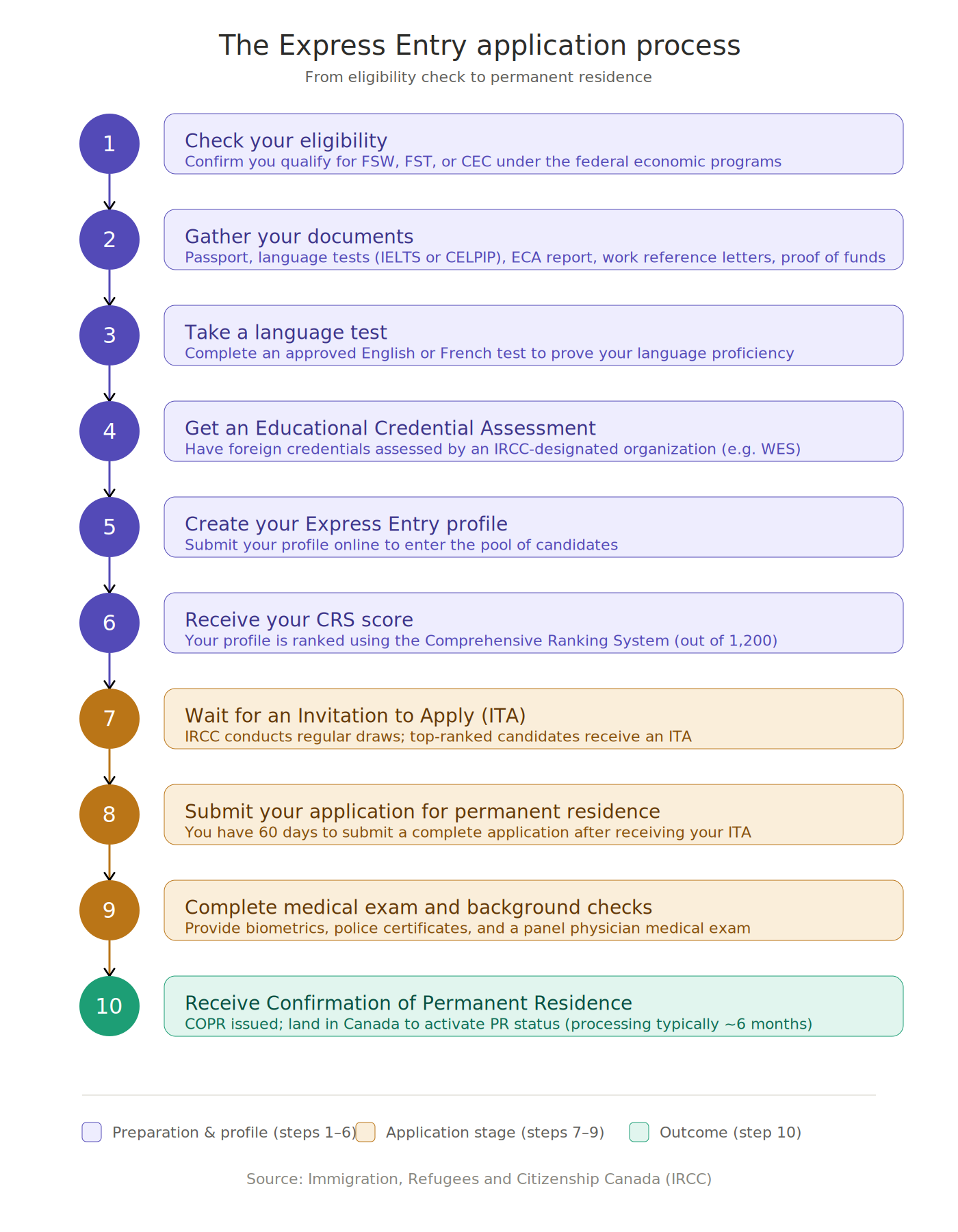
Your Express Entry journey will have ten (10) distinct stages from deciding to apply through to landing as a permanent resident. Not every stage has a deadline, but several do and they are very important. Missing a deadline after an ITA is issued usually ends the process and you have to start again from the very beginning.
Step 1: Confirm you are eligible for at least one program
Before you do anything else, confirm you meet the eligibility for FSW, FST, or CEC. Use the IRCC eligibility tool. If you think CEC may fit, our CEC self-eligibility checklist will walk you through the steps in detail.

Step 2: Take an approved language test
Book and take a language test before you create a profile. IRCC accepts IELTS General Training, CELPIP General, TEF Canada, or TCF Canada. Check out IRCC’s language testing requirements. Once completed the results are valid for two (2) years from the test date. You need to include the exact score that you received on your language exam on your profile.
To qualify for FSW you will need minimum Canadian Language Benchmark (CLB) 7 in all four skills which include reading, writing, listening and speaking.
CEC on the other hand has different requirements which include CLB 7 for NOC TEER 0 or 1 and CLB 5 for TEER 2 or 3.
FST has a lower language barrier, and the minimum requirement is CLB 5 for speaking and listening and CLB 4 for reading and writing. IRCC’s language-test guidance lists accepted tests and the minimum results for each Express Entry program.
Step 3: Obtain an Educational Credential Assessment (ECA)
If you have graduated from any post-secondary school outside of Canada, it is recommended to complete an ECA. An ECA is required for the FSW program, however you will get additional CRS points if you qualify for CEC. An ECA must be completed by a designated organisation. Common providers include World Education Services (WES), IQAS, ICAS, and ICES. Assessments typically take twenty (20) to thirty-five (35) business days. The costs vary, however it should be in the ballpark of CAD $300 plus courier fees.
Step 4: Create your Express Entry profile
Once your language and ECA results are in, only then you should start with the creation of your profile through the IRCC online portal. Your profile will include your age, education, work history, language scores, adaptability factors, any provincial nomination, or valid job offer. Upon the completion of your profile, IRCC generates a CRS score immediately. Profiles stay active in the pool for twelve (12) months. If you do not receive an ITA within that year, you have to recreate a new profile to be added to the pool of candidates.
Step 5: Wait for an Invitation to Apply
IRCC holds Express Entry draws from the pool regularly. During each draw, candidates at or above a published CRS cut-off receive an ITA. The cut-off depends on the draw size, draw category (general or targeted), and pool composition. IRCC’s rounds of invitations page provides draw results and explains how general, program-specific and category-based rounds work.
Step 6: Submit your electronic Application for Permanent Residence
Once you receive an ITA, you have 60 days to upload a full electronic Application for Permanent Residence (e-APR). You must include all supporting documents and pay government fees in that window. If you miss the 60-day deadline, the ITA expires. You then must recreate your profile from scratch, and there is no guarantee of a second invitation. It is also recommended to complete an upfront medical examination with an IRCC-approved panel physician prior to the submission of the application to avoid delays. Results go directly from the panel physician to IRCC. Some applicants may be exempt from this requirement.
Planning an Express Entry application? Book an Express Entry profile review with Mirzoyan Immigration. An RCIC will check your eligibility, CRS accuracy, and document readiness before you submit. This is the stage where errors become expensive.
Step 7: Provide biometrics and medicals
After your e-APR submission, IRCC issues a biometrics instruction letter. You have 30 days to visit a Visa Application Centre or Service Canada location for fingerprints and a photo.
Step 8: Background check and security screening
IRCC runs criminal background and security checks against Canadian and international databases. Most candidates clear this stage in weeks. Candidates with complex travel histories, high-security occupations, or nationals of certain countries may wait months. If you worked in any government positions in the past, this would cause additional delays. Processing-time causes and how to check status are covered in the Express Entry processing times article.
Step 9: Passport Request (PPR) and Confirmation of Permanent Residence
If IRCC approves your application, you receive an Original Passport Request (OPR). IRCC asks for your passport so they can issue the Confirmation of Permanent Residence (COPR) document. Some candidates also receive a PR visa, if they are outside of Canada. The COPR is your entry document. It has a validity date tied to your medical or passport, which means you must travel before the expiration of that specific date. COPR cannot be extended.
Step 10: Land as a permanent resident
You land by presenting your valid COPR at a Canadian port of entry before the document expires. A Canada Border Services Agency (CBSA) officer completes the landing interview. Once landed, you are a permanent resident of Canada. Your PR card arrives by mail. The processing time for the PR card varies and you should always check the latest processing times from IRCC directly to be prepared in case you need to travel outside of Canada.
How Much Does Express Entry Cost in 2026?
As of April 30, 2026, Express Entry government fees will increase to CAD $990 for the principal applicant and accompanying spouse, CAD $270 for each dependent child and CAD $600 for the Right of Permanent Residence Fee (RPRF). See IRCC fee schedule for most accurate and recent fees. These are IRCC fees only. Language tests, ECAs, translations, police certificate clearance, medicals, and biometrics fees are extra.
The full cost breakdown for a typical single applicant from outside Canada:
Language test (IELTS General or CELPIP General): CAD $300 to $320
ECA: CAD $220 to $280 plus courier fees
Biometrics: CAD $85 per person, $170 per family of 2 or more
Medical examination: CAD $200 to $450 per adult, varies by panel physician
Police certificates: usually $20 to $100 each country
IRCC application fee and RPRF: CAD $1,675 combined
Proof of settlement funds is also required for FSW and FST applicants who do not have a valid Canadian job offer. Current amounts start around CAD $15,267 for a single applicant and increase with family size.
What's New in Express Entry for 2026?
The biggest 2026 change is the expanded use of category-based draws. IRCC now prioritises candidates in specific occupational categories aligned with Canadian labour market needs. This gives the federal government to pivot and directly tackle labor shortages where they matter the most. Active categories in 2026 include French-language proficiency, healthcare, STEM professionals, skilled trades, education occupations, transport, physicians with Canadian work experience, senior managers with Canadian work experience, researchers with Canadian work experience and skilled military recruits. (IRCC category-based selection)
Category draws have a meaningfully lower CRS cut-off than general draws. The reason is simple, it targets candidates who are needed to address the long-term shortages of the labor market. A healthcare-category draw in 2024 issued ITAs at as low as CRS 463. During the same period the general CEC draw was hovering at 530 CRS. IRCC’s draw history records the round type, date and CRS cut-off for each invitation round.
What Is a Provincial Nomination Program (PNP) Through Express Entry?
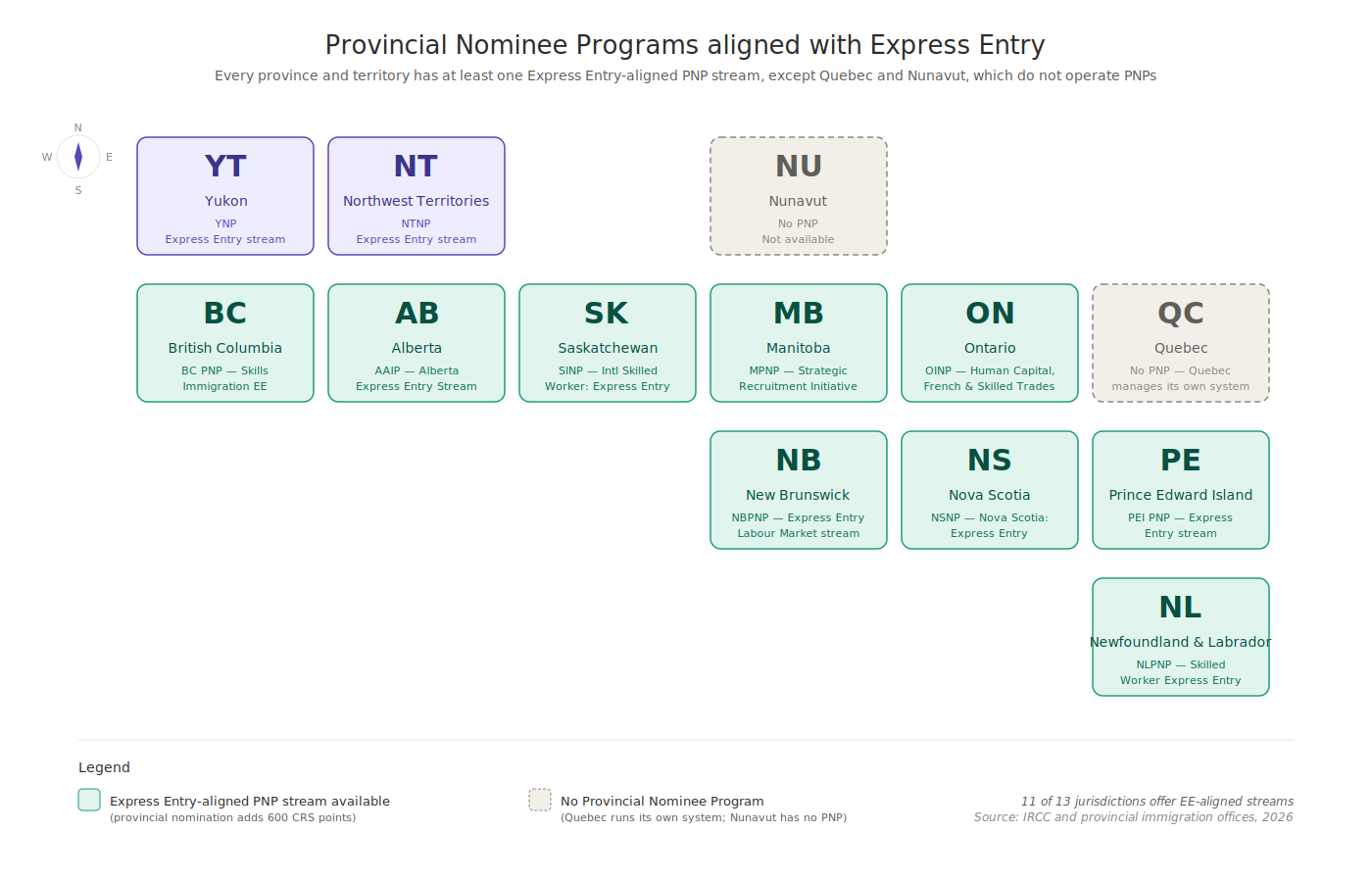
A PNP nomination certificate through an Express Entry-aligned pathway will add additional 600 CRS points. These additional points practically guarantee that you will receive an ITA in the next general draw. Each province runs their own PNP with distinct occupation lists, work experience and language requirements. Ontario, BC, Alberta, Saskatchewan, Manitoba, and the Atlantic provinces all operate their specific streams.
PNP adds an extra layer of processing and timelines. It remains the most reliable path for increasing your score, for candidates whose CRS score is 20 to 80 points below recent general cut-offs. The full CRS math, including how the 600-point PNP bonus points affect the application can be found in our CRS score explained article.
Common Reasons Applications Are Refused
Understanding the reason for your refusal is as important as understanding your eligibility. Luckily, starting in 2025, IRCC officers must include detailed notes on every refused application. Based on our experience, we see five common problems which appear again and again in refused e-APRs.
Misrepresentation, intentional or accidental
IRCC uses "misrepresentation" broadly. Submitting a reference letter that overstates responsibilities can trigger a misrep. So can omitting a previous visa refusal on a form or failing to disclose a minor arrest. A misrep finding carries a five (5) year bar on Canadian immigration. Once you fail to disclose material information to IRCC for your application, it is hard to recover, almost impossible.
Reference letters that do not meet IRCC standards
A reference letter must list job titles, responsibilities, hours worked, salary, and be signed on company letterhead. Many self-drafted letters are missing fields. IRCC’s supporting-document guidance explains the employment evidence you may need. Follow the checklist in your application for the requirements that apply to you.
Insufficient proof of settlement funds
FSW and FST candidates without a valid job offer must show liquid, accessible funds. The amount must meet or exceed the IRCC threshold for six (6) months. Lump-sum transfers into an account right before submission are a huge red flag to IRCC officers. If it walks like a duck, talks like a duck, it’s a duck.
Medical inadmissibility on grounds of excessive demand
A medical finding that a family member would cause excessive demand on Canadian health or social services can result in the refusal of the whole application. Even if the person is not an accompanying dependent. This is not a common occurrence; however, it does appear in applications involving dependants with significant health needs.
Security screening delays that trigger deemed abandonment
Applicants sometimes fail to respond to a Procedural Fairness Letter (PFL) in time. Missing the 30-day deadline for additional documents can end the file. This is more important for e-APR applications, as most often than not, you may not be able to extend this 30-day deadline.
Conclusion
Express Entry is the clearest, fastest federal route to Canadian permanent residence for skilled workers. Because of the way it is processed, it is also the least forgiving of small mistakes. Understand your eligibility from the get-go, calculate your CRS score accurately, and gather the required documents prior to entering the pool. That is what separates a successful applicant from an unprepared one.
Book an Express Entry profile review with Mirzoyan Immigration. We will verify your eligibility stream. We will calculate your CRS accurately and flag any risks before you enter the pool. Book your profile review.
What is your biggest worry about applying through Express Entry? Drop it in the comments below, and an RCIC will reply.
Frequently Asked Questions
Is Express Entry the same as permanent residency?
No, Express Entry is the online platform used by IRCC to manage three economic PR programs. You apply through Express Entry, but the permanent residence is the outcome. Receiving an ITA and submitting an e-APR is the actual application for PR. Landing on a valid COPR grants you PR at the time of your arrival.
Do I need to live in Canada to apply through Express Entry?
No, you can apply from inside or outside Canada. The Canadian Experience Class requires Canadian work experience and not your physical presence in Canada. The Federal Skilled Worker Program and Federal Skilled Trades Program both accept foreign work experience. Your location at the time of application does not affect eligibility.
Can I include my spouse and children in an Express Entry application?
Yes, it is highly encouraged to include all dependent family members in your application. Your spouse or common-law partner and your dependent children can be included as accompanying family members in the same e-APR. Each must pass medical and security checks. Your spouse's language and education can also add CRS points under the Spouse factor.
What happens if I get rejected after receiving an ITA?
A refused e-APR means your PR application was denied, often for misrepresentation, medical inadmissibility, or insufficient documentation. Straight-forward refusals allow you to reapply after fixing the issue. Misrepresentation carries a five (5) year bar on any Canadian immigration application which will make you inadmissible to stay in Canada. In almost all cases you will have to depart Canada after Immigration Division deems you inadmissible.
Is there an age limit for Express Entry?
No hard age cap for Express Entry. Age affects your CRS score under the Core Human Capital factor. Maximum age points (100 single / 110 with spouse) apply between ages 20 and 29. Points decrease each year after 30 and reach zero at 45.
How Can We Help?