Canadian Citizenship by Descent: Current Rules and Eligibility

Canadian Citizenship by Descent: Current Rules and Eligibility depend first on whether either parent was Canadian when you were born. So you may already be a citizen. If neither parent was Canadian then, Bill C-3, your birth date, and generation may still make you a citizen. Grandparent ancestry can matter, but family history alone does not prove status. Bill C-3 received Royal Assent on November 20, 2025. Its citizenship amendments came into force on December 15, 2025. The law can recognize a parent's citizenship retroactively.
You can be Canadian without a certificate. But a short-form birth certificate that omits the parent's name may prompt IRCC to request stronger lineage evidence. Check your status and records before choosing an application.
By Narek Mirzoyan, RCIC # R1005184,. Verify this credential on the CICC public register.
Last reviewed by Narek Mirzoyan, RCIC # R1005184, on 2026-09-16.
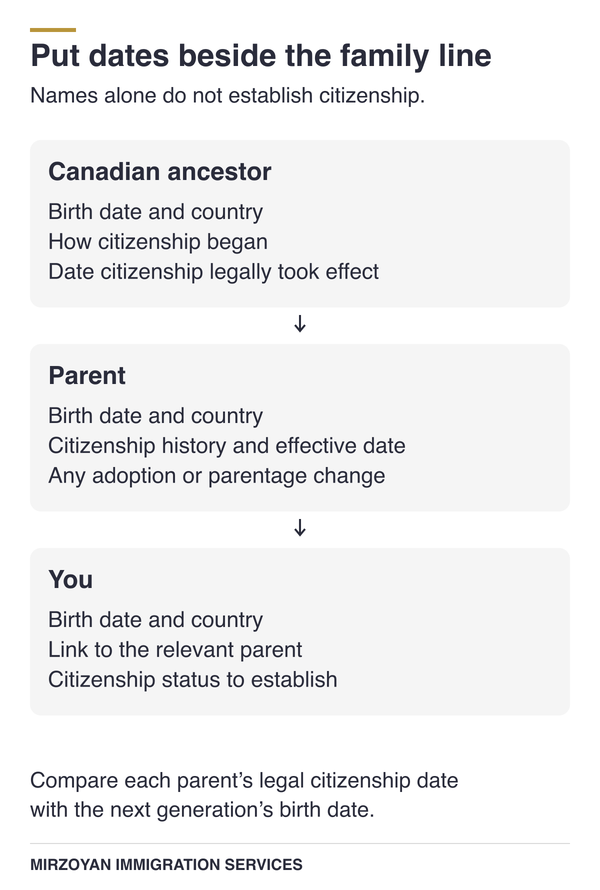
A preparation timeline records birth dates, countries, relationships and effective citizenship dates. It is not a finding that the family qualifies. Add adoption or legal-parentage events when relevant; a certificate’s issue date may differ from the legal start of citizenship.
Start with dates and legal status
Citizenship by descent begins with a dated family timeline. Terms such as "Canadian parent" or "Canadian grandparent" leave out facts that can change the result.
Record every birth date and country in the family line
Start with the full birth date and country for you, each parent, and each Canadian ancestor in the line. Add adoption dates and any legal parentage changes beside the person they concern. Note relevant Crown service separately so it can be checked against the applicable exception. IRCC's current guidance uses birth dates, birthplace, and generation to identify which rule applies. A timeline containing those facts is more useful than a family tree showing names and relationships alone.
Identify how and when each Canadian ancestor became Canadian
For each Canadian ancestor, record how citizenship arose and the date it legally took effect. The person may have become Canadian by birth, naturalization, descent, adoption, or a later statutory provision. A certificate issued years afterwards does not necessarily identify when that status began. I compare that effective date with the child's birth date before choosing an application route. If the records give different dates, identify what each date represents before treating either as the start of citizenship.
Ask whether the parent was Canadian when the child was born
Compare the parent's effective citizenship date with the child's birth date, rather than the date a passport or certificate was issued. An ordinary grant received after the birth usually does not make the child Canadian from birth. A restoration or statutory change may produce a different result because it can recognize citizenship from an earlier date. IRCC's citizenship status checker can help identify which situation needs examination. If the parent already holds a certificate, the remaining question may therefore concern its effective date rather than the parent's current status.
How the December 15, 2025 changes affect citizenship by descent
Bill C-3 expanded citizenship by descent beyond the former first-generation limit. A person's birth or adoption date now separates two different legal tests.
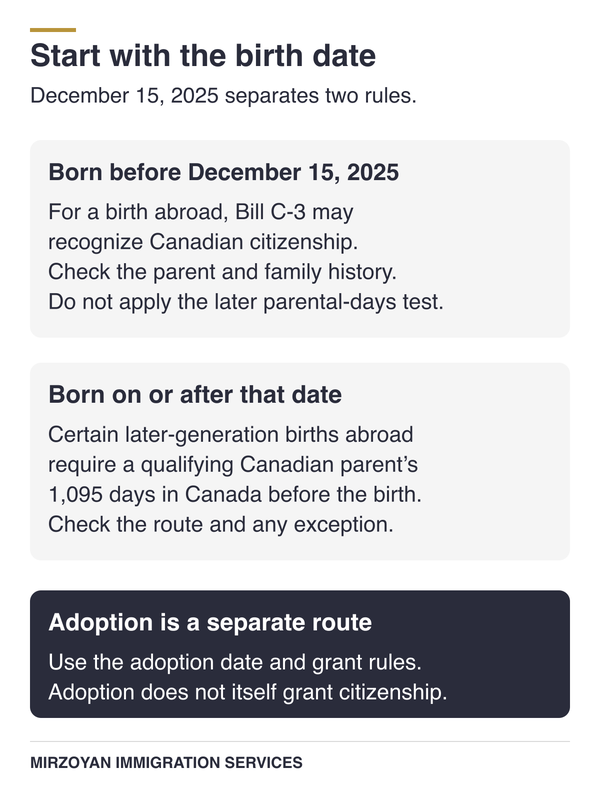
For births abroad before December 15, 2025, examine automatic citizenship under the amendments without importing the later parental-presence test. For certain births on or after that date, parental presence matters. Adoption uses a separate grant route and its relevant adoption date; no blanket eligibility conclusion is shown.
Bill C-3 received Royal Assent on November 20, 2025
Parliament records that Bill C-3 received Royal Assent on November 20, 2025. But Royal Assent made the bill law several weeks before its citizenship amendments took effect. The legislation addressed people excluded by the former first-generation limit. It created a Canadian-connection test for certain children born or adopted later. Citizenship already held before Bill C-3 remained valid.
The amendments came into force on December 15, 2025
The citizenship amendments took effect on December 15, 2025. For people born abroad earlier, Bill C-3 restored or granted citizenship to specified later-generation descendants. IRCC states that, in most cases, a person born abroad before that date to a Canadian parent is now automatically Canadian. That can include a parent who became Canadian because of the same amendments. But the complete family chain and any statutory exceptions still require review.
Current status and future transmission are not the same test
Becoming Canadian under the amended law does not settle whether you can pass citizenship to a later child born abroad. First establish whether you or your parent acquired citizenship under the amendments. Then consider the rules that apply to the later child's birth or adoption. For certain later-generation cases, the parent generally needs 1,095 cumulative days in Canada before that event. A family may establish the parent's citizenship but still need separate records of the parent's time in Canada.
What if your parent became Canadian after you were born?
A parent's later citizenship grant usually does not make an earlier-born child Canadian. But a later law may recognize that parent as Canadian earlier.
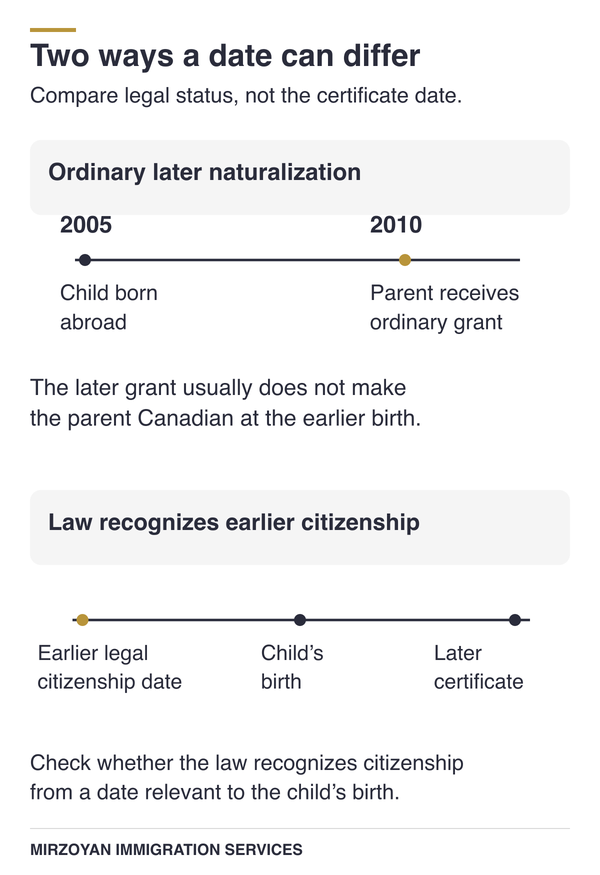
The upper timeline uses the article’s illustrative 2005 birth and 2010 ordinary grant. The lower is schematic: later documentation can record an earlier legal status. Neither timeline settles a claim; identify the applicable law and effective date. Not to scale.
Ordinary post-birth naturalization usually works prospectively
Suppose you were born abroad in 2005 and your parent became a naturalized Canadian citizen in 2010. An ordinary grant in 2010 generally takes effect that year. It does not usually make the parent Canadian on your 2005 birth date. The parent's current passport therefore cannot, by itself, establish that citizenship passed to you at birth. This example concerns ordinary naturalization; citizenship recognized from an earlier date under legislation needs the separate review below.
Retroactive statutory recognition requires separate analysis
Legislation can recognize citizenship from an earlier date, which differs from an ordinary grant received after a child's birth. IRCC says some people became citizens because their parent became Canadian under the amended rules. In such a case, the date the parent learned about the change may be irrelevant to the child's status. What matters is the legal effect of the provision that restored or granted the parent's citizenship. Identify that provision and its effective date before concluding that the parent's later recognition rules out the child's claim.
A certificate confirms status; it does not create descent status
A Canadian citizenship certificate documents citizenship, but its printed issue date may be years later than the date that status began. That difference can explain why a parent's certificate appears to postdate the child's birth. Compare the certificate with the citizenship history and applicable law instead of treating the printing date as decisive. If the parent obtained an ordinary later grant, that history may support a different conclusion from statutory restoration. Resolve the effective date before using the certificate to support the child's descent claim.
How the former age-28 rule may affect your citizenship
The former age-28 rule matters when an older family record says someone lost Canadian citizenship on their twenty-eighth birthday. It applied to certain people born abroad beyond the first generation, rather than everyone with a Canadian parent. The requirement has been repealed, so turning 28 today does not create the same deadline. But a loss that occurred before repeal can still appear in documents used to establish your family history. Review that historical record together with the later restoration rules before deciding what it means for your current citizenship.
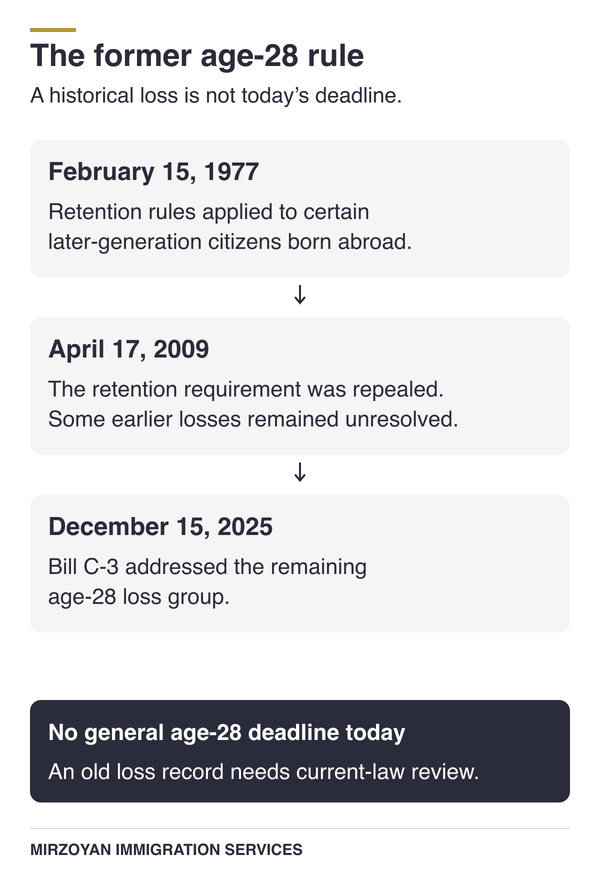
The former retention rule affected certain later-generation births abroad. The 2009 repeal did not restore every earlier loss; Bill C-3 addressed the remaining age-28 group in December 2025. Renunciation and revocation are different histories. No present universal age-28 certificate deadline is implied.
Why former section 8 still appears in family files
The unresolved age-28 loss group included certain people born from February 15, 1977 through April 16, 1981. These people had already turned 28 before the rule was repealed on April 17, 2009. IRCC's chronology of citizenship changes identifies why their earlier loss remained unresolved after that repeal. Birth within those dates alone does not establish loss; generation and any successful retention also matter. Look for correspondence about retaining citizenship or a decision recording loss, then compare it with the person's birth and parentage records.
An older letter recording loss is evidence of the earlier decision, not necessarily the answer under today's law. Keep the letter rather than removing it because it appears inconsistent with a current claim. It can show the precise historical issue that later legislation addresses. The next step is to determine whether the current restoration provisions apply to that recorded loss.
How later restoration provisions may matter
Bill C-3 restored citizenship to people affected by the former age-28 loss rule when the amendments took effect. That means an affected person should not assume an old loss decision permanently prevents obtaining proof today. The earlier document still belongs in the history because it explains the status problem being addressed. Restoration of the parent's status may also affect a descendant, but the descendant's own birth and parentage must be established. The Bill C-3 transition guide explains that legal effect in more detail.
A formal renunciation or revocation is a different history from failure to retain citizenship. Do not treat those events as covered merely because the family uses the same phrase, “lost citizenship.” Identify the actual decision before relying on the age-28 restoration explanation. This also prevents an adoption or missing-parentage issue from being mistaken for a retention problem.
Why there is no current general age-28 filing deadline
There is no current rule requiring every citizen by descent to obtain a certificate before turning 28. Turning 28 today does not itself cancel citizenship by descent. The separate historical question concerns someone who reached that age while the former retention rule applied. Check that person's birth date, generation, and recorded status at the time. If the former rule caused a loss, examine later restoration provisions rather than treating the old deadline as a current application deadline.
Grandparents and earlier generations require a complete legal chain
A Canadian grandparent can support a claim, but does not automatically make every grandchild Canadian. Each generation must connect under the law.
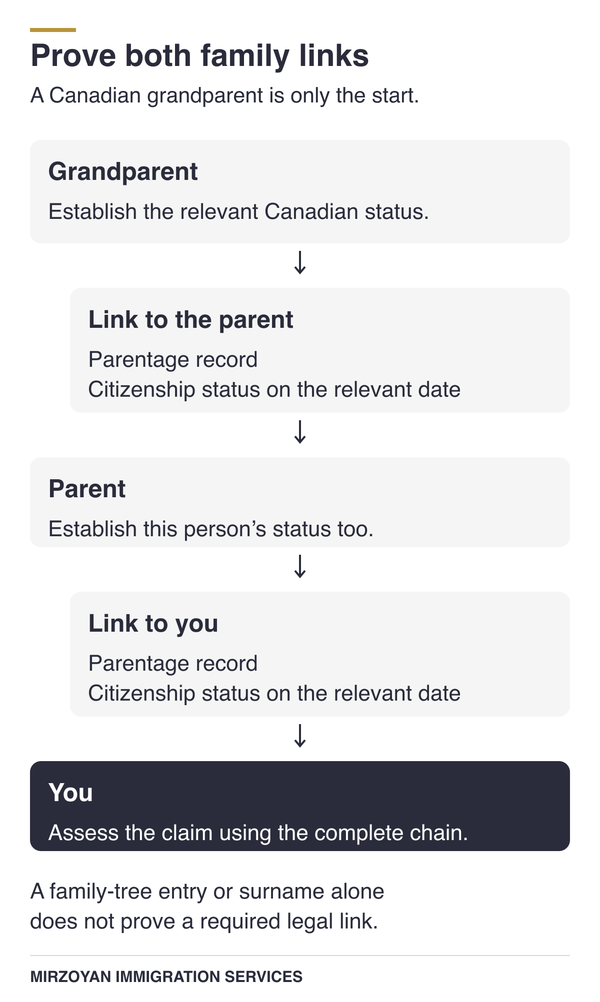
Every relevant generation needs supported citizenship history and legal parentage. The connections illustrate evidence to establish, not automatic transmission to every grandchild. Birth, adoption, parentage and official name-change records can resolve different links.
A Canadian grandparent is relevant evidence, not an automatic result
A grandparent's Canadian passport or citizenship certificate establishes only part of a grandchild's possible claim. First determine whether the grandparent was Canadian when the parent was born. Then determine the parent's status when the grandchild was born, including any later statutory recognition. The records must also connect the grandparent to the parent and the parent to the grandchild. A missing status or parentage link can change the result even when the grandparent's citizenship is clear.
Each generation needs a status and parentage link
For every generation, connect the citizenship record to the person named in the birth or adoption record. Marriage and legal name-change records may explain why that person appears under different names. A surname or relationship shown in an ancestry database does not establish legal parentage or Canadian status on its own. Use it as a lead to the authority that registered the birth, adoption, or citizenship event. The evidence should allow IRCC to follow the same family line described in the status analysis.
Earlier-generation cases need a deeper review
Each additional generation introduces another citizenship date and parentage relationship to establish. Changed names or delayed birth registrations can make those connections harder to follow. Pre-1947 facts need particular care because Canadian citizenship did not exist as a separate statutory status before 1947. Identify the legal status and records relevant to that historical period rather than applying today's document labels to every ancestor. The Canadian citizenship through a grandparent guide provides earlier-generation examples and document-planning guidance.
Unsure which family link needs evidence?
Mirzoyan Immigration Services can review the citizenship dates and records connecting the generations. Explore first-time proof and descent assistance if that uncertainty affects your claim.
When does the 1,095-day connection rule apply?
The connection requirement generally concerns overseas births from December 15, 2025 onward to a Canadian parent also born abroad. It is particularly relevant when that parent obtained citizenship through a Canadian parent or a direct adoption grant. Unless an exception applies, at least one qualifying Canadian parent needs 1,095 pre-birth days of physical presence in Canada. A birth before December 15, 2025 does not require that parental presence evidence under IRCC's current proof instructions. Start with the child's birth date and the parent's citizenship history before asking anyone to reconstruct three years of travel.
A Canadian parent born in Canada can generally pass citizenship to a child born abroad without this additional connection test. The same generally applies where the parent became Canadian through ordinary naturalization before the child's birth. A direct adoption grant has different treatment from ordinary naturalization for this purpose. Qualifying Crown service can also provide an exception, as explained below. For adopted children, use the separate citizenship-for-minors and adoption guide, which explains the pre-adoption requirement.
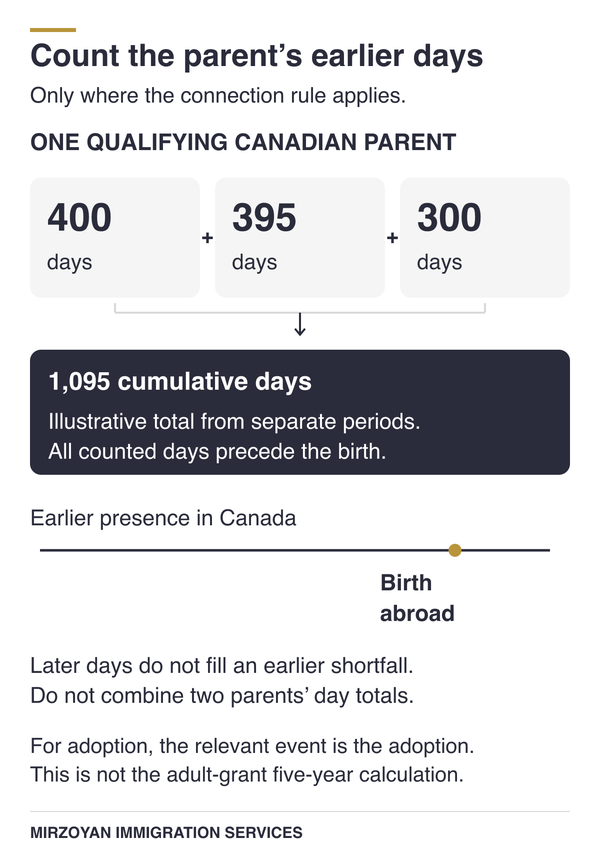
An illustrative 400 + 395 + 300 days totals 1,095. Where the rule applies, the same qualifying Canadian parent’s cumulative presence must precede the relevant birth or adoption. This is not a child’s residence requirement or the adult grant’s five-year calculation. Exceptions and the parent’s citizenship route still matter.
Do not confuse it with a permanent resident's grant-presence rule
The two citizenship rules use the same 1,095-day number but count different people's time over different periods. For a regular adult grant, the calculation concerns the permanent resident applying for citizenship and the relevant five-year period. For descent, the calculation concerns a Canadian parent's presence before a child's birth or adoption abroad. A total prepared for the parent's own grant may therefore answer a different question. Confirm whose days count and when the period ends before using an earlier calculation.
The Canadian parent must prove the qualifying connection where the Act requires it
Where the connection requirement applies, the relevant presence belongs to the Canadian parent, not the child seeking proof. These 1,095 days must precede the birth; later residence cannot count toward the parent's earlier presence. A parent's employment or school records may help explain particular periods in Canada. But records showing a Canadian address should be checked against travel during the same dates. IRCC's proof guide identifies the evidence used to support the parent's physical presence.
Organize the calculation around the parent whose status and presence support the claim. Where both parents are Canadian, assess whether one meets the applicable requirements rather than combining their separate day totals. Keep the eligibility conclusion separate from the task of assembling supporting documents. The certificate application instructions then determine how to present the calculation and evidence.
Crown service and adoption can change the analysis
Special provisions may apply when a parent or grandparent served abroad with the Canadian Armed Forces or government. The relevant relationship and service history need to be examined before relying on an exception. International adoption also follows its own statutory route. It may require a different application from the proof process used for a descent claim based on birth. The birthright and first-generation guide explains the general framework for identifying when a more specific assessment is needed.
Build an original-authority evidence chain
IRCC expects original-authority evidence for every applicable generation. Your file must connect Canadian status and legal parentage without unexplained gaps.
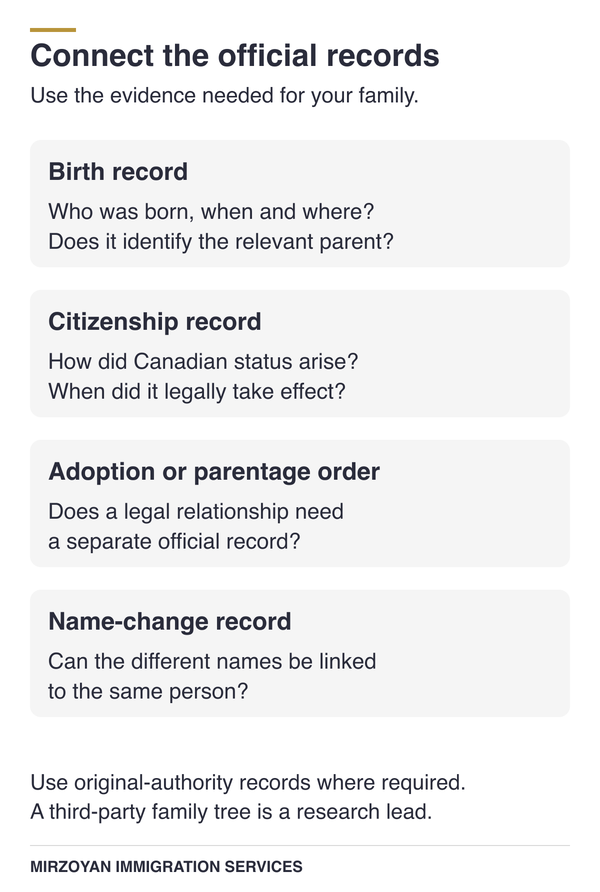
These are categories of evidence, not a universal checklist or replicas of official documents. Use the current application instructions and relevant issuing-authority records. Official linking records can explain name and parentage differences; third-party genealogy alone is not proof of every required link.
Prove the Canadian ancestor's status
Locate the record showing how and when the relevant ancestor became Canadian. It may be a provincial birth certificate, naturalization record, citizenship certificate, or official status record. Match the named person to the ancestor in your family timeline. Then check whether the record supports citizenship at the date required for the next generation. Evidence that the ancestor held Canadian identification later may leave that earlier status question unanswered.
Prove parentage and identity through each generation
IRCC's current guide requires authentic, reliable, and verifiable evidence from original authorities. When I review a multi-generation file, I match every claimed relationship to its original authority. Long-form birth records often matter because a short-form certificate may not name the parents. Adoption orders, parentage judgments, and official civil-status records may be needed where ordinary birth records do not show the relationship. Third-party records can support context, but they should not be the only proof of a required status or parentage link.
Explain name, date, and record discrepancies
Transliteration, marriage, adoption, and delayed registration can produce different names or dates across documents. Do not leave IRCC to guess whether two records concern the same person. Provide the official linking document and a concise explanation of the difference. The guide to proving Canadian citizenship covers document types in more detail. If the chain crosses several generations, book citizenship-by-descent application help before filing an unsupported family-history claim.
Choose the correct next step after the status analysis
Choose your next step only after deciding whether you are already Canadian and whether IRCC issued a certificate previously.
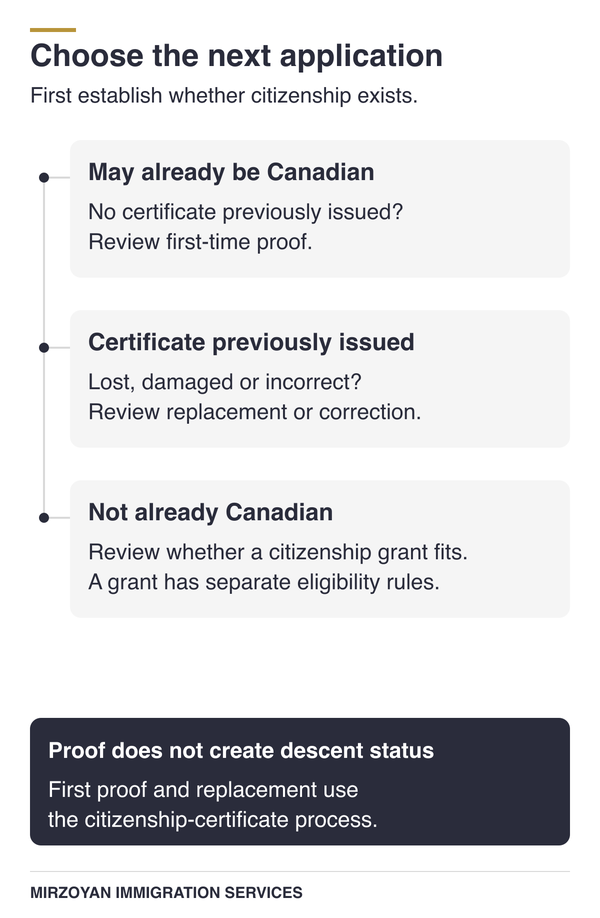
An existing-status claim generally calls for first proof, while a previously issued certificate may need replacement or correction. A person who is not already Canadian must consider a grant’s separate requirements. First proof and replacement are circumstances within the certificate process, not different citizenship statuses.
Apply for first-time proof if you may already be Canadian
If you may already be Canadian, you generally apply for a citizenship certificate to document that status. IRCC assesses whether citizenship exists and whether the evidence supports issuing proof. The application does not turn a non-citizen into a citizen by descent. Assemble the status and family records needed to support the claim before completing the certificate package. The citizenship-by-descent application guide explains that preparation and filing process.
Replace a certificate only if one was previously issued
Replacement applies when IRCC previously issued your certificate and it was lost, damaged, destroyed, or needs correction. Identify the earlier document before preparing the replacement explanation. Its prior issuance distinguishes this situation from a first-time request to determine and document citizenship. Do not substitute a replacement application for an unresolved first citizenship claim. If you need another copy of previously issued proof, use Canadian citizenship certificate replacement help.
Use the grant route only if you are not already Canadian and qualify
If you are not a citizen by descent, you may need a citizenship grant after becoming a permanent resident. And that route has different requirements for physical presence, tax filing, language, knowledge, and prohibitions. Read the Canadian citizenship requirements guide before treating a grant as the fallback. If an official status check confirms you are not Canadian, citizenship grant application help may fit your situation. So check status first, then choose proof, replacement, or grant.
The Internal Logic of an IRCC Officer
An officer starts with the relevant legal date, then tests parental status and every required documentary link.
Which statutory pathway applies on the relevant date?
The officer applies the Citizenship Act provisions governing the relevant birth, adoption, loss, restoration, or transmission event. The date therefore determines part of the legal test. A general reference to Bill C-3 does not explain which part of the amendments supports the claim. Identify the event and date before explaining the applicable rule. The officer should be able to connect that explanation to the corresponding records in the file.
Was the parent Canadian at the legally relevant time?
The officer must establish whether the parent held citizenship at the relevant birth or adoption date. An ordinary later grant differs from citizenship recognized retroactively under legislation. A certificate issued later may document either history without explaining it on its face. Its issue date can help locate the record, but does not automatically establish when citizenship began. Provide the citizenship history needed to connect the parent's status to the child's claim.
Does the documentary chain support every required link?
The officer compares the claimed family line with official records of status, parentage, identity, and dates. A legal explanation cannot, by itself, establish a relationship missing from the evidence. Complete civil records also cannot create citizenship where the applicable legal conditions were not met. Identify both the rule supporting the claim and the record supporting each relationship. If either remains uncertain, address that gap rather than adding unrelated documents.
Red Flags & Procedural Fairness Letters (PFL)
A procedural fairness letter identifies a concern that could affect the decision and gives you a deadline to provide a focused answer.
Conflicting status, parentage, or chronology evidence
IRCC may question a claim when the parent's certificate postdates the child's birth and the effective citizenship date is unexplained. Different parent names, birth dates, or countries across forms and civil records can raise a separate concern. Identify each discrepancy before deciding which documents answer it. Explain what the correct fact is and connect that explanation to records from the issuing authority. A response about the certificate's effective date will not resolve a conflicting parentage record unless that difference is also addressed.
Third-party-only records and unexplained gaps
An ancestry profile, family Bible, or private genealogy report may help you locate official records. Such material alone may not establish the citizenship or parentage link required for the claim. A missing long-form birth record leaves a particular gap when no official substitute or explanation accompanies it. Identify which relationship that record needs to prove before collecting more general family history. The response should address the missing link rather than add background that leaves parentage unresolved.
A routine request is not automatically a PFL
IRCC can ask for additional evidence without alleging that the application should be refused. So read the letter's wording, stated concern, document request, and deadline before deciding how to respond. Do not send an unfocused bundle. For a citizenship PFL, I match each response document to the officer's exact concern and deadline. And if you need help, book first-time proof and descent assistance before the response deadline.
Which citizenship pathway fits your situation?
Record quality, legal uncertainty, and deadlines determine whether self-assessment, focused advice, or full representation makes sense.
Self-assess, obtain focused advice, or retain full representation
A simple first-generation claim with matching official records may be suitable for self-assessment. Focused advice can address a single question, such as the parent's effective citizenship date. Full representation may be appropriate when several generations, historic losses, or an active IRCC concern need to be addressed together. Consider the number of unresolved questions and the records available before deciding how much help you need. The table compares those levels of assistance without suggesting that representation changes the legal requirements.
| Decision factor | Self-assessment | Focused advice | Full representation |
|---|---|---|---|
| Main concern | Best suited to a clear legal route with complete, matching official records. | Tests one controlling issue before you prepare or submit the file. | Addresses several linked legal or documentary problems throughout the application. |
| Decision recourse | Your available recourse depends on the decision, not who prepared the application. | Advice can identify recourse, but does not create new review or appeal rights. | A representative can manage responses and next steps within the available legal process. |
| Costs to plan for | No professional fee, but you carry the research and preparation work. | A narrower professional cost for a defined question or document review. | Higher professional cost because the representative manages the complete file. |
| What happens next | Filing may be faster if records are ready, but omissions can prompt further requests. | A targeted review may resolve one issue before submission. | Preparation can take longer, and representation does not accelerate IRCC processing. |
Apply now or reconstruct missing records first
Before filing, check whether every required generation has an official status or parentage record. If a long-form birth record is unavailable, identify the issuing authority's substitute. Explain how that substitute connects the people named in the claim. Reconstructing the evidence may delay submission, but filing without it can lead to a request with a response deadline. Consider the time needed to obtain records abroad before choosing to submit an incomplete family chain.
When a citizenship-by-descent review can help
Choose first-time proof when the analysis indicates that citizenship already exists. But investigate a grant or another immigration route only when the person is not already Canadian.
Under One on One Advisory, client communications receive direct answers from Narek Mirzoyan or Vahe Mirzoyan. And they are licensed RCICs, with licence numbers R1005184 and R514223. Intake staff, assistants, or call routing do not answer those communications.
If the route and official records are clear, you may be able to prepare the proof application yourself. Mirzoyan Immigration Services can review uncertain citizenship dates and the records connecting each generation. That assessment helps identify the legal or documentary gap that needs attention before filing. Explore first-time proof and descent assistance for this work.
A consultation cannot replace required evidence or guarantee a certificate.
Key Takeaways
A parent's citizenship on your birth date is usually the starting point, but later statutory recognition may change that date.
Bill C-3 changed status for specified people born abroad before December 15, 2025, and added a future connection rule.
A Canadian grandparent requires a complete legal chain. Review grandparent descent cases before assuming eligibility.
First-time proof, certificate replacement, and a citizenship grant are different routes with different purposes.
Complex records may require first-time proof and descent assistance before filing.
Frequently Asked Questions
What is the 28 year rule in Canada?
The former age-28 rule required certain second-generation citizens born abroad to take steps to retain citizenship before turning 28. Some people lost citizenship automatically when they did not. It is not a current general filing deadline. Later restoration laws, including Bill C-3, may have restored status, but the person's birth date and history still require review.
Am I automatically a Canadian citizen if my parent became a citizen after I was born?
An ordinary citizenship grant received by your parent after your birth usually does not make you Canadian retroactively. The answer can differ if legislation recognized or restored your parent's citizenship from an earlier date. Bill C-3 created that possibility for some families. Confirm the parent's effective citizenship date, rather than relying only on the certificate issue date.
Is there an age limit for citizenship by descent?
There is no current general age limit for applying for proof of citizenship by descent. However, age can matter when historic law applies. The former age-28 retention rule affected some people born abroad in the second generation. Their status may depend on later restoration provisions, renunciation, revocation, and the dates in their family history.
What are the new changes in Canadian citizenship by descent?
Bill C-3's citizenship amendments took effect on December 15, 2025. They covered specified people previously excluded by the first-generation limit. For certain later-born children abroad, a Canadian parent born or adopted abroad needs 1,095 prior days in Canada. The days must precede birth or adoption.
Do I qualify for Canadian citizenship if my grandfather was Canadian?
A Canadian grandfather can be relevant, but does not automatically make you a citizen. You must establish whether he was Canadian when your parent was born. You must then determine your parent's status when you were born. Official records must prove parentage and status through both generations, subject to current and historic citizenship rules.
Next steps
Your next move depends on status, not ancestry alone. Assemble the family dates and official records before choosing proof, replacement, or grant. Mirzoyan Immigration Services offers citizenship-by-descent and first-time proof assistance across Canada, in person, online, or by phone.
Bring the family chronology and existing records to discuss the legal route and documentary gaps.
Disclaimer
This article provides general information, not legal or immigration advice. Citizenship outcomes depend on individual facts and the law applying to each event.