Canadian Experience Class Requirements in 2026: Full Guide
Last updated: May 16, 2026 | Written by Vahe Mirzoyan RCIC#R514223 | Reviewed by Narek Mirzoyan RCIC#R1005184 at Mirzoyan Immigration
Table of Contents
Key Takeaways
TL;DR
How Does IRCC Count the 12 Months of Work?
NOC TEERs Explained
What Language Levels Does CEC Require?
What Counts as “In Canada” for CEC?
What Types of Work Do Not Count?
Admissibility Requirements
Common Mistakes RCICs See Every Week
Frequently Asked Questions
Key Takeaways
Canada could be right for you in 2026
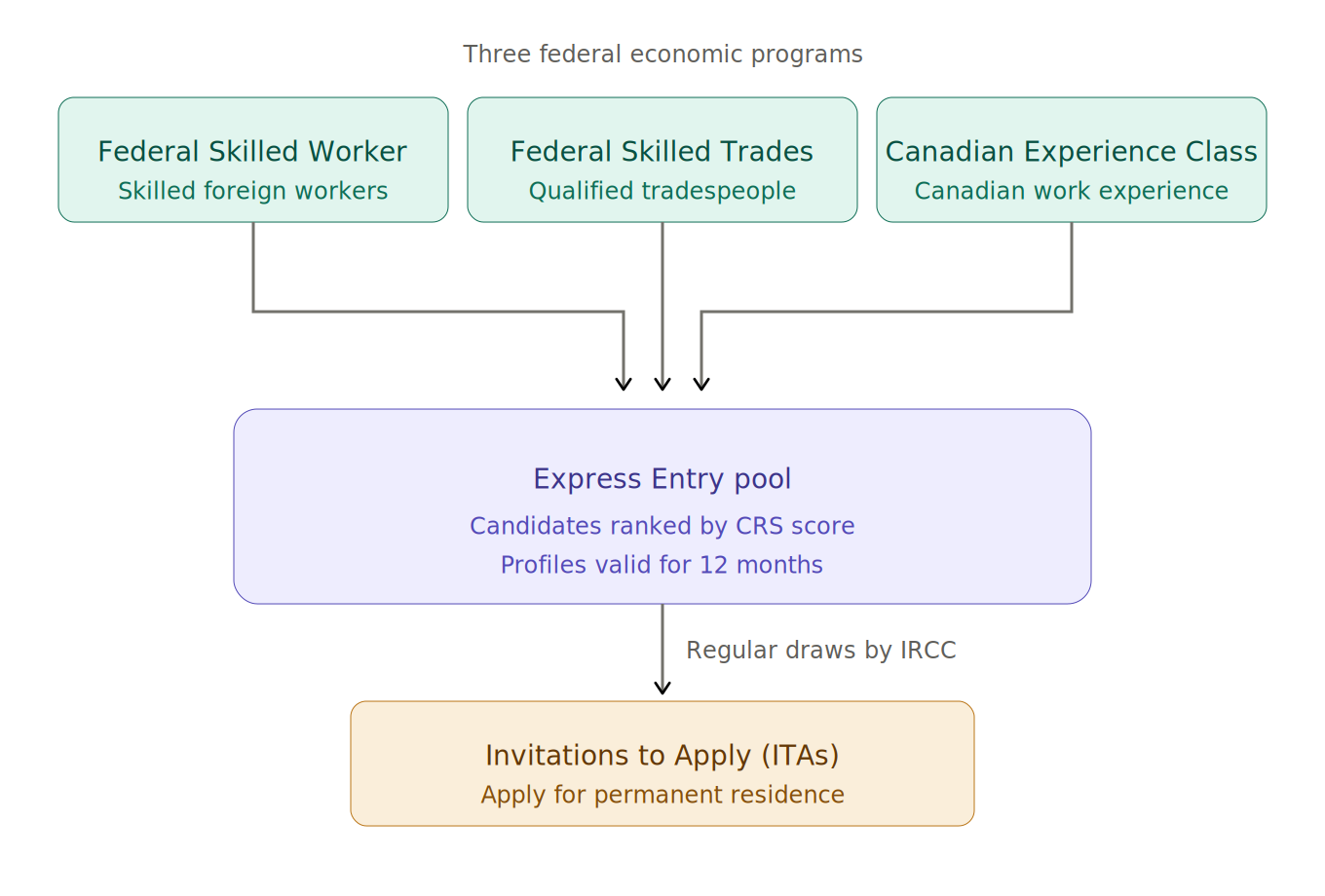
Express Entry remains the primary economic immigration system, with draws held regularly and category-based rounds targeting specific occupations
Family sponsorship is available for spouses and children but processing times vary depending on the relationship category
We love Canada and we want to share it with you
TL;DR
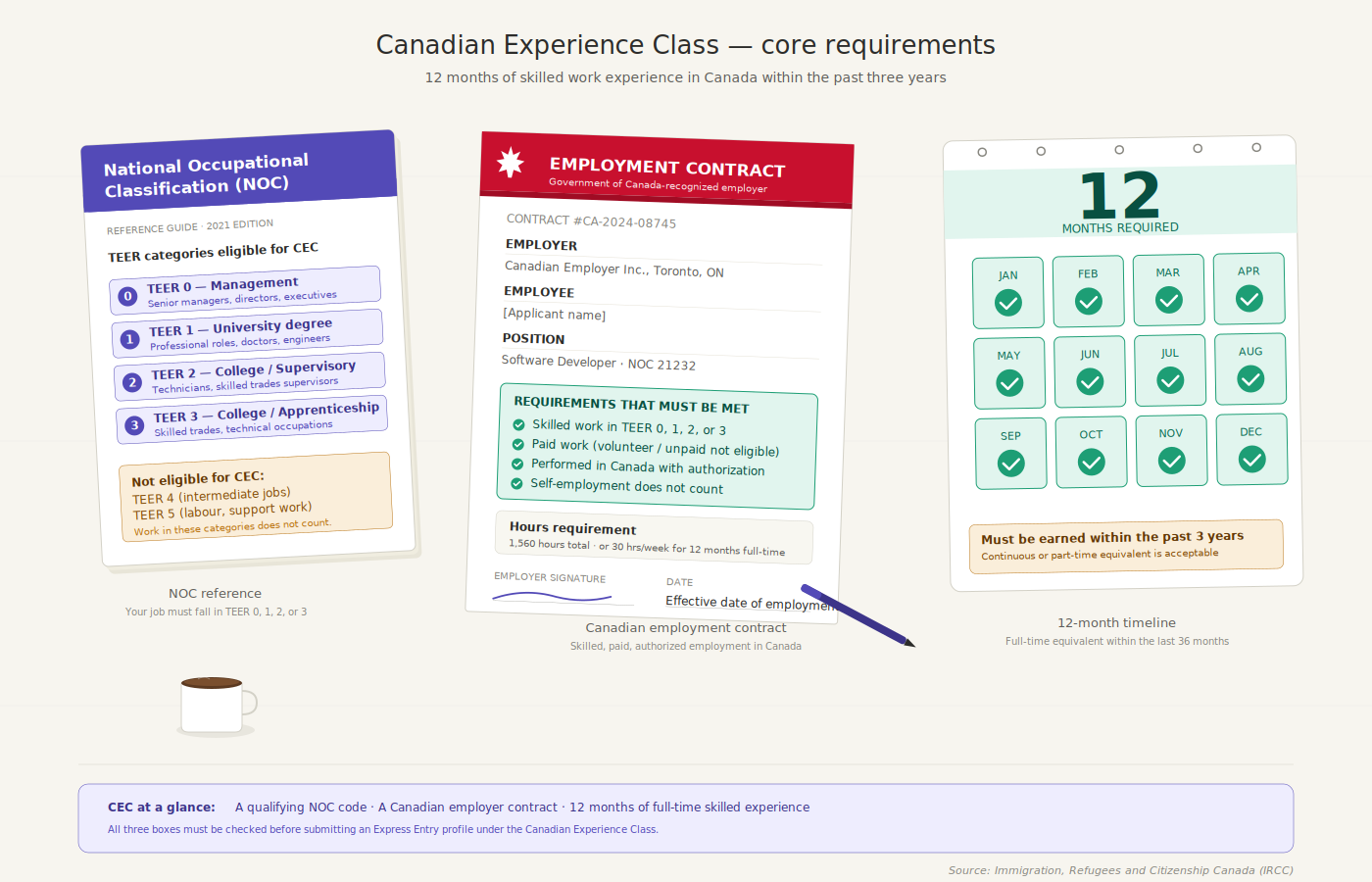
You need twelve (12) months of full-time skilled Canadian work experience, or equivalent part-time hours adding up to 1,560, in the three (3) years before you apply. The work must be in NOC TEER 0, 1, 2, or 3. Language results must be CLB 7 for TEER 0 and 1 occupation, and CLB 5 for TEER 2 and 3 roles. You must be admissible to Canada. Self-employment, student work, and work outside Canada do not count. In some limited cases self-employed may still be eligible.
Everything below in this article is for you if you want to dive deeper into the four requirements mentioned above. If you do not meet any one of these requirements, you cannot apply through CEC. There are no exceptions.
How Does IRCC Count the 12 Months of Work?
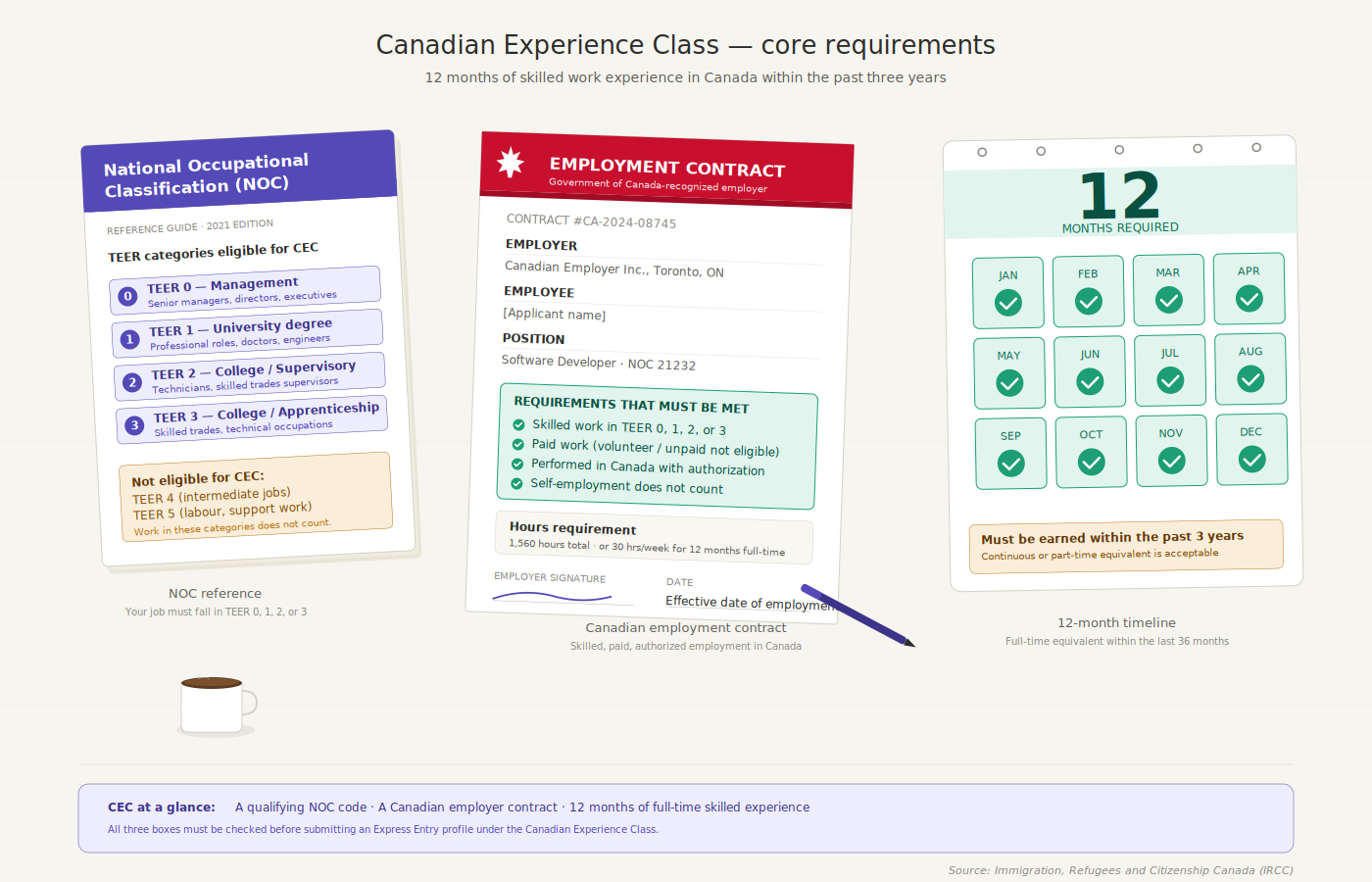
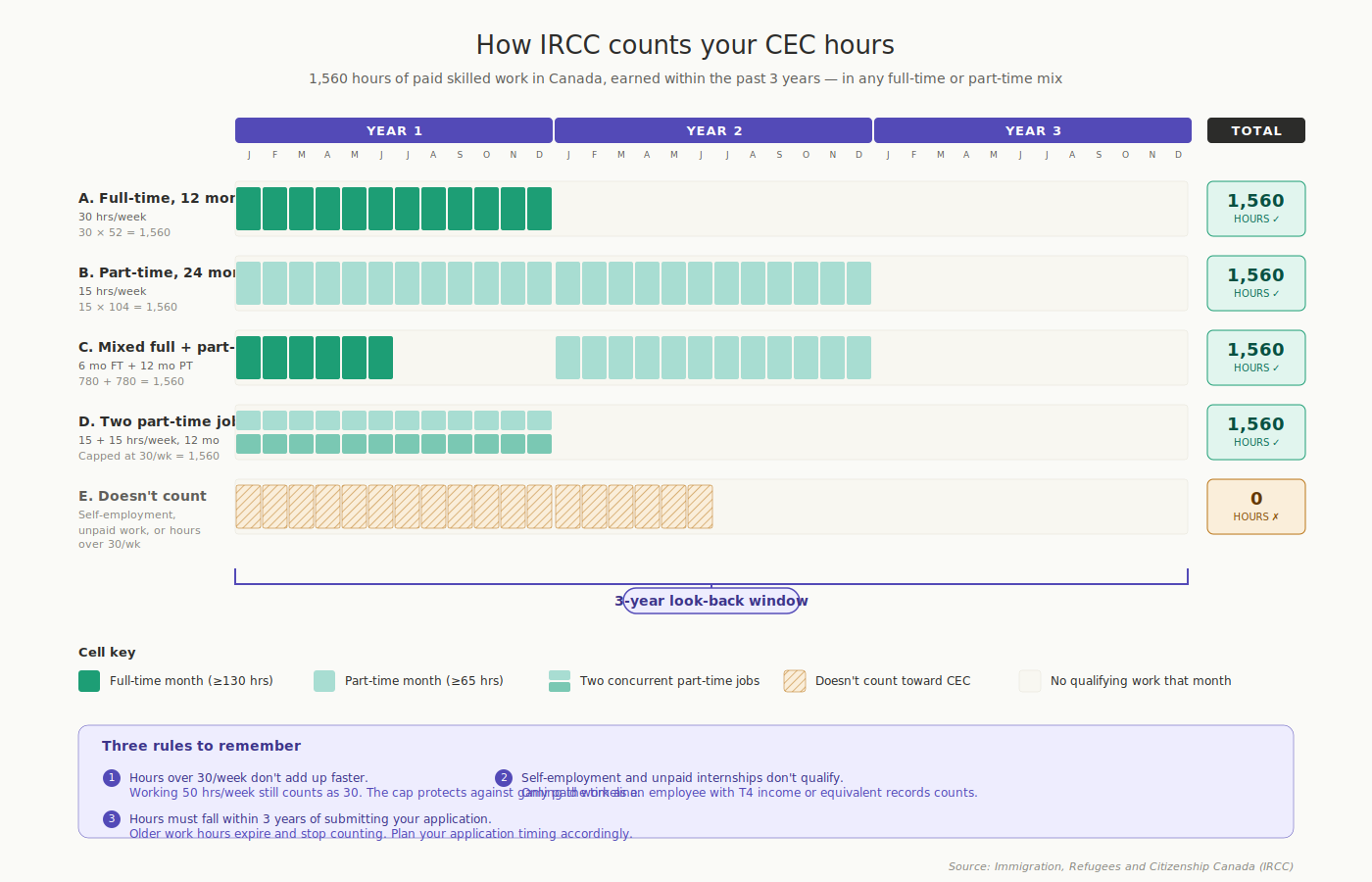
IRCC counts work experience as 1,560 paid hours in a three (3) year window before your application or Invitation to Apply (ITA). Full-time at 30 hours a week for 52 weeks equals exactly 1,560 hours. Part-time hours count toward the same total, and so do hours from multiple jobs running at the same time, as long as the total reaches 1,560.
But there is a cap. IRCC counts a maximum of 30 paid hours per week no matter how many employers you have or even when you worked more with only one employer. Overtime does not add any value.
Full-time work
Full-time means at least 30 paid hours per week. One year of full-time work meets the hour requirement on its own. Breaks between jobs are fine, as long as your paid hours still add up to 1,560.
Part-time work
Part-time work counts proportionally. Two 15-hour weekly jobs held for a year equal full-time for CEC purposes. You can also combine part-time stretches with full-time stretches. What matters is the 1,560-hour threshold.
The three-year window
IRCC only counts hours worked in the three years immediately before you apply. Anything older is disregarded, even if it was skilled or Canadian work experience. What this means is the twelve (12) months can be continuous or split, only while every counted hour falls inside that 36-month window.
Multiple employers are fine
You can reach 1,560 hours across multiple employers, sequentially or at the same time. Each employer must give you a reference letter that meets IRCC’s format requirements. The Express Entry document checklist article lists every field those letters must contain.
NOC TEERs Explained
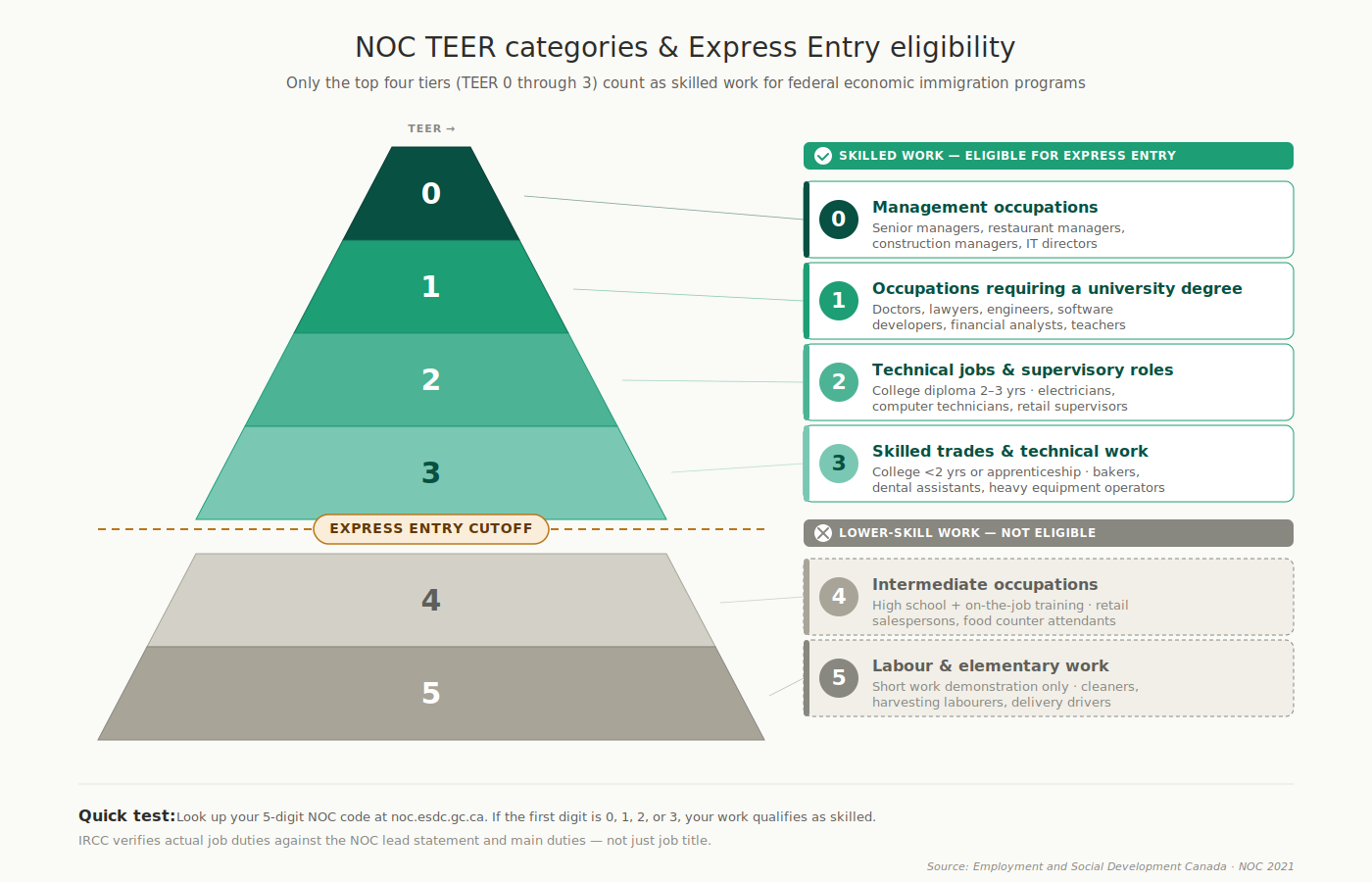
NOC TEERS are divided into five (5) different groups. TEER 0 are managerial positions, TEER 1 requires a university degree, TEER 2 covers technical occupations and skilled trades that usually require a college diploma or apprenticeship, and TEER 3 covers occupations that usually require college training or a shorter apprenticeship. For CEC, TEER 4 or TEER 5 do not qualify as these occupations usually require either a secondary school (high school) diploma or several weeks of on-the-job training.
How to verify your NOC
You can start by looking up your duties and comparing them with the NOC 2021 matrix on the Employment Social Development Canada (ESDC) web page. The match is based on duties performed; a role can fall anywhere from TEER 1 to TEER 4 depending on what your duties and responsibilities were. IRCC Officer reads your reference letter and decides based on the enclosed information whether you meet the requirements for that specific NOC TEER.
What Language Levels Does CEC Require?
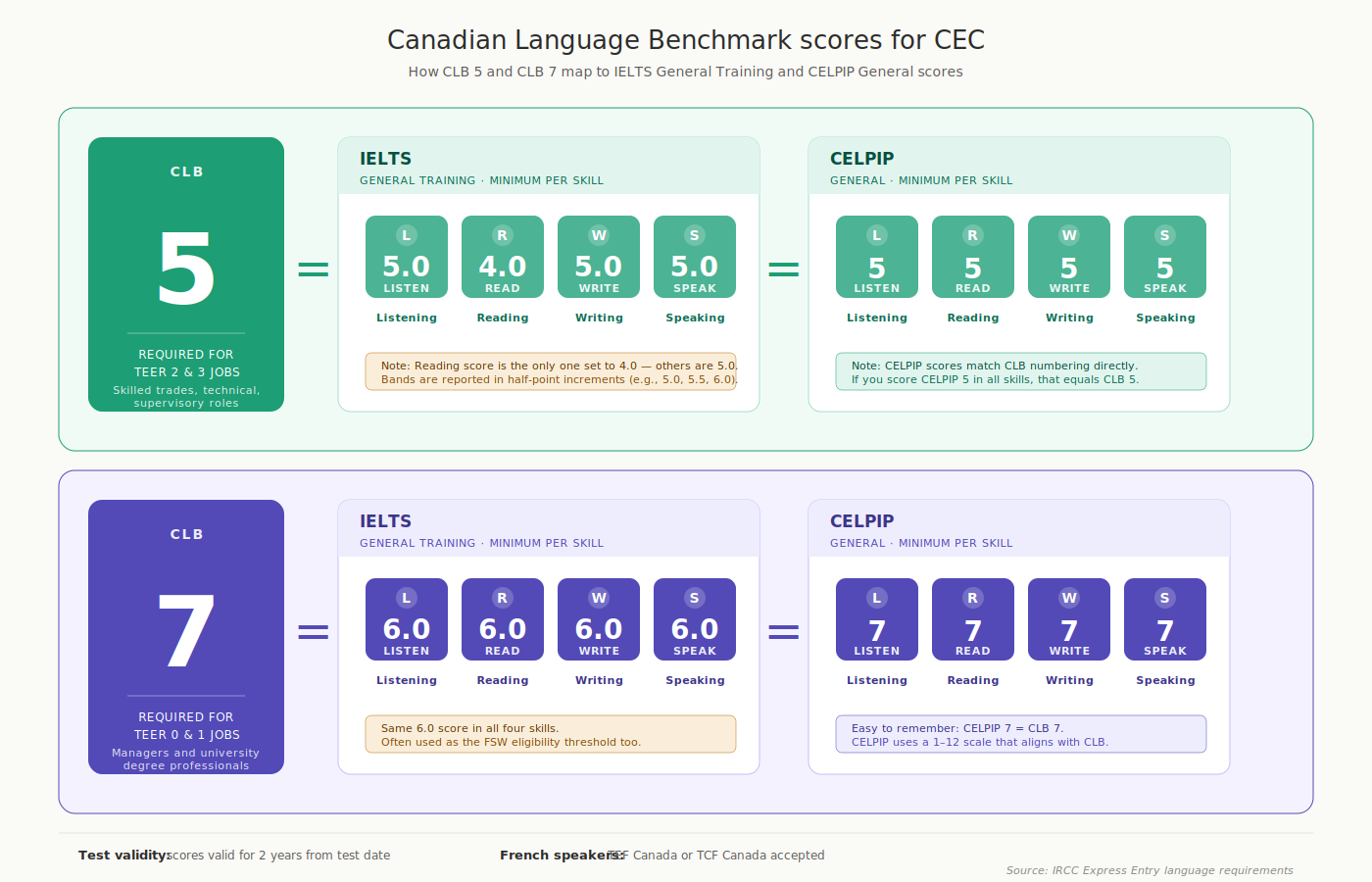
Language thresholds depend on the TEER level of your work experience. CLB 7 in all four abilities applies to TEER 0 and TEER 1 applicants. CLB 5 applies to TEER 2 and TEER 3 applicants. IRCC only accepts IELTS General, CELPIP General, TEF Canada, and TCF Canada results. (IRCC language requirements)
If you look at the official IRCC chart, CLB 7 roughly translates to IELTS 6.0 in each ability or CELPIP 7. CLB 5 to IELTS 5.0 in listening, reading, speaking, and 4.0 in Reading. Your results must be less than two (2) years old on the date you apply for your e-APR, not the date you create your EE profile.
If your TEER 0 or TEER 1 work puts you into CEC, but your language scores are as low as CLB 5, you do not meet the CEC requirements. The threshold follows the highest TEER level you claim in your profile, not the average.
Unsure what CLB you need for your NOC TEER? Book a CEC eligibility assessment with Mirzoyan Immigration. We will review your test scores, your job duties, and your hours before you create an Express Entry profile.
What Counts as “In Canada” for CEC?
“In Canada” means you were physically present in Canada while the paid work took place. You must have worked for a Canadian employer and have held a valid work permit or other authorization throughout your stay in Canada during the specific period you are claiming for CEC.
Typical Work Permits
Post-Graduation Work Permit (PGWP), employer-specific work permits issued under LMIA or LMIA-exempt streams, Global Talent Stream permits, and intra-company transferee work permits will all help you qualify for CEC. You must have been paid for the hours in question. Unpaid volunteer hours do not qualify.
What about remote work for a Canadian employer?
Remote work performed from outside Canada does not qualify for CEC, even if it is a Canadian employer and your pay is in CAD $. You must be physically present in Canada during the claimed period of your work experience to qualify for CEC.
What about cross-border commuters?
If you are a cross-border commuter (for example, living in the US and working in Windsor), you can still qualify as long as the work was performed physically in Canada and you were authorized to perform this work in Canada. Talk to an RCIC before claiming this as Canadian work experience.
What Types of Work Do Not Count?
Five scenarios that will disqualify you from the CEC 12-month requirement. Knowing them up front prevents application refusals that may trigger a five-year misrepresentation bar. Trust me, you do not want this surprise at the e-APR stage.
Self-employment
Self-employment does not count for CEC in most cases. IRCC excludes it because CEC requires a verifiable employer-employee relationship. Invoicing Canadian clients as an independent contractor is treated as self-employment for CEC purposes, even if you received T4A slips. There are, however, some exceptions. Talk to an RCIC before claiming this as Canadian work experience.
Work during full-time studies
Working while you were a full-time student does not count. That includes on-campus and off-campus work authorised under a study permit. Even if the work was skilled and in a TEER 0-3 occupation, it does not qualify. CEC hours only start once you move off the study permit to a PGWP or other work permit. Most study permits are given to international students on the basis that they are studying full-time and not part-time.
Co-op placements
If you needed to complete a Co-op work period to graduate as part of a study program, this period on the Co-op work permit does not help you to qualify for CEC. IRCC views them as part of the education, not standalone employment.
Unauthorised work
Work done without proper authorization does will not benefit you; in fact, it will do the opposite. That covers working before your permit was issued, working beyond permit limits, or working for an employer not listed on an employer-specific permit. Claiming unauthorized work experience also risks a misrepresentation which can result to upwards of five (5) year ban.
Period older than three years
Hours worked before the three-year window do not count, no matter the amount. You can still include older than three (3) years of work experience for CRS points, but not to meet CEC eligibility.
Admissibility Requirements
The fourth requirement is admissibility. You must not be inadmissible on grounds of criminality, security, health, misrepresentation, or financial reasons. Most CEC applicants clear admissibility easily because they already live in Canada on a valid permit. But three flags trigger closer review: any prior visa refusal, Canadian or foreign, any arrest or charge in any country, and any prior misrepresentation in Canadian applications.
If any of the listed above apply to your specific situation, you have to disclose them fully in your application with IRCC. Do not omit any information. Omission is the single most common trigger of a five (5) year bar on Canadian immigration. Our Express Entry pillar guide covers the misrepresentation rule in more detail.
Common Mistakes RCICs See Every Week
These four mistakes recur in CEC files that reach our offices for second opinions time and time again. Each one is a refusal if missed during the initial review stages.
Miscounting hours
Applicants add up every hour they worked, including hours past 30 per week. IRCC caps the paid hours to 30 per week. The correct count is the sum of capped weekly hours, not gross hours worked. I have reviewed many files where this single error made the difference between the applicant qualifying for their ITA or not and they end up having to withdraw their ITA.
Claiming TEER 00 work under a TEER 0, 1, 2, or 3 job title
A job title does not make the performed work fall under NOC TEER 00. Job duties trump over everything else. Before the job offer points changes, applicants would get 200 additional points for NOC TEER 00 and 50 additional points for NOC TEER 0, 1, 2 or 3. Some applicants claimed TEER 00 to receive the higher CRS, only to have IRCC reclassify the work at e-APR stage. The reclassification can drop the CRS score below the draw cut-off and have the application refused.
Counting PGWP time while also in school
Some applicants begin a second programme of study after a PGWP ends. Any paid work during that second programme does not count. CEC hours pause the moment you become a full-time student again.
Counting foreign work for a Canadian employer
As mentioned earlier, the work must be performed in Canada, on a valid status. This becomes challenging for remote workers and intra-company transferees who spent part of the qualifying year working from another country.
Worried a PGWP gap or a job reclassification might derail your CEC application? Book a program-eligibility assessment with Mirzoyan Immigration. Narek Mirzoyan, RCIC, will verify your TEER claim and hour count against IRCC’s standards before you apply.
Conclusion
CEC is unforgiving at the ITA stage. The rules are specific, and the refusals they produce could potentially trigger a five (5) year bar when misrepresentation is found. Understanding the right TEER, hours, and language requirements right before you create a profile is what separates a fast path to PR from a file that is refused.
Book a CEC eligibility assessment with Mirzoyan Immigration. Narek Mirzoyan, RCIC, will verify your TEER classification, count your paid hours correctly, confirm your language scores map to the right CLB, and flag any exclusion that might apply. Book your assessment.
Frequently Asked Questions
Does part-time work count toward the 12-month CEC requirement?
Yes. Part-time hours in a skilled occupation count as long as they add up to 1,560 hours inside the three (3) year window. IRCC caps paid hours at 30 per week, even when you worked more. Combining two part-time jobs running at the same time is also fine.
Can my work experience during studies count for CEC?
No. Work you did while you were a full-time student, on or off campus, does not count towards CEC. Only work performed while maintaining a valid work authorization qualifies. Co-op work terms done as part of a degree also do not qualify.
What TEER categories qualify for CEC?
CEC accepts Canadian work experience in NOC TEER 0, TEER 1, TEER 2, and TEER 3 roles. TEER 4 and TEER 5 do not qualify. TEER is decided by job duties and the required education qualification, not job title.
Why does self-employment not count towards CEC requirements?
IRCC excludes self-employment because CEC requires a verifiable employer-employee relationship. The programme is built around Canadian payroll and tax reporting as proof. Self-employed income, even with T4A slips, cannot be verified the same way.
Does work experience outside Canada count for CEC?
No. CEC only counts skilled work performed physically in Canada on a valid work authorization. Foreign work experience counts toward the Federal Skilled Worker programme instead. Remote work for a Canadian employer while living abroad also does not qualify for CEC.
How can we help?