CEC Eligibility Checklist: Do You Qualify In 2026?
Last updated: May 16, 2026 | Written by Narek Mirzoyan RCIC#R1005184 | Reviewed by Vahe Mirzoyan RCIC#R514223 at Mirzoyan Immigration
Table of Contents
Key Takeaways
TL;DR
How to Use This Checklist
Step 1: Valid Work Permit
Step 2: Paid Hour Count
Step 3: NOC TEER Classification
Step 4: Language Test CLB Match
Step 5: Exclusion Check
Step 6: Admissibility
Step 7: Reference Letter Readiness
Step 8: Decide on CEC or Alternative
Frequently Asked Questions
Key Takeaways
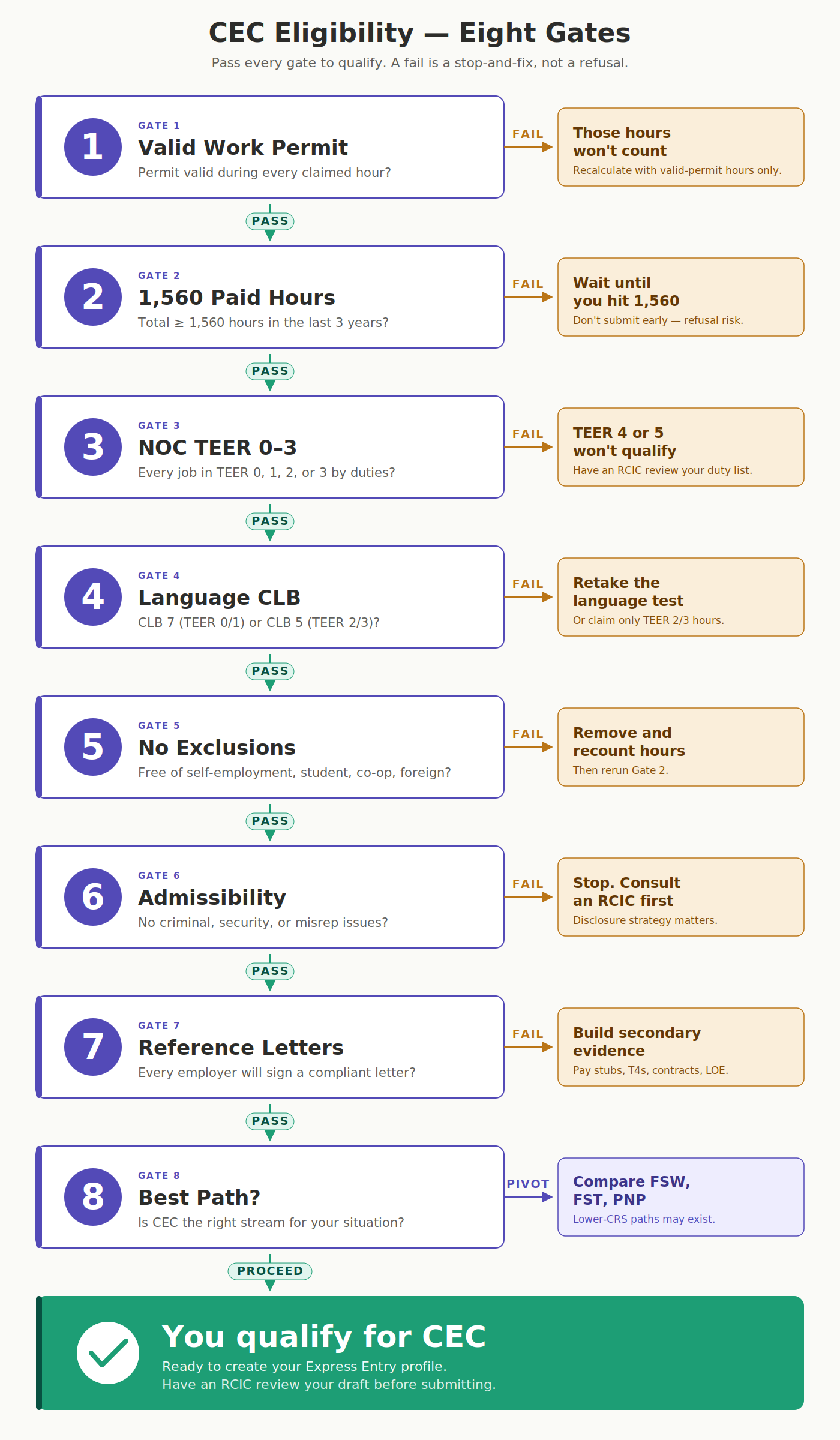
CEC eligibility comes down to eight specific steps. Pass all eight and you qualify.
The 1,560-hour count, the NOC TEER classification, and the language test CLB are the three steps that fail most candidates.
Self-employment, student work, co-op terms, unauthorized work, and foreign hours do not count. Claiming them anyway can trigger a refusal or a misrepresentation. Misrepresentation can have serious consequences.
A “maybe” on admissibility is a stop-and-consult signal, not a guess-and-submit signal.
Mirzoyan Immigration, led by Narek Mirzoyan, RCIC #R1005184, walks clients through all eight steps before they create an Express Entry profile. Fixing an eligibility error at a profile steps can be easily done. Fixing it after an ITA is not.
TL;DR
This eligibility checklist will provide you a quick answer whether you qualify for CEC or not. If you do not qualify, read the notes under each step.
How to Use This Checklist
Answer each question below with a simple yes or no. Do not guess. If you are not sure, click the citation and verify before you answer.
If you do not pass a question, stop and read the next-step note. Some fails mean that you are not eligible for CEC permanently and others mean you are not ready and need additional time to qualify. Keep a running list of what you passed, what you failed, and what you could not confirm. Bring that note to a consultation with a licensed Regulated Canadian Immigration Consultant (RCIC) for a final read.
Step 1: Did you have proper work authorization for the duration of the claimed CEC hours?
Every hour you plan to claim you must have worked while being in a possession of a valid Canadian work permit issued in the last three (3) years. You can only count the hours that fall inside the valid work permit issue and expiration dates.
-
Your permit was valid and authorized you to complete the work during this period. Move to Step 2.
-
Your permit was expired, restricted to a different employer, or never issued. Those hours cannot be counted for CEC.
Step 2: Do Your Paid Hours Add Up to 1,560?
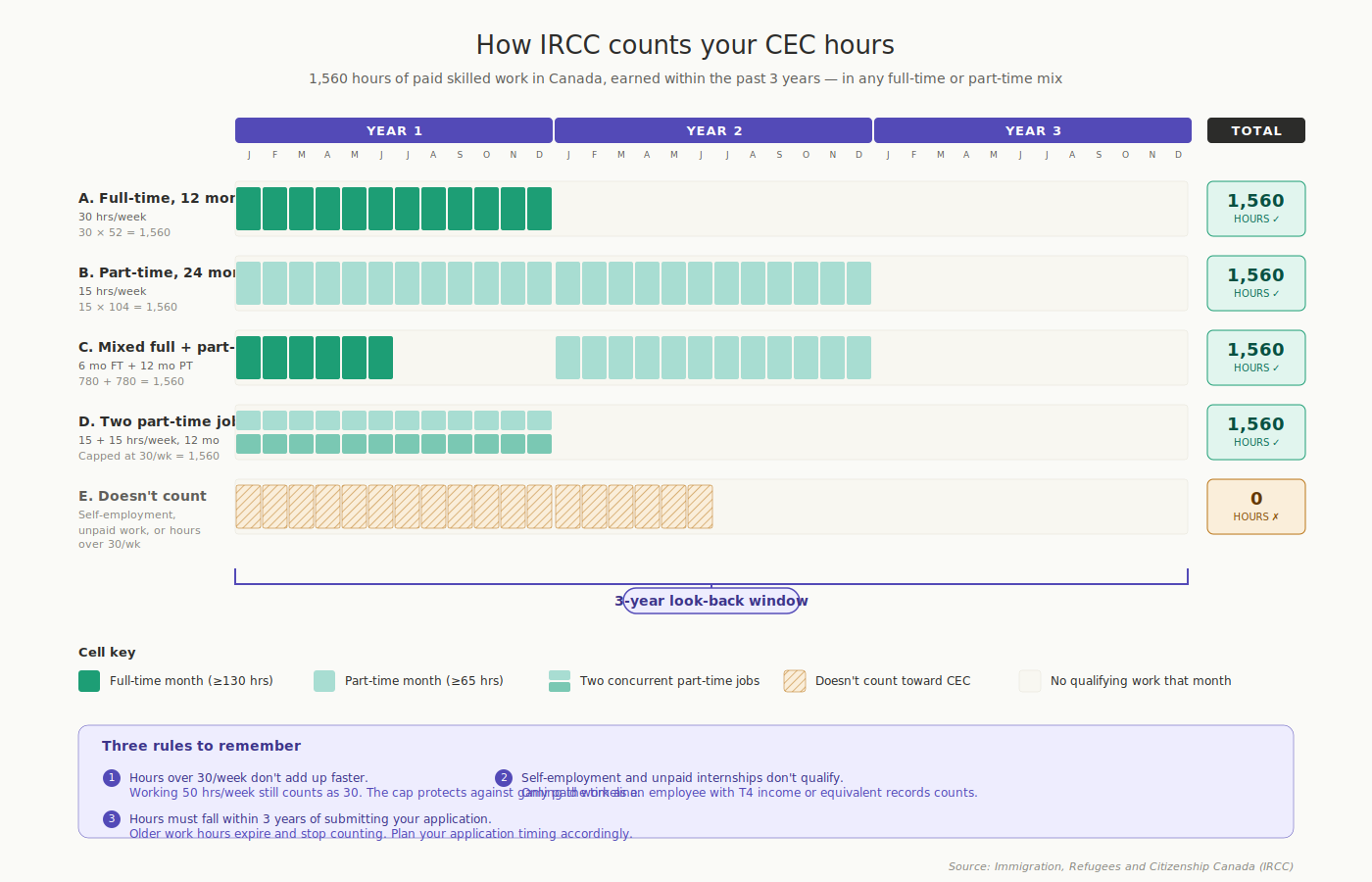
Your paid hours total at least 1,560 within the last three (3) years before the day of your ITA or EE portal creation. IRCC caps the worked hours at 30 paid hours per week, even when you worked 50. (IRCC CEC work experience rules) Full-time continuous work adds up to 1,560 in 12 months.
-
You have 1,560 or more paid hours of skilled Canadian work in the last three (3) years. Move to Step 3.
-
You are short of the 1,560 hours.
Step 3: Is Every Job You Plan to Include at NOC TEER 0, 1, 2, or 3?
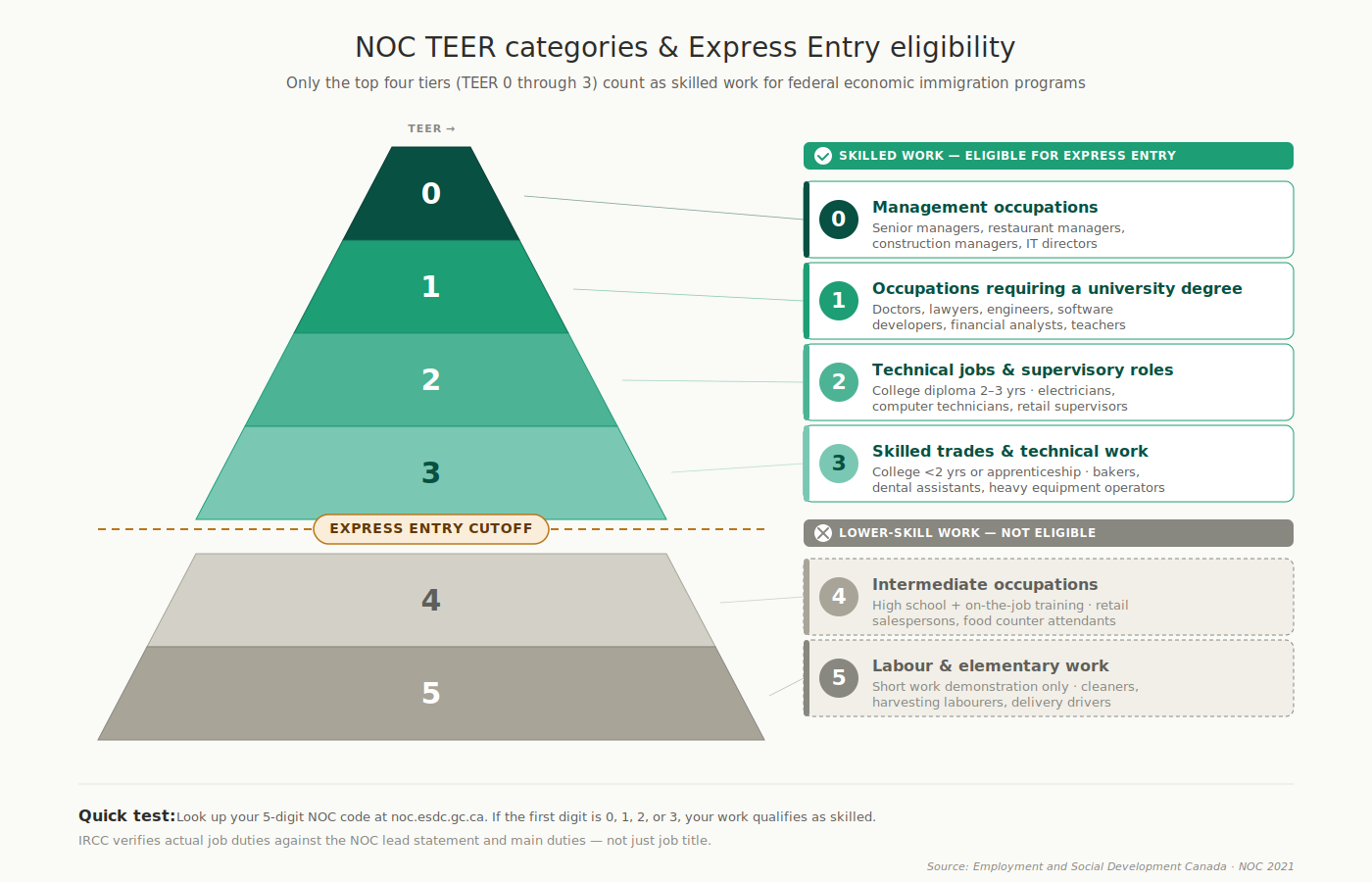
Check each job NOC TEER separately. The same job title can fall into different TEERs depending on the duty list. A NOC review by an RCIC before you create the profile is worth the fee. I have seen too many e-APRs refused because the applicant picked the wrong NOC at profile stage and the duties on the reference letter did not back them up.
-
Every job you want to claim matches a TEER 0, 1, 2 or 3 NOC by duty. Move to Step 4.
-
One or more jobs are TEER 4 or TEER 5. Or you cannot find a TEER 0, 1, 2 or 3 NOC which duties match your duties and responsibilities.
Step 4: Does Your Language Test Meet the CLB Threshold?
Yes if you hold a valid result in IELTS General, CELPIP General, TEF Canada, or TCF Canada. You need CLB 7 in all four abilities for TEER 0 and TEER 1 NOCs. You need CLB 5 in all four abilities for TEER 2 and TEER 3 NOCs. The result must be less than two (2) years old on the day you submit your e-APR. (IRCC language requirements for Express Entry). Most candidates I work with who miss CLB 7 benchmark but are close, clear it after two or three weeks of focused prep, and writing is usually the section that fixes the score. If retesting is not realistic, check whether your TEER 2 or TEER 3 hours alone reach 1,560. CLB 5 may be enough.
-
You meet the CLB threshold for the highest TEER level you are claiming. Move to Step 5.
-
Your score is under CLB 7 (claiming TEER 0 or 1 NOC) or under CLB 5 (claiming TEER 2 or 3 NOC).
Step 5: Does Any Claimed Work Period Meet a CEC Exclusion?
Five exclusions apply to CEC: self-employment, work done while being a full-time student, co-op work, unauthorised work, and work performed outside Canada. (IRCC CEC “who can apply” guidance). Remove these excluded hours and run Step 2 again. If you fall under 1,560, you do not meet the CEC requirements for now. And another common mistake is unauthorized work: claiming it on your PR file carries serious consequences. You may end up receiving a five (5) year misrepresentation bar. Speak with a consultant if this is the case in your situation.
-
None of your claimed hours fall into the above exclusions. Move to Step 6.
-
Some or all of your claimed hours are excluded.
Step 6: Are You Admissible to Canada?
If you have no criminal, security, medical, misrepresentation, or financial issue on your record you are NOT inadmissible. (IRCC inadmissibility overview) Three common issues raise red flags with IRCC include prior refusals in any country, any arrest or charge in any country (even a withdrawn one), and any earlier misrepresentation in any IRCC application.
-
If none of the issues outlined above apply to you, or you already declared them honestly on past Canadian applications. Move to Step 7.
-
You have an issue and you do not know how to disclose it. Do not self-diagnose admissibility. And do not ask a friend who applied last year. Book an RCIC consultation before you file anything. A clean disclosure strategy is the difference between a delayed file and a five (5) year bar from Canada.

Step 7: Can You Get Compliant Reference Letters?
Will you be able to provide a reference letter from every employer you want to claim to include the company letterhead listing your job title, duties, salary, paid hours per week, and exact employment dates? IRCC significantly scrutinizes reference letters and this may be a reason for refusal if they are incomplete.
-
Each employer you plan to claim will issue a compliant letter. Move to Step 8.
-
At least one employer refuses to sign, cannot list the full detail, or has gone out of business. For employers that are out of business or unresponsive, secondary evidence is usually required to strengthen the application. IRCC’s supporting-document guidance describes employment evidence, including employer reference letters. Check your program’s checklist for the requirements that apply to your application.
Step 8: Should You Choose CEC, or Another Stream?
You passed Step 1 through 7. You are eligible for CEC. The last decision is whether CEC is the right path to PR for you.
In some select situations, it may be a better idea to apply through another stream rather than CEC. Since the start of 2026, the CRS scores for CEC draws have been very high and not many qualify solely based on CEC and at times, category-based draws are far easier to qualify for based on their lower CRS draws. At other times, clients reach out to us where they qualify for CEC and Spousal Sponsorship and they want to find out which is the right path for their situation. There is no one correct path for all, it is all dependent on your specific situation.
Conclusion
A 30-minute self-check saves you the cost of a refused PR application. Every step above maps to specific reason CEC files get rejected at the e-APR stage. Working through them before you create an Express Entry profile will provide you with a peace of mind.
Book a CEC eligibility assessment with Mirzoyan Immigration. I will walk you through all eight steps with your actual documents in front of us. You will leave the call knowing whether you qualify today, when you will qualify, or which alternative stream fits your file. Book your assessment.
Frequently Asked Questions
I’m 11 months short on Canadian work experience. Can I apply anyway?
No. CEC requires the full 1,560 hours (12 months full-time equivalent) inside the three (3) year window. Submitting at 11 months will result in a refusal. Wait until you reach the threshold, then file with a reference letter dated after your 12-month period.
Can I combine multiple part-time jobs to reach 1,560 hours?
Yes. Part-time hours from one or several Canadian employers count toward the 1,560-hour threshold. The jobs can run sequentially or at the same time. Each employer must issue a compliant reference letter, and every claimed hour must be skilled (TEER 0, 1, 2, or 3).
Can I start preparing my CEC profile before I hit the 12-month mark?
Yes. Book your language test, ask your employers to prepare your reference letters, and gather your supporting documents now.
If I fail the language test once, can I retake it?
Yes. Language tests can be retaken as many times as you need to clear the threshold.
Can I switch to FSW if I don’t qualify for CEC?
Once in the pool of candidates and qualify for both FSW and CEC, IRCC will provide you with an ITA based on your highest score in the two categories.
How Can We Help You?