Express Entry Document Checklist 2026: What IRCC Wants
Last updated: May 16, 2026 | Written by Vahe Mirzoyan RCIC#R514223 | Reviewed by Narek Mirzoyan RCIC#R1005184 at Mirzoyan Immigration
Table of Contents
Key Takeaways
TL;DR
What Are the Three Document Stages?
Which Language Tests Does IRCC Accept?
Do I Need an Educational Credential Assessment (ECA)?
What Must a Reference Letter Contain?
Which Countries Need a Police Certificate?
When Should You Do the Medical Exam?
Who Needs Proof of Settlement Funds?
Identity Documents and Photos
What Counts as a Certified Translation?
Frequently Asked Questions
Key Takeaways
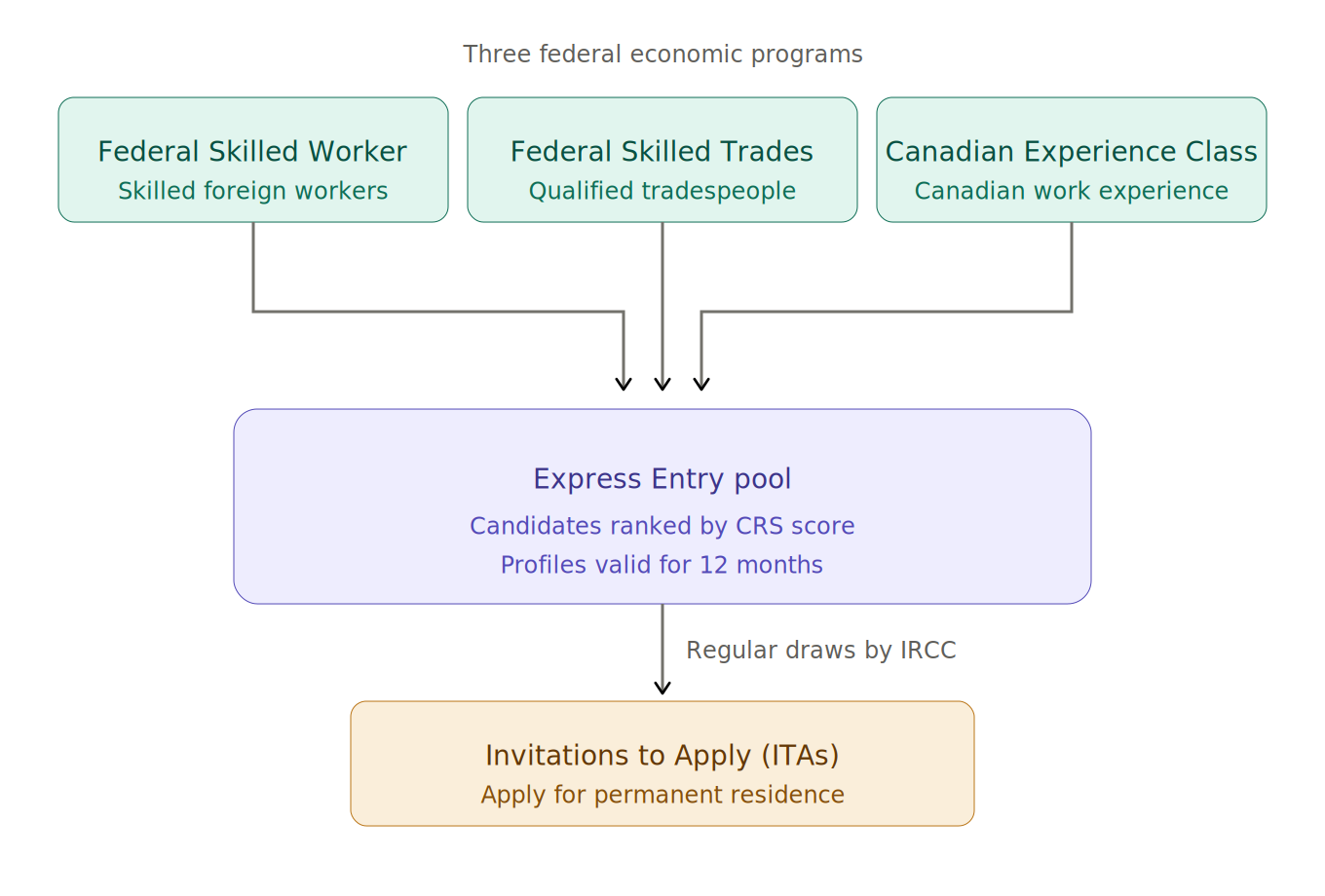
Express Entry documents arrive in three (3) stages. Your initial profile covers the language and nomination. ITA covers the full stack of documents which need to be submitted within the 60 day window. Post-submission covers biometrics and sometimes a follow-up medical.
Language results, ECA, reference letters, police certificates, and proof of funds are the five most common reasons why applicants are refused.
Reference letters on company letterhead with every required field are the biggest determinant of e-APR success.
Any document not in English or French needs a certified, notarized translation paired with the original.
Mirzoyan Immigration, will audit every document against IRCC’s 2026 requirements before submission. A quick fix before the portal creation costs an hour. An e-APR refusal costs months and sometimes the ITA itself.
TL;DR
Every Express Entry candidate needs a valid language test from one of four IRCC-approved providers. You also need a valid passport, a digital photo, and the full list of documents required to be uploaded at the ITA-stage. These documents cover everything from work history, education, police certificates, medicals, and (for FSW or FST applicants without a job offer) proof of funds. Foreign education needs an ECA, typically done from WES. Each employer needs a reference letter on a letterhead. Anything not in English or French needs a certified translation. Everything goes in during this 60-day window. Organized submission of documents at this stage are the single biggest predictor of fast Express Entry processing time.
You opened your IRCC account, saw the Invitation to Apply, and a 60-day clock is now running. Every Express Entry e-APR is only as strong as the documents you upload in the portal. Miss a single item, or upload one that fails IRCC’s format rules, and your file stalls or worse, it gets refused. This guide lists every document IRCC expects in 2026 and what each must contain.
For the broader process, see the Express Entry pillar guide. For program eligibility, see the FSW vs CEC vs FST comparison article.

What Are the Three Document Stages?
Express Entry documents arrive in three waves. Profile stage covers language results and any provincial nomination, with no uploads. ITA stage has a 60-day window and requires the full document pack. Post-submission you need to complete your biometrics and respond to any procedural-fairness letters that are issued by IRCC after your file is submitted for processing.
At the profile stage, IRCC asks for language scores, education level, work history entries, and any PNP nomination (if applicable). What you enter has to match what you upload later. If your profile shows five (5) years at a job and your letter shows four (4), that is a problem.
At ITA stage, seven classes of documents go into the portal:
Reference letters for every work history entry.
Full education credentials with ECA where required.
Police certificates for every country you lived in for six (6) or more months since turning 18.
Upfront Medical exam results.
Proof of funds, for FSW and FST applicants without a Canadian job offer.
Identity documents for you and any family members.
Digital photos for you and every family member.
After submission, biometrics are completed once you receive the Biometrics Instruction Letter. Each accompanying family member including you over the age of 14 must complete the biometrics. Medicals are typically done upfront, however if the processing takes longer than expected, be sure to expect IRCC to request for the completion of medicals again.

Which Language Tests Does IRCC Accept?
IRCC accepts four tests for Express Entry: IELTS General Training and CELPIP General for English, plus TEF Canada and TCF Canada for French. (IRCC accepted language tests) IELTS Academic and TOEFL are not accepted for permanent residence. Results must be less than two (2) years old when you submit your profile, and still valid when you submit your e-APR.
What this means is your test cannot expire mid-process. If your IELTS is at 22 months when you receive your ITA, you must book a new exam before you submit your application. Do not gamble on a test which expires two days before AOR.
English test options
IELTS General Training is the most common. CELPIP General is computer-based and faster to book in most Canadian cities. Both map to the Canadian Language Benchmark (CLB) scale.
French test options
TEF Canada and TCF Canada are both accepted, with TEF the more widely taken. Both map to the Niveaux de compétence linguistique canadiens (NCLC), the French equivalent of the CLB.
Test score minimums
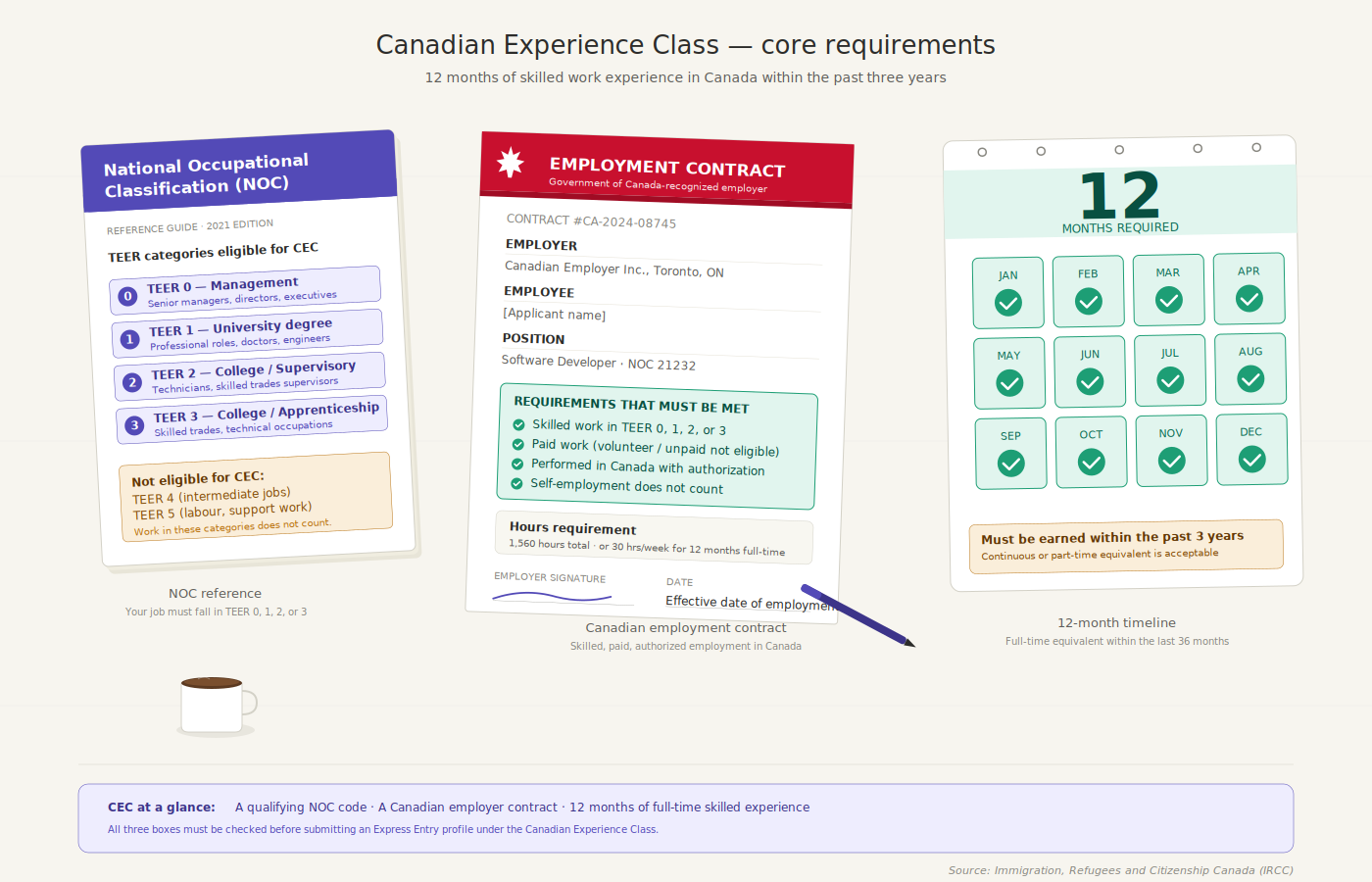
Minimum CLB varies by program. FSW needs CLB 7 in all four abilities. CEC needs CLB 7 for TEER 0 and 1 jobs, CLB 5 for TEER 2 and 3. FST needs CLB 5 in speaking and listening, CLB 4 in reading and writing. For how scores drive CRS points, see the CRS score explained article
Do I Need an Educational Credential Assessment (ECA)?
You need an ECA if your education is from outside Canada and you are applying under FSW. You also need one if you are claiming education points under CEC or FST. The ECA must come from an IRCC-designated organisation. Canadian education from a Designated Learning Institution does not need one. ECAs are typically valid for five (5) years. (IRCC designated ECA organizations)
Designated ECA organisations
IRCC designates five general-education providers:
World Education Services (WES).
International Credential Assessment Service of Canada (ICAS).
International Qualifications Assessment Service (IQAS).
International Credential Evaluation Service (ICES).
Comparative Education Service (CES).
Two profession-specific bodies cover regulated occupations. The Medical Council of Canada (MCC) assesses physicians. The Pharmacy Examining Board of Canada (PEBC) assesses pharmacists. If you are in either field, a general provider will not work.
ECA processing times
Most ECAs take 20 to 35 business days once all transcripts and degree documents reach the provider. International courier adds another 5 to 10 business days. Start early. The most common reason an ITA gets rushed is a candidate who waited until the invitation arrived to begin.
ECA costs
2026 ECA fees run roughly CAD $220 to $280 for basic services, plus courier. Expedited service adds $50 to $100. The fee goes to the provider, not IRCC. (Based on April 2026 data.)
Canadian education does not need an ECA
Credentials completed in Canada at a Designated Learning Institution are accepted as-is. Submit transcripts and degree certificates directly.
What Must a Reference Letter Contain?
A compliant reference letter sits on company letterhead, is signed by someone with authority over your employment, and contains every required field IRCC specifies. In my experience, reference letters are the single most common cause of e-APR refusals at the ITA stage.
Required fields
Every Express Entry reference letter must include:
Your job title.
Main duties and responsibilities.
Paid hours per week.
Annual or hourly salary plus benefits.
Employment start and end dates.
Signing officer’s name and position.
Company’s full contact information.
If the role is ongoing, the letter should say so directly.
Formatting standards
The letter must be on printed company letterhead. Digital letters must come from a verifiable company email domain. Letters on plain paper, even if signed, get flagged. For digital letters, be sure to print it with a Gmail or Hotmail address. I do not typically recommend this for our clients.
What to do when the employer will not sign
Two fallback paths exist. The first is a letter from a peer or former manager who can attest to the duties. Pair it with secondary evidence: pay stubs, T4s, employment contract, offer letter, or company org chart. The second is a detailed statutory declaration explaining why the primary letter is unavailable. Both are weaker than a signed letterhead letter, but they can be a substitute when the employer is hostile or defunct.
Worried your reference letter will not clear IRCC review? Book a reference-letter audit with Mirzoyan Immigration. An RCIC will go through every letter field-by-field before you submit your e-APR.
Which Countries Need a Police Certificate?
You need a police certificate from every country where you lived for six (6) or more months since turning 18. When it comes to validity, it can get tricky. This is country specific. In some situations if you have not been in that specific country since the PCC was obtained, IRCC may still accept the PCC. (IRCC police certificate requirements)
How to get a Canadian police certificate
RCMP criminal record checks are the standard Canadian source. Electronic checks return in 3 to 5 business days. Fingerprint checks take longer, sometimes weeks.
How to get foreign police certificates
Each country runs its own process. Some, like the US and UK, are online and fast. Others require an in-person consular application and take weeks or months. I have seen clients lose days here purely because they did not start the request the day the ITA arrived. Refer to IRCC’s PCC guidelines to find out your country’s requirements.
What to do if a certificate is delayed
Upload proof that you requested it. Receipts, reference numbers, and confirmation emails all count. IRCC will accept the proof and wait for the final document. Submitting without any proof risks refusal. Do not assume IRCC will be lenient.

When Should You Do the Medical Exam?
Every applicant and every accompanying family member must be examined by an IRCC-approved panel physician. The physician sends the results directly to IRCC. You walk out with an IMM 1017B receipt, which is the document you upload in the portal.
When to do the medical
The good news is you control the timing. Most candidates do the medical upfront, right after the ITA. Upfront medicals save weeks. If you wait for IRCC to request one, the request typically adds 4 to 8 weeks before your file is processed again.
Medical cost
Costs vary by physician and city. Adults generally fall in the CAD $200 to $450 range, plus a chest X-ray. Children’s exams run CAD $100 to $200. (Based on April 2026 data.)
Medical validity
Results are valid for 12 months. If your e-APR is still in processing past that window, IRCC may request a new exam. The longer your file lingers, the higher the chance you redo a medical you already paid for.
Who Needs Proof of Settlement Funds?
FSW and FST applicants need proof of settlement funds unless they have a valid Canadian job offer. CEC applicants never need it. The 2026 minimum for a single applicant is approximately CAD $15,262, rising with family size. Exact thresholds are published on IRCC’s page each year. (IRCC proof of settlement funds)
What counts as proof of funds
Official bank letters or statements covering the six (6) months immediately before e-APR submission. The letter must show your name, account numbers, currency, current balance, average balance, and any outstanding debts or loans.
What does not count
Property value does not count. Money in retirement accounts (RRSPs and foreign equivalents) does not count unless accessible without penalty. Loans taken to meet the threshold do not count. The funds must be liquid and unencumbered.
What this means is a sudden $20,000 deposit a week before submission will draw a procedural fairness letter. IRCC reviews the full six (6) month window, not a snapshot. If you genuinely received a gift, document it with bank transfer records, a gift letter, and the donor’s bank statements.
Identity Documents and Photos
Every applicant and every family member needs a valid passport plus a digital photo that meets IRCC specifications.
Passport
Your passport must be valid at least six (6) months past the date of intended landing. Include a clear scan of the biographical page. If it expires inside that window, renew it before submission. You can alternatively renew your passport once the application has been submitted and provide IRCC with the updated passport by a Webform.
Digital photos
Photos must be taken within the six (6) months before submission. IRCC specifies exact dimensions, background, and facial expression. A professional passport photographer produces compliant files faster than a home setup.
Marriage and birth certificates
Marriage certificates for married applicants. Birth certificates for dependent children. Divorce decrees for any previous marriages. Each supports the family information declared in your profile.
What Counts as a Certified Translation?
A certified translation is signed by a qualified translator and accompanied by a notarised declaration of accuracy. Any document not in English or French needs one. The translation, original, and notarised declaration travel together in the same upload. (IRCC translation requirements)
What “certified translation” means
A certified translation has three parts: the original document, the translation into English or French, and the translator’s signed declaration confirming they are qualified and the translation is accurate. The declaration must be notarized.
Who can translate
A member of a recognised translators’ association (ATIO in Ontario, OTTIAQ in Quebec, and similar provincial bodies) can certify directly. A non-member can translate and have the translation notarized by a notary public.
What does not need translation
Standard bilingual documents do not need translation. Documents originally issued in both English and French, or in one of those alongside another language, are accepted as is.
Not sure which letter, certificate, or translation will trip you up? Book an Express Entry document-pack review with Mirzoyan Immigration. An RCIC reviews every file against the 2026 IRCC checklist before you submit.
Conclusion
Strong document organization is where Express Entry candidates become approved permanent residents and candidates who rush their documents typically end up having their applications. Almost every refusal I see at second-opinion stage traces back to the five (5) classes above. Missing reference letter fields. ECA missing. A police certificate from a country the candidate forgot they lived in. Proof-of-funds gaps inside the six (6) month window. Translations missing the notarised declaration.
Book a document-pack review with Mirzoyan Immigration. Narek Mirzoyan, RCIC # R1005184, will audit each document and flag any format, content, or timing risk. Verify credentials on the CICC public register, then book at mirzoyanimmigration.ca/contact.
Frequently Asked Questions
Do I need an ECA if I studied in Canada?
No. Canadian education from a Designated Learning Institution does not need an ECA. Foreign education needs an ECA from a designated organisation (WES, IQAS, ICAS, ICES, CES, plus PEBC for pharmacists and MCC for physicians). The ECA is needed if you are claiming education points or applying under FSW.
Which language tests does IRCC accept for Express Entry in 2026?
IRCC accepts IELTS General Training and CELPIP General for English. TEF Canada and TCF Canada for French. IELTS Academic and TOEFL are not accepted. Results must be less than two years old when you submit your profile and when you submit your e-APR.
What must an Express Entry reference letter contain?
An Express Entry reference letter must be on company letterhead and must include: your job title, main duties, paid hours per week, annual salary, employment start and end dates, the signing officer’s name and position, and company contact details. Missing any single field is a common refusal cause.
Can I submit my police certificate after I apply?
Yes and no. Police certificates are due at the time when you submit the e-APR. If a certificate is delayed by the issuing country, you upload proof of request and submit the final document the moment it arrives. Submitting without any proof of request risks refusal. There are some countries where they require an IRCC request before a PCC is issued, an example of that is Singapore.
How recent do my proof-of-funds documents need to be?
Proof of funds must cover the six (6) months immediately before the e-APR submission date. IRCC reviews the full six (6) month window, not a snapshot. Large unexplained deposits inside that window can trigger a procedural fairness letter asking for the source of funds.
How Can We Help?