Express Entry Draw Trends in 2026: Cut-Offs, Patterns, Types
Last updated: May 16, 2026 | Written by Vahe Mirzoyan RCIC#R514223 | Reviewed by Narek Mirzoyan RCIC#R1005184 at Mirzoyan Immigration
Table of Contents
Key Takeaways
TL;DR
How Does an Express Entry Draw Work?
What Are the Three Draw Types in 2026?
How Often Does IRCC Hold Draws?
What CRS Cut-Offs Have We Seen in 2024-2026?
Category-Based Draws Active in 2026
How to Read a Draw Result as a Candidate
Seasonality and the IRCC Draw Calendar
Why Past Draws Do Not Predict Future Draws
Frequently Asked Questions
TL;DR
Through 2024 and 2026, IRCC has run draws roughly weekly, alternating general rounds with category-based rounds. General draws were around 520 to 540 CRS. Category draws were anywhere between 70-150 points lower. There is no published schedule. Track the active category based list, confirm whether you qualify under one, and plan to have your profile active in the pool across several draw cycles.
You opened the IRCC news page on a Wednesday morning. You wanted to see if today’s draw cleared your CRS score. It did not. Now you are asking whether to wait, retake your IELTS, or chase a PNP. That answer depends on reading the draw pattern correctly. This article will go over the 2024-2026 Express Entry draws in depth and explain what the numbers actually mean for your profile in 2026.
If you do not yet know what Express Entry is, start with the Express Entry pillar guide. If you want the math behind your score, read the CRS score explained article.
How Does an Express Entry Draw Work?
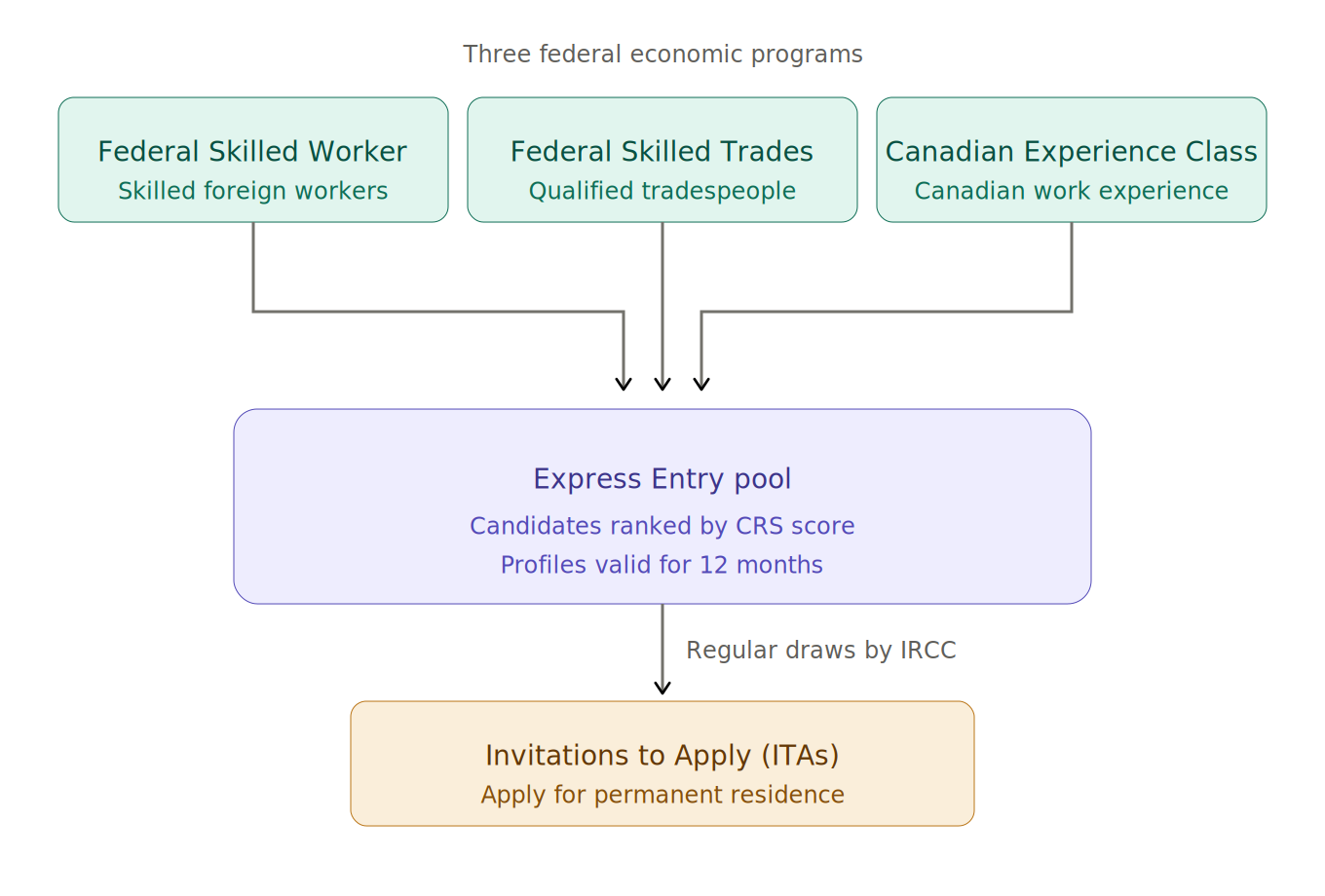
Every draw follows the same IRCC playbook. IRCC decides how many ITAs to issue and, for category draws, which category to target. The system filters the pool by eligibility and ranks every candidate by CRS. The cut-off is the score of the lowest-ranked candidate who still received an ITA. Anyone at or above that score gets the invitation in their online account within 24 hours. (IRCC Express Entry rounds of invitations)
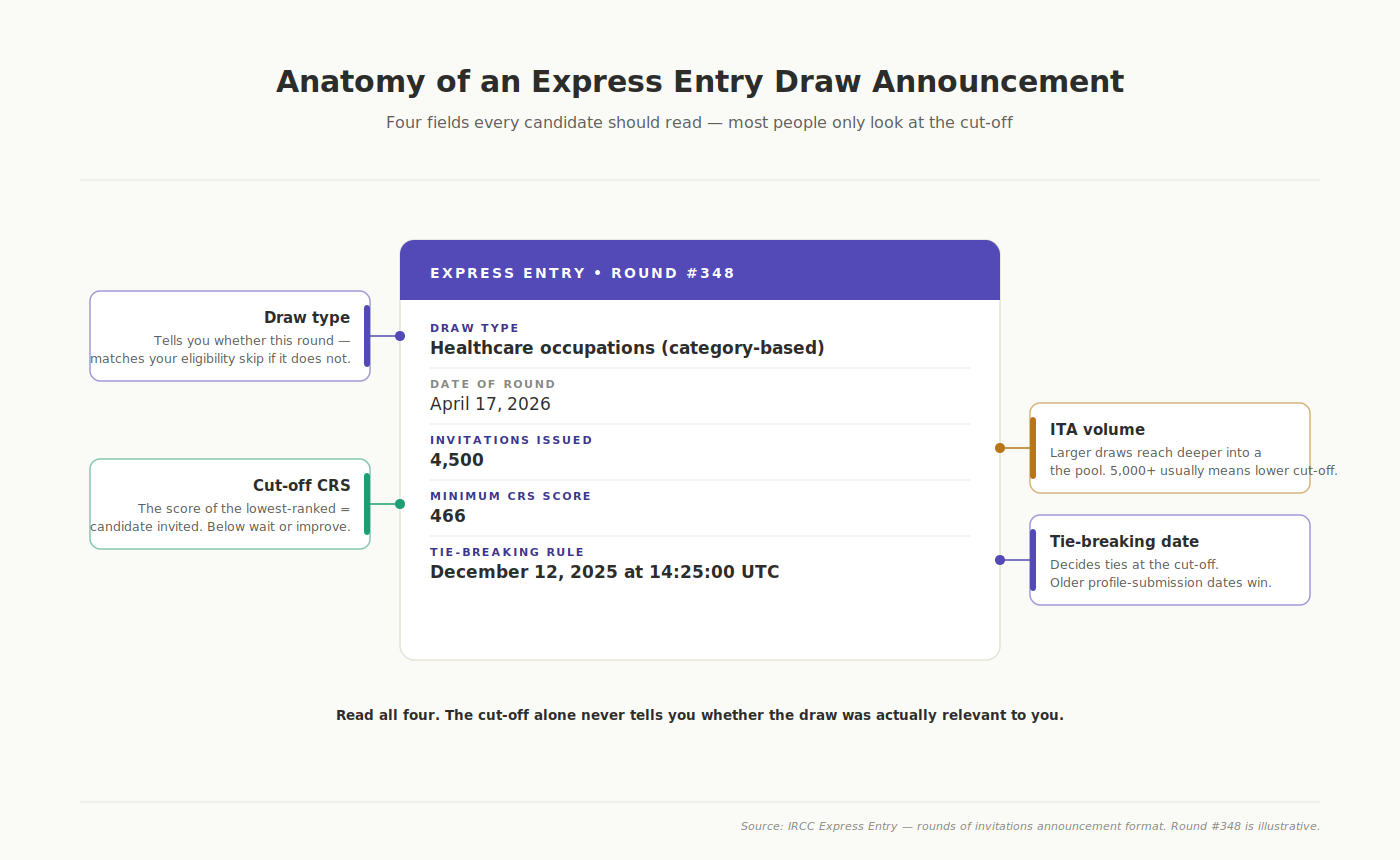
The draw results are published on the official IRCC website the same day. Each announcement lists four things: the draw type, the cut-off CRS, the number of ITAs issued, and the tiebreaker rule. The tiebreaker is a profile-submission date used when multiple candidates share the exact cut-off score. More on why that date matters later in this article.
What Are the Three Draw Types in 2026?
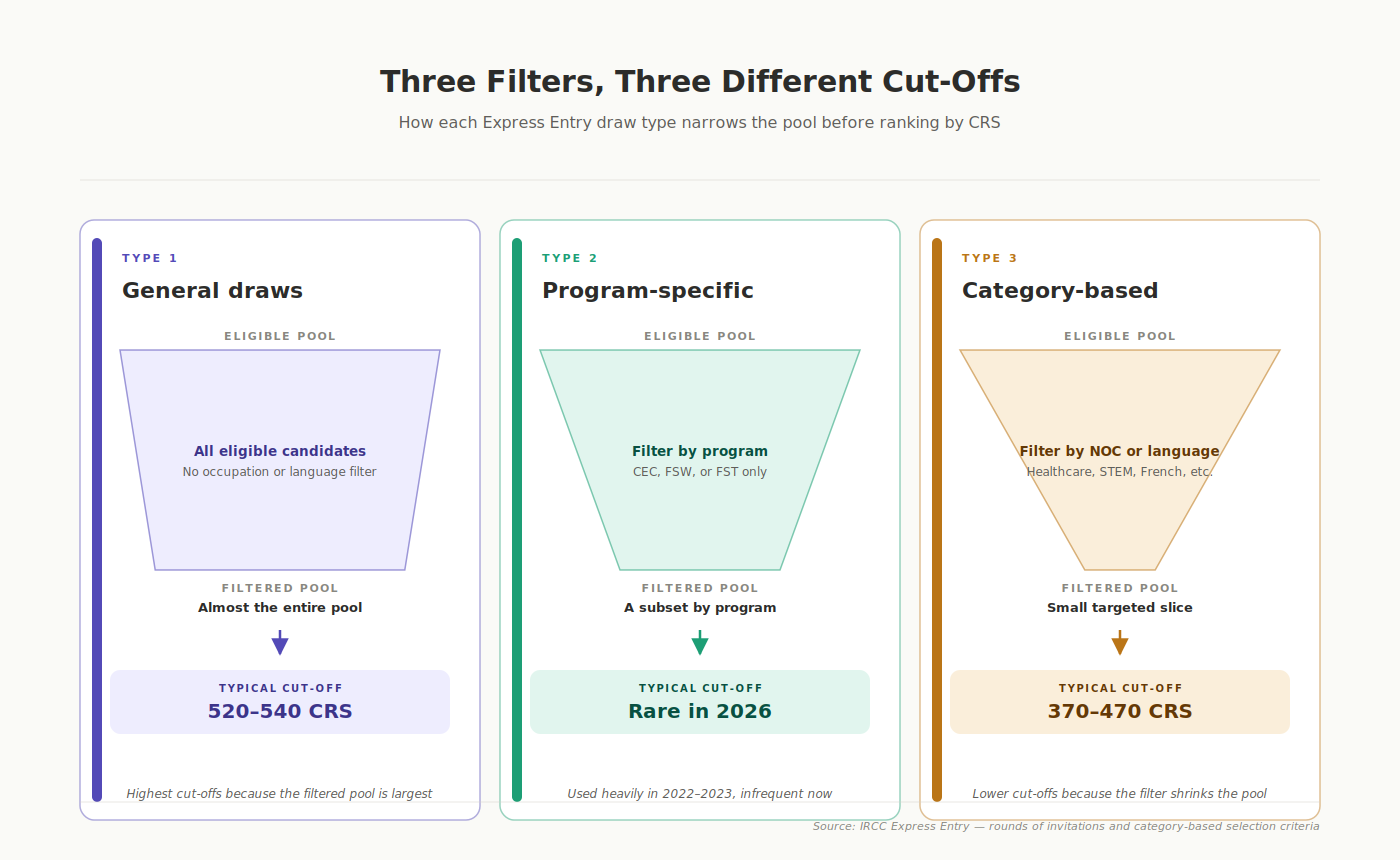
Express Entry runs three draw types in 2026: general draws, program-specific draws, and category-based draws. Each one applies a different filter to the pool before ranking candidates by CRS. Knowing which type targets your profile is the difference between waiting and waiting blind.
General draws
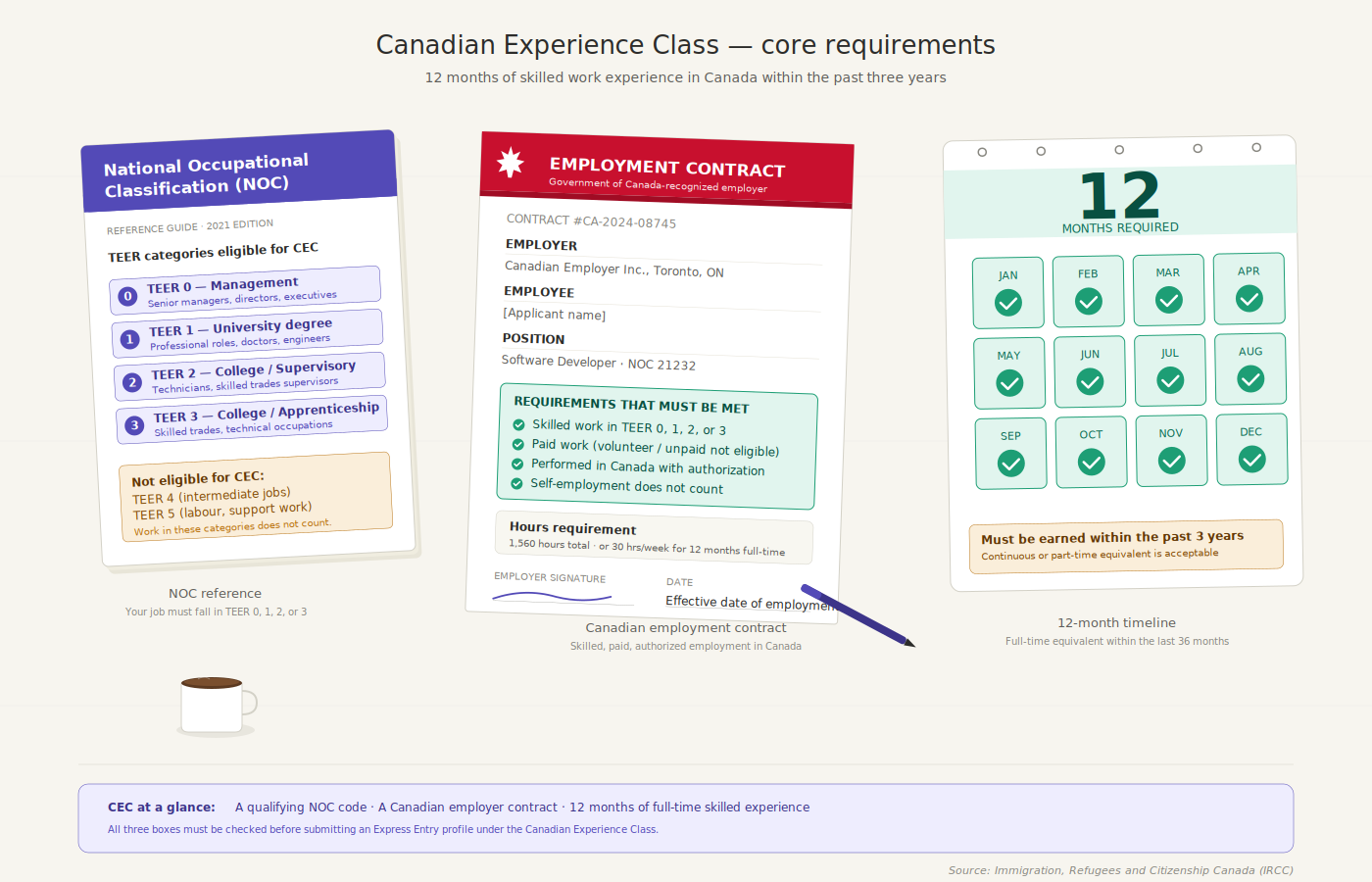
General CEC draws pull from every eligible candidate in the pool, regardless of program or occupation. The cut-offs are highest because the pool is unfiltered. In 2024-2025, general CEC draws commonly cleared between 520 and 540 CRS.
Program-specific draws
The program-specific draws filter to one of the three Express Entry programs (CEC, FSW, or FST) before ranking. IRCC leaned on these heavily in 2022-2023. In 2024-2026 they have largely been replaced by category draws and now appear infrequently.
Category-based draws
Category draws filter to occupations (French-language proficiency, healthcare, STEM, trades, education occupations, transport, physicians with Canadian work experience, Senior managers with Canadian work experience, researchers with Canadian work experience and skilled military recruits). The filtered pool is smaller, so cut-offs fall further. This is the draw type that has changed the math for candidates sitting in the 420-480 CRS range.
How Often Does IRCC Hold Draws?
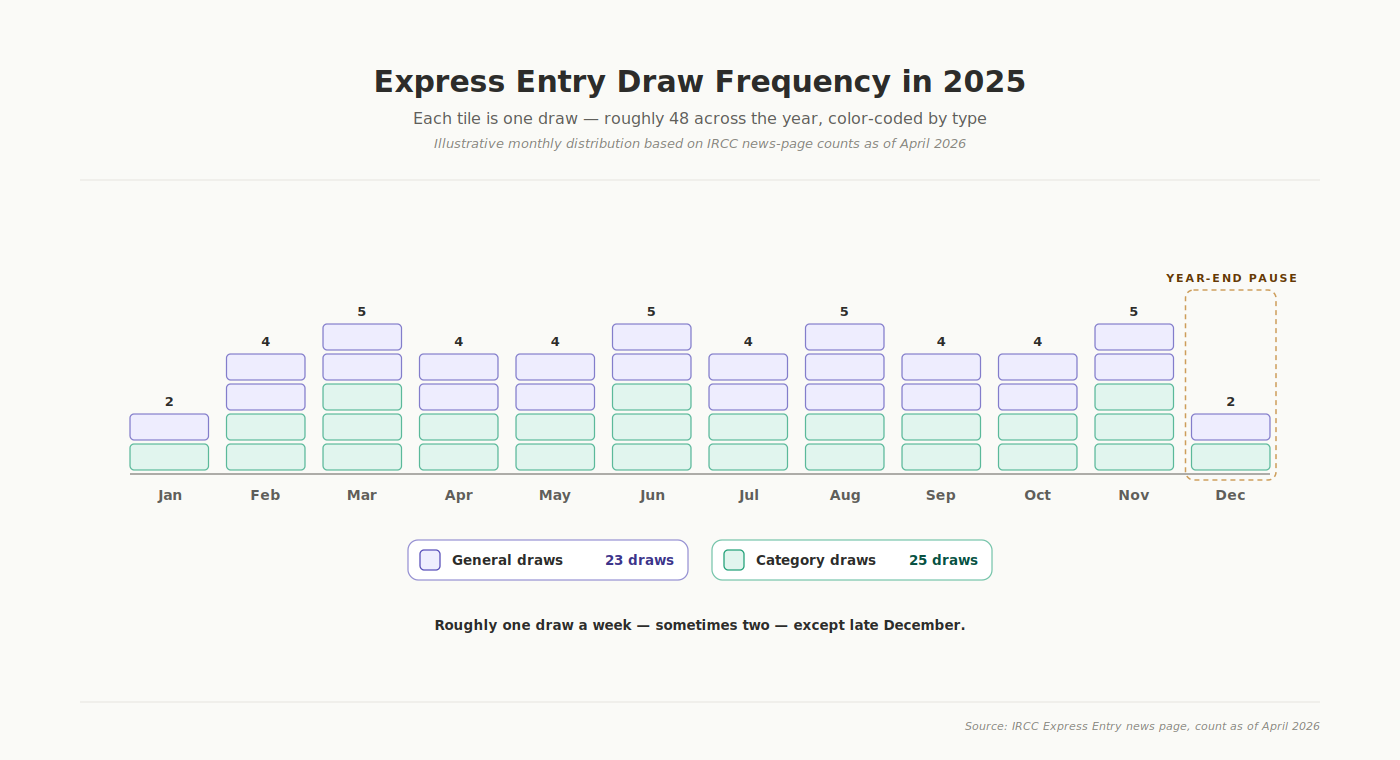
IRCC generally holds a draw every 7 to 14 days. Some weeks see two draws back to back, often a general followed by a category, or two categories on consecutive days. Some months are quieter, especially during policy-change periods. There is no fixed schedule and no pre-announced calendar. (IRCC Express Entry news page)
In 2024, IRCC held approximately 45 draws. In 2025, approximately 48. Those figures combine every draw type. The roughly weekly pattern is the most reliable expectation, but it is not a promise. (This figure is based on IRCC news-page counts as of April 2026.)
What CRS Cut-Offs Have We Seen in 2024-2026?
Recent cut-off ranges vary sharply by draw type. The story is in the gap between unfiltered general rounds and the targeted category rounds.
General draw cut-offs
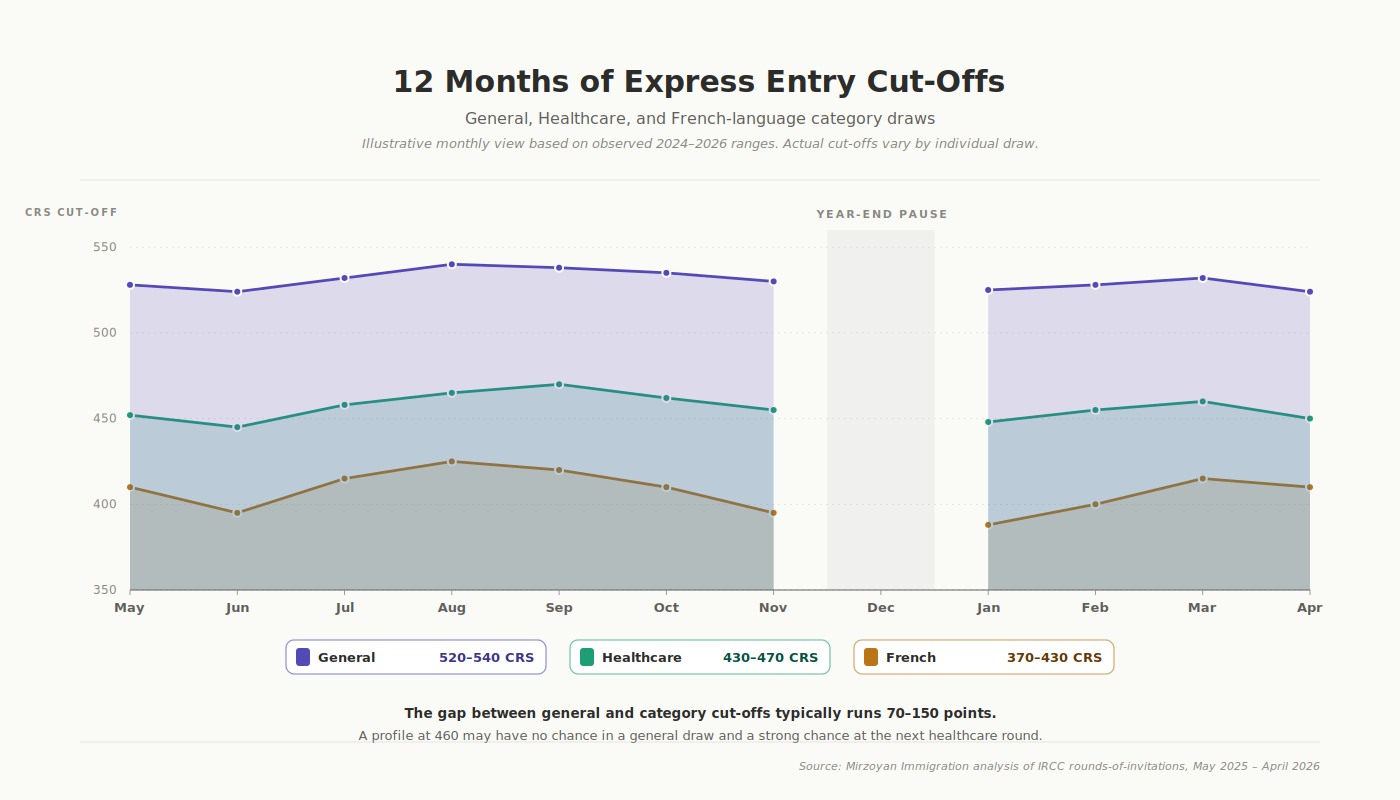
General draws in 2024-2026 typically cleared at 520-540 CRS. Cut-offs occasionally spiked at the end of a policy window, for example when IRCC cleared the pool before switching priorities. They dipped when a smaller ITA quota was issued.
Category draw cut-offs
Category draws are typically 70-150 points below general draws in the same week. Healthcare draws are at 430-470. Trades draws are at 420-460. Last STEM draw in 2024 had a cut-off at 491. Transport draws in 2024 were at 430. Last Agriculture draw cut-off was at 437. French-language draws cleared lowest, often 370-430.
PNP-targeted draws
PNP-targeted draws always sit at very high CRS (700+) because invited candidates already carry the 600-point PNP boost. These draws are essentially a processing convenience for already-nominated candidates. They are not a scoring race that other candidates can enter.
Category-Based Draws Active in 2026
IRCC reviews its category list each year based on labour market signals from Statistics Canada and Employment and Social Development Canada. The 2026 active categories are:
Strong French-language proficiency (NCLC 7+ across all four abilities).
Healthcare and social services occupations (physicians, nurses, personal support workers, dentists).
STEM occupations (software engineers, data scientists, civil engineers, mathematicians).
Skilled trades (welders, electricians, plumbers, heavy-duty equipment mechanics, carpenters).
Education (early childhood educators, elementary and secondary teachers).
Transport (truck drivers, transport truck drivers, aircraft mechanics).
Physicians with Canadian work experience (GPs and specialists).
Senior managers with Canadian work experience (NOC 00 TEER except – NOC 00010 and 00011).
Researchers with Canadian work experience (post-secondary teaching and research assistants and university professors and lecturers).
Skilled military recruits (Foreign Skilled Military Applicants).
Each category has its own NOC list. Do not guess which category covers your job title. Check your NOC through the IRCC category-based selection page before you build your strategy around it. NOCs move between categories year after year, and a NOC that qualified in 2024 will not always qualify in 2026.
Not sure whether your NOC qualifies for any 2026 category? Book a category-eligibility review with Mirzoyan Immigration. We will map your current and any future NOCs against every active category. You will know exactly which draws you can compete in before you make a decision.
How to Read a Draw Result as a Candidate
A draw announcement tells you four things: draw type, cut-off, ITA volume, and tiebreaker date. Each one means something different for your planning, and most candidates only look at the cut-off. That is a mistake.
Draw type
Did this draw target the category you qualify for? If yes, the cut-off gives you a real benchmark to beat. If no, this draw is largely irrelevant to your timing. Skim it and move on.
Cut-off
The cut-off tells you where you currently sit. If your CRS is at or above, you received an ITA. If you are below, you did not, and the size of the gap tells you whether the solution is patience or additional points.
ITA volume
Larger draws (5,000 or more ITAs) reach deeper into the pool and often carry lower cut-offs. Smaller draws (1,000 or fewer) are more selective. IRCC has varied volumes widely in 2024-2026 depending on processing capacity and annual targets.
Tiebreaker date
If your CRS exactly matches the cut-off, the tiebreaker decides who gets the ITA. Only candidates with profiles submitted before the tiebreaker date are invited. What this means is simple, you need to submit your profile as soon as you are eligible, even at a low score. An older profile beats a newer one at a tied score. I have seen clients lose an ITA by less than 24 hours because they delayed creating their profile.
Seasonality and the IRCC Draw Calendar
Two seasonal patterns show up clearly in 2024-2025 draw data. Both shape when you should expect movement and when you should expect silence.
Year-end pause
IRCC typically pauses draws in late December through early January. The last pre-Christmas draw usually lands in mid-December. The first January draw usually lands in week 2. If you receive an ITA late in the year, file your e-APR with the holiday processing slowdown in mind. Your 60-day clock does not pause for the calendar.
Annual levels plan reset
Canada publishes its annual Immigration Levels Plan in early November every year. Draw patterns sometimes shift in the weeks after the plan drops. IRCC rebalances by category to hit the new annual targets, and the category mix in November and December often hints at where 2026 will lean.
Why Past Draws Do Not Predict Future Draws
I get this question almost weekly in my consultations. Clients show me a spreadsheet of the last twelve healthcare draws and ask when the next one will happen. Here is why the answer is always the same. You cannot reliably predict it. Three reasons why.
Policy can change between draws
A Ministerial Instruction published on Monday can change the category list by Wednesday. Candidates who built a plan around a “healthcare draw next week” sometimes wake up to find the next draw targeting a different category entirely.
ITA volume is at IRCC’s discretion
The number of invitations in any given draw is decided by IRCC, not by the pool. Processing capacity, annual targets, and political signals all feed into the call. A week that looked like a “healthcare week” can produce a general draw instead.
Pool composition changes daily
New candidates join the pool every day. A category that was small (and therefore low-cut-off) three weeks ago can fill up and push the cut-off back upward. Waiting on an expected pattern is risky. Worse, it costs you weeks where you could have been improving your file.
Concerned that waiting for the right draw is costing you pool time? Book a draw-strategy session with Mirzoyan Immigration. Narek Mirzoyan, RCIC (#R1005184), will review your current CRS against the last six months of draw results. You will leave with a clear recommendation: wait, improve, or pursue PNP.

Conclusion
Draw trends inform strategy. They do not predict outcomes. The real question for any candidate is not “when is the next draw?” but “which draw type can I actually win?” Answering that takes four data points on the same page: your CRS, your NOC, your language results, and the current category list.
Book a draw-strategy session with Mirzoyan Immigration. Narek Mirzoyan, RCIC (#R1005184), will benchmark your CRS against current cut-offs across general and every active 2026 category. You will leave with a ranked list of draw types you can compete in and the specific CRS lifts that would open more.
Frequently Asked Questions
What was the most recent Express Entry draw cut-off?
IRCC publishes every draw result at canada.ca, and cut-offs change with every round. At time of writing, 2025-2026 general draws have typically cleared in the 520-540 range. Healthcare and trades category draws have cleared in the 430-470 range. French-language draws have cleared lowest, in the 380-430 range. For the actual latest draw, check the IRCC news page directly.
How often does IRCC hold Express Entry draws?
IRCC has generally held a draw every week or every two weeks. Some weeks see two draws, alternating between general and category-based. Intervals have ranged from 7 to 28 days. There is no fixed schedule. Draws happen when IRCC decides to do so.
Why do category-based draws have lower cut-offs than general draws?
Category draws filter the pool first to only candidates in the target occupation or language. The filtered pool is smaller and less competitive. IRCC reaches deeper into the CRS distribution to fill the ITA quota. That is why healthcare category cut-offs often sit 70-100 points below general cut-offs in the same week.
If I’m below the cut-off, should I wait or improve my score?
It depends how far below you are. Within 20 points, waiting for the right category draw is often faster. More than 40 below, actively improving your score (retake your language test, add Canadian work, pursue PNP) usually beats waiting. Between those gaps, do both. File for PNP while you sit in the general pool.
Can I tell when the next draw will happen?
No. IRCC does not pre-announce draws. Patterns exist (typically Wednesdays or weekly) but there is no guarantee. Past draws do not predict future draws, especially in 2026 when IRCC has reshuffled category priorities. Do not plan around a predicted date.
How Can We Help You?