CRS Score Explained: How Points Are Calculated in 2026
Last updated: May 16, 2026 | Written by Narek Mirzoyan RCIC#R1005184 | Reviewed by Vahe Mirzoyan RCIC#R514223 at Mirzoyan Immigration
Table of Contents
Key Takeaways
TL;DR
What Is the CRS?
How Are CRS Points Distributed?
What Do Core Human Capital Factors Cover?
How Do Spouse Factors Work in the CRS?
What Does Skills Transferability Reward?
Which Additional Points Matter Most?
Worked Example 1: Single 28-Year-Old with a Master’s
Worked Example 2: Married CEC Candidate
Worked Example 3: Tradesperson with French
Frequently Asked Questions
Key Takeaways
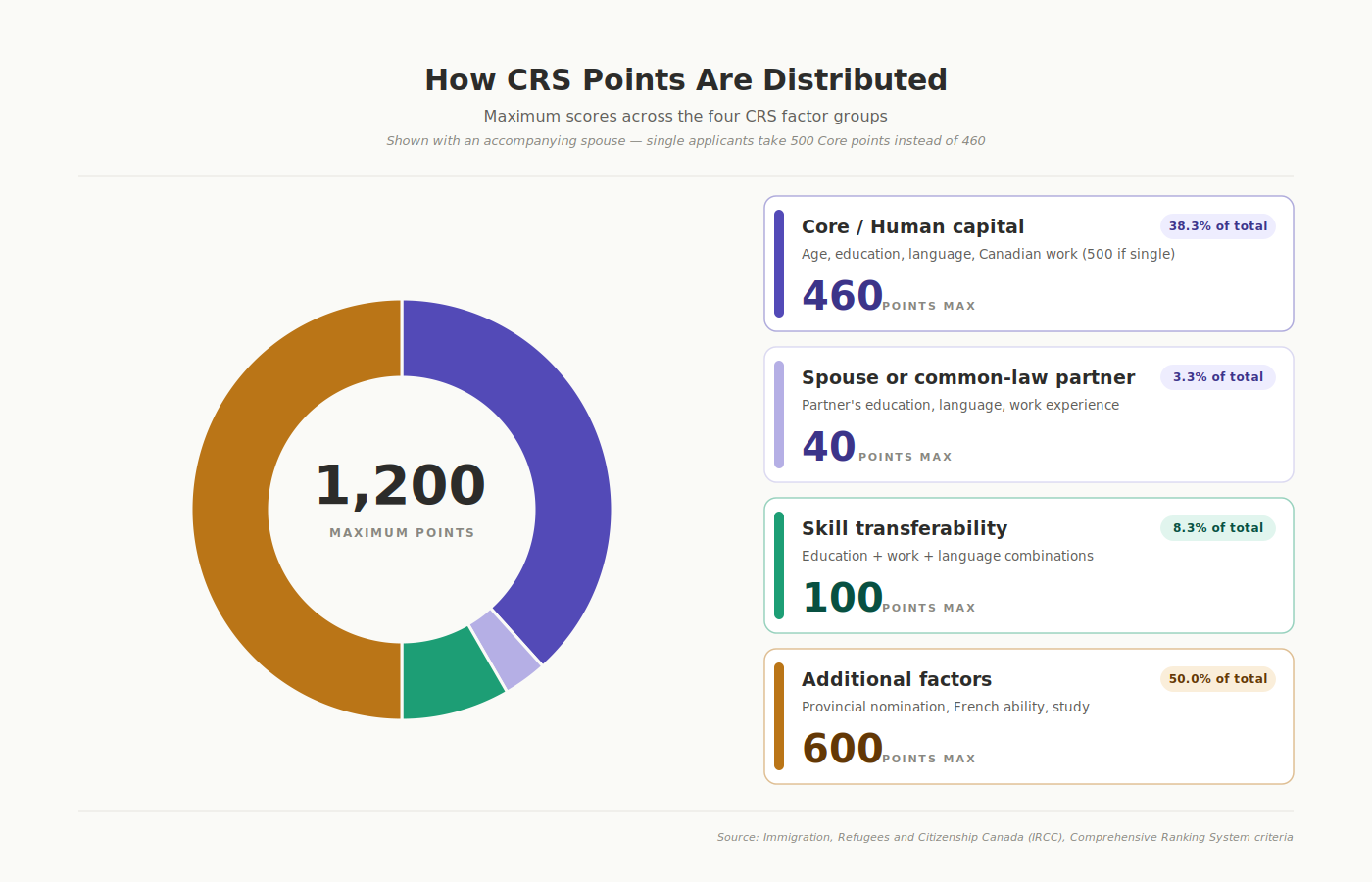
CRS has a total of 1,200 points across four groups: Core Human Capital (500), Spouse (40) points, Skills Transferability (100), Provincial Nomination (600).
Age and education are fixed at the time of your ITA.
Language and Canadian work experience are the two factors most candidates can actively improve.
Provincial nomination adds 600 points and practically guarantees an ITA. It is the most reliable way to increase your scores. For the current cut-off ranges, see IRCC’s Express Entry draw results.
French at NCLC 7 plus English CLB 5 or higher adds a significant amount of points. For most, this can be a game changer.
We will accurately calculate your CRS before we submit your profile. Most applicants make errors when calculating their scores initially. The worst time to find this out about the error is at the time of your ITA or getting a refusal from IRCC after submitting your e-APR.
TL;DR
CRS is scored out of 1,200 across four categories. Core Human Capital covers your age, education, language, and Canadian work experience. Skills Transferability rewards combinations of education, language, and work. Additional Points cover provincial nomination (worth 600), Canadian education, a sibling in Canada, French, and a valid job offer. Most candidates who are single score in the 450 to 490 range before any nomination or French bonus. If you are married, you automatically lose 40 points, and your spouse will have to go through their language exam, work experience and education credential assessment to get these points. A typical candidate at this score level holds a master’s degree, CLB 9 in language, and a year of skilled Canadian work.
IRCC uses the Comprehensive Ranking System (CRS) to rank every candidate in the pool, and it decides whether you receive an Invitation to Apply in the next draw. There are four (4) groups: Core Human Capital (up to 500 pts), Spouse (up to 40 pts), Skills Transferability (up to 100 pts), and Additional Points (up to 600 pts).
This guide will break down each walk you through three (3) scenarios with various profile types so you can calculate your own score within a few points. For the broader Express Entry context, read our Express Entry guide.

What Is the CRS?
The Comprehensive Ranking System (CRS) is the driving factor behind every Express Entry draw. When IRCC holds a draw, candidates at or above the announced cut-off receive an ITA. The higher your score, the you receive an invitation. (IRCC Comprehensive Ranking System)
Your CRS score is generated automatically when you submit your Express Entry profile. You can estimate it ahead of time using IRCC’s online calculator, but what you get on your profile is the correct score. Scores update the moment you change any underlying factor. A new language test result, your age changes, a new Canadian work month, a sibling who just landed in Canada. All of it affects the number.
As your score is half of the equation, the other half is your eligibility into one of the federal programs including CEC, FSW, or FST. You compete with other candidates in the pool with your CRS. Our FSW vs CEC vs FST comparison article does a deep dive in the topic of eligibility. Everything in this article is about scoring after you found out you are already eligible.
How Are CRS Points Distributed?
CRS points come from four categories. Core Human Capital covers age, education, language, Canadian work experience and your spouse. If you are single, you automatically receive the 40 points which your spouse would have had to qualify for if you were married instead. Skills Transferability rewards combinations of education and language, or education and Canadian work. Additional Points cover PNP, job offer, Canadian education, sibling, and French. Add them together and the maximum is 1,200.
Core Human Capital reaches 500, or 460 if you have an accompanying spouse. Spouse reaches a maximum of 40. Skills Transferability peaks at 100. Additional Points peak at 600 and most candidates score on Core and Skills first, then get additional points through PNP or French.
Core Human Capital Factors
Core Human Capital is the largest points category of 500 points. It is scored across four sub-factors: age, education, language, and Canadian work experience. If you have an accompanying spouse, each sub-factor maximum drops slightly to make room for Spouse points. The total in a spouse case is 460 Core plus 40 Spouse.
Age (up to 110 single / 100 with spouse)
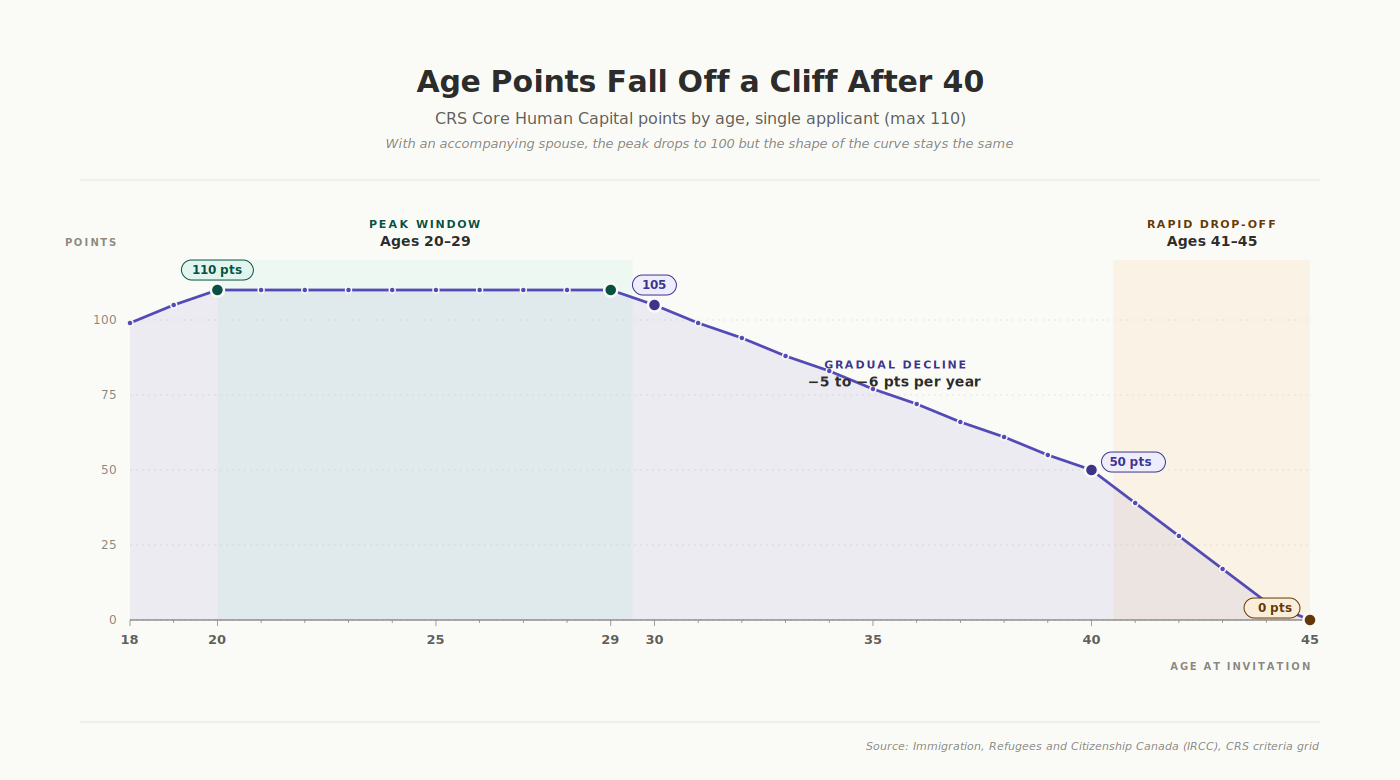
Age peaks between 20 and 29 at 110 points single. Points fall by 5 each year from age 30 onwards, hitting zero at age 45. This is the most unforgiving factor in the system because you cannot improve it. (IRCC CRS age points)
Education (up to 150 single / 140 with spouse)
A PhD will give you 150 points. A master’s or professional degree 135 points. Two or more post-secondary credentials (with at least one three-year program) 128 points. A bachelor’s degree 120 points. A one-year post-secondary credential 90 points. A Canadian high school 30 points. Finally, foreign credentials require an Educational Credential Assessment (ECA). Canadian credentials are automatic and do not require an ECA.
Language (up to 160 single / 150 with spouse)
Language points scale with your CLB. CLB 10 or higher in all four abilities earns 136 if English is your first official language, or 150 when paired with French. CLB 9 gives you 124 points, CLB 8 - 92 points. CLB 7 - 68 points. Points are awarded for your first official language. A second official language at CLB 5 or higher adds up to 24 more points.
Canadian work experience (up to 80 single / 70 with spouse)
You get additional 40 points for Canadian work experience after year one. Two years: 53 points. Three years: 64 points. Four years: 72 points. Five or more years: 80 points. This factor rewards the same hours that qualify you for the Canadian Experience Class. See the CEC requirements article for the counting rules.
How the Spouse Factors Work in the CRS
Your accompanying spouse can add up to 40 CRS points across three sub-factors. Education contributes up to 10. First-language CLB contributes up to 20. Canadian work experience contributes up to 10. The Spouse calculator mirrors the Core calculator at smaller caps. Your spouse only counts here if they are accompanying you on the application.
A spouse who is already a Canadian citizen or PR does not take away or give you additional points. In that case you apply as married without an accompanying spouse, and you keep the full 500 Core cap.
Unsure whether listing your spouse as accompanying will improve your score? Book a CRS review with Mirzoyan Immigration. We will explain to you what the risks are when you are applying as a single applicant versus with an accompanying spouse if you are currently married or in a relationship.
What Does Skills Transferability Reward?
Skills Transferability rewards combinations with high education and language abilities. High education plus high language is one combination. High education plus Canadian work experience is another. Foreign work and Canadian work experience is a third combination. The three sub-factors together cap at 100 points. (IRCC Skills Transferability table)
Skills Transferability – Maximum of 100 points total
Edu. + Lang.
Max of 50 Pts
Education + Canadian Work Experience
Max of 50 Pts
Foreign Work Experience + Canadian Work Experience
Max of 50 Pts
Certificate of Qualification + Language
Max of 50 Pts
There are three sub-factors where each cap at 50 points, with the overall Skills Transferability total capped at 100. Education combined with language will net you up to 50. Education combined with Canadian work experience will net you up to 50. Foreign work combined with Canadian work experience will net you up to 50. For FST candidates, a certificate of qualification and strong language scores will net you up to 50 in place of education.
In practice, most CEC candidates score 50 from “education plus Canadian work.” They earn another 25 to 50 points from “education plus language.” This category caps at 100 once the maximum points are acquired. What this means is most strong CEC profiles get 100 points here without much effort, and the real differentiator becomes the Additional Points section.
Which Additional Points Matter Most?
Additional Points can push a decent profile over a draw cut-off. Six of these additional categories exist and they cap together at 600. The headline two are provincial nomination (600), and Canadian education (15 or 30). The remaining three are siblings in Canada (15), French language (25 or 50), and the French-only pathway. If your current Core plus Skills Transferability total puts you 30 points below the most recent cut-off, this is the section that decides whether you get invited.
Provincial nomination (600 points)
A nomination from a PNP aligned with Express Entry adds 600 points. In practice this guarantees an ITA at the next general draw. Every province runs its own process. Most PNPs review the occupation first, then CRS, then language.
Job offer (50 or 200 points)
A valid Canadian job offer in a TEER 0 “Major Group 00” senior management role used to give candidates 200 points. All other TEER 0 to 3 job offered 50 additional points. (IRCC valid job offer definition). Even though this has been removed from the pool, there is a strong chance that it will come back sometime in late 2026 or in early 2027.
Canadian education (15 or 30 points)
A one-year or a two (2) year Canadian post-secondary credential gives you additional 15 points. A three (3) year or more Canadian credential gives you 30 points. The credential must come from a Designated Learning Institution and have been completed in person in Canada.
Sibling in Canada (15 points)
A sibling who is a Canadian citizen or PR, aged 18 or older, sharing at least one parent with you, earns 15 points. Half-siblings count if the shared-parent test is met.
French language (25 or 50 points)
An NCLC 7 or higher in French, combined with CLB 5 or higher in English, earns the maximum 50 points. NCLC 7 in French, with English CLB 4 or lower earns 25 points. TEF Canada and TCF Canada results are the only accepted French language tests. Most do not realize the significance of French when it comes to how influential it is when obtaining Permanent Residence. I have seen candidates who already speak French often skip the test because they assume the bonus is small. It is not.
French-only bonus
Candidates with NCLC 7 French and no English can still apply, earning the regular amount of point without the bilingual bonus, alongside their other factors. This pathway fits bilingual candidates coming out of Quebec who are applying to provinces outside the Quebec programs.
CASE STUDY 1: Single 28-Year-Old with a Master’s
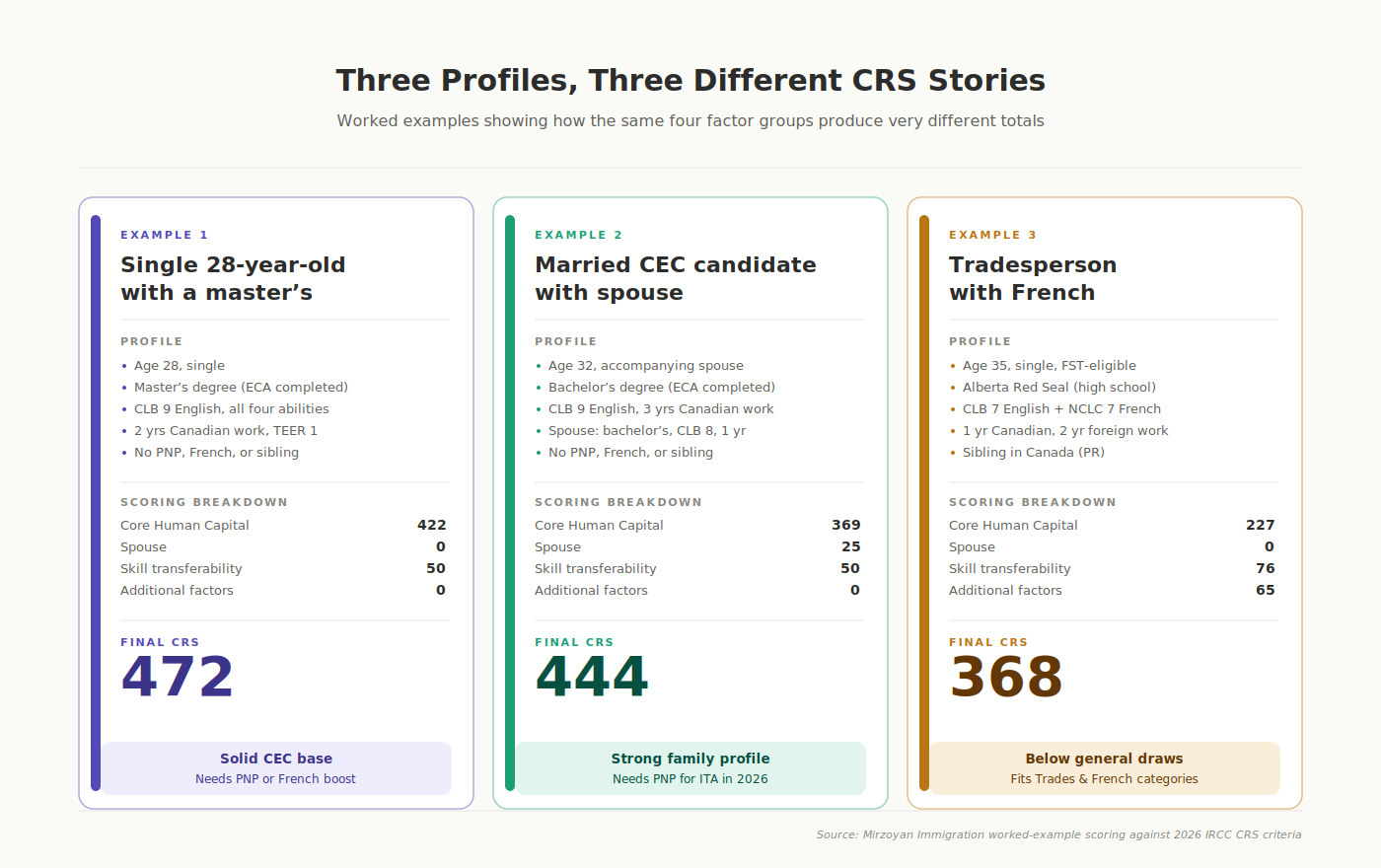
Profile: Age 28, single, master’s degree from outside Canada with ECA completed, IELTS General with CLB 9 across all four abilities, two (2) years of skilled Canadian work experience in a TEER 1 role. No spouse, no sibling in Canada, no French, no job offer, no nomination.
Core scoring: Age 28 single = 110. Education (master’s) = 135. Language CLB 9 = 124. Canadian work experience 2 years = 53. Core total = 422.
Skills Transferability: Education plus language (master’s + CLB 9) = 50. Education plus Canadian work (master’s + 2 years) = 50. Even though Skills Transferability total is capped at 100, this applicant only receives 50 points as they would need foreign work experience to obtain additional 50 points for the skills transferability section to give them additional 50 points.
Additional Points: none applicable. Additional Points total = 0.
Final CRS: 422 + 0 (spousal factor) + 50 + 0 (PNP) = 472.
This is a typical strong-profile first draft. See IRCC’s Express Entry draw results, however this will not be strong enough to receive ITA on its merits based off of Canadian Experience Class. If this applicant works in one of the category specific NOC, their chances of being selected would be much better than just CEC.
CASE STUDY 2: Married CEC Candidate
Profile: Age 32, married with accompanying spouse, bachelor’s degree (ECA done), CLB 9 English, three (3) years of skilled Canadian work. Spouse: age 30, bachelor’s degree, CLB 8 English, one year of Canadian work. No sibling, no French, no job offer, no nomination.
Core (with spouse caps): Age 32 = 85. Education (bachelor’s) = 112. Language CLB 9 = 116. Canadian work experience 3 years = 56. Core total = 369.
Spouse: Education (bachelor’s) = 8. Language CLB 8 = 12. Canadian work experience 1 year = 5. Spouse total = 25.
Skills Transferability: Education + Canadian work = 50. Foreign Work Experience + language = 50. Even though Skills Transferability total is capped at 100, this applicant only receives 50 points as they would need foreign work experience to obtain additional 50 points for the skills transferability section to give them additional 50 points.
Additional Points: 0.
Final CRS: 369 + 25 (Spouse) + 50 + 0 (PNP)= 444.
Before 2020 this would have been considered as a strong profile. However, given the current immigration atmosphere, the only other way to increase points for this family this will not be strong enough to receive ITA on its merits based off Canadian Experience Class. If this applicant works in one of the category specific NOC, their chances of being selected would be much better than just CEC.
CASE STUDY 3: Tradesperson with French
Profile: Age 35, single, FST-eligible with an Alberta Red Seal certificate, three years of trade work experience (two foreign, one Canadian), CLB 7 English, NCLC 7 French on TEF Canada. Has a sibling in Toronto who is a Canadian PR.
Core: Age 35 = 77. Education (high school) = 30. Language CLB 7 = 68 English. Second Official Language = 12 French. Canadian work experience 1 year = 40. Core total = 227.
Skills Transferability: Official Language + Foreign Work = 13. Canadian and foreign work experience = 13. Certificate of qualification = 50. Skills Transferability total = 76.
Additional Points: French NCLC 7 with CLB 7 English = 50. Sibling = 15. Additional Points total = 65.
Final CRS: 227 + 0 (spouse) + 76 + 65 = 368.
This candidate sits below most general draw cut-offs. But Trades and French category draws are often much lower than general draws are. For how those category draws compare against general ones, see the Express Entry draw results published by IRCC.
Want a second pair of eyes before you submit? Book a CRS pre-submission review with Mirzoyan Immigration and I will calculate your score against the 2026 tables, factor by factor, before you finalize your profile.

Conclusion
CRS is the single biggest lever between eligibility and an ITA. Most candidates leave points on the table because they miscount Canadian work experience, misclassify their education, or miss the spouse-versus-single scoring question. Walking through the tables before you submit your profile is worth the hour. I have helped many of my clients add 10 to 40 points just by correcting those three errors at the profile stage.
Book a CRS-scoring review with Mirzoyan Immigration. Narek Mirzoyan, RCIC # R1005184, will run your profile against the 2026 CRS tables, flag any scoring mistake, and calculate the lift from adding French, PNP, or a Canadian credential. Verify our RCIC status on the CICC public register. Book your CRS review.
Frequently Asked Questions
How many CRS points do I get for a master’s degree?
A master’s degree (or equivalent professional degree like JD or MD) earns 135 Core Human Capital points if you are single. It earns 126 Core points plus up to 10 Spouse points if you have an accompanying spouse. Points appear under the Education factor inside your profile.
Does my spouse help or hurt my CRS score?
It depends. A spouse who has equal if not better qualifications than you will level the playing field. If their language abilities, education and work experience, is above yours, you will get additional points. Very rarely does a spouse lower your overall score, because IRCC splits the 500 Core maximum proportionally when a spouse is included.
How many points for a French NCLC 7 alongside English?
An NCLC 7 or higher in French, when English is your first official language, will give you additional 50 bonus points if your English is CLB 5 or higher. With English at CLB 4 or lower you will get 25 points instead.
What’s the maximum CRS score possible without provincial nomination?
The maximum without a PNP or Additional Points is 600. With a Canadian degree, sibling, or French bonus the cap rises to 695. Provincial nomination adds another 600. The maximum number you can ever earn is 1200. Almost no real profile reaches 600 without French or a Canadian degree.
How many points is a Canadian sibling worth?
Having a sibling who is a Canadian citizen or PR living in Canada earns 15 Additional Points. The sibling must be 18 or older and share at least one parent with you. Half-siblings count as long as the shared-parent test is met. Proof requires documents like birth certificates and the sibling’s PR card or passport.
How Can We Help You?