FSW vs CEC vs FST: Which Express Entry Stream Fits You?
Last updated: May 16, 2026 | Written by Vahe Mirzoyan RCIC#R514223 | Reviewed by Narek Mirzoyan RCIC#R1005184 at Mirzoyan Immigration
Table of Contents
Key Takeaways
TL;DR
What Does Each Express Entry Program Do?
Side-by-Side: FSW vs CEC vs FST
Which Program Processes Fastest?
Scenario 1: Which Stream Fits a PhD Student on a PGWP?
Scenario 2: Foreign-Trained Accountant in India
Scenario 3: Which Stream Fits a Red Seal Electrician in Alberta?
Scenario 4: Dual-Eligible Candidate
Frequently Asked Questions
Key Takeaways
CEC covers applicants with twelve (12) months of Canadian skilled work. FSW is for foreign skilled professionals. FST is for trades.
Work experience, language thresholds, education requirements, and proof of funds are the four biggest pain points for most applicants.
A single Express Entry profile is screened against all three programs at the time of creation. Dual eligibility is common and triple is generally rare. If you meet the requirements of more than one program, it is always an advantage.
Mirzoyan Immigration, led by Narek Mirzoyan (RCIC #R1005184), will review your information and identify your eligibility, and flag provide you with guidance on the fastest route to an ITA for your profile.
TL;DR
If you have twelve (12) months of skilled Canadian work in the past three (3) years, CEC is usually the stream that most applicants would qualify for. If your work experience is entirely foreign, FSW is likely the path for you. If you are a tradesperson with a Canadian certificate of qualification or a valid Canadian trade job offer, FST is the option. Your Express Entry profile checks and tries to qualify you for all three federal programs, and many candidates qualify for more than one. Which program wins depends on your primary NOC.
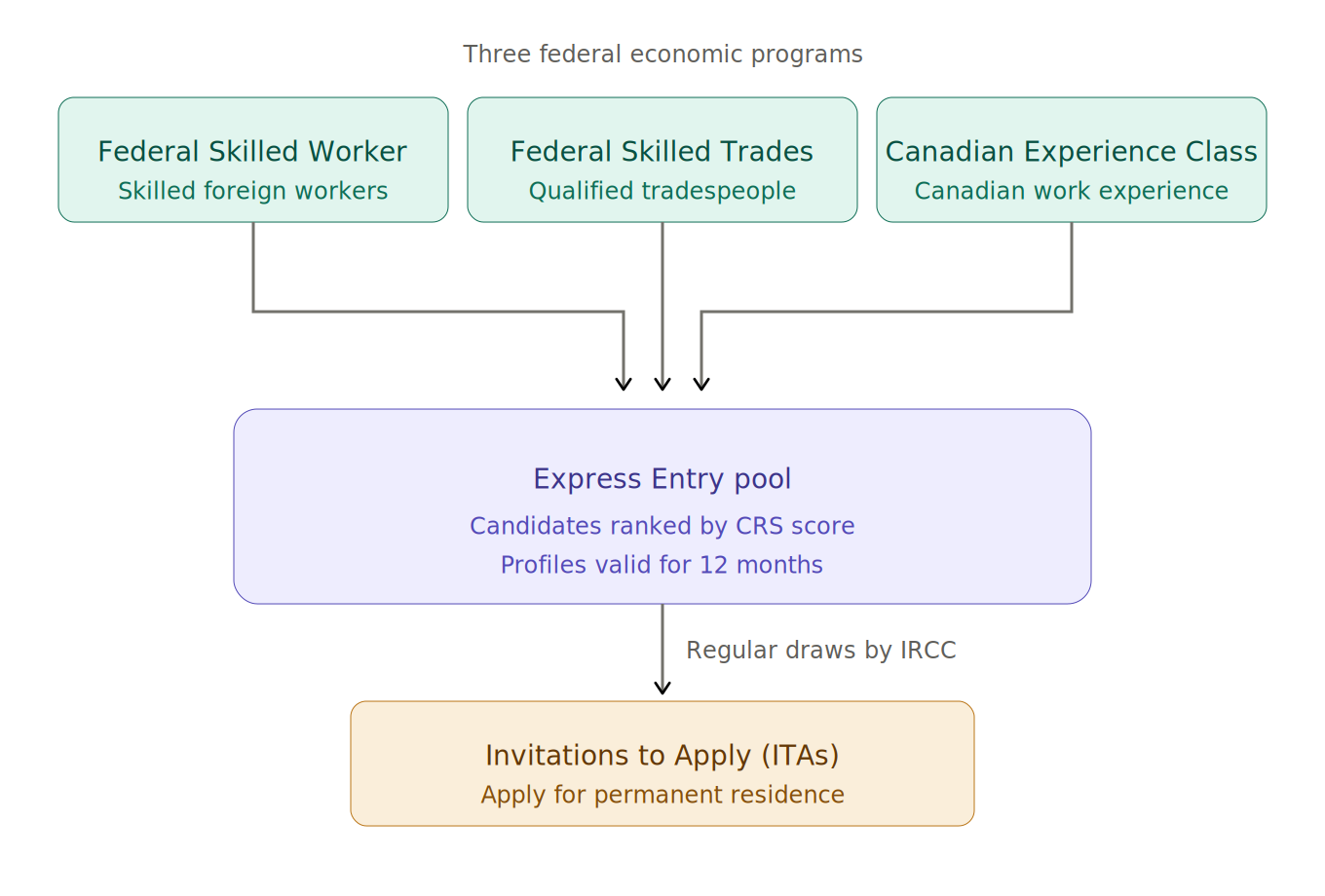
What Does Each Express Entry Program Do?
For a system-level view of how all three programs feed the Express Entry pool, see our Express Entry pillar guide. For a beginner-level intro to CEC, see What the Canadian Experience Class Is?
Side-by-Side: FSW vs CEC vs FST
Here is the short version of each before the deep-dive sections that follow.
CEC requires 12 months of Canadian work experience in the past three years.
FSW and FST do not require Canadian experience.
FST still demands two years of trade experience somewhere in the world.
Work experience:
FSW requires 12 months in a NOC TEER 0, 1, 2, or 3 role within the past ten (10) years.
CEC does not use foreign experience to qualify.
FST’s two-year trade experience can be Canadian, foreign, or mixed.
Language requirements:
FSW requires CLB 7 in all four abilities.
CEC requires CLB 7 for TEER 0 and TEER 1 jobs, and CLB 5 for TEER 2 and TEER 3 jobs.
FST has the lowest threshold: CLB 5 speaking and listening, CLB 4 reading and writing. (IRCC language requirements)
Education:
FSW requires Canadian secondary (high school) or a foreign equivalent with an ECA.
CEC and FST have no minimum education requirement.
Canadian certificate or trade job offer:
Only FST requires this. You need a Canadian certificate of qualification in the trade or a valid Canadian trade job offer.
Settlement funds:
FSW and FST both require proof of funds unless you hold a valid Canadian job offer.
CEC does not require settlement funds. (IRCC proof of funds)
Physical presence:
None of the three programs require you to be in Canada when you apply.
Program specific points-test grid:
FSW uses a 67-of-100 selection grid at the eligibility stage. This is separate from the CRS score every candidate competes on in the pool.
CEC and FST do not use this grid.
The 67 points are separate from the CRS score of Express Entry draws. For the CRS math that applies to every candidate in the pool, see our CRS score explained article.
Which Program Processes Fastest?
IRCC’s published service standard is six (6) months for 80% of complete applications across all three programs. However, in our experience it can take anywhere between 8-10 months with current backlogs. CEC applications with only Canadian work experience are typically processed faster because Canadian employment is easy to confirm. FSW and FST files require more external verification. (IRCC processing times)
The draw frequency matters as much as processing time. General draws from the pool tend to have higher CRS cut-offs than program-specific or category-based draws. IRCC’s draw history lists the date, round type and CRS cut-off for each round.
Not sure which stream fits your file? Book a program-eligibility assessment with Mirzoyan Immigration. A licensed RCIC will screen your profile against all three programs and tell you which one (or which combination) gives you the strongest position before your next draw.
Scenario 1: Which Stream Fits a PhD Student on a PGWP? (For Education Purposes Only)
Meet Samara, a 29-year-old PhD graduate on a three (3) year PGWP. She is in month 14 of a Canadian postdoc matching NOC TEER 1. She has 12 months of qualifying Canadian experience. She does not need proof of funds. She scored above CLB 7 on her language test. She qualifies for both CEC and FSW and has a strong candidacy for a category-specific draw.
Once she receives her ITA under CEC and the category-specific draw, her employer’s reference letter and Canadian tax returns (T4s, NOAs) give IRCC everything they need to verify her work experience. (IRCC CEC application guide)
Scenario 2: Foreign-Trained Accountant in India (For Education Purposes Only)
Meet Priya, a 33-year-old chartered accountant in Mumbai. She has seven (7) years of experience in a TEER 1 occupation. CLB 9 English (IELTS 7.5 each ability) and a master’s degree. Never worked in Canada.
FSW is the only option for her. She will need an ECA for her Indian master’s degree. She also needs proof of funds (because she does not have a Canadian job offer) and a valid IELTS result. Her CRS will score heavily on education, foreign experience, and language. Priya’s chances to get an ITA in this case are very low as she does not qualify for one of the category-specific draws. To have a better shot at PR, Priya would have to get a job in Canada and complete twelve (12) months of Canadian work experience to increase her chances of receiving an ITA.
Scenario 3: Which Stream Fits a Red Seal Electrician in Alberta? (For Education Purposes Only)
Meet Rolando, a 34-year-old electrician from the Philippines. Prior to coming to Canada, he worked as an electrician for five (5) years. He holds an Alberta Red Seal certificate of qualification. He is working in Calgary on an LMIA-based work permit for ten (10) months now. He fits FST first. He has the Canadian certificate of qualification in a regulated trade. That is the critical FST entry condition. His foreign trade experience is already on record.
He does not yet have 12 months of Canadian experience, so CEC is not open to him until he hits the one-year mark. Once he passes 12 months in the trade in Canada on a valid work authorisation, CEC opens up, and he becomes dual-eligible. He should file under FST now rather than wait for CEC, as he is also eligible for a category-specific draw. The one-year gain in processing time usually outweighs any marginal CRS difference between the two routes. Because electricians are on the list of eligible occupations for the trade occupation in the category draws, Rolando has a very good chance of getting an ITA.
Conclusion
Picking the right Express Entry stream is less about which program is “better” in the abstract. It is about which one best fits your profile. Most applicants are dual-eligible without realising it, and the fastest route to an ITA depends on your specific situation.
Book a program-eligibility assessment with Mirzoyan Immigration. I will screen your file against all three Express Entry programs, identify any dual-eligibility, and tell you which stream offers the fastest path to an ITA given current draw patterns. Book your assessment.
Frequently Asked Questions
Can I apply to more than one Express Entry stream at the same time?
Yes. Once you complete your Express Entry profile, it is screened against all three federal programs. If you meet the rules for two or three, IRCC marks you eligible under each program. Category-based draws may target any of the programs you qualify under, so dual or triple eligibility increases your ITA odds.
Which Express Entry stream historically has the lowest CRS cut-off?
FST draws and some CEC-only draws have historically cleared at lower CRS cut-offs than general draws, sometimes in the 300s and 400s in the pre-COVID-19 times. General draws mixing all three programs typically hover above 500. Cut-offs change with every draw. See our draw trends article for the current pattern.
Is FSW faster than CEC?
It depends. Both aim for six (6) months of IRCC processing after submission. But CEC files require less supporting documentation if you only have Canadian work experience. Canadian work history is easier to verify, where FSW requires a foreign ECA and proof of settlement funds. Those steps can add additional time to verify.
Do I need proof of settlement funds for CEC?
No. CEC does not require proof of settlement funds. FSW and FST applicants must show funds unless they hold a valid Canadian job offer on arrival. The funds threshold is published by IRCC and increases with family size.
Which Express Entry stream is best if I’m a tradesperson already working in Canada?
It depends. CEC does not require you to have a job offer or certificate of qualification, whereas FST does. If your CRS is high enough, maybe it makes sense to go with CEC rather than FST.
How Can We Help?