Canadian Citizenship Procedural Fairness Letter: How to Respond

Respond to a Canadian citizenship procedural fairness letter by addressing each concern with evidence before the deadline in your letter. A PFL raises concerns before a decision, while an ordinary information request may simply ask for documents needed to continue processing. If IRCC directs you to its secure account, uploading a document is not enough; finish the signing and transmission steps. If a document is unavailable, explain what is missing and your efforts to obtain it. Follow the submission instructions in your letter and keep a copy of everything you send. This guide covers letters about applying for Canadian citizenship and proving citizenship you already hold.
By Narek Mirzoyan, RCIC # R1005184,. Verify this credential on the CICC public register.
Last reviewed by Narek Mirzoyan, RCIC # R1005184, on 2026-09-16.
TL;DR:
An IRCC document request, a citizenship PFL and a returned application require different responses. For a PFL, answer each concern with a clear explanation and supporting evidence. Follow the letter's deadline and submission instructions, explain missing records, and keep proof of delivery. If you need more time, ask promptly and provide evidence of your efforts; do not assume the deadline has changed.
Table of Contents
Is IRCC asking for documents or raising concerns about your application?
Check your response deadline and submission instructions
What if you need more time to get a document?
How to answer each concern in your citizenship PFL
Choose evidence that answers what IRCC is questioning
Missing records and conflicting information
Send your response and keep proof of submission
What if the response deadline has already passed?
What happens after you respond to IRCC?
How IRCC reviews your explanation and documents
Mistakes that can leave IRCC's concerns unanswered
Should you prepare the response yourself or get professional help?
Is IRCC asking for documents or raising concerns about your application?
An IRCC letter can ask for missing information, question your eligibility or require you to attend an appointment. So read its purpose before deciding what response to prepare. A document request may need a short explanation and a particular record, while a PFL can require a fuller answer.
And an appointment notice may require attendance as well as documents. The wording inside the letter matters more than the subject line of the email carrying it. An application returned during the completeness check belongs to a different process.
Use the guide to a returned Canadian citizenship application if IRCC has sent your package back. But a final refusal comes after a decision, when the next steps are different. Check which stage your letter describes so you do not prepare a PFL response for a decision already made.
Requests for additional documents or information
An additional-document request does not, by itself, mean IRCC intends to refuse your citizenship application. It may identify information the officer needs to finish checking your file. IRCC also selects some citizenship applications for quality assurance, which can involve further documents or an interview.
An unexpected request can be worrying when you thought you had already supplied everything. But an extra check does not establish that IRCC suspects wrongdoing. Read the specific items before deciding what the officer needs.
Build a short checklist from the letter rather than sending your entire application again. If IRCC requests a clearer copy, check the new scan at normal viewing size before attaching it. But if it requests an explanation, a replacement scan alone may leave the question unanswered. Make your response as specific as the request, and identify anything you cannot supply.
Procedural fairness letters
A citizenship procedural fairness letter gives you an opportunity to address concerns before IRCC decides your application. The concern may involve your eligibility, the reliability of a document or information that conflicts with your application. But disagreeing with the concern will not explain why the officer should accept your account.
Your response needs to connect the disputed point with the relevant facts and evidence. Treat the letter as a request for a reasoned answer, not simply a request for more paperwork. IRCC's citizenship processing overview distinguishes PFLs from other document requests.
Look for the facts or requirements being questioned and the possible consequence described. Do not assume that every PFL alleges misrepresentation, or that every information request is harmless. So address the concerns actually raised, without inventing allegations the officer has not made.
Interview notices and requests to appear
An interview notice requires you to prepare for the appointment described, not automatically to submit a written PFL response. The Citizenship Act permits requests for information and an appearance, including by telecommunications. Check the date, attendance method and documents listed in your notice.
If the notice also asks for documents beforehand, treat that as a separate task with its own instructions. But bringing a record to an interview may not satisfy a direction to submit it earlier.
Read your application again so you can explain the information you previously provided. Make a note of any correction and the records supporting it rather than rehearsing an answer you cannot verify. And if attendance is difficult, contact IRCC promptly using the notice instructions and explain the problem. For test-related interviews or hearings, the Canadian citizenship test guide explains that separate part of the process.
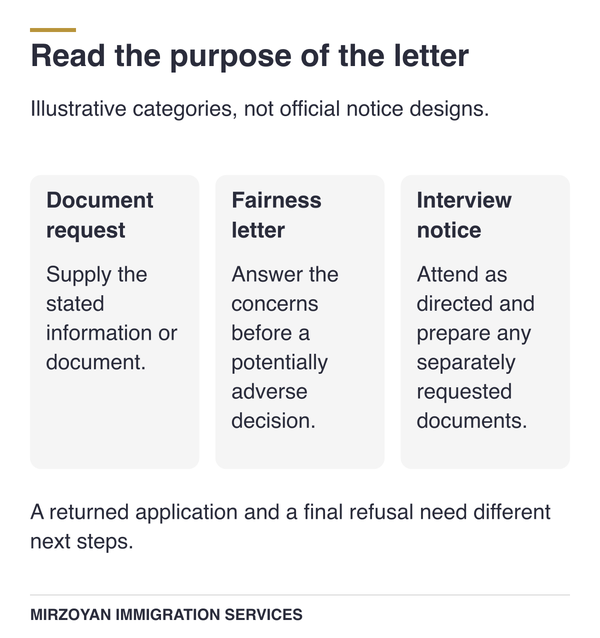
Letter categories, not reproduced correspondence. A document request, procedural fairness letter and interview notice have different purposes. Use the actual wording, requested action and deadline rather than the email subject alone.
Check your response deadline and submission instructions
Use the deadline and delivery method in your own IRCC letter, not a response period quoted on another website. Read every page, including attachments, before adding the date to your calendar. And record any stated time and time zone; the deadline may not mean midnight where you live.
Keep the application number, letter date and requested items together in a working checklist. Mark each requested item complete only when the document or explanation is ready to send. IRCC's requested-document instructions explain that the letter controls how you respond.
But a message appearing in one account does not make every upload tool suitable for that response. If the wording is unclear, seek clarification promptly while preparing the parts you can understand. Set an earlier personal completion date so translation, scanning or a technical problem does not consume your remaining time. Keep the original letter available during the final check, rather than relying on a summary from memory.
What if you need more time to get a document?
You can ask IRCC for more time when a requested document cannot be obtained before the response deadline. Explain the reason and support it with evidence of your efforts. An order confirmation can show when you requested the record and help explain the delay.
But asking for an extension does not establish that your deadline has changed. So plan around the existing date unless IRCC gives you different instructions.
Explain what is missing and your efforts to obtain it
An extension request should identify the missing document and why you cannot provide it on time. State when you requested it, who holds it and what response you received. Attach the order confirmation, correspondence or other available proof rather than relying only on your account of the delay.
But if the issuer gave an estimated completion date, do not present it as a guaranteed delivery date. But if no estimate exists, say so instead of choosing a date you cannot support. IRCC's guidance on needing more time calls for reasons the record is delayed and proof of your attempts to get it.
Use the response route available for your request and identify the outstanding item clearly. And explain whether you can provide the remaining requested material within the original period. For example, identify a delayed civil record separately from translations you can still complete before the deadline.
Keep working on your response while you wait for an answer
Continue preparing the available parts of your response while your extension request is outstanding. You can organize records, check translations and answer concerns that do not depend on the missing document. Keep a dated list of the work completed and any further contact with the issuer.
But if you send available material, label it accurately so it is not mistaken for a complete response. Explain which item remains outstanding and connect it to your earlier extension request.
And send the missing document when it becomes available, even if your extension request remains unanswered. Keep copies of both submissions so their relationship is clear. But do not treat silence as permission to stop working or to wait indefinitely. Where the deadline is close and the missing evidence is central, seek individual advice about the response you can presently support.
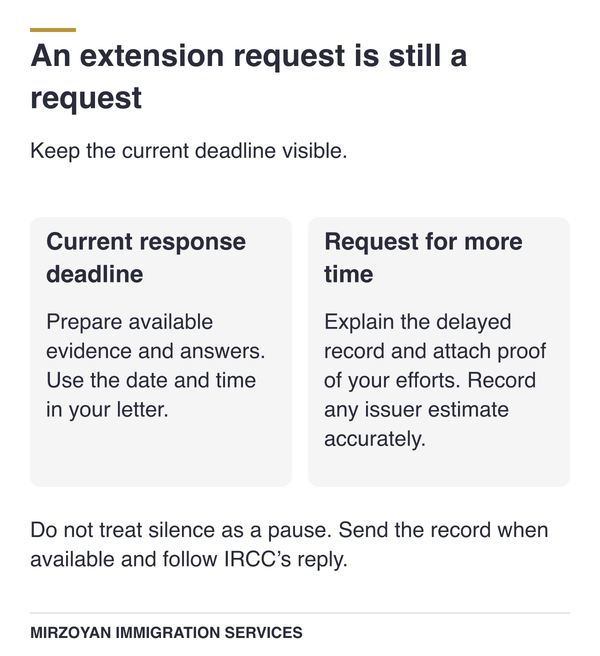
Illustrative deadline and record-order arrangement. A request for more time does not confirm an extended deadline. Continue preparing the available response and send the missing document when obtained, following IRCC’s instructions.
How to answer each concern in your citizenship PFL
A useful PFL response lets the officer follow each concern from your explanation to the record supporting it. Begin with the points in the letter and address them in the same order where practical. For each point, explain the relevant facts, identify the evidence and acknowledge any remaining limitation.
Label your attachments consistently so the officer can find the page you discuss. But a longer letter still leaves the concern unanswered if it does not explain what the attached records establish. I check the proposed attachments against the particular concern they need to answer and the time available to respond. Deciding that first helps you avoid gathering records that leave the officer's question unanswered.
The examples below illustrate organization, not a universal document checklist or a response from an actual client. The appropriate evidence depends on your letter and circumstances. IRCC's evidence-assessment guidance helps explain why relevance matters alongside reliability.
| IRCC's concern | Your explanation | Possible supporting record |
|---|---|---|
| A trip appears in a passport but not in the travel history. | Identify the trip, explain the omission and address its effect on the submitted information. | Relevant passport pages and records supporting the departure and return dates. |
| Two family records show different names for the same person. | Explain the name change or discrepancy and how the records relate to that person. | An official record connecting the names, with a translation where required. |
| A requested official record has not been provided. | Describe why the record is unavailable, your attempts to obtain it and any proposed alternative. | The issuer's reply and dated evidence of your record request. |
If you find a genuine error in your application, describe it plainly rather than quietly replacing the original information. Identify what was wrong, what you now believe is correct and the basis for the correction. And keep uncertain facts separate from facts you can verify. If a relative's recollection is your only source for an event, say so and explain what you tried to verify.
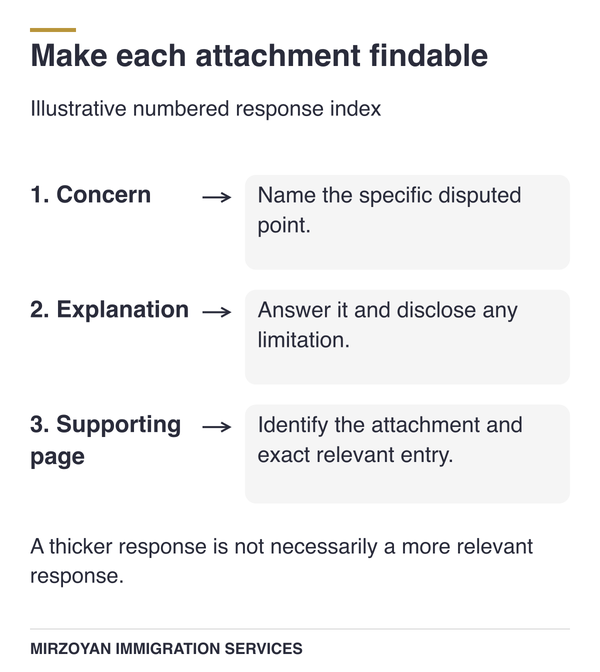
An illustrative attachment index, not a client submission or government form. Each concern should be traceable through its explanation to a relevant supporting page; numbering helps identification, not proof of correctness.
Choose evidence that answers what IRCC is questioning
Choose records for the fact they can establish, not simply because they look official or make the response thicker. But a document may be genuine while leaving the officer's particular question unresolved. Before attaching it, identify the fact it supports. If you cannot identify that connection, reconsider whether it belongs in the response. And check whether your explanation claims more than the document actually shows.
Time in Canada and travel history
When IRCC questions time in Canada, focus on the disputed dates and the records that help explain them. Compare the relevant travel entries with the application information you submitted. But employment or tax records do not necessarily account for every day of a disputed period.
Someone can hold a Canadian job or file a return while also taking a trip abroad. Explain the dates directly rather than asking the officer to infer them from unrelated records. For an omitted trip, identify the departure and return dates and explain how you established each date. And if the correction changes your calculation, address the effect rather than presenting it as a spelling correction.
The citizenship physical-presence guide covers the counting method and relevant period. But use it alongside the particular concern in your letter, not as a substitute for answering that concern. The response should make any change to the submitted travel history easy to identify.
Identity, family relationships and citizenship records
For a citizenship-certificate claim, a family record needs to establish the relationship or citizenship fact IRCC is questioning. A family tree may help you organize the history. But you still need evidence of the relationships it describes.
IRCC's proof-of-citizenship guide emphasizes reliable, verifiable records for the relevant generations. Identify the particular parent-child connection or citizenship date the officer needs clarified. So focus on that connection before adding records from other generations. For a disputed family link, I compare the claimed relationship with the records issued by the authority responsible for documenting it. And a record connecting two people may leave the date their citizenship began unresolved.
So if both points are disputed, explain them separately and show which attachment supports each answer. The citizenship-by-descent eligibility guide covers the status question in more detail. The citizenship-by-descent application guide covers preparing the initial certificate package.
Unsure which evidence answers IRCC's concern?
Mirzoyan Immigration Services can review the letter against your application and supporting records.
Use citizenship application services for a grant response, or proof-of-citizenship assistance for a certificate or descent claim.
Share the response deadline when requesting help.
Language, test and other eligibility concerns
An eligibility concern needs an answer about the requirement IRCC identifies, not a general statement that you deserve citizenship. Start by checking whether the officer is asking for a document, questioning its meaning or requesting an assessment. A request for language evidence is different from an invitation to complete a test or attend an interview.
But sending the same record again may not answer a question about what it demonstrates. Explain how your evidence relates to the requirement and identify any genuine limitation.
If a disability or another relevant circumstance affects participation, review IRCC's citizenship accommodation and waiver guidance. An accommodation helps you meet a requirement, while a waiver concerns an exemption where available. But mentioning a difficulty does not establish that IRCC has granted either request. Questions involving criminal proceedings or alleged false information can carry consequences beyond supplying another document. Those concerns deserve individual advice tied to the letter and the applicable citizenship requirements.
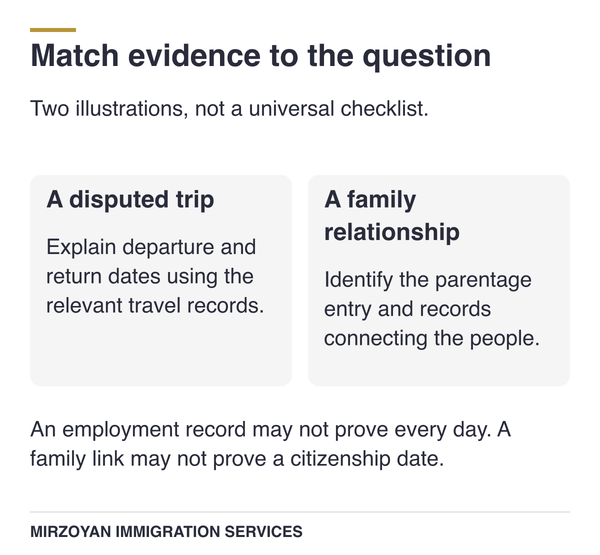
Illustrative travel-date and family-evidence examples. These belong after the complete parent evidence discussion, not as examples of language or test proof. A genuine record can still leave the particular question unanswered.
Missing records and conflicting information
Missing evidence and contradictory evidence create different problems, so explain them separately in your response. A missing record leaves a fact unsupported; a contradiction can leave the officer unsure which account is correct. So identify whether a record is missing or conflicts with another, instead of burying the problem among attachments. Explain what you checked, what you found and what remains uncertain. A response should not describe a missing record as proof that an event did or did not happen.
When a requested record is unavailable
Explain why a requested record is unavailable and show the steps you took to obtain it. An unanswered order is different from written confirmation that the issuing authority holds no record. Describe the situation accurately, including any search result or correspondence you received.
And if you propose another record, explain which fact it supports and which details it cannot establish. But do not describe an alternative as equivalent simply because it is the only document presently available.
For proof applications, IRCC's certificate guide addresses unavailable official records and evidence of efforts to obtain them. Apply that guidance to your circumstances without assuming every suggested alternative will resolve every missing family link. Keep a record of further searches so you can explain what changed if additional evidence arrives. Your explanation helps IRCC understand the gap. But it does not guarantee that the remaining proof is sufficient.
When names, dates or other details do not match
Identify conflicting details directly and explain the evidence supporting the correct information. A spelling variation, legal name change and incorrect birth date are not interchangeable explanations. Compare the original records before deciding which situation applies. And if a translation introduced an error, seek a corrected translation rather than changing the source document yourself. Retain the earlier version so you can explain what was corrected and why.
Use the applicable translation instructions in IRCC's certificate guide for a proof application. But for another citizenship application, follow its guide and your request letter. A short comparison of the conflicting entries can help the officer locate the issue across several attachments. But the comparison is your explanation, not independent evidence that one version is correct. Where you cannot resolve the discrepancy, say what remains uncertain and obtain advice before making an unsupported declaration.
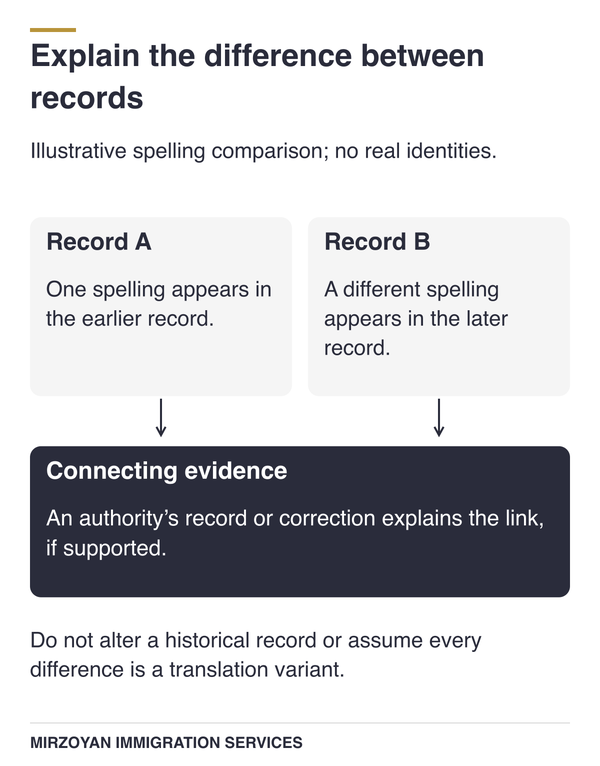
Fictional record comparison without names or personal data. The explanatory link must be supported by actual records or a documented correction; a side-by-side comparison is not independent proof that the names identify one person.
Send your response and keep proof of submission
Keep a complete copy of the response you send, including the explanation, attachments and available submission confirmation. So before submitting, compare the final package against each item in the letter. Open every file to check that it contains the intended pages and remains readable. Use clear labels and an index where several attachments support different concerns. Record the application identifiers accurately so the response can be connected to the correct file.
Save the final versions in a separate folder rather than mixing them with working drafts. If a later request raises the same issue, you can compare it with the exact version IRCC received. But a delivery acknowledgement does not show that the officer accepted your explanation. Check later correspondence for the officer's assessment, rather than reading acceptance into a delivery message. IRCC must still assess whether the documents you sent resolve its concerns about your application.
Check that your documents were submitted, not just uploaded
Uploading a document may leave another submission step unfinished, depending on the account IRCC tells you to use. For the IRCC secure account, the official instructions distinguish uploading from transmitting. They describe signing and transmitting after the upload, followed by a confirmation. But those steps are account-specific, not a description of every online citizenship application. Read the final status and instructions in the account named in your letter.
Do not close the session immediately after selecting a file from your computer. And check that the system shows completion and retain the available confirmation. But if you cannot establish whether transmission occurred, investigate before assuming the response is delivered. And keeping files on your device does not establish that IRCC received them.
What to do when the upload option is missing or does not work
Use IRCC's published alternative when the requested upload option is unavailable, and document the technical problem. Its technical-problem guidance asks for details such as the error, timing, device and screenshots. Include the application identifiers and explain what you were trying to submit. But a screenshot describes the technical problem; you still need to send the evidence IRCC requested. Distinguish reporting the problem from actually delivering the response.
IRCC's requested-document page provides web-form directions for a missing upload option or technical difficulty. Follow the applicable route and identify the request letter when sending the documents. Keep the technical report and document submission records together, including their dates. And do not assume that reporting an error automatically extends the deadline. If the deadline is close, explain that clearly while completing the steps available to you.
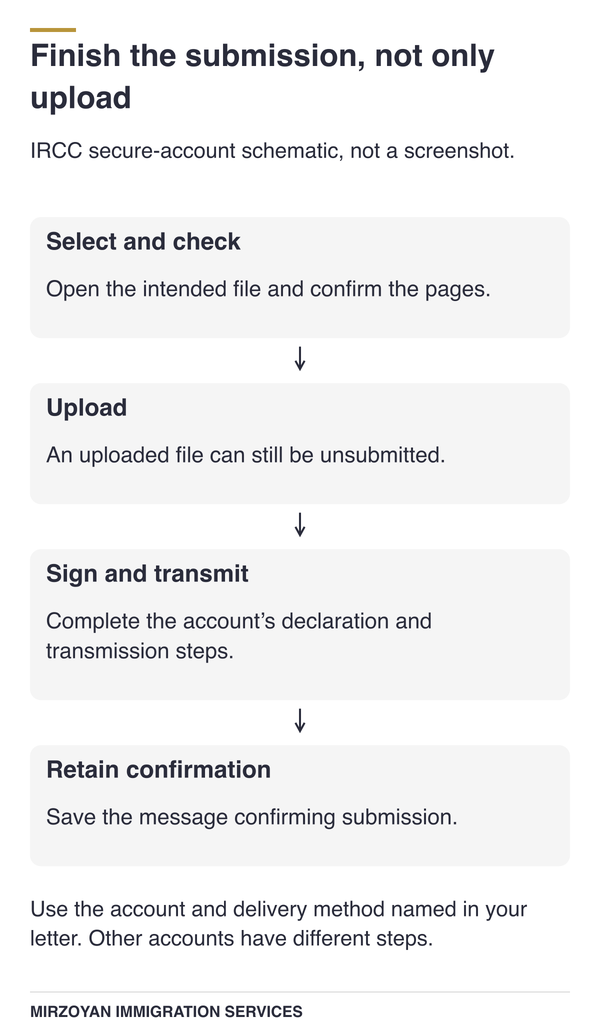
Account-specific schematic based on the IRCC secure-account instructions. Uploaded is distinct from transmitted. A technical-error report is also distinct from submitting the requested evidence and does not itself extend the deadline.
What if the response deadline has already passed?
Contact IRCC promptly if you have missed a citizenship response deadline, but do not assume a late response will be accepted. Explain why the date was missed and provide evidence supporting that explanation. Check whether the file remains pending or whether IRCC has already issued a decision. But sending documents does not automatically reverse a completed decision; the next steps depend on the file's status. Keep a copy of the original request and any later correspondence so the sequence is clear.
Under section 13.2 of the Citizenship Act, certain failures without a reasonable excuse can result in an application being treated as abandoned. These include failing to provide required information or evidence by the specified date, or missing a required appearance. But the provision does not make every missed deadline an automatic refusal. It also states that no further action is required on an abandoned application. If IRCC has already declared abandonment or refused the application, obtain individual advice about that decision. Any further action must address that decision, not just the earlier request for a document.
What happens after you respond to IRCC?
After a citizenship PFL response, IRCC may continue assessing the file, request further information, arrange an interview or issue a decision. The outcome depends on the application and whether the concerns are resolved. But a submission confirmation does not tell you which outcome will follow.
Keep monitoring the communication channel used for your application and maintain current contact information. Save any further request alongside your earlier response so you can identify what IRCC still needs. IRCC's after-you-apply guidance explains citizenship tracking and further contact during processing.
And your response deadline does not set a deadline for IRCC to decide the file afterward. Do not plan travel, a passport application or another commitment around an assumed PFL review period. If another letter arrives, compare its wording with the concern you already answered. The later letter may identify a different issue or ask you to clarify part of your earlier answer.
How IRCC reviews your explanation and documents
IRCC considers whether evidence is reliable, relevant and sufficient to establish the facts needed for the application. Its decision-making guidance distinguishes believable evidence from evidence that actually proves the disputed point. But an authentic document can still leave the question being asked unresolved. For example, a record identifying a parent does not necessarily establish that parent's citizenship date. So your explanation should make clear which fact each attachment supports.
Review the response from the perspective of someone who does not already know your family or travel history. Can that reader find the disputed date, the explanation and the supporting page without guessing? Does an attachment contradict your answer, or leave an important period unexplained? Correct the presentation where you can and disclose any limitation that remains. This is a way to check your explanation, not a prediction of the order an officer will read the file.
Mistakes that can leave IRCC's concerns unanswered
A general explanation of why you want citizenship may leave the specific concern in your PFL unanswered. A paragraph about your ties to Canada does not resolve a specific unexplained absence. And a long family history may not establish the missing parent-child relationship. Use the actual concern as the test for each paragraph, then remove material that distracts from it. Keep facts, explanations and supporting records connected throughout the response.
Unexplained corrections create another avoidable problem. Replacing a travel schedule without identifying the change makes the officer compare two versions without your explanation. Submitting a new civil record without addressing its conflicting date creates a similar difficulty. IRCC's evidence guidance identifies inconsistencies as relevant to assessment. Explain the correction and its supporting basis rather than hoping the newer attachment will speak for itself.
But even a complete explanation can remain unsent if you leave the account's final submission step unfinished. Before the deadline, check both the content and the delivery record. Ask whether every concern has an answer, every referenced attachment is included and any outstanding item is explicitly identified. And confirm the response was sent through the applicable channel. If an attachment is missing, add it before sending rather than leave the officer searching for a record you referenced.
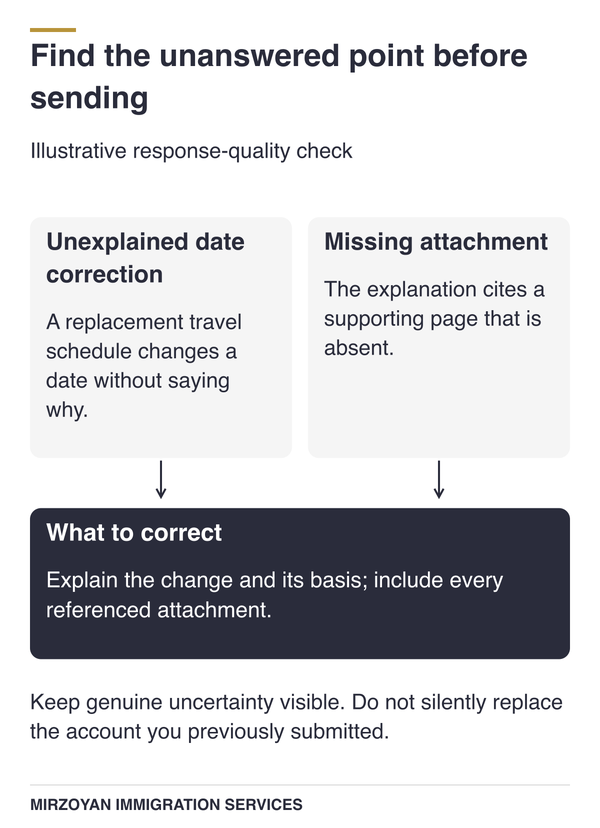
Fictional review example of two response defects, not an actual letter. Identify the changed information, explain its support and verify every cited attachment is present. A correction still needs assessment; no result is promised.
Should you prepare the response yourself or get professional help?
A straightforward request for a readable copy may be manageable if you understand the instructions and have the document.
A PFL involving disputed citizenship, conflicting records or an allegation of false information calls for a more careful assessment.
But the difficulty is not always the number of pages requested.
It may be the effect of a correction, a missing family link or uncertainty about what the officer is alleging.
Consider seeking advice early enough for the concern and available evidence to be reviewed before the deadline.
For help with a grant response, consider Mirzoyan Immigration Services' Canadian citizenship application service.
For a disputed certificate or descent claim, start with proof-of-Canadian-citizenship assistance.
Have the letter, submitted application, earlier correspondence and available supporting records ready for that discussion.
Ask what review or representation would cover, especially if some evidence is still outstanding.
And professional help does not remove the deadline or guarantee that IRCC will accept the response.
Through One on One Advisory, the consultant answers your communications directly, without intake staff or assistants handling them.
That consultant is Narek Mirzoyan, RCIC # R1005184, or Vahe Mirzoyan, RCIC # R514223.
You discuss the citizenship letter with the licensed professional advising you, including any concern you do not understand.
Share the response deadline when requesting help so the urgency is clear from the outset.
A consultation can establish what assistance is appropriate for your circumstances.
Reviewing the letter against the submitted application helps separate the officer's concern from unrelated background.
Matching each explanation to its supporting record helps identify gaps before you send the response.
Key Takeaways
Read the full letter to distinguish an information request, a PFL, an appointment notice and a completed decision.
Answer each concern with an explanation and supporting evidence; more attachments do not necessarily make a stronger response.
Explain missing records and extension requests promptly, with evidence of your efforts to obtain the documents.
Check that your response was submitted, retain the complete package and monitor for further correspondence.
Mirzoyan Immigration Services can review the letter and evidence with you; professional assistance does not guarantee a particular decision.
Frequently Asked Questions
What is a procedural fairness letter from IRCC?
An IRCC procedural fairness letter gives you an opportunity to address concerns before a decision on your application. For citizenship, read which facts or requirements the officer questions. A PFL is different from a routine request for a clearer document. Your reply should connect each concern to an explanation and supporting evidence. The letter also sets the response instructions you need to follow.
What does it mean when IRCC asks for additional documents?
An IRCC request for additional documents means more material is needed to assess your application. It does not automatically mean refusal is planned. Citizenship quality-assurance checks can also involve further information or an interview. Read whether the letter simply requests a record or identifies a concern requiring an explanation. Respond to those instructions rather than assuming every additional-document request is a PFL.
How to respond to IRCC procedural fairness letter?
Respond to an IRCC procedural fairness letter by answering each concern and identifying the evidence supporting your explanation. Use the deadline and delivery method in your letter. Explain any missing record and document your efforts to obtain it. Ask promptly if you need more time, without assuming an extension. Before finishing, check that the response was transmitted and keep the complete submitted package.
What happens after a procedural fairness letter?
After your PFL response, IRCC assesses the explanation and evidence alongside the application. The officer may request further information, arrange an interview or make a decision. Sending a response does not guarantee approval. A transmission confirmation establishes delivery information, not whether the concerns were resolved. Continue checking the communication channel for your application and keep your contact details current while the assessment continues.
How long does IRCC respond after a procedural fairness letter?
IRCC's published citizenship instructions do not give a universal decision period after a PFL response. The time depends on the file and any further assessment needed. The deadline in your letter is your deadline to respond, not IRCC's decision date. Keep monitoring your application and any later correspondence. Do not rely on an online estimate of weeks or months as a promise for your file.
Conclusion

AI-generated illustrative preparation scene. Bring the full letter, submitted application and available supporting records; no actual client or outcome is depicted.
Have the full IRCC letter, submitted application and available supporting records ready before seeking advice about your response. Identify the deadline and the concern you cannot yet answer. But do not wait for every outstanding record before asking whether the response needs professional review. Mirzoyan Immigration Services can discuss assistance with your citizenship-grant response or a letter concerning proof of citizenship. Share the response deadline when requesting a citizenship-letter consultation.
Disclaimer
The citizenship information in this guide is general and does not assess an individual application or IRCC decision. Requirements and procedures can change, and the facts of your file matter. Read your letter and current official instructions, and obtain individualized advice where needed. Reading this article does not create a consultant-client relationship.