Canadian Citizenship Test: Format, Study Guide, Attempts and Results
Applicant taking Canadian citizenship test
The Canadian citizenship test measures knowledge of Canada and citizenship responsibilities, but it remains one part of a larger grant application. And for the broader eligibility and filing journey, read about Canadian citizenship in Canada.
Current IRCC test rules give most applicants 20 questions and 45 minutes, with at least 15 correct answers required. And online applicants normally receive a 30-day access period and up to three chances.
By Narek Mirzoyan, RCIC # R1005184,. Verify this credential on the CICC public register.
Last reviewed by Narek Mirzoyan, RCIC # R1005184, on 2026-09-16.
TL;DR:
Canadian Citizenship Test: Format, Study Guide, Attempts and Results explains the current exam, preparation, and what follows. The test has 20 questions, allows 45 minutes, and requires at least 15 correct answers. Most invited applicants take it online within a 30-day period and receive up to three chances. Discover Canada is the official study guide, but an unclear ID image can invalidate the result, even after a high displayed score.
Table of Contents
The current Canadian citizenship test at a glance
Who normally has to take the test?
What questions are asked in the Canadian citizenship test?
A preparation loop built around Discover Canada
Practice-test claims that can mislead applicants
How the online test invitation and access window work
Test-day rules that protect result validity
Technical problems, missed tests and rescheduling
The Internal Logic of an IRCC Officer
Temporary score, official result and the three attempts
Interview, retest and hearing are not the same
Red Flags & Procedural Fairness Letters (PFL)
The current Canadian citizenship test at a glance
The current test has 20 multiple-choice or true-or-false questions in English or French, with 45 minutes and 15 correct answers required. But unclear ID or webcam images can invalidate a displayed score when IRCC cannot confirm identity.
| Feature | Current rule | Stale claim to avoid | Official source |
|---|---|---|---|
| Questions | 20 questions | A different question count | IRCC study page |
| Question types | Multiple choice or true or false | Multiple choice only | IRCC study page |
| Time | 45 minutes | 30 minutes | IRCC online-test page |
| Pass mark | 15 of 20, or 75% | An unofficial pass percentage | IRCC results page |
| Attempts | Up to three during the test period | One attempt only | IRCC results page |
The timer cannot pause, and the system submits an online test automatically after 45 minutes, even when questions remain unanswered. And IRCC provides a five-minute warning, so a 30-minute practice timer does not reproduce the current official duration.
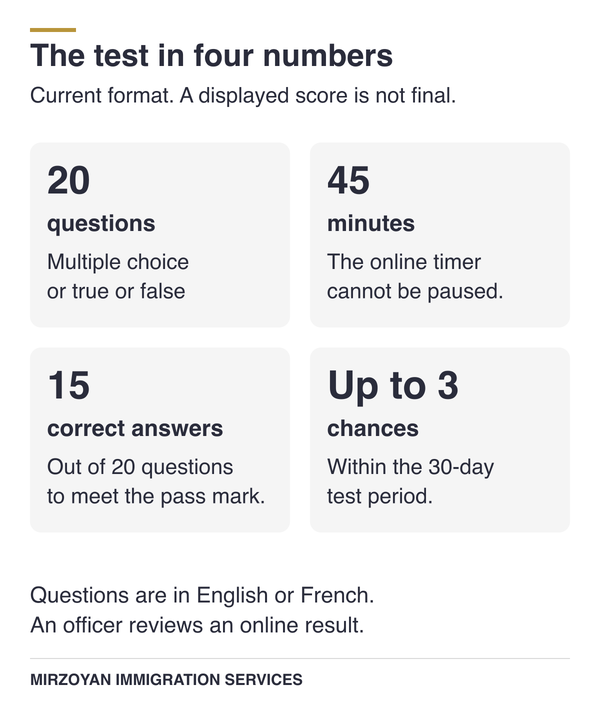
The test uses 20 multiple-choice or true-or-false questions, a 45-minute duration and a 15-answer pass mark. Up to three chances fall within the 30-day test period. Online results remain temporary until reviewed; the graphic does not promise a pass.
Who normally has to take the test?
Most applicants aged 18 through 54 when signing must take the test because that date fixes the age assessment. But an approved waiver, not a pending request, changes that normal rule for someone inside the age range.
Age is measured when the application is signed
IRCC applies the age range when you sign, so turning 55 later does not rewrite the age recorded at filing. And the Citizenship Act sets the knowledge requirement for applicants aged 18 or older but under 55.
If the application concerns a child, use the separate citizenship rules for minors because minor grant procedure does not belong here.
A waiver is not the same as an automatic age exemption
Applicants under 18 or aged 55 and older when they sign normally do not take the citizenship test. Applicants aged 18 to 54 remain subject to it unless IRCC approves a waiver. An accommodation instead helps you meet the requirement, such as through extra time or an oral, large-print or Braille test. IRCC's accommodation instructions also address applicants without suitable internet access or equipment. Request the assistance that addresses your difficulty rather than assuming you must seek a complete exemption.
You can identify accommodation needs in the application. After applying, IRCC recommends using the accommodation email address in your test invitation; a web form is another option. Explain what you need and include your application number, UCI and supporting documents where applicable. A waiver request requires a different assessment of why you cannot meet the requirement. Broader language eligibility and waiver distinctions are covered in the Canadian citizenship requirements guide.
What questions are asked in the Canadian citizenship test?
Questions cover Canadian rights, responsibilities, history, geography, government, laws, economy, and symbols, and IRCC bases every official question on Discover Canada. But it does not publish future live questions, so an answer bank cannot prove what will appear.
Every official question is based on Discover Canada
IRCC identifies Discover Canada as the official study guide, available free in online, PDF, eBook, audio, and paper formats. But paying for another guide cannot make its questions official.
The legal subject list covers Canadian history, geography, constitutional monarchy, democratic participation, society, rights, freedoms, obligations, and citizenship responsibilities under the regulations.
The knowledge test is not itself a language-skills test
Questions are available in English or French, but IRCC says the knowledge test is not designed to assess language ability. However, an officer may observe official-language communication during a later interview.
Third-party questions are practice, not official exam content
Practice questions can reveal weak topics but cannot prove which questions will appear on your examination. So do not rely on any seller claiming access to live questions.
A preparation loop built around Discover Canada
If practice scores stall, taking another round of random quizzes is rarely the answer. Effective preparation returns each error to Discover Canada, the official source. But tracing weak topics back to the guide builds recall instead of rehearsing guesses.
Take a diagnostic practice set. Record the topic behind each missed answer, such as government, history, rights, or geography.
Find each weak topic in Discover Canada. Read the complete source section instead of memorizing one explanation from a quiz.
Write a short recall note. Explain the rule, event, institution, or responsibility without looking at the guide.
Retest under a 45-minute limit. Use the current official duration and include both multiple-choice and true-or-false items.
Review mistakes before taking another set. Stop searching for real questions and repeat the source-based cycle.
IRCC's official study questions show the knowledge to review, but they are not a published copy of a future test.
If one chapter repeatedly causes errors, explain it aloud because the examination requires unaided recall, not recognition.
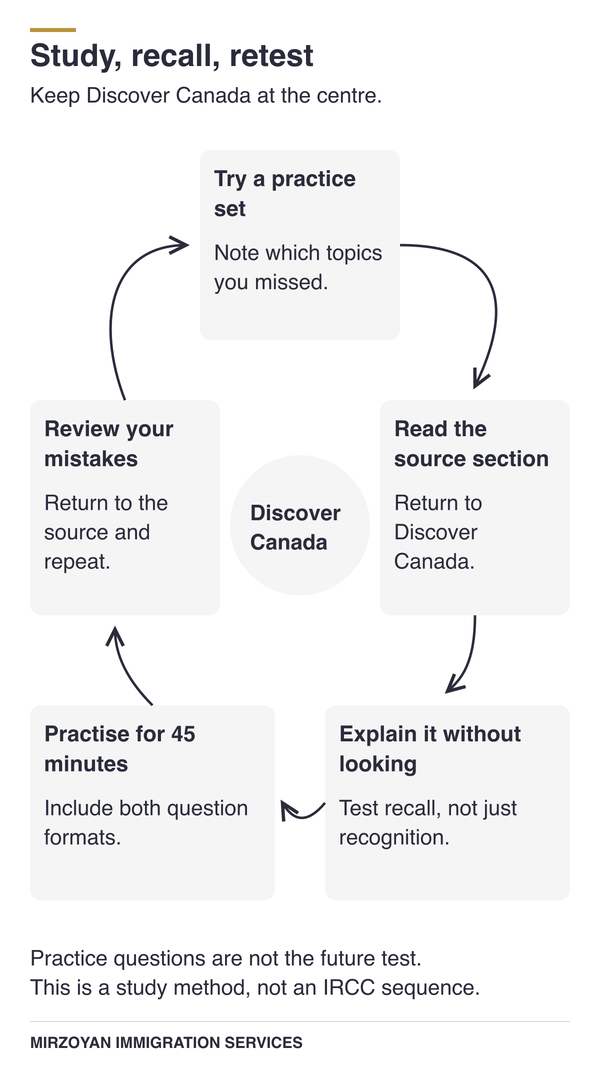
Use a practice attempt to locate weak topics, review the official guide, practise recall and retest. The loop is the article’s suggested preparation method, not an official IRCC workflow or a claim to know future examination questions.
Practice-test claims that can mislead applicants
A practice score can mislead you when the tool's timer or format conflicts with current IRCC rules. So check its question types, source edition, and review date before relying on it.
A useful quiz still is not an official source
IRCC warns that third-party guides, tests, and questions are used at your own risk. But a polished interface or app-store rating does not establish official status.
Check duration, question types and reviewed date
A 30-minute simulation trains pacing against the wrong clock and a multiple-choice-only set omits true-or-false questions. An undated guide gives no reliable way to check whether its process instructions remain current.
Use practice content carefully for recall, then confirm mechanics, access rules, and next steps on Canada.ca before the invitation period begins.
Never pay for a claim of access to live questions
IRCC does not publish a live examination bank, so a seller's “real questions” label cannot be verified through the official guide. And it may distract you from the broad topic coverage IRCC actually tests.
How the online test invitation and access window work
Treat the invitation as an operating window, so compare its dates with your location and supported device before day one. If dates are not 30 days or access may fail, use the invitation contact route before the period narrows.
The invitation defines the 30-day period
IRCC says most people receive an invitation one to three months after their Acknowledgement of Receipt. But a non-routine application may take longer, and you cannot book the test yourself.
Check that the PDF lists a 30-day start-to-end period, application number, UCI, and contact address. If the dates are wrong, email that address with the invitation, explanation, application number, and UCI.
If the tracker shows a scheduled test but no email before the start date, follow IRCC's missing-invitation instructions before losing access time.
You do not need to be physically in Canada for the online test
IRCC permits testing outside Canada, but its online-test instructions still require supported equipment, identification, privacy, and a pre-start room and connection check. But if only excluded technology is available, arrange another device before opening the timed test.
The test link will not work outside the access window
The emailed test link expires after 15 minutes, but the invitation period lasts 30 days. If the short link expires, sign in again and request the newest one.
Near the period's end, save any error and contact the invitation office because another requested link does not extend the window.
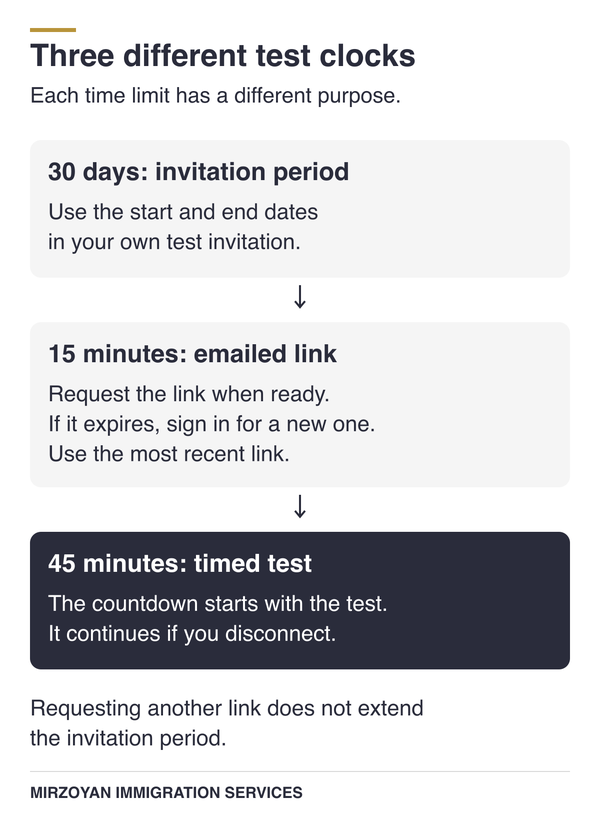
The 30-day invitation window, 15-minute emailed-link lifetime and 45-minute test timer are separate. A replacement link does not extend the invitation window; the timed test cannot be paused. Follow the dates and instructions in the actual invitation.
Test-day rules that protect result validity
The online system must confirm your identity and independent work, so inspect the approved ID and face images before starting. But a high score cannot cure unreadable photographs, so inspect a PR card or other photo-and-signature ID before starting. And make sure your card and face are clear before approving each image because IRCC's online testing rules require the following setup.
Keep your webcam on and your full face visible.
Use a reliable Internet connection.
Close every other tab, window, program, and browser extension that could interfere.
Turn off any VPN.
Stay alone and in the place used for the pre-test photographs.
Remove background items showing personal information.
Do not use another device, study material, or the browser's back button.
Random webcam photographs are compared with earlier images, and technical or cheating concerns may invalidate the result or require another test.

AI-generated illustrative setup, not an IRCC screen. Follow the article's device, browser, identification and VPN instructions.
Technical problems, missed tests and rescheduling
A technical interruption, first missed invitation, and second miss have different consequences, so preserve the details before choosing a contact route.
Document the technical failure before contacting IRCC
Record the error message, time, device, browser, connection, steps tried, and screenshots. When I review an interruption, I compare those records with the explanation before it goes to IRCC.
If a webcam failure blocks return within 45 minutes, email the invitation address with troubleshooting, device, application number, and UCI details. The online help page says rescheduling usually takes four to eight weeks, although some cases may take longer.
A first missed online invitation and a second miss are treated differently
The good news is that IRCC sends a new invitation after the first missed period, with three chances in the new window.
After a second missed invitation, email the rescheduling address with your explanation, application number, and UCI. And after two missed online periods without contact, IRCC may abandon the application; explain missed in-person or Teams appointments within 30 days.
Follow the contact route in the invitation
Do not send test details to an unrelated general mailbox because the invitation identifies the responsible office and rescheduling address. And keep the sent email and attachments with your application records.
Application-level support:
Technical correspondence may expose a broader identity, document or eligibility issue. Mirzoyan Immigration Services offers help through Canadian citizenship application services. The service does not sell test questions or promise a passing score.
The Internal Logic of an IRCC Officer
An officer reviews more than the displayed number because the result must connect to a verifiable identity and valid testing event.
IRCC compares random webcam photographs with the pre-test image and application photographs. And the officer must confirm that the same person remained visible and worked alone. But blurred identification or another person can prevent confirmation, while the results page separates pass, fail, and invalidated outcomes. But a suspected cheating concern or technical problem can invalidate a score when identity or results cannot be confirmed.
I never treat a displayed 19/20 as final during file review when IRCC has questioned the ID image or webcam record.
An official pass resolves only the knowledge-test requirement, although IRCC may still interview you to verify identity, authenticate documents, or confirm eligibility. And the interview does not necessarily produce a final decision.
Temporary score, official result and the three attempts
An online score shown after submission is temporary, and an officer reviews the event before the result becomes official. So save the page immediately, then follow the official pass, fail, or invalidation notice.
A high temporary score followed by an invalidation email is upsetting, but it does not automatically mean you failed the knowledge questions.
Save the results page through its print or email controls because IRCC sends no completion email and blocks later reopening.
| Event | What it means | Immediate next step |
|---|---|---|
| Score displayed online | Temporary result only | Save the page and wait for officer review |
| Official pass | Knowledge requirement met | Follow any interview or ceremony instructions |
| Failed attempt one or two | Another chance remains in the current test period | Review weak topics and sign in again during the period |
| Three failed attempts | IRCC records a failed test result | Wait for a hearing invitation |
| Invalidated result | Identity, score, technical integrity, or conduct could not be accepted | Follow IRCC's retest or correspondence instructions |
| First missed online invitation | No test was completed in the period | Wait for the automatic new invitation |
| Second missed online invitation | Application-abandonment risk | Email the invitation's rescheduling address |
An invalidated result is not the same as failing the knowledge questions, and IRCC may send another invitation or retest instruction. So follow the notice instead of assuming an attempt was counted.
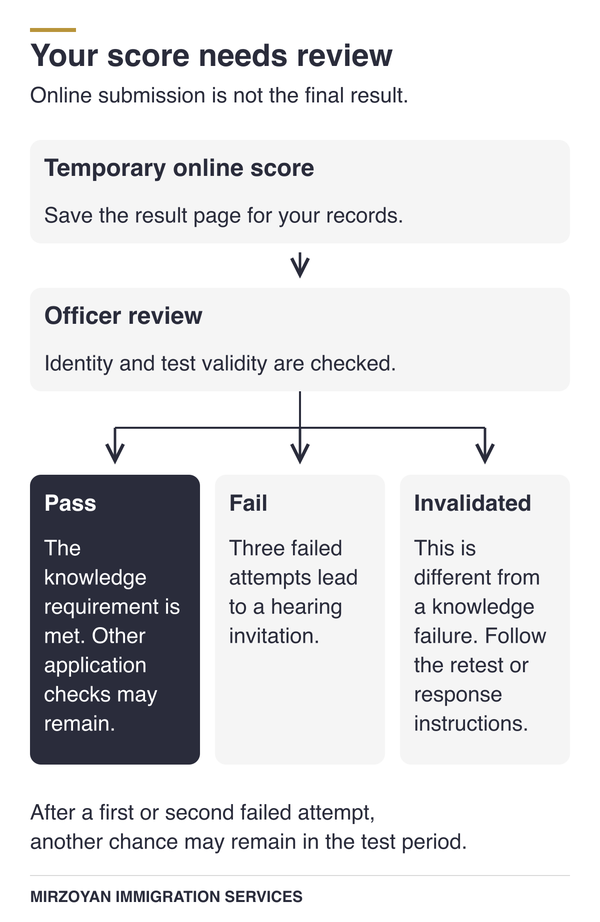
An officer makes the online result official. Passing addresses knowledge, not all citizenship requirements. The fail branch here is the official result after three failed attempts; earlier failed attempts can leave another chance in the same window. An invalidated result requires IRCC’s own next-step instructions.
Interview, retest and hearing are not the same
The next notice after a test result determines what you need to prepare. An interview may concern identity or application evidence, while a retest requires following another test invitation. A hearing can involve oral questions and a wider eligibility assessment. Read the appointment type and requested documents before deciding that more practice quizzes are your only preparation. If the notice is unclear, use its contact instructions to ask what you must provide rather than guessing from another applicant's experience.
An interview can follow a passed test
Passing the test does not remove the need to verify your identity or the documents in your application. For an interview, IRCC asks for the original application documents and relevant five-year passports or travel documents. Match those originals to the copies you submitted so you can locate each item during the appointment. Review any specific document request in the invitation alongside that general list. If something is unavailable, raise that issue through the invitation's contact route before the appointment rather than silently omitting it.
A hearing follows three failed attempts
After three failed attempts, IRCC invites you to a hearing with a citizenship official. The oral knowledge assessment has 20 questions, with 15 correct answers required. Prepare to answer aloud rather than relying only on recognizing answers in an online multiple-choice quiz. Use Discover Canada to practise explaining the topics you found difficult in your own words. Read the hearing invitation for its format, arrangements and any documents you need to prepare.
If an accessibility need affects your ability to participate, request assistance through the office that sent the invitation. Describe the difficulty and the support you need rather than waiting until the oral assessment begins. Practising aloud can help preparation, but it does not replace an accommodation decision or change the knowledge requirement.
The hearing may assess more than knowledge
A hearing can also cover residence or language, depending on the appointment, and can last 30 to 90 minutes. IRCC's language assessment can include up to nine questions, with six correct answers required. The results guidance explains that IRCC sends its decision afterward: passing leads toward the ceremony, while failing results in refusal. A fresh application after refusal requires paying the fees again. Prepare for the subjects identified in your notice rather than assuming every hearing repeats only the knowledge test.
A failed test can also affect applications being processed together as a family or group. IRCC may separate applications in some cases; ask through the rescheduling email address in the test invitation. Separation is a request, not an automatic result of another applicant passing. Keep the response with your application records so each person follows the instructions applying to their own file.
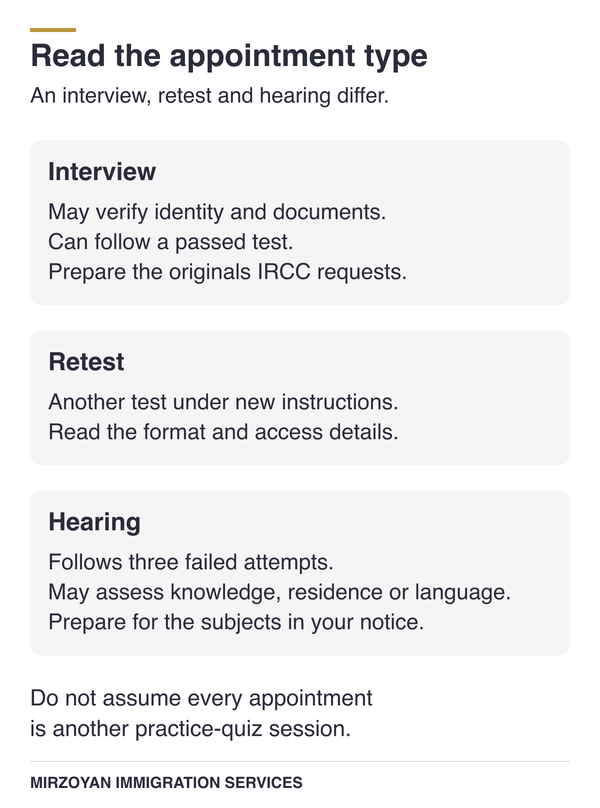
The invitation determines the appointment and preparation. An interview may check identity and eligibility even after a pass. A retest follows its specific instructions. A hearing after three failures may assess knowledge, residence or language; the article explains the separate assessments.
Red Flags & Procedural Fairness Letters (PFL)
Not every invalidated result produces a Procedural Fairness Letter because IRCC's public test guidance usually describes invalidation, follow-up, or another test.
Three test-record concerns require careful reading if IRCC raises them in correspondence:
Identity photographs do not align. A blurred ID image or inconsistent pre-test and monitoring photos can prevent IRCC from confirming who took the test.
The record suggests outside assistance. Another person, device, open program, or study material may create a suspected cheating concern.
The technical explanation conflicts with cited records. An answer should address each timestamp, photograph, device fact, or system event named by IRCC.
Cheating or technical identity concerns can invalidate a result, while false information can cause refusal and a citizenship-application ban.
If you receive a PFL, answer the exact concern and attach supporting records. But “the webcam failed” may leave identified facts unanswered, so I first separate identity, assistance, and technical-record concerns.
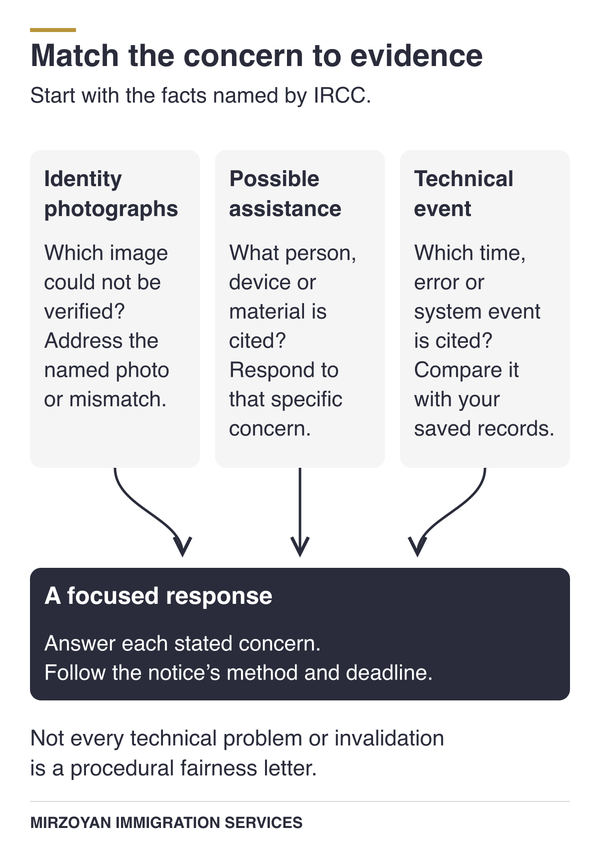
The diagram illustrates how to connect a stated concern with relevant existing evidence. It is not a mandatory document list and does not imply every invalidation is a PFL. Preserve the full correspondence and follow the response method and deadline actually given.
When a test-related application review can help
The official study guide and test instructions may be enough when you are preparing for an ordinary test invitation. A consultation becomes useful when IRCC correspondence raises an identity, document or eligibility concern that you cannot resolve. Mirzoyan Immigration Services can review that correspondence alongside the application and available records. Separating the stated concern from a study or technical-access question helps identify what the response needs to address.
Through One on One Advisory, Narek Mirzoyan, RCIC # R1005184, or Vahe Mirzoyan, RCIC # R514223, answers your citizenship-file questions directly. Intake staff and assistants do not replace that discussion with the licensed consultant. Explore Canadian citizenship application services if the issue concerns the application or an IRCC response. This assistance does not provide test questions or guarantee a passing score.
Key Takeaways
The current test has 20 questions, allows 45 minutes, and requires at least 15 correct answers.
Discover Canada is the official study guide; paid or third-party questions remain unofficial.
Online validity depends on clear identity photographs, webcam visibility, working alone, and following device rules.
The immediate online score is temporary, while an officer's later review creates the official result.
Mirzoyan Immigration Services supports application-level risks and IRCC correspondence, not access to test questions or a guaranteed pass.
Frequently Asked Questions
Is it easy to pass the Canadian citizenship test?
The Canadian citizenship test is manageable when you study Discover Canada and can recall its main subjects. You must answer at least 15 of 20 questions correctly within 45 minutes. Difficulty varies with preparation and language comfort. IRCC does not publish a current national pass rate on its test pages, so unsupported percentages should not guide your planning.
How to pass the Canadian citizenship test?
Use Discover Canada as the controlling source, identify weak topics through practice, review those source sections, and retest under 45-minute conditions. Do not memorize an unofficial answer bank. The real test includes multiple-choice and true-or-false questions. You need at least 15 correct answers, and IRCC gives up to three chances during the test period.
Can I take my Canadian citizenship test online?
Most invited applicants take the Canadian citizenship test online during the 30-day period stated in their invitation. IRCC allows the online test from outside Canada. You need a supported computer or tablet, Chrome or Safari, a webcam, and acceptable identification. Mobile phones, Chrome on iPad, Microsoft Surface Pro, and VPN connections are currently excluded.
What topics are covered on the Canadian citizenship test?
The Canadian citizenship test asks about rights and responsibilities, history, geography, economy, government, laws, and symbols. And every official question is based on Discover Canada, using multiple-choice or true-or-false questions. But IRCC does not publish future live questions, so third-party claims of an official question bank should be treated as unofficial.
How many attempts for the Canadian citizenship test?
IRCC gives up to three chances within the test period, whether the assigned format is online, Microsoft Teams, or in person. After three failed attempts, IRCC invites you to a hearing with a citizenship official. An invalidated result is different from a failed knowledge attempt, so follow the specific retest or correspondence instructions IRCC sends.
Conclusion
Your next move now depends on the file's current state: study, test, save the result, or answer IRCC. But if application-level correspondence arrives, Mirzoyan Immigration Services can review it through Canadian citizenship application services. Bring the correspondence and response deadline to the consultation.
Disclaimer
This article provides general information, not legal or immigration advice. Citizenship rules and procedures can change, and individual circumstances differ. Obtain advice about your specific application before acting on an IRCC notice.