Canadian Citizenship by Descent Application: Forms, Documents and Process

A Canadian citizenship by descent application lets you request a certificate confirming citizenship you may already hold through a Canadian parent or ancestor. Your supporting documents must establish the family relationships and citizenship history behind that claim. A Canadian ancestor's records alone do not establish every link between you and that person. Before completing the forms, check Canadian citizenship by descent eligibility and whether you must apply on paper. Then prepare the evidence for your first certificate, including explanations for missing records or differences between family documents.
By Narek Mirzoyan, RCIC # R1005184,. Verify this credential on the CICC public register.
Last reviewed by Narek Mirzoyan, RCIC # R1005184, on 2026-09-16.
TL;DR:
Apply for a citizenship certificate if you need official proof of citizenship you may already hold through descent. Check whether you can apply online before preparing the forms, photos and supporting records. Your evidence must connect each relevant generation, and missing official records need an explanation with proof of your efforts to obtain them. Keep a complete submission copy and follow IRCC's instructions for tracking, further requests and certificate delivery.
Table of Contents
Before you apply for your first citizenship certificate
Complete the citizenship certificate application
Documents for your Canadian citizenship by descent application
Missing records and differences between documents
Pay the application fee and save your receipt
Submit your application and track its progress
Processing times and receiving your certificate
How IRCC reviews your citizenship claim
If IRCC asks for more information
Before you apply for your first citizenship certificate
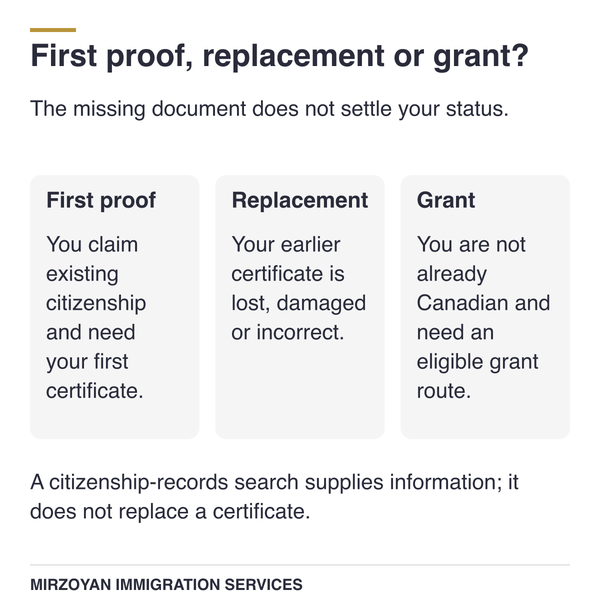
Three reader needs, not three interchangeable applications. Establish whether citizenship already exists before choosing the process. First proof and replacement are circumstances within the certificate process; grant eligibility is separate.
Apply for a citizenship certificate when you need IRCC to confirm Canadian citizenship you believe you already hold. You may already be Canadian even if your family never obtained a citizenship certificate for you. However, the application must explain why the law recognizes the person as Canadian; identifying a Canadian relative is only the starting point. If recent changes affected your family, review how Bill C-3 changed citizenship by descent before selecting the supporting records. The application process below assumes you are seeking your first certificate through descent.
If your previously issued certificate is missing or damaged, get help replacing a Canadian citizenship certificate. But if you are unsure what an old document establishes, start with documents that prove Canadian citizenship. And a records search may locate an earlier citizenship record, although the result does not replace the certificate. If the status assessment shows that you are not already Canadian, review the applicable Canadian citizenship requirements. But if you need a grant, use that application rather than asking for a certificate of citizenship you do not hold.
Applying online or on paper
Check whether you qualify to apply online before choosing how to prepare your application. IRCC's application questions consider your circumstances, including relevant details about your Canadian parent's birth and citizenship history. But creating an online account does not mean your descent claim qualifies for online submission. And you can use paper if you cannot or prefer not to apply online. Once you know which channel you can use, prepare the photos and documents in the required format.
For an eligible online application, use the IRCC secure-account instructions, which identify the proof-of-citizenship application option. The online questionnaire generates your document checklist, and the guide currently allows 60 days to submit after starting an application. So obtain records with long waiting periods before you start the online application and its submission clock. If the screening questions or guide leave your online eligibility unclear, clarify the instructions with IRCC or use the paper application. And if you have already applied on paper, keep that application active rather than duplicating the request online.
Complete the citizenship certificate application
Use the current citizenship-certificate application instructions, even if a relative has given you a copy of their successful package. For paper applications, download CIT 0001 directly from IRCC and read its completion instructions alongside the guide. Use the associated document checklist, CIT 0014, to identify what your circumstances require. But online applicants follow the guided application and personalized checklist; the paper-form steps do not all apply unchanged. If collecting your family's records took several months, check whether IRCC has updated the package before you sign.
Answer questions about the applicant, including when a parent completes the application for a child. In a paper application, enter “Not Applicable” where a question does not apply, and identify the question number on any additional sheet. But if you do not know an answer, explain the gap as permitted rather than inventing a date for the form. Print, sign and date a paper application according to its instructions, including the requirements that apply when signing for a child. Then compare the completed form with your records, particularly the names, birthplaces and citizenship dates, before signing.
Documents for your Canadian citizenship by descent application
Your documents must support both your identity and the citizenship history connecting you to your Canadian parent or ancestor. Begin with the current application package and checklist, then group the records by person. Beside each record, note the relationship or citizenship fact it supports so that a missing link is visible before submission. And some claims need additional evidence, such as a parent's time in Canada when the physical-presence requirement applies. The parental physical-presence form, CIT 0555, applies to certain births outside Canada from December 15, 2025 onward. So check the guide's questions before adding that form to your application. Your relative's checklist may concern a different citizenship history, so use the one that applies to your claim.
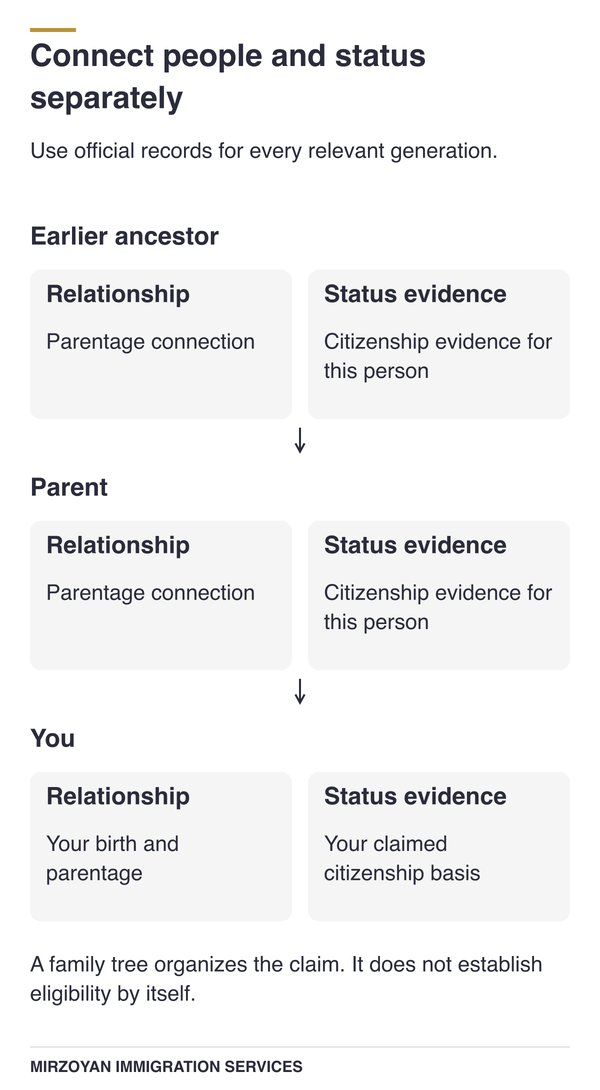
Unbranded record map. Parentage records connect each generation, while separate evidence establishes the relevant person’s citizenship and effective date. This is not a determination that citizenship passed through the illustrated chain.
Proof of your parent’s or ancestor’s Canadian citizenship
Identify the Canadian citizenship evidence for the person through whom you are claiming descent. Depending on the family history, relevant records may include a Canadian birth certificate, citizenship certificate, naturalization record or qualifying historical record. But check which person and citizenship fact the document identifies before relying on it for your claim. The IRCC evidence instructions require records from the authority that originally created or maintains them. A genealogy website can help you locate a record. However, material collected from third parties cannot be the sole support for the application.
I check whether the parent's citizenship took effect before the child's birth when reviewing the dates in a descent application. So record when citizenship took effect separately from when the certificate was printed or issued. Where later legislation may have recognized citizenship, keep the supporting history with the relevant family member's documents. For a claim through a grandparent or earlier ancestor, the guide to citizenship through grandparents explains which intervening generations need examination. But the ancestor's certificate cannot, by itself, establish whether citizenship passed through the intervening generations to you.
Birth records connecting each generation
Use birth and parentage records that connect you to each relevant generation in the claim. Your birth record needs to identify the parent through whom you are claiming citizenship. And each earlier generation needs records showing its own parent-child relationship. Check the parentage fields before ordering a certificate, because a short extract without the necessary information may not answer the question. But a requirement for an official record does not necessarily mean you must mail the physical original. The paper guide generally requests clear, readable colour copies unless it says otherwise. So send originals when IRCC specifically requires them; a third-party checklist alone is not a reason to mail irreplaceable documents.
Read each copy at the size an officer will receive it, checking that names, registration details and page edges remain visible. And if the reverse contains relevant information, include that side as the checklist requires. Quebec birth and marriage certificates issued before January 1, 1994 are not accepted under the current guide. Obtain an acceptable newer document from the provincial authority. For other records, check the issuing authority and required contents rather than assuming that age alone makes a certificate unusable.
Identity documents, name changes and translations
Prepare the identity documents separately from the records proving your family relationships. IRCC generally asks for two valid identity documents showing your name and date of birth. At least one must include a photograph. But your birth certificate does not count toward the separate identity-document requirement. Applicants outside Canada may use qualifying equivalent foreign government identification. But if a child lacks two identity documents or photo identification, include the explanation permitted by the guide. Match the identity documents to the name requested on the certificate and include any required name-change evidence.
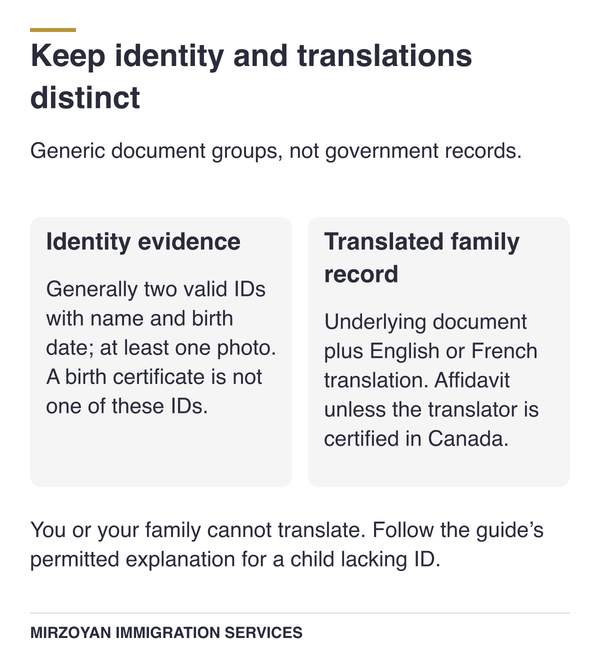
Identity evidence is separate from family records and their translation material. The translator affidavit is conditional. For an online application, combine the underlying record, translation and any required affidavit as instructed.
For a document in another language, provide the required English or French translation together with the underlying document. And unless the translator is certified in Canada, the instructions require the translator's affidavit. But neither you nor a family member can prepare the translation for this application. For online submission, combine the translation, underlying document and any required affidavit in the same upload file, following the guide. Check the translated names and dates against the original before uploading. If the translation introduces a different birth date, ask the translator to address it before submitting the document.
Citizenship certificate photo requirements: online and paper
Use the photo instructions for a citizenship certificate, selecting the version for your application channel. Both versions require a professional colour photo taken within the six months before you submit the application. The specifications show a 50 mm by 70 mm photo. And the chin-to-crown face measurement must be between 31 mm and 36 mm. Face the camera straight on, with your face centred and shoulders square, against a white or light-coloured background. Keep a neutral expression, with your eyes open and mouth closed, without smiling or frowning.
An online certificate application requires a single digital photograph, saved as a minimally compressed JPG or JPEG. IRCC specifies at least 420 by 540 pixels and a file size of approximately 240 kB, with a maximum of 4 MB. However, IRCC describes 240 kB as approximate; it does not state that figure as a minimum. Ask the photographer for the digital file saved directly from the camera without alteration. Do not retouch or digitally change it yourself. And record the person's first and last name, studio name and complete address, and photo date on the receipt or text file. Upload the photo to the digital-photo item and that supporting information to the client-information item identified in the online guide.
For a paper certificate application, include two identical colour prints on plain, high-quality photographic paper. The required back information includes your first and last name, the studio's name and full address, and the date taken. Follow the package instructions for enclosing the photographs without stapling or gluing them to the form. So check the printed measurements and required information before leaving the photo studio. And if the records search delays your application for several months, recheck the photo date before mailing. IRCC can return a paper application if the two required photos do not meet its specifications.
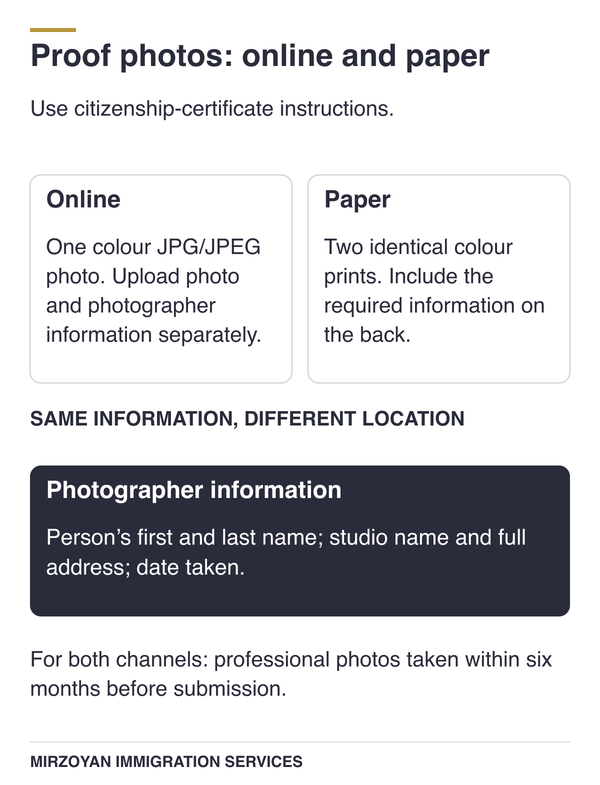
Proof/certificate applications only. Online: the photo goes in the digital-photo item; the receipt or text file with names, studio address and date goes in client information. Paper: two identical prints with required back information. Follow all current photo specifications.
You may be concerned about meeting the photo rules if you use medical equipment or wear a religious head covering. The specifications explain how to accommodate these circumstances while keeping your full face visible and free of shadows. But glasses must leave your eyes clearly visible, and tinted lenses are not accepted. A wheelchair user can use a white blanket behind the head to create the required background. For medical headwear or a nasal cannula, include the required signed explanation; IRCC may also ask for a doctor's letter. A child's photo must show the child without another person's hands, and IRCC allows some flexibility with a newborn's expression. Give the photographer the certificate instructions so that accessibility needs are considered before the photo is taken.
Missing records and differences between documents
Searching for an old family record can be frustrating, especially when the issuing office cannot locate it. Start by separating records you have not yet requested from those the issuing authority says it cannot provide. A record still being processed needs follow-up, while an unavailable record needs an explanation of the search and its outcome. But conflicting names, dates or places on existing records need their own explanation. Keep the evidence with the family member it concerns so the officer can follow the explanation without reconstructing the whole family history.
When you cannot obtain an official record
If you cannot obtain a required official record, explain why and document the efforts you made to get it. IRCC's missing-record instructions require more than a statement that the document is unavailable. Keep the request, any payment confirmation, the authority's reply and relevant search results together. Explain what record you sought and which fact remains unsupported. But do not assume that a personal affidavit or family tree will satisfy IRCC's requirement for the missing official evidence.
So check whether the unavailable record is your only evidence of a parent-child relationship or citizenship fact essential to the claim. An explanation can show why the record is missing, but you still need evidence of the relationship or citizenship fact. If the authority has said that a record will be issued, obtaining it may prevent a foreseeable gap in the application. But if the authority cannot provide the record, assess the reliable alternative evidence you can obtain. If that evidence leaves the parent-child relationship uncertain, identify the unresolved point before deciding whether to submit.
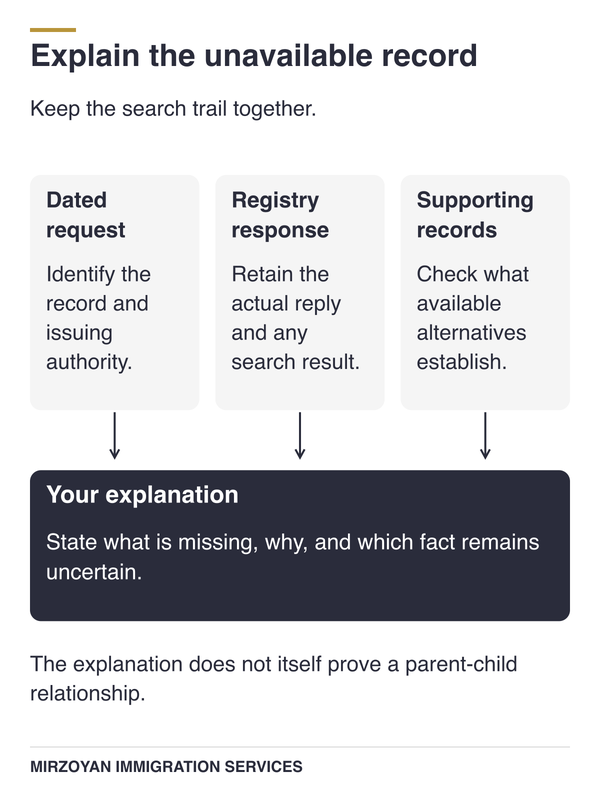
Illustrative evidence arrangement, not a real registry response. Request records from the appropriate authority and preserve evidence of the effort. The search explains the missing record; the underlying relationship or citizenship fact still needs support.
Unsure how to address a missing record?
Mirzoyan Immigration Services can review the available evidence and the fact the missing document needs to establish.
Explore proof of Canadian citizenship application assistance for your first certificate claim.
When names, dates or places do not match
Explain differences between documents using records that connect the conflicting information. A married surname, legal name change or spelling variation may have a straightforward explanation. Provide the supporting document so the officer can verify it. Set out the two versions and identify the supporting marriage certificate, name-change record or other relevant evidence. For a date or birthplace discrepancy, check whether the issuing authority can correct an error or explain how the entry arose. But keep the original discrepancy visible; do not edit the image to make the document match your form.
But distinguish facts you can support from explanations you are inferring about the difference. If a record uses an unfamiliar spelling, avoid stating that it is a translation variant unless you have support for that conclusion. Where a correction is pending, keep the correspondence and explain the unresolved point accurately. Identify the person and disputed entry in your explanation so IRCC can compare the records without guessing which difference you mean. If conflicting records leave you uncertain before signing, consider Mirzoyan Immigration Services' first citizenship-certificate application review.
Pay the application fee and save your receipt
The government fee for a citizenship certificate is currently CAD $75 per applicant. Check the official proof-of-citizenship fee before paying, particularly if you began preparing the application months earlier. And allow separately for records, translations, photographs, delivery and any professional assistance you choose. Use the payment instructions for your application channel and location, then include or upload the receipt where required. Keep your own copy with the submitted application so that you can identify the payment if IRCC later asks about it.
The processing fee is generally non-refundable once processing begins, including if IRCC refuses the application. But paying the fee does not establish eligibility or guarantee that IRCC will issue a certificate. For family applications, confirm the number of applicants covered by the payment and follow the instructions for attaching the receipt. The citizenship fees guide covers broader payment and refund questions without treating the certificate fee as the fee for a citizenship grant.
Submit your application and track its progress
Keep a complete copy of the application before submitting it. Save the final answers, documents, translations, explanations, photos and receipt in a folder you can refer to if IRCC contacts you. For paper applications, use the current destination instructions for where you live and keep the postal or courier tracking record. And for an online application, save both the confirmation page and the confirmation number. According to IRCC's after-application instructions, submission confirmation comes before the acknowledgement of receipt issued after the completeness check.
Check the account, email and mailing address used for your application while waiting. Online applicants receive messages through their account, while paper applicants should follow the tracking instructions provided with their acknowledgement. If you applied through a Canadian office abroad without providing an email address, contact that office. Ask it to confirm receipt and provide your identifier. But courier delivery only confirms arrival; wait for IRCC's acknowledgement before treating the package as accepted for processing. If IRCC returns the application or identifies missing information, read the accompanying instructions before correcting and resubmitting it.
Processing times and receiving your certificate
Plan for the application decision and the delivery of your certificate as separate steps. The published processing estimate cannot account for every family's records, verification needs or response delays. A file requiring additional evidence may take longer. A paper certificate also needs to reach the correct address or Canadian office abroad. But choosing electronic delivery does not give your application a guaranteed processing advantage. Consider any employment, study or travel deadline before relying on an estimated completion date.
Checking the current processing estimate
Use IRCC's processing-time tool and select the citizenship-certificate category. But do not use the grant-application estimate; you are checking the time for a certificate confirming existing citizenship. Read the explanation accompanying the current result, including any additional time identified for applications outside Canada and the United States. The certificate overview also flags mailing and overseas-routing allowances. Another applicant's approval date will not tell you how long IRCC needs to verify your family's records. If the normal processing time has passed, follow the contact instructions for your application channel and location.
Requesting urgent processing
You can request urgent processing when your circumstances meet IRCC's criteria and you can provide supporting evidence. Examples include certain employment or education needs, hardship, statelessness and specified family or travel circumstances. Read the current urgent-certificate instructions closely because each reason has its own conditions. Explain the deadline and attach evidence connecting it to your need for a certificate. But IRCC must accept your reason for urgency, and that acceptance still does not guarantee completion before your deadline.
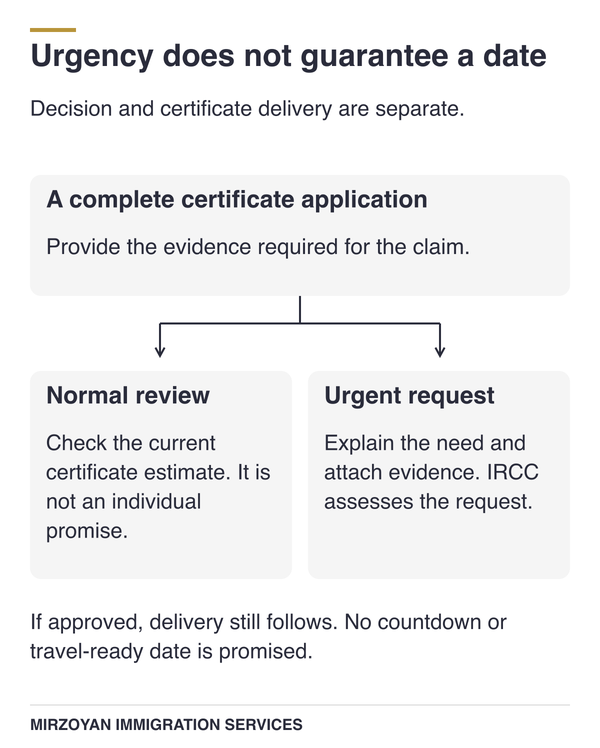
Normal review and an evidence-supported urgent request are distinguished without suggesting automatic priority. An urgency request must meet IRCC’s criteria and does not guarantee a decision or delivery by the requested date.
For a new online application, answer the urgency question and upload your explanation and documents. For a new paper application, include them in the package and use IRCC's specified urgent-certificate wording on the envelope. If you have already applied, follow the instructions for adding an urgent request to that application. Use the web form for online applications and paper applications from Canada or the United States. For a paper application submitted through a Canadian office abroad, contact that office. Do not file a duplicate application to make the same urgency request. And your application must still be complete for IRCC to process it urgently.
Receiving an electronic or paper certificate
Choose the available certificate format in the application, considering how you will receive and keep it. And an eligible paper application can request an electronic certificate, so paper submission does not necessarily mean paper delivery. If you choose an e-certificate and IRCC approves the application, follow the download letter and IRCC Portal instructions. But the download portal is separate from the secure account where you submitted an online proof application. So keep your application number, client identifier and relevant email address accessible when following the download instructions.
Paper certificates are mailed to the applicable address in Canada or the United States. Elsewhere, delivery is through the relevant Canadian embassy, high commission or consulate. Check your name and other details when the certificate arrives, and follow IRCC's correction instructions if something is wrong. But although both formats are official proof, you can hold only one valid certificate. When planning travel, remember that the certificate supports a passport application but cannot replace your passport or travel document.
How IRCC reviews your citizenship claim
IRCC reviews whether the evidence establishes the citizenship claimed in your application. The officer must consider the applicable requirements, the facts that need proof and the reliability of the records supporting them. IRCC's decision-making guidance distinguishes a document's credibility from how much it proves. A genuine marriage record may explain a surname change without establishing when someone became Canadian. So identify what each record proves before relying on it to support a different part of your citizenship claim.
Read the application once for citizenship history and again for consistency with the supporting records. Check whether the named parent on each birth record is the person identified in the next generation's documents. Then check whether the citizenship dates you entered match what the records and applicable law establish. But this preparation does not predict the order in which an officer will examine your records. IRCC may need different verification steps depending on the evidence in the file. Where IRCC cannot resolve a point from the submitted records, it may request more evidence before deciding.
If IRCC asks for more information
Read an IRCC request against the application you actually submitted before preparing a response. The Citizenship Act permits IRCC to require additional information or evidence by a specified date. The request may concern a missing record, an unclear relationship or a difference between documents. Record the deadline and the required submission method, then identify which part of the file needs attention. The wording of the letter determines what you need to answer. An email notification may contain little detail, so open the actual request before deciding what work the response needs.
The difference between a document request and a procedural fairness letter
A document request usually asks for information needed to continue assessing the application. A procedural fairness letter explains concerns that could lead to an adverse decision, with an opportunity for you to address them. Read the substance of the letter rather than relying on its subject line alone. For example, a request for a clearer birth-record copy calls for different work from a concern about whether the record is credible. But a request or fairness letter gives you an opportunity to respond; neither is a final refusal. For help deciding what the letter requires, read the guide to citizenship PFLs and IRCC document requests.
Responding to the concerns in IRCC’s letter
Match each response document to the particular question or concern in the letter. For a citizenship PFL, I check each response document against the officer's concern and deadline. If the officer asks about one generation's parentage, explain how the attached record addresses that relationship. But resending the whole family archive may leave that particular parent-child relationship unexplained. Identify the document and relevant entry in a short covering explanation, and address any remaining inconsistency directly. If a required record cannot arrive before the deadline, request an extension promptly with evidence of your efforts and the expected availability. Do not assume that asking extends the deadline; follow IRCC's response and obtain advice where the unresolved issue affects your citizenship claim. Save the final response and confirmation of submission with the original application.
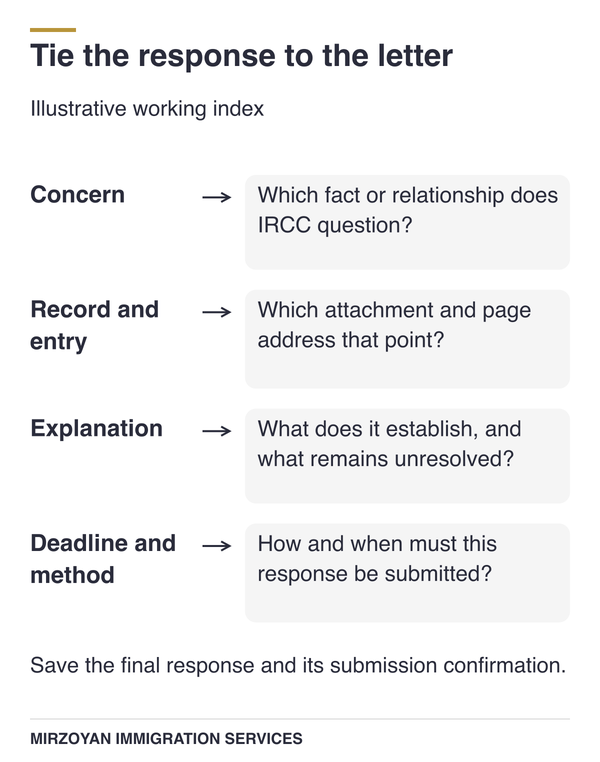
A generic response worksheet, not an invented IRCC letter. Match the document and relevant entry to the stated concern, disclose remaining uncertainty, and follow the actual deadline and submission method.
Applying on your own or with professional help
You can prepare a citizenship-certificate application yourself if you can follow the instructions and support the claim with reliable records.
But professional help may be useful if citizenship dates are uncertain, records conflict, essential evidence is missing or IRCC has raised concerns.
Identify the question you need help answering before deciding whether you want advice on part of the application or representation throughout it.
Yet a representative cannot guarantee approval or remove IRCC's requirements for supporting documents.
Even with representation, read the answers submitted in your name and keep a complete application copy.
One on One Advisory gives you direct contact with the licensed consultant handling your application at Mirzoyan Immigration Services.
Narek Mirzoyan holds RCIC licence R1005184; Vahe Mirzoyan holds RCIC licence R514223.
They answer your application questions directly, without passing client communications through intake staff, assistants or a call-routing service.
If your first application needs a review of citizenship history or supporting evidence, explore proof of Canadian citizenship application assistance.
That service concerns establishing and documenting a first claim, while replacement of an already-issued certificate follows a separate process.
Comparing the family chronology with the supporting records helps identify which relationship or citizenship date still needs evidence.
That review can focus the remaining preparation on the gap affecting your first certificate application.
Key Takeaways
Confirm that you are applying for a first certificate based on existing citizenship, rather than seeking a grant or replacing an earlier certificate.
Check your permitted application channel before preparing the forms, uploads and photographs.
Connect each relevant generation with reliable records, and explain missing documents or conflicting information with supporting evidence.
Keep the application, payment and submission records together so you can respond precisely if IRCC contacts you.
Mirzoyan Immigration Services can help assess first-certificate evidence gaps; identify the unresolved issue before choosing professional assistance.
Frequently Asked Questions
Do I need a birth certificate for Canadian citizenship?
For a Canadian citizenship by descent application, you normally need birth records establishing the relevant parent-child relationships. If a required record is unavailable, explain why and provide evidence of your efforts to obtain it. Follow IRCC's missing-record instructions and provide other reliable supporting evidence. An explanation alone does not prove the missing relationship. Your birth certificate also does not replace the separate identity documents required for this application.
How do I apply for citizenship by descent?
To document Canadian citizenship you hold through descent, submit a citizenship-certificate application with evidence supporting that status. First check your eligibility and whether IRCC permits you to apply online. Then complete the applicable application and provide the records, identification, photos and payment required by your checklist. Paper applicants use the current citizenship-certificate package, including CIT 0001. Keep a copy and follow the submission instructions for your circumstances.
How long does citizenship by descent take in Canada?
Check the current IRCC estimate for a citizenship certificate rather than the estimate for a citizenship grant. The certificate application documents status you may already hold; the processing period is not necessarily when citizenship begins. Verification, missing information and your response to requests can affect the time needed for your file. Delivery and overseas handling can add time after or around processing. Use the current processing-time tool before making plans around a certificate arrival date.
What documents do I need for Canadian citizenship by descent?
Your checklist will identify the documents required for your citizenship history and application channel. A first application usually needs birth and parentage records, the relevant Canadian citizenship evidence, identity documents and photos. Name-change records, translations or other supporting evidence may also be necessary. Provide the required records for every relevant generation and explain any document you cannot obtain. Follow the official document instructions, including whether copies or originals are required for each item.
Can I download my Canadian citizenship certificate online?
Yes, if you selected an electronic certificate and IRCC approved the application, you can download it using the instructions provided. A qualifying paper application can also request electronic delivery. The e-certificate guidance explains the IRCC Portal account and identifying details needed. An existing paper certificate does not automatically become downloadable. For a proof application, follow the approval letter rather than the separate instructions about receiving a certificate after a citizenship ceremony.
Conclusion
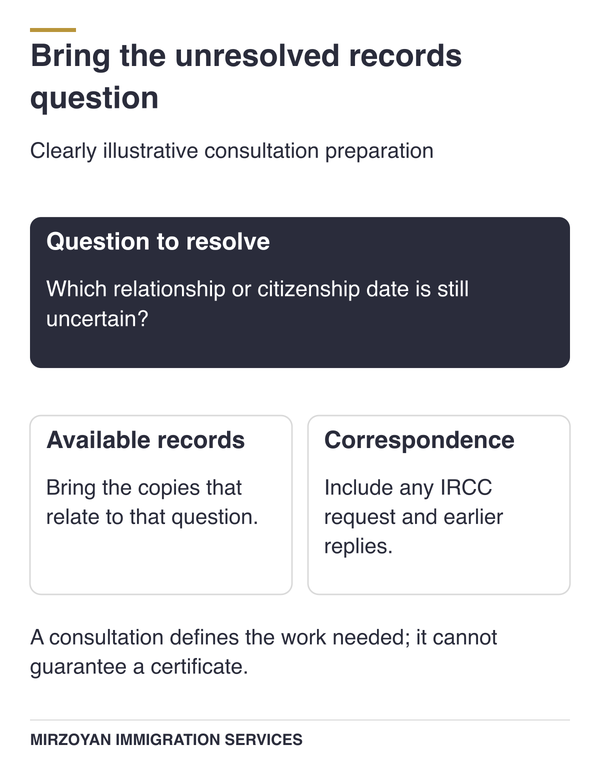
Clearly illustrative arrangement of an unanswered records question and supporting copies, as permitted by the brief. No real consultant, client, personal record or outcome is depicted. First-time proof assistance remains distinct from replacement.
Before you sign, identify any record that still leaves a required relationship or citizenship date uncertain. Write down the question you need to resolve and gather the records that relate to it. If you want professional advice, bring those records and any IRCC correspondence to a first-certificate application consultation. Mirzoyan Immigration Services can review how the available evidence supports your citizenship claim and where further clarification may be needed. Use the consultation to discuss the scope of first-time citizenship-certificate assistance you need.
Disclaimer
This article provides general information, not advice about your individual citizenship status or application. Requirements, forms, fees and procedures may change. Consult the current IRCC instructions and obtain advice about your circumstances before applying.