Canadian Citizenship Oath Ceremony: What to Expect

At your Canadian citizenship ceremony, you will verify your identity, take the oath and follow instructions for signing your oath form. Your invitation tells you when to attend, whether the ceremony is online or in person, and which documents to prepare. For a virtual ceremony, sign your oath form on the ceremony date and return it as instructed. Your certificate’s availability depends on completing those steps, so avoid assuming that you can travel immediately after the ceremony. While you prepare, check where this appointment fits in the broader Canadian citizenship application process.
By Narek Mirzoyan, RCIC # R1005184,. Verify this credential on the CICC public register.
Last reviewed by Narek Mirzoyan, RCIC # R1005184, on 2026-09-16.
TL;DR:
Your Canadian citizenship ceremony includes identity checks, taking the oath and completing the required form. Prepare the documents in your invitation and confirm whether you will attend virtually or in person. For a virtual ceremony, sign the oath form on the day you take the oath and return it as instructed. Contact IRCC promptly if you cannot attend, and allow for certificate delivery before relying on post-ceremony travel plans.
Table of Contents
The current Oath of Citizenship wording and the source distinction
Rescheduling, outside-Canada circumstances, and missed ceremonies
What to check in your citizenship ceremony invitation
Your IRCC invitation confirms your ceremony date and explains how to attend. It also lists the arrival time, ceremony language and instructions for joining online or travelling to a venue. Use these details to arrange time off, childcare or any assistance you need. A public listing cannot confirm your individual arrangements, even when it shows a ceremony nearby. Read the invitation instructions and any attachments before making those plans.
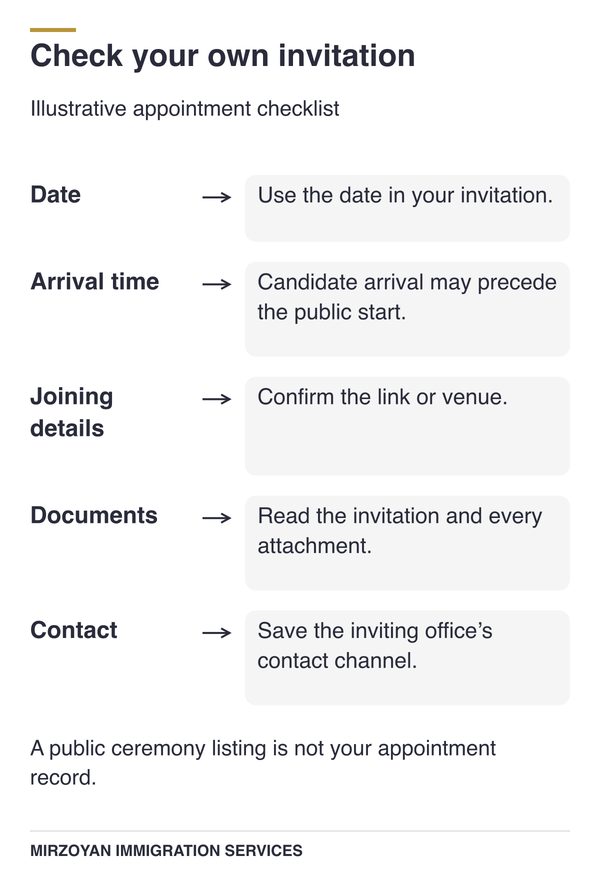
Illustrative checklist, not an IRCC letter. Confirm your candidate arrival time, format, documents and contact channel from your own invitation. Public listings do not include virtual ceremonies.
The invitation is the candidate’s operational source of truth
Read the invitation and its attachments before adding the ceremony to your calendar. Save the joining link or venue address together with the document checklist and contact email. Then compare the arrival time with your work, transport and childcare arrangements. IRCC normally sends the invitation at least one week beforehand, so check your inbox and junk folder while awaiting it. If something is unclear or missing, contact IRCC through its stated channel while there is still time to clarify it.
Virtual ceremonies do not appear in the public finder
You will not find your online ceremony in IRCC’s public ceremony finder. That list shows in-person events and helps members of the public find ceremonies they may attend. Even for a listed event, candidates can have an earlier arrival time than the public starting time. A missing listing therefore does not mean your virtual invitation is invalid or your appointment has been cancelled. Use the finder for public attendance information, but use your invitation for your own appointment.
A format-change request produces a new date
You can ask IRCC to change your ceremony between virtual and in-person formats after receiving the invitation. But the current format-change instructions allow one request and require a new ceremony date. Changing the format therefore means rearranging any work, travel or care commitments tied to the original appointment. Explain why the change is needed, especially when accessibility, travel or caregiving arrangements are involved. Wait for IRCC’s revised instructions before treating your preferred format or date as confirmed.
Who must take the Oath of Citizenship?
Applicants aged 14 or older generally must take the oath, while children under 14 do not have to attend. IRCC uses the person’s age on the ceremony date, not simply their age when the application was submitted. This matters when a child’s birthday falls between applying and receiving an invitation. Families should check each child’s instructions instead of assuming every family member has the same obligation. Where a waiver may be needed, resolve that separately with IRCC rather than assuming attendance is optional.
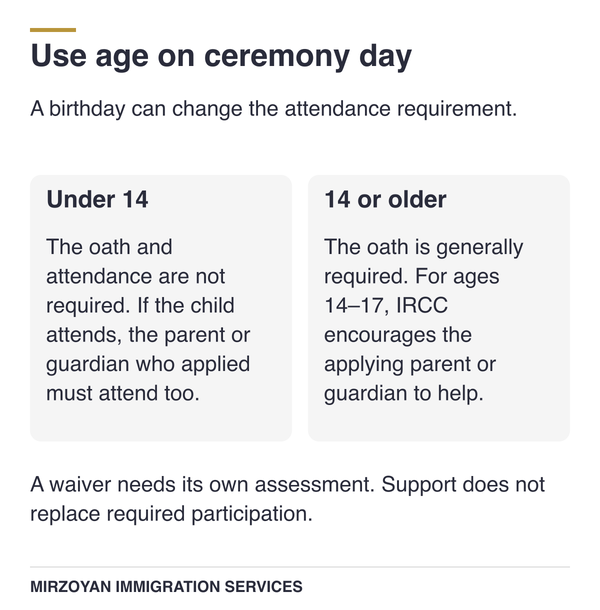
Age is measured on the ceremony date, not application signing. Under-14 attendance is optional; an attending child must be accompanied by the parent or guardian who applied. Applicable oath waivers are separate.
Adults and applicants aged 14 to 17 take the oath
A teenager who is 14 by the ceremony date generally needs to participate, even if a parent handled the application. Prepare their identification and help them understand the oath and appointment instructions beforehand. IRCC encourages the parent or guardian who applied for them to attend and assist. That support does not replace the teenager’s own participation where the oath is required. Check the family’s arrangements early so school commitments or a parent’s availability do not create a last-minute attendance problem.
Applicants aged 13 or younger usually do not have to attend
A child under 14 can attend the ceremony even though taking the oath is not required. If the child attends, the parent or guardian who applied on their behalf must attend too. IRCC also asks families to prepare the child’s relevant documents, including a PR card, even when the child is absent. Read the invitation carefully before deciding whether bringing the child will work for your family. Their optional attendance does not remove the need to follow the document and certificate instructions affecting their application.
The current Oath of Citizenship wording and the source distinction
Practise using IRCC’s current English and French oath wording. It names King Charles the Third and includes recognition of Indigenous constitutional rights. You may swear or affirm, depending on whether you want to refer to religious belief. Older recordings and some official legal text display different monarch wording, which can make searching confusing. For ceremony preparation, use the current IRCC text and follow the presiding official’s instructions.
Use IRCC’s current ceremony wording for preparation
Reading the oath aloud beforehand can help you feel comfortable with its language and meaning. The ceremony involves repeating the words after the presiding official, rather than delivering a speech you have written yourself. IRCC encourages participation in both official languages if you can, and provides the oath and anthem for practice. If you choose to swear, you may bring a holy book; affirming does not refer to a religious belief. Prepare with the version provided by IRCC instead of relying on an old video saved by another applicant.
Justice Laws and IRCC currently render different monarch names
The Citizenship Act schedule and IRCC’s ceremony page currently display different names for the monarch. The Justice Laws page viewed for this draft names Queen Elizabeth the Second, while IRCC’s preparation text names King Charles the Third. The difference is visible in the sources themselves, so an undated copy can leave you practising the older wording. Finding the older name does not tell you to substitute it during your ceremony. Follow IRCC’s current preparation instructions and raise any specific concern with the office handling your invitation.
Legal explanation of the discrepancy requires review
The difference between those pages should not be used on its own to draw conclusions about citizenship validity. The Citizenship Act sets out the requirement to take the oath. Explaining how legislation concerning the Crown applies requires a separate legal analysis beyond comparing two webpages. That issue is different from knowing which words IRCC currently instructs candidates to practise. If your concern affects a particular application or completed ceremony, obtain advice on that issue rather than changing the oath yourself.
Virtual versus in-person ceremony preparation
Virtual and in-person ceremonies are formats for completing the same citizenship step, not competing immigration pathways. IRCC issues the invitation and considers requests to change the format. Your practical decision concerns accessibility, attendance arrangements and any effect a new date has on your plans. Use the comparison below to plan your documents, joining arrangements and certificate choice before asking IRCC for a different format. Choose what to request based on your circumstances, while treating IRCC’s eventual instructions as the confirmed arrangement.
The format in your invitation determines how you prepare your surroundings, identification and forms. A virtual appointment needs a working camera, reliable connection and a quiet place where you can remain visible. An in-person appointment needs travel planning and the documents required at registration. Both formats include the oath, but certificate delivery also depends on whether you select paper or electronic proof. Compare these practical arrangements without assuming either format guarantees a faster completion date.
| Preparation or step | Virtual ceremony | In-person ceremony |
|---|---|---|
| Joining or arriving | Use your invitation link and seat number; test the device beforehand. | Arrive at the candidate time, which can precede the public start time. |
| PR card | Have it ready and cut it only when IRCC directs you. | Bring it for collection during registration. |
| Oath form | Sign on the day you take the oath and return it as instructed. | Sign during the ceremony when staff direct you. |
| Paper certificate | Normally mailed within 2–4 weeks after IRCC receives the signed form. | Provided at the ceremony when paper is your confirmed choice. |
| E-certificate | Normally available within 5 business days after IRCC receives the signed form. | Electronic access follows completion; it is not a paper handout. |

AI-generated illustrative preparation scene, not an actual ceremony. Keep required documents nearby and follow your invitation's camera and signing instructions.
Prepare the device, room, and camera for a virtual ceremony
Test your camera, microphone and connection before the appointment using the equipment instructions. Choose a quiet location, stabilize your device and position it so your head and shoulders remain visible. Keep your invitation, identification, scissors and required forms within reach without leaving the camera. If the connection drops, try the same invitation link and passcode again, then follow IRCC’s contact instructions if necessary. Leave enough time for registration and waiting, rather than arranging another appointment immediately after the oath itself.
Follow arrival and venue controls for an in-person ceremony
Plan to reach the venue at the candidate arrival time shown in your invitation. Registration happens before the ceremony, so arriving only for the public starting time can leave you late for your own instructions. Check transport, accessibility and guest arrangements together, particularly if someone is accompanying a child. Wear business attire or appropriate traditional, religious or ceremonial clothing, and avoid scented products as IRCC requests. Keep your documents accessible when you arrive so you can complete registration without unpacking bags or leaving the queue.
Certificate delivery depends on format and certificate choice
An in-person ceremony does not mean every attendee receives a paper certificate that day. IRCC asks you to confirm whether you want a paper certificate or an e-certificate. Paper certificates are provided at an in-person ceremony, while electronic access follows IRCC’s completion steps. After a virtual ceremony, the signed oath form must be returned before the usual certificate delivery period begins. Confirm your choice and follow the applicable delivery instructions before arranging any appointment that requires proof of citizenship.
What to bring, show, sign, and keep
Prepare your documents by separating what you must show, what you must surrender and what you must keep. The ceremony checklist covers identification, your invitation and immigration documents, with different requirements for adults and children. Your PR card is handled during registration, but other records may remain useful afterward. The oath form also has different signing instructions from the personal release and consent form. Keep the oath form and consent form separately labelled so you can find the correct document when staff request it.
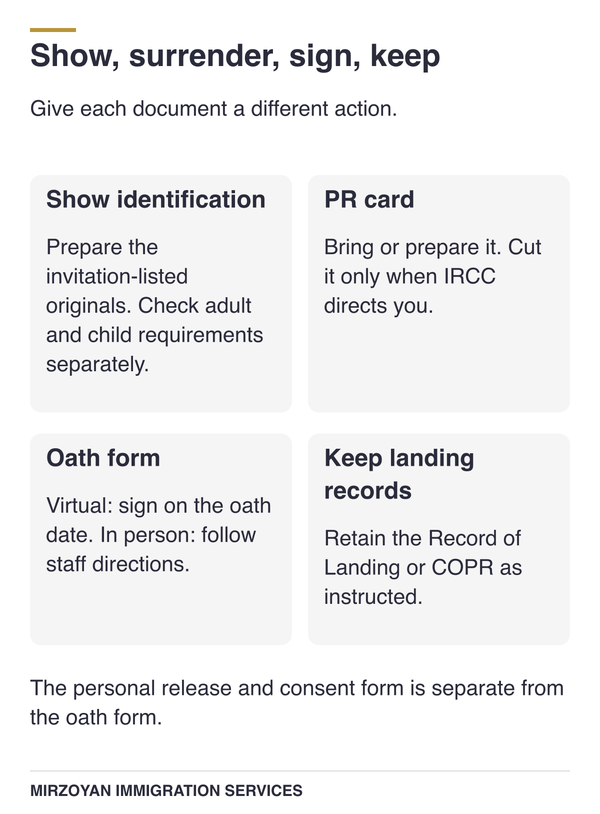
These are document-action groups, not a replacement for the invitation checklist. PR-card handling depends on ceremony format; do not cut it as advance preparation. Keep the oath and consent forms distinct.
Bring the invitation-listed originals
Adults generally need two pieces of identification, with at least one showing a photograph and signature. If you use your PR card as identification, the second piece must be issued by a Canadian government. Children’s identification requirements differ, so check the adult and minor lists separately when preparing a family. Bring the requested PR card, even if expired, or other specified immigration record, and keep any required translations with foreign documents. If a required original is missing, ask the inviting office what to do instead of assuming a copy will be accepted.
Do not pre-sign the oath form unless instructed
For a virtual ceremony, IRCC requires signing the oath form on the day you actually take the oath. That means preparing the file beforehand without signing it the previous evening or leaving the signature for the next day. The personal release and consent form is a different document and may need preparation before registration. At an in-person ceremony, staff direct you to sign the oath form during the event. If the invitation and form instructions differ, ask the inviting office to clarify the signing process before ceremony day.
Keep the certificate secure after delivery
When your certificate arrives or becomes available, check your personal details before putting it away. Store a paper certificate securely and do not laminate it, because its features need to remain readable. For an e-certificate, follow IRCC’s download instructions and keep the original electronic file accessible for future use. Also retain your Record of Landing or Confirmation of Permanent Residence when instructed, because it may help establish earlier residence for benefits. If you later need to identify acceptable citizenship evidence, see how to prove Canadian citizenship.
What happens at a Canadian citizenship oath ceremony?
Your ceremony normally moves from registration and identity checks to the oath, celebration and completion instructions. The spoken oath is only one part of the time you need to reserve. Staff may need to register many candidates before everyone can proceed together. You will also receive instructions about your signed form and certificate, so remain attentive after taking the oath. Following the whole ceremony sequence helps you leave with the correct next step, not just a completed video call.
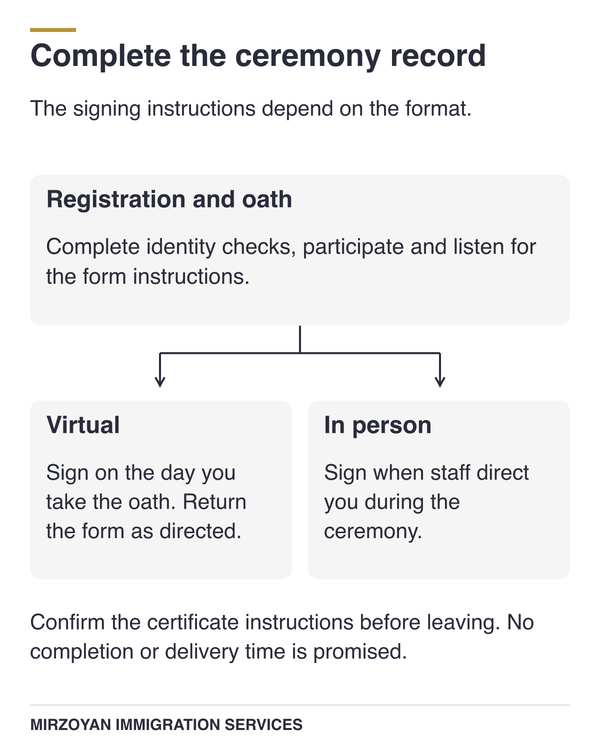
A simplified ceremony sequence with a format-dependent signing branch. Registration and identity checks precede the oath; signing and return instructions differ. Remain until the required next steps are clear.
Registration and identity verification come first
Registration allows IRCC to confirm who is attending and ask about circumstances that could prevent citizenship. At a virtual ceremony, this happens privately for you or your family before joining the larger group. Use the seat number from your invitation as your screen name, following IRCC’s privacy instructions. At an in-person ceremony, staff check your documents at registration and collect the required PR card and consent form. Answer questions directly and wait for staff to finish registering the group before expecting the ceremony to begin.
The oath and signed form complete the central requirement
When the presiding official leads the oath, follow the words and participation instructions provided to the group. The ceremony also includes the national anthem and may include speeches or video presentations. Virtual candidates should remain seated and visible, while in-person candidates stand for the oath and anthem if able. The signed oath form then records that you took the oath, with submission handled according to your ceremony format. Do not leave the appointment or close the connection until staff have explained what you must complete.
Certificate instructions follow the ceremony
Before the ceremony ends, confirm how you will receive your citizenship certificate and whether anything remains outstanding. Virtual candidates should check the return email address and signing instructions against the invitation. Save the completed form and sent message so you can refer to them if a question arises later. In-person candidates receiving paper certificates should check the document and follow the staff’s instructions before departing. Keep the return instructions with your saved form so you can identify the correct office if certificate access remains unresolved.
Unsure how to answer ceremony correspondence?
Bring the invitation, earlier replies and any unresolved IRCC request to Mirzoyan Immigration Services.
Canadian citizenship application services can address the response needed in an active file. This review cannot guarantee a faster ceremony.
Children, guests, accessibility, and helpers
Arrange childcare and any assistance you need so you can remain present for registration and the oath. A child taking the oath has different responsibilities from a child attending as a guest. Guest access also depends on whether the ceremony is virtual or in person. If you need childcare, interpretation or accessibility support, contact IRCC before the appointment rather than relying on arrangements at the door. Tell the inviting office if those arrangements will prevent you from attending or staying for the full appointment.
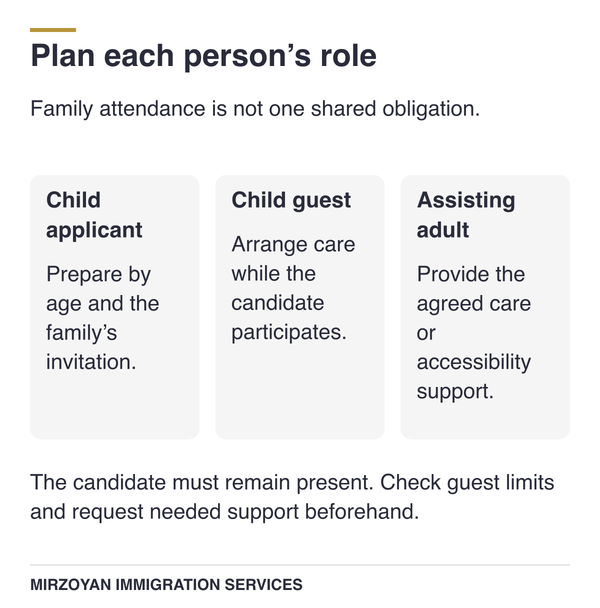
Illustrative role map, not a portrayal of clients. A child applicant and a child guest have different roles. Invitation-specific guest limits and candidate participation remain controlling.
A child applicant and a child guest are not the same
A child who is applying for citizenship needs preparation based on their age and the family’s invitation. For a child attending as your guest, plan around their care needs while you complete your own ceremony requirements. If a young guest will need care, arrange another adult who can help while you complete registration and take the oath. For a virtual appointment, consider whether you can stay visible without repeatedly leaving to attend to the child. Ask IRCC about rescheduling if workable childcare is unavailable, following its family-attendance guidance.
The invitation controls in-person guest limits
Check the guest allowance before inviting relatives to an in-person ceremony. Venue space can limit attendance even when a public listing says the event is open to visitors. Virtual guests may join you in the same room, but they should not disrupt your participation. Do not distribute the videoconference link or ask guests to join independently from another device. Explain these guest arrangements beforehand so family members can celebrate without affecting registration or the ceremony itself.
Request accommodations before the ceremony
Contact the office that sent your invitation if you need an accommodation for the oath. Explain the assistance you need and include your application number and unique client identifier. Support can include accessible seating, sign-language interpretation or arrangements involving a care attendant. An accommodation helps you meet a requirement; a waiver removes a requirement only where IRCC grants the applicable exemption. If assistance will not let you take the oath, ask about the appropriate process rather than assuming an accommodation request excuses attendance.
Rescheduling, outside-Canada circumstances, and missed ceremonies
If you cannot attend, tell IRCC promptly and explain what prevents your participation. The response differs depending on whether you request a change or miss the appointment without notice. Your invitation also matters if you are outside Canada when the ceremony is scheduled. Keep the invitation, your explanation and any supporting records together so the office can understand the circumstances. Do not assume that requesting another date means the original appointment has already been cancelled.
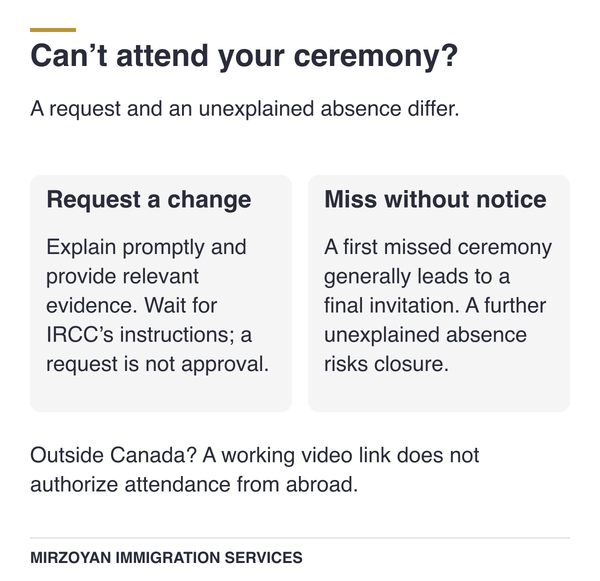
The two branches distinguish a rescheduling request from an unannounced absence. IRCC considers explanations and final-notice circumstances; neither branch guarantees approval or a further invitation. Follow the actual notice.
Do not assume virtual attendance from outside Canada is authorized
An online invitation does not automatically authorize you to take the oath from another country. Reply to the invitation using IRCC’s outside-Canada instructions, including your application details and relevant travel dates. Explain when you last left Canada, when you plan to return and why you are asking to attend from abroad. Special circumstances may need consideration, but your ability to open the video link does not settle that request. Wait for instructions before deciding where you will attend or changing travel around an assumed approval.
A first missed ceremony is not consequence-free
If you miss your first ceremony without telling IRCC, the current process generally leads to rescheduling with a final invitation. Receiving that final invitation gives you another appointment, but a further unexplained absence can lead to the application being closed. If you ask to reschedule instead, IRCC considers your explanation rather than treating the appointment as an unannounced absence. Its rescheduling page states a 30-day response window tied to the ceremony date in the invitation. Contact the office as soon as the problem is known, and do not treat that window as a reason to wait.
A final missed invitation can put the application at risk
Missing a final ceremony without notifying IRCC can lead it to begin abandoning and closing the application. If you need another change, explain the reason and provide relevant evidence rather than assuming another invitation will follow automatically. IRCC distinguishes a further request it considers reasonable from one it does not accept. Read any final notice for the exact action required and respond through the specified channel. If the deadline, previous correspondence or consequences are unclear, obtain help while a response can still address the problem.
The Internal Logic of an IRCC Officer
At registration, IRCC checks your identity and asks about circumstances that could prevent you from becoming a citizen. Completing the oath and returning the signed form then give IRCC the records needed for the ceremony’s remaining steps. But an unresolved problem with your identity documents needs its own answer, even when you have followed the other instructions. For example, joining the video call does not establish that IRCC received a signed oath form. When IRCC contacts you afterward, check whether it needs an identity document, an eligibility explanation or the completed oath form.
Identity and attendance must match the invitation record
Have identification ready that allows staff to match you with the person named in the invitation. If a name has changed or a document is unavailable, explain that specific issue and follow IRCC’s instructions. A family member’s identification cannot substitute for the candidate’s own required evidence. For face-covering removal during identification, IRCC can arrange a private space, including a private virtual room. Ask about that arrangement beforehand if needed, so the identity check can proceed without an avoidable misunderstanding.
The oath must be taken and documented as instructed
Taking the oath and returning the required form are connected but distinct completion steps. IRCC needs the form documenting your participation, not just evidence that you received an invitation or joined the meeting. So check the signature, ceremony date and return instructions if IRCC says the oath record remains incomplete. If you discover an error, identify it to the office and ask how to correct the record accurately. Do not backdate a form or recreate a signature process to make the paperwork appear complete.
A ceremony problem can reveal a broader unresolved file issue
A question at registration may concern eligibility rather than the practical arrangements for your ceremony. IRCC asks about situations that can prevent citizenship, including relevant criminal proceedings or other prohibitions. If circumstances change while the application is being processed, IRCC directs applicants to report them promptly. A new ceremony date alone does not resolve an underlying issue of that kind. Where the concern instead relates to an earlier assessment, distinguish it from the separate citizenship test process.
Certificate delivery and the immediate travel gap
You need to plan separately for becoming a citizen, receiving the certificate and obtaining suitable travel documents. These steps do not necessarily happen on the same day. Your PR card is collected or destroyed during the ceremony process, and the citizenship certificate is not a passport. A trip booked close to the ceremony can therefore depend on documents you do not yet have. Check the applicable delivery and travel requirements before committing to a departure or return date.
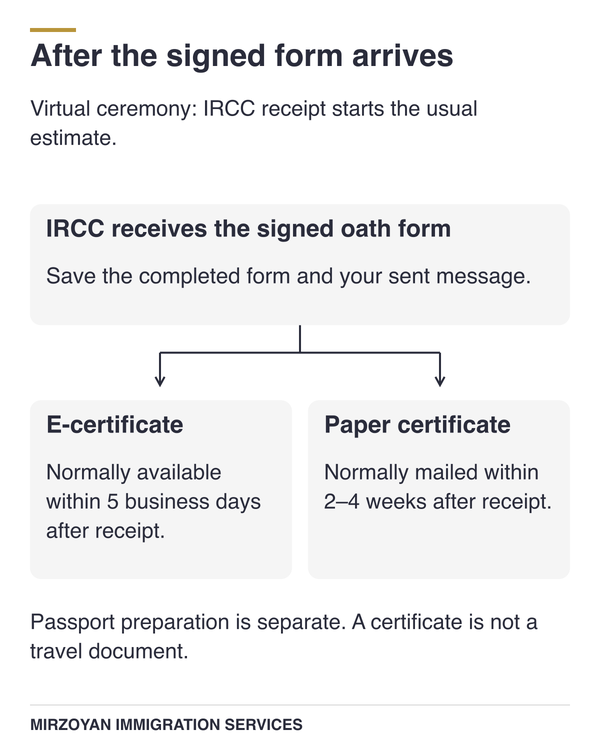
This delivery branch concerns virtual ceremonies and starts with IRCC’s receipt of the signed form. In-person paper certificates are provided at the ceremony when paper is the confirmed choice. Estimates are not guarantees; passport requirements remain separate.
Certificate format changes the delivery route
For an e-certificate, IRCC says access is normally available within five business days after it receives the signed oath form. After a virtual ceremony, a paper certificate is normally mailed within two to four weeks of that receipt. In-person candidates who confirm a paper certificate receive it at the ceremony. These different delivery routes explain why someone else’s ceremony date does not predict when your proof will arrive. If your certificate remains unavailable, include the date you returned the signed form when asking IRCC about your next step.
The citizenship certificate is not a travel document
A citizenship certificate proves your status but does not let you board an international flight in place of the required passport. A valid Canadian passport is generally required for a dual citizen’s flight back to Canada, with applicable exceptions. A certificate that establishes your citizenship for an application may still be insufficient for the airline’s boarding requirements. Consult the official travel guidance for your circumstances before relying on another passport. Keep the certificate secure for the next application rather than assuming carrying it alone will resolve airline document checks.
Do not assume immediate international air travel is workable
If you have a trip planned after the oath, check when you can obtain the documents needed for your return. A passport appointment is not evidence that the required citizenship certificate will be available by that date. Urgent service also has its own eligibility and document requirements, so it cannot be assumed from a booked flight alone. Use the current Canadian passport instructions once your certificate is available. If travel is already booked, assess the document gap before the ceremony and contact the inviting office if rescheduling is necessary.
Red Flags & Procedural Fairness Letters (PFL)
A ceremony-related message can concern scheduling, missing paperwork or a substantive problem with the citizenship application. The email’s subject line alone may not tell you whether IRCC needs a new date, a document or an explanation. A procedural fairness letter usually raises concerns you are invited to address before a potentially adverse decision. A routine request may instead ask for a document, explanation or corrected form. Read the actual wording and deadline before deciding which kind of response the file needs.
A reschedule request or first missed ceremony is not automatically a PFL
A scheduling exchange is not automatically a procedural fairness process because the appointment did not proceed. For example, the first missed-ceremony branch can result in a final invitation under IRCC’s attendance instructions. An identity discrepancy, inconsistent eligibility answer or concern about the oath record may require a more substantive explanation. Those issues can lead to further review, but they do not guarantee that IRCC will issue a particular kind of letter. Match your response to the stated concern rather than describing every ceremony problem as a PFL.
Respond to the exact attendance, identity, or eligibility issue
Start by identifying the information IRCC says is missing or inconsistent. An attendance issue may need a dated explanation, while an identity mismatch needs records connecting the names or documents involved. An eligibility concern needs evidence addressing that concern, not only an explanation of why you want citizenship. The Citizenship Act permits requests for relevant additional information, evidence or an appearance. For a detailed response approach, see citizenship PFLs and IRCC information requests.
Do not treat abandonment procedure as procedural fairness
An abandonment warning concerns whether the application will continue after a failure to complete a required step. It should not be treated as interchangeable with a letter questioning the truth or sufficiency of your evidence. That distinction does not mean procedural fairness obligations disappear from an abandonment decision. Read the notice alongside IRCC’s attendance instructions, then address the missed step, circumstances and response deadline. If IRCC has already closed the application, get advice on the decision rather than assuming a late scheduling email reopens it.
When help with ceremony correspondence is useful
An ordinary invitation with clear instructions may be manageable without professional assistance.
If IRCC sends a final invitation or questions your ceremony documents, uncertainty about the next response can be stressful.
Mirzoyan Immigration Services can assist through Canadian citizenship application services for unresolved issues in an active file.
Through the One on One Advisory framework, you discuss the correspondence directly with Narek Mirzoyan, RCIC # R1005184.
Bring the invitation, notices and earlier replies so the consultation can focus on the stated concern and response deadline.
That review cannot guarantee another invitation, a faster ceremony or immediate certificate delivery.
Comparing the notice with earlier replies helps identify which concern remains unanswered.
Key Takeaways
Use your invitation for the date, arrival time, documents and joining instructions; the public ceremony finder is not your appointment record.
Check each applicant’s age on ceremony day: those aged 14 or older generally take the oath, while younger children need different arrangements.
Practise with IRCC’s current oath wording and sign the virtual oath form on the actual ceremony date.
Explain attendance problems promptly, especially after a final invitation; Mirzoyan Immigration Services can review unresolved citizenship application issues.
Certificate delivery and passport readiness are separate from the ceremony, so confirm the required documents before committing to travel.
Frequently Asked Questions
How long does a Canadian citizenship oath ceremony take?
Allow a few hours for your Canadian citizenship ceremony, using the duration and arrival time in your invitation. Registration and waiting are part of that period. The spoken oath takes only part of the appointment. Larger groups may take longer to register. Follow IRCC’s timing guidance and avoid scheduling another commitment immediately afterward.
What to wear for a Canada citizenship ceremony?
IRCC recommends business attire appropriate for the ceremony, and also permits traditional, religious or ceremonial clothing. Head coverings and medical masks are allowed. Staff may request temporary removal for identity verification, with private arrangements available. Avoid scented products at an in-person ceremony. Check the official clothing guidance rather than treating another attendee’s outfit as the dress standard.
What are the words on the Canadian Oath of Citizenship?
The current IRCC oath pledges allegiance to King Charles the Third and commits you to Canada’s laws and citizenship duties. It includes recognition of Indigenous constitutional rights. IRCC publishes the complete English and French wording for preparation. You may swear or affirm. Follow the presiding official at the ceremony instead of substituting wording from an older recording.
What is the new Oath of Citizenship in Canada?
The current oath includes recognition of the constitutional rights of First Nations, Inuit and Métis peoples. IRCC’s preparation text also names King Charles the Third. These details can differ from older versions found online. Read the current official oath, not an undated search excerpt. Calling it “new” does not establish that the oath changed in the year you attend.
Do I need to memorize the Oath of Citizenship in Canada?
You do not need to deliver the oath from memory because you repeat it after the presiding official. IRCC encourages practising beforehand. Reading the words aloud can help you follow their meaning and pronunciation. You can choose to swear or affirm according to your beliefs. Use IRCC’s preparation material, and request assistance beforehand if a disability affects your participation.
Conclusion
Keep your invitation beside the identification and forms you will use on ceremony day. Check the arrival time, signing instructions and any arrangements for children or assistance before the appointment. After the oath, retain your completed form and return email while waiting for certificate access or delivery. If IRCC raises an unresolved concern, bring that correspondence and its deadline to your consultation. Mirzoyan Immigration Services can discuss Canadian citizenship application services for the unresolved issue in your file.
Disclaimer
This article provides general information and is not legal or immigration advice. Requirements and individual circumstances can change, and your IRCC instructions may require additional steps. Obtain advice specific to your situation before deciding how to respond to a notice or application issue.