What Documents Prove Canadian Citizenship?

Proof of Canadian citizenship can include a citizenship certificate, a qualifying Canadian birth certificate, or an accepted older citizenship document. However, unauthorized lamination can hide security features and make an otherwise valid document unacceptable. The document must also belong to the person whose status needs proof. This article is for someone who already is, or may already be, Canadian and needs to identify acceptable proof. But it is not a replacement guide or a complete descent-application guide.
If you lost proof previously issued to you, get help replacing a Canadian citizenship certificate. But if citizenship may have passed through your family, begin with Canadian citizenship by descent in Canada.
By Narek Mirzoyan, RCIC # R1005184,. Verify this credential on the CICC public register.
Last reviewed by Narek Mirzoyan, RCIC # R1005184, on 2026-09-16.
TL;DR:
Proof of Canadian citizenship comes from an accepted certificate, qualifying Canadian birth certificate, valid citizenship card, or certain historic documents. A passport, identity record, or family document may serve another purpose without formally proving citizenship. The correct route depends on how citizenship arose, whether proof was issued before, and what the receiving program requests.
Table of Contents
Which documents are accepted as proof of Canadian citizenship?
IRCC's accepted list is the starting point, not the end of the document review. Condition, effective date, certificate format, and the receiving program's instructions determine whether an accepted document solves the immediate proof problem.
Paper and electronic citizenship certificates
Paper and electronic citizenship certificates serve the same legal purpose, with K and X certificate numbers respectively. The format still matters when another government program asks you to submit proof. It may require an original paper certificate or a printed electronic certificate, rather than a screenshot or partial printout. Identify which format you hold before following that program's checklist. A certificate's issue date is not always the date citizenship began, so I compare the effective date with the relevant family event. This is particularly relevant when a parent's certificate is being used to assess a child's citizenship.
Provincial or territorial birth certificates
A qualifying provincial or territorial birth certificate generally proves citizenship for someone born in Canada. Check the issuing authority and any applicable diplomatic-status exception before relying on it. Some Canadian birth certificates do not prove citizenship when diplomatic privileges applied and neither parent held Canadian citizenship or permanent resident status. A DND 419 certificate is also not accepted as citizenship proof. Those records documented births abroad to Canadian Forces personnel before November 1979, rather than births registered by a Canadian province or territory.
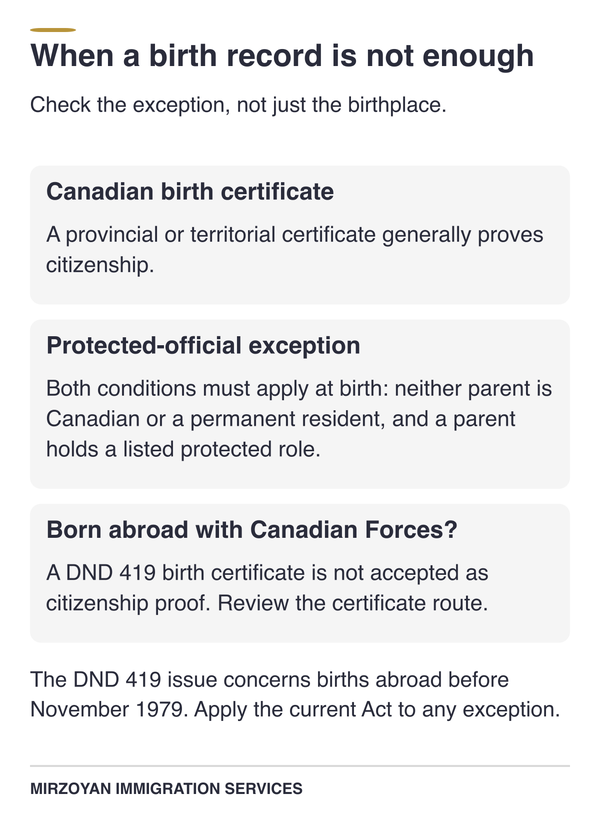
Canadian birth certificate: A provincial or territorial certificate generally proves citizenship. Protected-official exception: Both conditions must apply at birth: neither parent is Canadian or a permanent resident, and a parent holds a listed protected role. Born abroad with Canadian Forces?: A DND 419 birth certificate is not accepted as citizenship proof. Review the certificate route. The DND 419 issue concerns births abroad before November 1979. Apply the current Act to any exception.
Citizenship cards and older citizenship documents
IRCC stopped issuing citizenship cards in February 2012, but existing cards remain valid proof. Yet the printed date may record card production rather than when citizenship began. Older paper citizenship certificates may also remain valid, and accepted historic documents include specified naturalization, birth-abroad registration, and retention certificates. Do not replace a legacy document merely because IRCC no longer issues that format. First confirm that it remains readable, undamaged, and accepted for your intended transaction.
| Document | Does it prove citizenship? | Important limitation |
|---|---|---|
| Paper or electronic citizenship certificate | Yes | It is not a passport or general identity document |
| Qualifying provincial or territorial birth certificate | Usually, for a person born in Canada | Diplomatic-status exceptions and excluded document types can apply |
| Citizenship card | Yes, if the document remains valid and readable | The printed date may be the card’s production date |
| Accepted historic citizenship document | Yes, when the format and issuing period qualify | Confirm the exact document against current IRCC guidance |
| Commemorative certificate or records-search letter | No | It may contain citizenship information without being legal proof |
Which documents do not prove citizenship by themselves?
Before submitting, assign one evidentiary job to every record. A passport may support identity, and civil records may connect relatives. But neither replaces accepted proof of the applicant's citizenship for the requested transaction.
Passports and identity documents serve different purposes
A Canadian passport supports travel and identity, but another program may still ask for the underlying citizenship proof. If its checklist requests a certificate, submitting only a passport may leave that requirement unanswered. Driver's licences, health cards, permanent resident cards, and social insurance records serve other administrative purposes. Check what fact the receiving program needs you to establish before selecting a document. Conversely, a citizenship certificate is not a travel or identity document and cannot replace a passport at an airport.
Family and civil records can support a claim
Records from the authority that registered an event can establish birth, parentage, adoption, marriage, or a legal name change. Their role is to connect the people and events in the claim, not necessarily to prove your citizenship directly. So I separate the parent's citizenship proof from the applicant's parentage record, giving each document one clear job. A marriage or name-change record may then explain an identity difference between those documents. Family trees and genealogy indexes can help locate evidence, but third-party records alone are insufficient where original-authority records should exist.
Commemorative certificates are not legal proof
Older citizenship cards sometimes came with a commemorative certificate that displayed a citizenship date. IRCC does not accept that commemorative certificate as proof, even though the accompanying plastic card may remain valid. Check both documents rather than relying on the one that looks more formal. A search-of-records letter is another document that contains citizenship information without serving as proof. It reports the result of a search and cannot replace the proof required for a Canadian passport application.
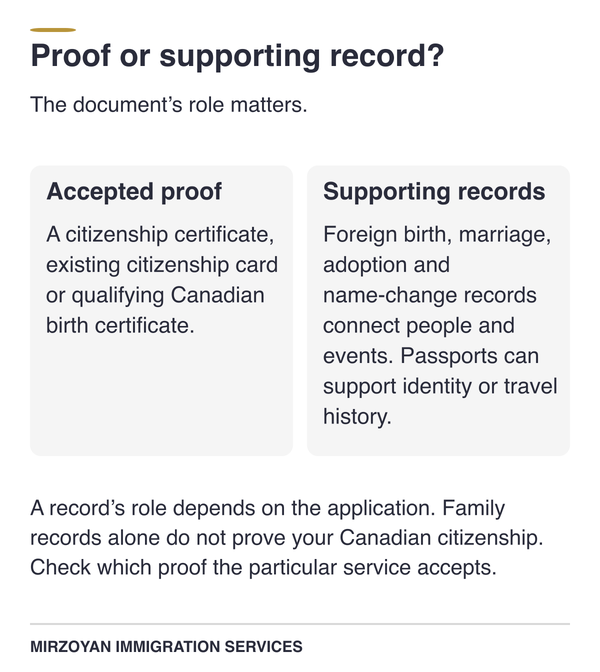
Accepted proof: A citizenship certificate, existing citizenship card or qualifying Canadian birth certificate. Supporting records: Foreign birth, marriage, adoption and name-change records connect people and events. Passports can support identity or travel history. A record’s role depends on the application. Family records alone do not prove your Canadian citizenship. Check which proof the particular service accepts.
When do you need a citizenship certificate?
You generally need a citizenship certificate when you require formal proof and lack another accepted document. The good news is that one certificate can support several government and employment transactions.
You were born outside Canada and need formal proof
Someone born outside Canada usually cannot rely on a Canadian provincial or territorial birth certificate. If that person is already Canadian, the citizenship certificate is the standard personal proof document. The legal question comes first, and birth to a Canadian parent does not settle every case. Birth date, generation, parental status, and current law can change the result. If status is uncertain, review Canadian citizenship by descent eligibility before preparing the application. A certificate application confirms existing citizenship; it does not grant citizenship merely because the applicant has Canadian relatives.
Your accepted proof is unavailable or no longer usable
If your previously issued proof is lost, stolen, damaged, or unreadable, you may need a replacement certificate. Identify the earlier card or certificate when explaining the problem. A first-time descent account does not replace the information IRCC requests about a document already issued to you. Details about the loss, theft, damage, or error belong in the replacement process. Use help replacing a Canadian citizenship certificate for corrections, urgency, timing, and the corresponding application instructions.
Another organization asks for a specific proof document
An organization may ask for an original, a copy, or a printed electronic certificate in a particular format. So always follow its current written instructions instead of assuming every certificate format works identically. For example, the Passport Program distinguishes older originals, newer certificates, and printed electronic certificates. And a valid document can fail in the wrong copy format. Before ordering a new certificate, confirm whether your existing proof is accepted. Replacing a valid citizenship card or older certificate may create delay without solving the actual submission problem.
Proof documents and descent evidence are not the same thing
IRCC requires reliable records for every claimed generation that connect status and family relationships. The ancestor's document establishes Canadian status, while original-authority civil records establish family relationships, identity continuity, and the relevant birth dates.
The Canadian parent's document proves the parent's status
A parent's Canadian birth certificate, citizenship certificate, or accepted legacy document may prove that parent's status. But it does not automatically prove the child's citizenship or parentage. The parent's citizenship effective date can matter more than the certificate's printing date. So do not treat those dates as interchangeable in a family timeline. If the parent became Canadian through later legislation, the status analysis may require current-law review. The document identifies status, while the law determines whether that status passed to the child.
Birth and parentage records connect the applicant to that parent
Original-authority birth, adoption, or court records must connect you legally to the Canadian parent. Matching surnames alone do not establish that relationship. If the names differ, identify the marriage, legal name-change, adoption, or government record that explains the difference. Repeat this check for each relationship in an earlier-generation claim. The citizenship through a Canadian grandparent guide explains how to follow those connections through more than one generation.
Eligibility must be resolved before the application route
Complete civil records do not necessarily establish that the citizenship rule applies to your family. Birth and marriage documents may connect the people correctly while leaving the parent's legal status unresolved. Conversely, you may already be Canadian but lack enough evidence for IRCC to issue a certificate. Identify whether the unresolved question concerns status or supporting documents before changing the application route. Once eligibility is reasonably established, use the citizenship by descent application guide for forms, fees, submission, processing, delivery, and urgent requests.
Choose the correct next page for your situation
IRCC separates first proof, replacement, records searches, and citizenship grants. Your next page depends on whether proof never existed, was lost, requires historical research, or follows a citizenship grant. Each process answers a different question.
First citizenship certificate
A first certificate application documents existing citizenship for someone never issued proof; it does not grant citizenship to an ineligible applicant. But any prior issuance points to the replacement route instead. So confirm whether IRCC ever issued a card or certificate before choosing the application. Birth abroad to a Canadian parent can raise eligibility questions first. Mirzoyan Immigration Services provides first-time proof of Canadian citizenship help when status or supporting records remain uncertain. The detailed filing sequence remains in the separate application guide.
Lost, damaged, or incorrect certificate
Previously issued proof that is lost, stolen, damaged, or incorrect calls for a replacement application. Identify the earlier card or certificate and explain what happened to it. The explanation should address the missing or unusable document, rather than present the case as a first citizenship claim. IRCC no longer replaces citizenship cards with new cards; an approved replacement is a current citizenship certificate. The replacement guidance explains the declarations, corrections, and submission issues associated with that earlier proof.
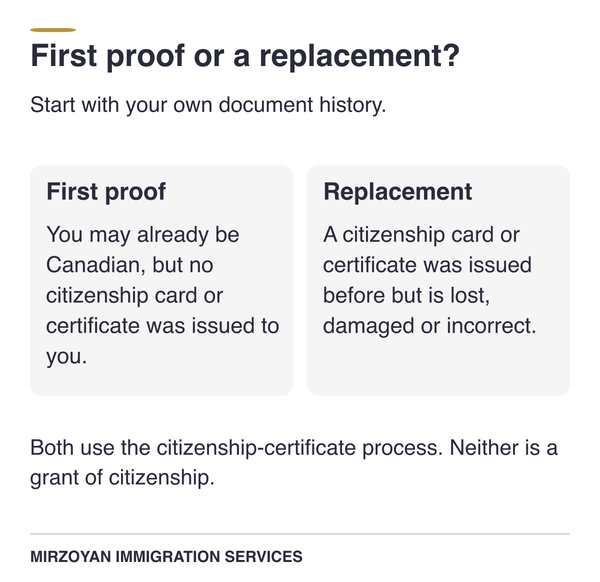
First proof: You may already be Canadian, but no citizenship card or certificate was issued to you. Replacement: A citizenship card or certificate was issued before but is lost, damaged or incorrect. Both use the citizenship-certificate process. Neither is a grant of citizenship.
Unclear which certificate route fits?
Mirzoyan Immigration Services can review the document problem before you choose an application.
Consider first-time proof assistance if you have never received proof.
For a lost, damaged or incorrect issued certificate, use certificate replacement assistance.
Search of citizenship records
A records search can locate or clarify an older citizenship or naturalization record. And it may help when the citizenship date, legal basis, or manner remains uncertain. IRCC issues a letter describing the search result rather than issuing a proof document. That letter is not valid proof of citizenship and cannot support a Canadian passport application. Use the search to investigate historical records, not as a substitute for a certificate. A living citizen needing formal proof will usually need an accepted proof document.
Citizenship grant
A citizenship grant serves an eligible person who is not already Canadian. But it is legally different from obtaining documentary proof of Canadian citizenship that already exists. Do not choose the grant route merely because you lack a certificate; first determine whether you may already be Canadian. If you are not, review the Canadian citizenship requirements guide. A successful grant applicant receives proof through the oath of citizenship ceremony. That person does not use a descent certificate application to become Canadian.
Can you use a citizenship certificate for a Canadian passport?
Yes, a citizenship certificate is accepted proof for a new Canadian passport; it is not the passport itself. But the practical question is whether its date and format match the submission instructions.
A new passport application requires accepted citizenship proof
A new adult passport application requires accepted citizenship proof, generally a qualifying birth certificate or accepted citizenship document. But the practical risk is choosing the wrong submission format. The Passport Program may require an original, permitted copy, or printed electronic certificate. Use the issue date and certificate number prefix to identify which checklist instruction applies. Then match the certificate type before sending the package.
A citizenship certificate is not a travel document
A citizenship certificate proves status; it does not authorize international travel or establish identity for every transaction. Do not present a citizenship certificate as a passport replacement at an airport. Obtain the appropriate passport or travel document before travelling. This distinction works both ways when another program requests underlying evidence. An old passport may document travel history, but another program can still require the underlying citizenship certificate.
Follow the checklist for the exact passport application
Start with the exact passport application type because a new passport and a renewal may require different citizenship documents. Match that checklist to your birthplace and certificate format. Check whether the instructions require an original, a permitted copy, or a printed electronic certificate. Do not assume an earlier passport application used the same requirements. The accepted document, copy format, or submission channel may have changed since then.
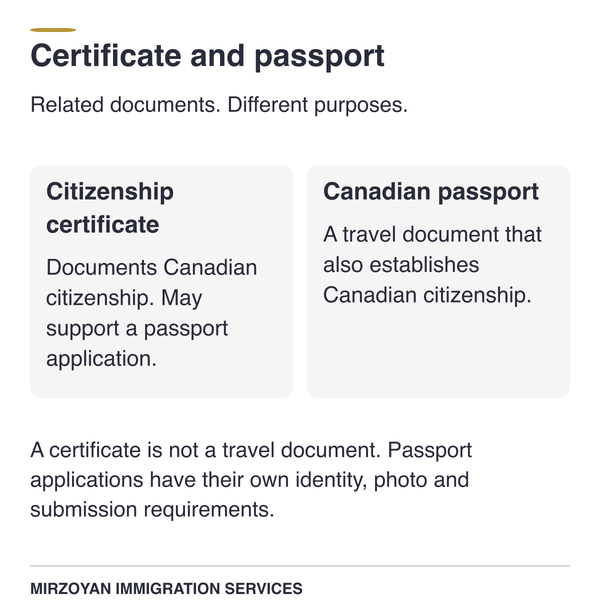
Citizenship certificate: Documents Canadian citizenship. May support a passport application. Canadian passport: A travel document that also establishes Canadian citizenship. A certificate is not a travel document. Passport applications have their own identity, photo and submission requirements.
The Internal Logic of an IRCC Officer
IRCC requires authentic, reliable, and verifiable records, and an officer reads each document for status, identity, parentage, or name continuity. The review focuses on what each record actually establishes in the file.
Does the document formally prove citizenship?
The officer first identifies whether the submitted document appears on the accepted proof list. A citizenship certificate can prove the named holder's status; a commemorative certificate cannot. The same title can hide important differences: a provincial birth certificate and DND 419 record are both birth documents. But IRCC treats them differently. The officer also checks whether the document belongs to the applicant. A parent's certificate may support a descent claim, but it is not the applicant's personal proof.
Does a supporting record prove the fact claimed?
Each supporting record should have one clear purpose; a long-form birth certificate, for example, can establish parentage. A marriage certificate may explain a surname change. Problems arise when you ask one document to establish too much. And a passport may support identity without proving the complete citizenship or parentage chain. Organize records by the fact they establish, making an unsupported relationship or unexplained date visible before submission.
Can IRCC verify the issuing authority and document chain?
IRCC expects authentic, reliable, and verifiable records, so the issuing authority and every required generation should be identifiable. Third-party genealogy records may point to an official record. But they should not replace a record available from the civil registry or archive. If an official record is unavailable, document the attempts made to obtain it. Explain why each substitute is reliable and what fact it establishes.
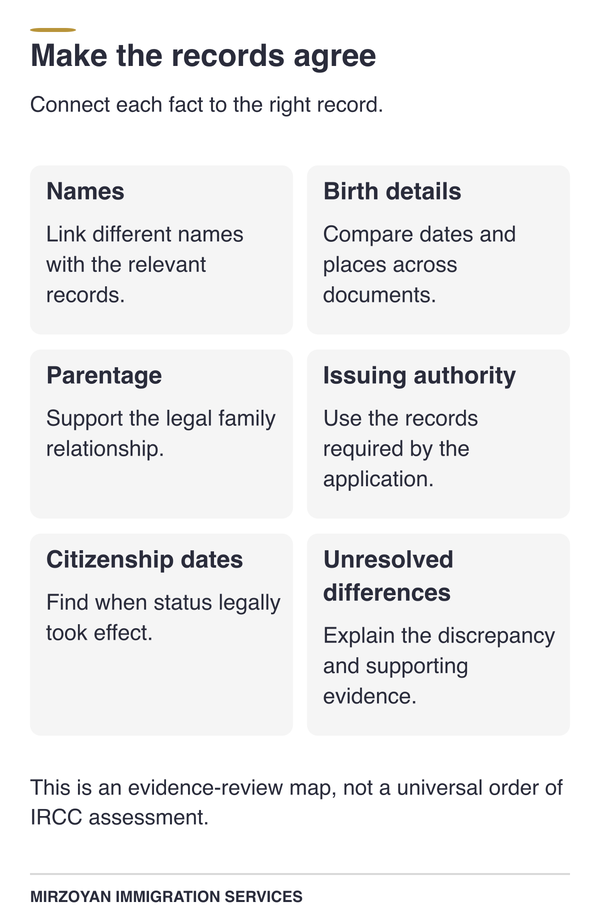
Names: Link different names with the relevant records. Birth details: Compare dates and places across documents. Parentage: Support the legal family relationship. Issuing authority: Use the records required by the application. Citizenship dates: Find when status legally took effect. Unresolved differences: Explain the discrepancy and supporting evidence. This is an evidence-review map, not a universal order of IRCC assessment.
Red Flags & Procedural Fairness Letters (PFL)
IRCC may request more information or documents when your evidence leaves status or parentage unresolved. A serious conflict can lead to procedural fairness correspondence.
The proof belongs to another family member
A parent's certificate supports the parent's citizenship, but does not establish the child's claim by itself. The child must also be connected to that parent through an appropriate parentage record. The applicable citizenship rule must then support transmission to the child. A parent's certificate and the child's passport may identify two people without establishing their relationship. Add the record connecting them rather than more identification that leaves parentage unresolved.
Names, dates, or parentage do not match
IRCC compares names, birth dates, places, parents, and citizenship dates across the package. An unexplained mismatch can cast doubt on identity or relationship. Address each difference directly; when I review mismatched names, I look for the document that legally connects them. A marriage certificate may bridge a surname change. The certificate's issue date can also be misunderstood, so explain the effective date when it affects the claimed family timeline.
A post-submission concern belongs in the response guide
If IRCC asks for another document, read the notice before deciding how serious the concern is. A routine request is not automatically a Procedural Fairness Letter. Identify the fact IRCC wants established, the evidence requested, the deadline, and the submission channel. The citizenship PFL and IRCC information-request guide explains how to prepare the response. Keep the original notice with the records you plan to provide so the reply addresses that request directly.
Which document route fits your situation?
IRCC's valid-proof list should be the first check before ordering another certificate. The actual problem may be format, condition, ownership, or missing parentage.
Use an accepted document you already hold
Check whether IRCC and the receiving program accept the proof you already hold before ordering another certificate. Its condition and submission format matter as well as its document type. An unreadable record or unauthorized lamination can prevent the program from accepting it. Sending an unacceptable copy can create a similar problem even when the original remains valid. Where the existing document meets the instructions, using it may avoid an unnecessary certificate application.
Obtain missing civil or citizenship records first
Before filing, identify any missing record needed to establish a family relationship, name change, or ancestor's citizenship. Determine the fact that record must prove before requesting more documents. Filing without it may move the same unresolved issue into an IRCC information request. A records search can help clarify an uncertain historical file. It cannot replace a citizenship certificate, so the search and certificate may serve different steps in your preparation.
When help can resolve a citizenship-proof problem
First-time proof assistance suits someone who may already be Canadian and has never received proof. Replacement help suits someone whose proof was previously issued. The service choice does not change legal status or guarantee faster processing. But it can help you select the correct route and evidence.
If IRCC refuses a certificate application, section 22.1 requires leave for judicial review and filing within 30 days of notice. So obtain case-specific legal advice promptly.
| Decision factor | Use existing proof | Obtain records first | Apply for a certificate |
|---|---|---|---|
| Main concern | Low when the document is accepted, readable, and submitted correctly | Lower than filing with a known relationship or status gap | Appropriate when existing citizenship is supportable but personal proof is missing |
| Appeal and review rights | A transaction refusal follows the receiving program's review or complaint process | No citizenship decision exists yet; resolve the evidence before filing | Federal Court judicial review requires leave and filing within 30 days of notice |
| Costs to plan for | Usually avoids a new certificate application | May require civil-registry, archive, translation, or certification expenses | Requires the current government fee and any evidence-preparation costs; see the citizenship fees guide |
| What happens next | No IRCC certificate processing when the existing proof satisfies the transaction | Delays filing but may prevent later document requests | IRCC timing depends on completeness, verification, and case complexity |
One on One Advisory puts your document question before Narek Mirzoyan or Vahe Mirzoyan. Their RCIC licence numbers are R1005184 and R514223, verifiable through the CICC public register. Questions about proof go directly to Narek or Vahe; they are not answered by intake personnel, assistants, or a routed call system.
You may not need professional help if the accepted document you hold already meets the receiving program’s instructions. Mirzoyan Immigration Services can compare the document problem with the evidence available and help identify the appropriate application.
Explore first-time proof of Canadian citizenship assistance if you have never received proof. For a previously issued certificate that is lost, damaged or incorrect, use help replacing a Canadian citizenship certificate.
Key Takeaways
Citizenship certificates, qualifying Canadian birth certificates, citizenship cards, and certain historic documents can formally prove citizenship.
A commemorative certificate and a records-search letter are not valid citizenship proof.
A parent's proof establishes the parent's status, not automatically the child's status.
First-time proof and replacement are different routes.
Mirzoyan Immigration Services can assess whether your issue requires first-time proof or replacement assistance.
Frequently Asked Questions
What can be used as proof of Canadian citizenship?
A citizenship certificate, qualifying Canadian birth certificate, valid citizenship card, and certain historic documents can prove Canadian citizenship. The accepted document depends on how and when citizenship arose. A commemorative certificate, records-search letter, permanent resident card, or family tree does not replace the proof required by the receiving program.
How do I verify my Canadian citizenship?
Start with IRCC's citizenship status guidance and identify how citizenship may have arisen. If you may already be Canadian but lack formal proof, apply for a citizenship certificate. IRCC reviews the status question and issues a certificate if you are a citizen. A records search may clarify an uncertain historic departmental record.
How can I request a search of citizenship records from IRCC?
Apply online for your own records, or use IRCC's paper application for your own or someone else's records. Follow that route's current document and submission instructions. Do not submit the same request through both channels. A records-search letter can clarify citizenship or naturalization history. It cannot prove citizenship or support a Canadian passport application.
Is it better to have a paper or electronic Canadian citizenship certificate?
Both formats prove Canadian citizenship; an e-certificate offers convenient digital storage, while paper provides a physical document. Choose according to how you need to use the proof. IRCC permits only one valid citizenship certificate, paper or electronic. You can print an e-certificate when needed, but do not photocopy or laminate that printout because it becomes invalid.
Do I need a citizenship certificate to apply for a passport?
You need accepted citizenship proof for a new Canadian passport, but it need not always be a citizenship certificate. Someone born in Canada may generally use an accepted provincial or territorial birth certificate. Someone born outside Canada generally uses a citizenship certificate or another accepted document, although renewal requirements can differ.
Next steps
Start with the exact document in your possession, including its title, issue date, and condition. Then compare it with IRCC's accepted proof list.
If you may already be Canadian but need your first certificate, use first-time proof of Canadian citizenship assistance. But if IRCC previously issued your proof, use the replacement route.
Mirzoyan Immigration Services reviews proof-document questions throughout Canada, with meetings available in person, online, or by phone. Bring the document and the receiving program’s request to discuss the correct route.
Disclaimer
This article provides general information, not legal or immigration advice. Citizenship status and documentary requirements depend on individual facts and current government instructions.