Canadian Citizenship by Descent Through a Grandparent

You may already hold Canadian citizenship by descent through grandparents, even if your parent never obtained a citizenship certificate. Bill C-3 extended citizenship to some people born abroad before December 15, 2025, including through parents recognized under the same changes. Your claim still depends on the citizenship history connecting your grandparent to your parent and then to you. IRCC requires reliable records for each relevant generation, rather than a family tree alone. Missing records or conflicting names need to be addressed before submitting your evidence. Start with that family history alongside the current Canadian citizenship by descent rules.
By Narek Mirzoyan, RCIC # R1005184,. Verify this credential on the CICC public register.
Last reviewed by Narek Mirzoyan, RCIC # R1005184, on 2026-09-16.
TL;DR:
A Canadian grandparent or great-grandparent may connect you to citizenship, but ancestry alone does not establish your status. Trace the relevant births and citizenship history through each generation, including any loss or restoration of citizenship. Beginning December 15, 2025, certain overseas births require 1,095 days of physical presence in Canada by a qualifying Canadian parent. A grandparent's residence cannot replace that parent's required presence. If you are already Canadian, the next step is a citizenship certificate application for official proof.
Table of Contents
Trace citizenship through your family
How your parent's citizenship affects your claim
Which dates can change your eligibility?
Documents that connect you to your Canadian ancestor
What to do about missing or conflicting records
Past events that may affect your family's citizenship
Which application do you need?
The Internal Logic of an IRCC Officer
Red Flags & Procedural Fairness Letters (PFL)
Trace citizenship through your family
Build a family timeline showing how citizenship could have passed from your Canadian ancestor to you. Put names, birthplaces and birth dates beside one another so you can see which events need supporting records. But keep citizenship dates separate, because a certificate's issue date may differ from the date citizenship began. The Citizenship Act determines whether those events establish citizenship, including where later amendments recognize earlier status. This working timeline helps you identify the first unanswered question before ordering more documents.
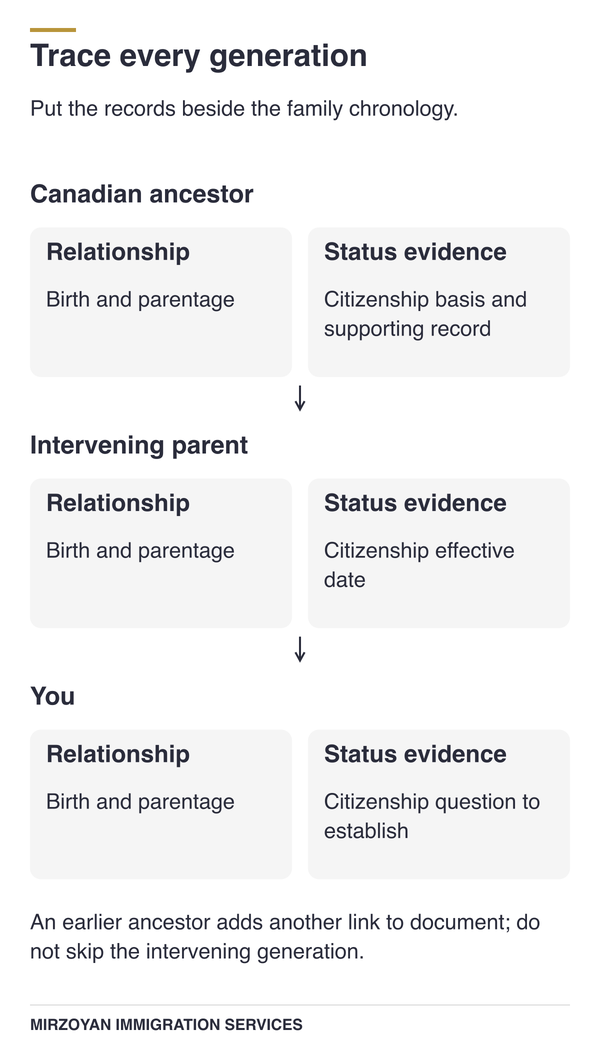
A working family chronology, not a finding that citizenship passed automatically. Record birth, parentage and citizenship facts for every relevant generation and keep the supporting records beside them.
How your grandparent became Canadian
Find out whether your grandparent was born in Canada, became Canadian through an application, or acquired citizenship through a parent. A relative's memory gives you somewhere to start, even if the family no longer has the citizenship documents. If you have a certificate, copy its identifying details into your timeline without treating every printed date as a citizenship date. For earlier ancestors, IRCC also identifies historical British-subject and immigration records that may be relevant. Establish how your grandparent qualified before relying on that person as the Canadian link in your claim.
Your parent's birth and citizenship history
Your parent's records connect your own birth to your grandparent's citizenship history. Read the parentage information on their birth record and compare it with the names used in your grandparent's documents. Then add any citizenship certificate, naturalization record, loss decision or restoration information available for your parent. But distinguish an uncertain citizenship date from a certificate you know existed and cannot find. Once you can explain your parent's position, you can assess what it means for your own citizenship.
Your birth date and the rules that apply
Your birth date helps determine which citizenship rules apply to you. The December 15, 2025 changes distinguish earlier births abroad from certain births on or after that date. Record your birthplace as well, because being born outside Canada raises questions that may not arise for someone born in Canada. Where the parent's physical presence matters, your grandparent's time in Canada cannot be substituted for it. Use the dates in the records rather than an estimated year passed down through the family.
How your parent's citizenship affects your claim
You establish a claim through your grandparent by examining your parent's citizenship as well as your own. A grandparent's Canadian birth certificate starts the inquiry, but you still need to connect that person to your parent. Your parent's birth record then connects those generations and establishes when the next citizenship question arose. Your own birth record completes the parent-child chain, alongside the citizenship rules applying to each birth. A missing certificate for your parent does not necessarily mean that citizenship stopped with your grandparent.
IRCC's generation examples begin with a Canadian citizen born in Canada or naturalized before their child's birth. Applied to a grandparent claim, the child born abroad is your parent: the first generation born outside Canada. You are the second generation if you were also born abroad to that parent. For a birth before December 15, 2025, Bill C-3 may remove the former limit that prevented citizenship reaching you. For a birth on or after that date, your parent's qualifying presence in Canada may also be required.
The records therefore answer different questions within the same claim. The grandparent's citizenship evidence establishes the starting status; the two birth records establish the relationships and dates. Compare those dates with any loss, restoration or adoption history before relying on this ordinary family sequence. This is an explanation of IRCC's generation framework, not a client case or a finding that every similar family qualifies.
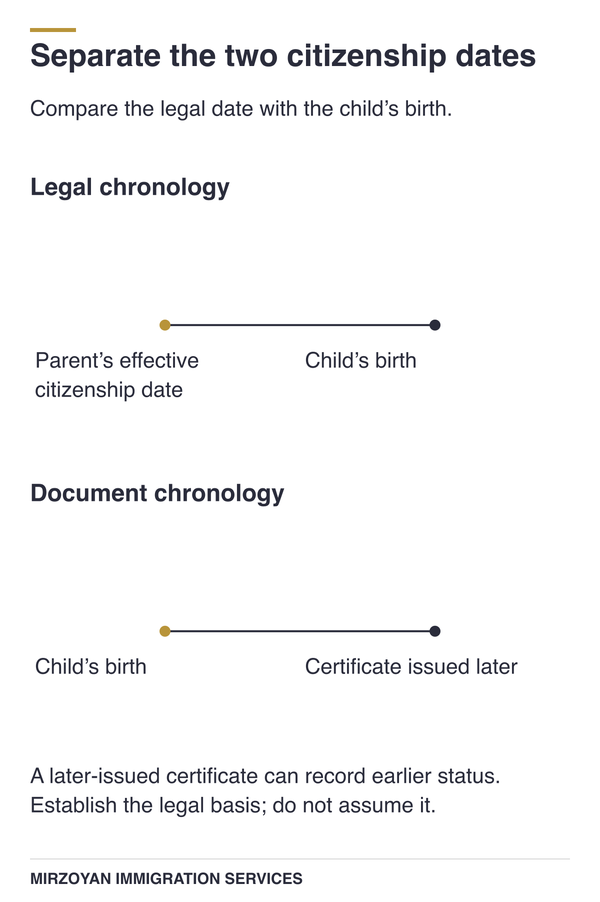
These undated example chronologies separate the parent’s citizenship effective date from certificate issuance. A later document is not proof that citizenship began later. Equally, an ordinary later grant must not be treated as earlier status.
When your parent needed to be Canadian
The date your parent acquired citizenship can affect whether you became Canadian through them. I establish when the parent's citizenship took effect, then compare that date with the child's birth before choosing an application. A certificate issued after your birth does not necessarily mean that citizenship began after your birth. But a later citizenship grant should not automatically be treated as citizenship held throughout the person's life. Compare the legal basis and effective date before deciding what the parent's document establishes.
When Bill C-3 also made your parent Canadian
Bill C-3 may affect your parent's status and your own claim within the same family. IRCC expressly addresses some people born before the changes whose parent also became Canadian because of those changes. That means your parent's lack of an earlier certificate should not end the inquiry. Identify which provision applies to the parent, then check its effect on your birth and citizenship history. The Bill C-3 guide explains the legislative changes without replacing that family-specific assessment.
Claims through a great-grandparent or earlier ancestor
A claim through a great-grandparent adds another relationship and another citizenship history to establish. Extend your timeline to include the intervening grandparent, rather than drawing a line directly from the oldest ancestor to yourself. Record what you know about each person and mark any uncertain birth, citizenship or name-change details. Another generation can mean more records to locate, even where the law supports the claim. Work through each link before concluding that a distant Canadian ancestor establishes your citizenship.
Which dates can change your eligibility?
Relatives born in different years may face different citizenship requirements, even when they rely on the same Canadian ancestor. Put the relevant births beside any naturalization, citizenship loss and restoration events before comparing relatives' outcomes. An older relative's unsuccessful application may reflect legislation that has since changed. Yet a younger relative's claim may involve a condition that did not apply to an earlier birth. Check the current law and its date-specific provisions against each person instead of assuming one family answer covers everyone.
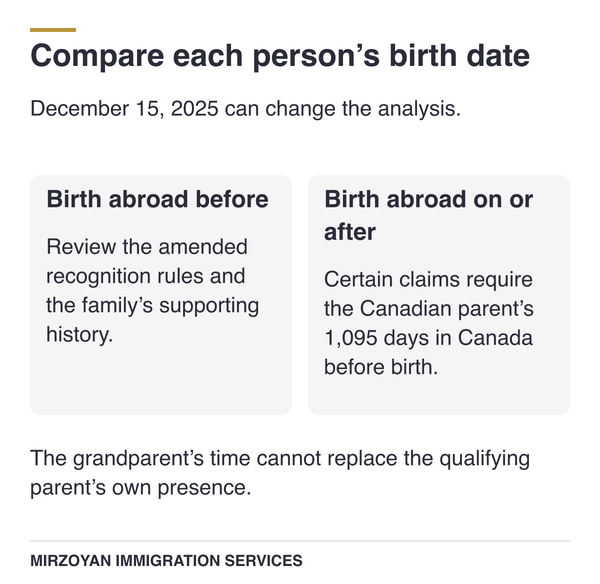
The parent’s 1,095 days in Canada before birth apply conditionally to specified later births abroad. A descendant does not automatically need to move to Canada for three years. Confirm each person’s citizenship basis and any exception.
Your parent's birth and the former first-generation limit
A parent's birth abroad needs to be considered alongside how their own Canadian parent acquired citizenship. The former first-generation limit may explain why the family previously believed citizenship could not pass further. But reassess that earlier understanding in light of the changes now in force. Keep any previous decision or correspondence, because it identifies what IRCC considered at the time. Use it to frame the present question rather than discarding it or treating it as permanently decisive.
Citizenship lost under the former age-28 rule
A historical loss under the former age-28 rule needs to be identified separately from the first-generation limit. Look for a retention certificate, loss correspondence or an earlier decision referring to that rule. IRCC confirms that Bill C-3 addressed people who lost citizenship this way, but your family history still needs examination. Include the relevant person's birth date and any loss or restoration dates in your timeline. Keep any retention or loss correspondence beside the birth record for the person affected.
Births before and on or after December 15, 2025
Certain children born overseas from December 15, 2025 onward need a Canadian parent with 1,095 pre-birth days in Canada. This is the parental physical-presence requirement, not a requirement that every descendant personally move to Canada for three years. Where it applies, time the parent spends in Canada after the birth does not satisfy the pre-birth condition. A grandparent's residence cannot fill the parent's shortfall. Check whether the requirement applies before gathering travel evidence or comparing the family's time in Canada.
Documents that connect you to your Canadian ancestor
Group each birth, citizenship and name-change record with the family relationship or citizenship event it supports. A large collection becomes easier to review when each record has a clear purpose in the family timeline. Separate documents establishing parentage from those supporting citizenship, and identify any record that helps with both. IRCC requires reliable evidence for every relevant generation, rather than a family tree standing alone. The table below can help you see which question each group of records should answer.
| Family record | Question it helps answer | What to check |
|---|---|---|
| Canadian ancestor's birth or citizenship record | How did this person acquire citizenship? | Citizenship basis, identifying details and relevant dates |
| Intervening parent's birth record | Does the record connect the parent to the ancestor? | Parentage and consistency with the preceding generation |
| Your birth record | Does the record connect you to that parent? | Parentage, birth date and birthplace |
| Marriage or name-change record | Why does one person appear under different names? | The earlier name, later name and connection between the records |
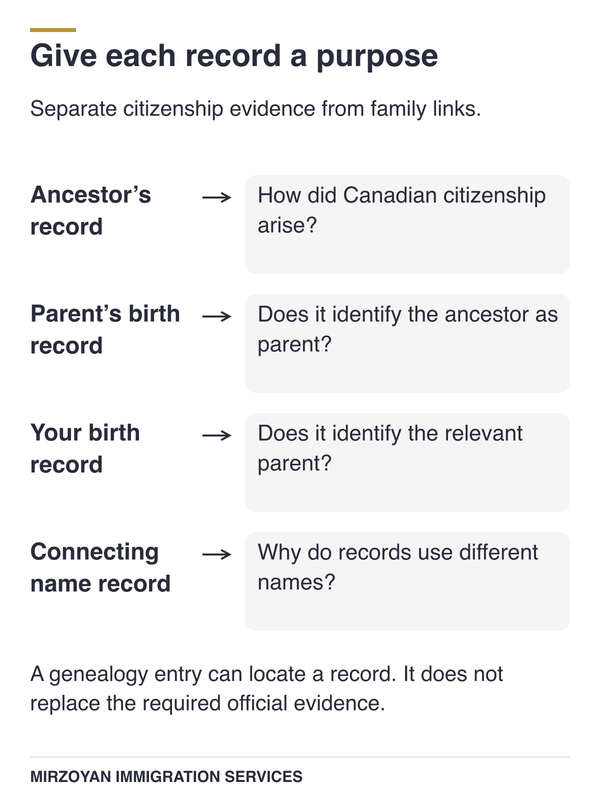
An organizer of record purposes, not a universal document checklist. Each relevant generation needs evidence of the relationship and citizenship facts relied on. Name-change and adoption records can answer different questions.
Birth and citizenship records for each generation
Read the details on each birth record before deciding that the family link is documented. But a record naming the child without the relevant parent may leave the relationship unresolved. Pair it with the citizenship evidence for that parent and check that the identifying details refer to the same person. I check the issuing authority for records supporting each claimed relationship in a family with several generations born abroad. The guide to proving Canadian citizenship explains the broader distinction between citizenship documents and supporting evidence.
Marriage, adoption and name-change records
Marriage and legal name-change records can explain why the same person appears under different names across generations. Place the connecting record beside the documents using the earlier and later names. An adoption record may raise a separate citizenship question, so do not treat it only as an explanation for a surname. The adoption provisions have their own conditions and may require a grant application. Identify the event behind the change before describing how the records connect.
Searching for citizenship records and translating documents
A citizenship-records search may help where the missing information concerns when someone became Canadian. IRCC explains what that search can establish, but it does not replace the relationships shown in civil records. And documents in another language need the translation required by the application instructions. Under IRCC’s translation rules, a translator who is not certified in Canada needs an affidavit; applicants and family members cannot translate. Arrange the search or translation that answers the specific gap, rather than ordering both automatically.
What to do about missing or conflicting records
If a family record is unavailable, keep evidence of your search and explain what you could not obtain. Start by identifying the person, event and authority connected with that record. Keep the authority's response alongside your request so the next reviewer can see what you asked for. IRCC provides instructions for unavailable official documents, including evidence of attempts to obtain them. You can explain an unavailable record without claiming that a relative's recollection proves the missing fact.
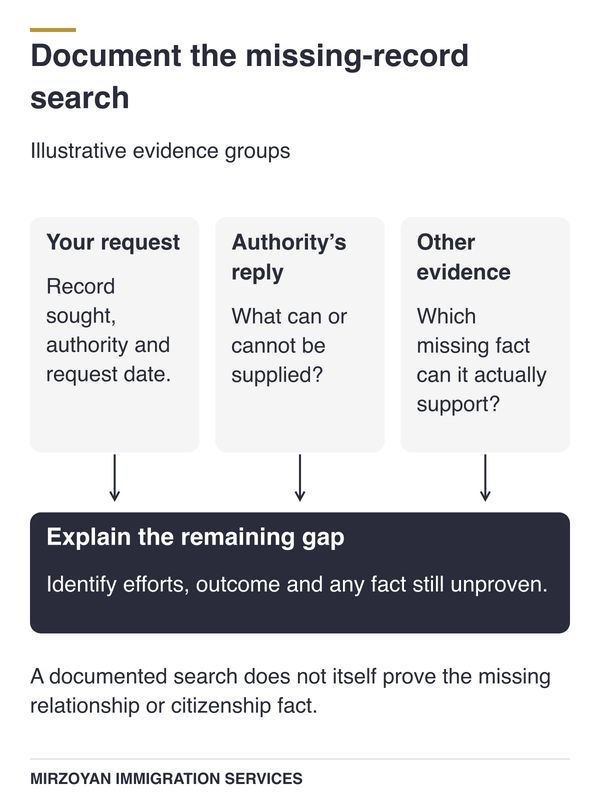
Illustrative request-and-response organizer, with no invented registry letter. Preserve the request, response and search references. Explain the limits of alternative evidence; IRCC determines its sufficiency.
When a family record cannot be found
Ask the responsible registry or archive what it holds and which version of the record you can obtain. If it cannot locate or release the record, retain its reply, your request and any search reference. Your explanation should identify the missing record, who you contacted and what the authority said. IRCC's proof guide permits consideration of certain alternative records, but their relevance depends on the fact you need to establish. A document's age alone does not make it a suitable substitute.
For missing parentage evidence, examine whether an available birth-related or near-birth record actually identifies the parent. A census entry or passenger manifest may help explain where someone lived or travelled without establishing the required parent-child relationship. If the missing fact is the ancestor's Canadian status, a residence record may leave that citizenship question unanswered. Explain what each substitute supports and disclose what remains unproven, rather than describing the entire gap as resolved. IRCC decides whether the combined evidence is sufficient; a documented search does not guarantee acceptance.
When names, birth dates or parentage do not match
Compare conflicting details side by side before deciding that they are a spelling error or refer to different people. Note the precise difference, the date of each document and the authority that issued it. A marriage record may connect surnames, while a conflicting birth date may need a different explanation. Request clarification or correction from the relevant authority where appropriate, preserving the existing record and correspondence. Name the conflicting entries in your explanation and identify the evidence connecting them to the same person.
When you only have records from a genealogy website
Genealogy websites can help you locate an ancestor, identify a registry or discover a record reference. Use those leads to find the original authority and determine whether it can supply the underlying record. IRCC does not accept an application supported solely by third-party records. Keep your family tree as an organizational aid, with each claimed relationship connected to the supporting evidence. If the official record cannot be obtained, document that difficulty instead of presenting the website entry as equivalent.
Does a missing family record leave the claim uncertain?
Bring the timeline and available official records to Mirzoyan Immigration Services.
First-time proof-of-citizenship assistance can help identify the relationship or citizenship date that still needs support.
Past events that may affect your family's citizenship
Older family histories may include events that changed citizenship under earlier legislation. Add foreign naturalization, formal renunciation, revocation, adoption and relevant government service to the timeline when they appear in your records. Each event raises a different question, so avoid grouping them together as a general loss of citizenship. The current Act’s recognition and restoration provisions must then be checked against the relevant history. Include documents about an inconvenient event as carefully as those supporting your claim.
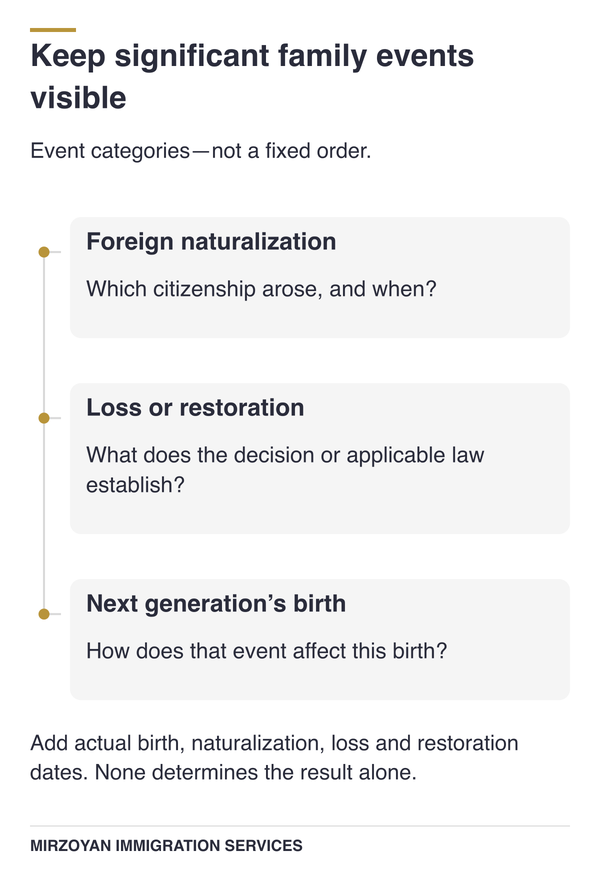
A chronology framework rather than a fixed sequence or automatic outcome. Add the family’s actual naturalization, loss, restoration and birth events in their real order. Renunciation and revocation require separate consideration.
When an ancestor became a citizen of another country
A foreign naturalization date can explain why an older Canadian record shows citizenship loss. Before February 15, 1977, Canadian law did not generally permit dual citizenship and included loss rules affecting some foreign naturalizations. IRCC's historical chronology explains that earlier framework and the later changes. But a foreign passport issued today does not establish that an ancestor lost Canadian citizenship under those older rules. You need the event that created the other citizenship and its date, not only the passport's issue date.
A foreign naturalization record and a Canadian restoration record can therefore answer different parts of the family question. The first may explain the earlier loss; the second may change how that loss affects a descendant's claim today. Compare both with the next generation's birth rather than assuming the foreign naturalization permanently ended the family's eligibility. Where the family account says only that an ancestor “became American,” request clarification of whether that meant birth, naturalization or obtaining documents. Those events should not be treated as interchangeable.
Citizenship that was renounced or revoked
Formal renunciation means giving up Canadian citizenship through the applicable legal process; revocation involves a decision removing it. Neither term should be inferred merely because someone moved abroad or started using a foreign passport. Family members may describe all these events as “giving up citizenship,” even though their legal effects differ. Ask for the renunciation or revocation decision, including its effective date, before treating the family account as a confirmed loss. If no decision is available, record that uncertainty rather than assigning a legal label.
The restoration rules exclude specified renunciations and fraud-related revocations. Bill C-3 therefore does not reverse every past loss in the same way as historical retention-related loss. A decision dated before the next generation's birth raises a different citizenship question from one taking effect afterward. Any later resumption or restoration must also be considered on its own terms. Have the actual decisions reviewed before concluding that your ancestor's experience either establishes or defeats your claim.
Adoption or qualifying Canadian government service abroad
Adoption and qualifying Canadian government service abroad should be flagged for separate consideration in your family history. An adopted person's citizenship may depend on the citizenship-by-adoption grant provisions rather than ordinary citizenship by descent. Certain Canadian Armed Forces or public-service employment abroad may engage exceptions to the descent limits. Those exceptions do not cover every Canadian employed overseas, and locally engaged employment is excluded from the relevant provisions. Identify the possible exception without assuming that an adoption record or overseas job resolves the claim.
Which application do you need?
Choose your application after identifying whether you are seeking proof of existing citizenship or asking to become Canadian. The citizenship certificate process is the relevant starting point when you believe citizenship already exists. A records search addresses a narrower information question, while replacement concerns a certificate previously issued to you. These processes can involve related family documents but serve different purposes. Describe the result you need before deciding which application to prepare.
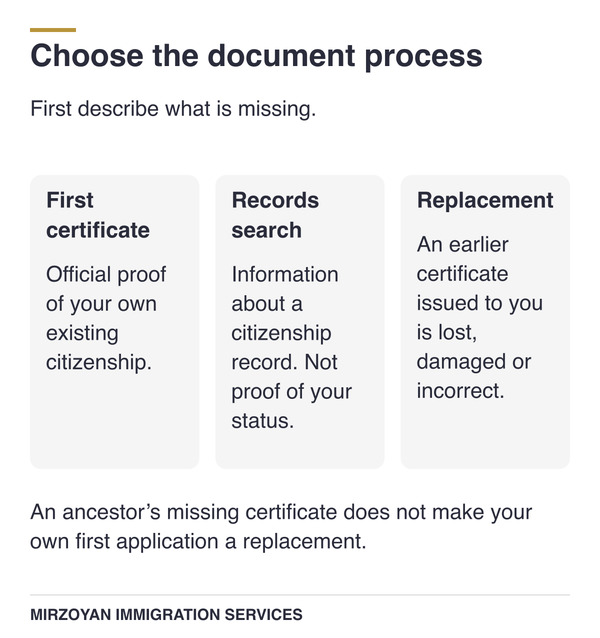
The three routes answer different document needs. A citizenship-records search is not a citizenship certificate. Replacement presupposes prior issuance to the person seeking replacement; a grant is separate when citizenship does not exist.
Getting your first citizenship certificate
A first citizenship certificate gives you official proof when you are already Canadian but have never held that document. But your application must establish your own claim, even where an ancestor already has a certificate. Keep the family timeline available as you assemble the evidence supporting each relevant generation. The citizenship-by-descent application guide covers the filing instructions and certificate-photo requirements. Use that guide once the citizenship basis and family evidence are sufficiently clear to prepare the application.
Requesting a search of citizenship records
A citizenship-records search can help establish whether IRCC holds a relevant citizenship record for your ancestor. To search someone else's records, use the paper application and authorization instructions. If the person is alive, they must sign and date the consent in section 4B. Being their child or grandchild does not replace that consent. Obtain it before preparing a request that depends on access to their personal information.
If the person died less than 20 years ago, provide the death date and evidence of the death. You must also establish your relationship and legal right to obtain the information, such as authority as estate administrator or executor. For someone deceased more than 20 years, IRCC instead specifies a copy of your own personal identification. Its summary does not expressly explain the exact twentieth-anniversary boundary, so seek clarification if that affects your request. A search result can help resolve the citizenship history, but it is not your citizenship certificate.
Replacing an existing certificate or applying to become Canadian
If you previously held your own certificate, you may need a replacement citizenship certificate. A grandparent's missing certificate does not turn your first proof application into a replacement application for yourself. If the assessment shows you are not Canadian, a grant application involves separate eligibility requirements. Review the citizenship grant requirements rather than assuming ancestry waives them. Resolve the distinction before paying for a service that cannot provide the result you need.
The Internal Logic of an IRCC Officer
Prepare your evidence so the decision-maker can follow both the citizenship history and the relationships connecting your family. The questions below explain the issues your records need to address, rather than a fixed internal review sequence. The statutory citizenship requirements determine the legal assessment, and IRCC may seek clarification about the evidence. But the officer still needs the underlying documents, even when your timeline explains the family history clearly. Organize the submission so each conclusion can be traced to the record supporting it.
Was each parent Canadian at the relevant time?
Identify the citizenship basis for each parent in the line you are relying on. Then compare that basis with the next person's birth and any relevant recognition or restoration provision. Where a certificate was issued much later, explain why you believe citizenship existed at the required time. If the citizenship date remains uncertain, identify the record or legal question that would help resolve it. For each parent, identify the document supporting the citizenship date you have used.
Do the records show every parent-child relationship?
Make every parent-child relationship visible in the evidence rather than leaving an intervening generation unexplained. Check that the person named as a parent in one record can be identified in the preceding generation's documents. Where names changed, include the connecting record and a concise explanation of the difference. IRCC’s evidence instructions require support for the relevant parent, grandparent and parental ancestor. A family tree can identify which records belong together; use the underlying documents to establish each relationship.
Did anyone lose citizenship or have it restored?
Show any known citizenship loss and restoration alongside the family births they may affect. An older refusal, retention document or renunciation record may identify a question that a current certificate does not fully explain. Avoid describing the family history as uninterrupted if the documents show an event requiring assessment. The current citizenship provisions may change the significance of that event, but the explanation still needs to address it. Present both the supporting history and the issue that could alter the conclusion.
Red Flags & Procedural Fairness Letters (PFL)
A procedural fairness letter requires a response to the concern IRCC actually raises about your application. A routine request for a missing document may instead seek information needed to continue processing. The Act authorizes requests for additional information and evidence, but that does not make every request a PFL. Read the notice's wording, requested action and deadline before deciding how to respond. The citizenship PFL guide covers response handling beyond the family-evidence issues discussed here.
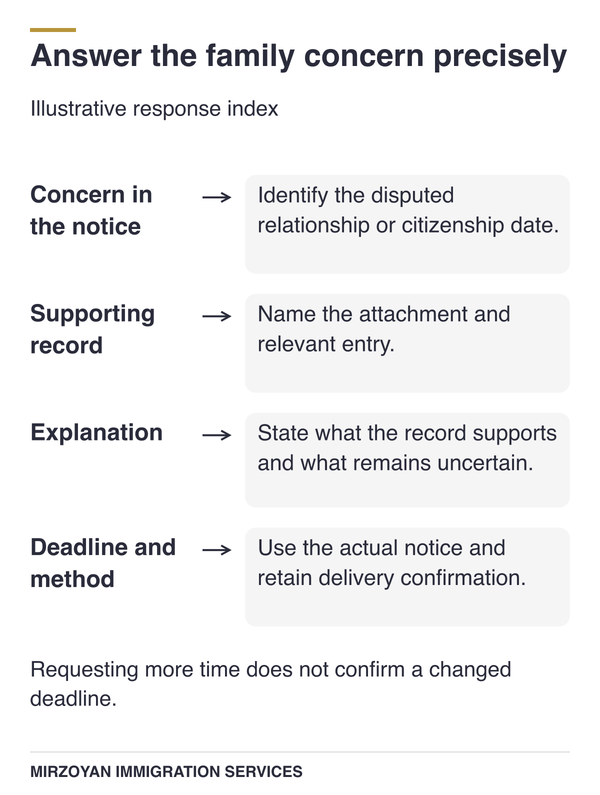
Illustrative response organization, not a template letter from IRCC. Match each family-history concern with the record and explanation addressing it. Follow the notice’s deadline and submission method.
Family stories without supporting official records
A family story becomes a problem when the application relies on it to establish a fact the records do not support. Identify which statement depends on recollection, such as a naturalization year or a parent-child relationship. Then check whether the relevant authority can supply evidence addressing that statement. IRCC’s published document requirements explain why unsupported third-party accounts cannot carry the application alone. If a gap remains, describe it accurately and provide the documented efforts to resolve it.
Conflicting names or parentage in family documents
Conflicting names or parentage need a focused explanation tied to the documents in question. If IRCC identifies a discrepancy, compare the exact records cited in the notice before preparing your response. Explain the difference and attach the evidence that supports your account of the relationship or identity. Do not alter a historical document to make it match another record. If you obtain a correction, explain the authority's correction and retain the supporting correspondence.
Responding when IRCC questions your evidence
Begin your response plan by listing each concern, the evidence addressing it and the stated deadline. Answer the points in the notice directly, with clear references to the documents you submit. If you cannot obtain a requested record in time, ask promptly about an extension and explain the outstanding steps. But do not assume that requesting more time changes the deadline without confirmation. Keep the complete response and delivery confirmation so you can show what was provided and when.
Strategic Trade-off Matrix
Choose your next step according to the missing citizenship fact or family record, rather than ordering every available service. A records search, targeted advice and a prepared certificate application involve different work and costs. None changes the citizenship requirements or guarantees a faster decision. Any challenge to a citizenship decision follows the applicable review process, including the requirement for leave for judicial review. Compare the options below against the unresolved question in your own family history.
| Next step | Risk addressed | Cost and timing | Review rights |
|---|---|---|---|
| Request a relevant citizenship-records search | Uncertain citizenship or naturalization information | Separate fee and processing step before proof, if needed | The search does not create an additional appeal route |
| Obtain advice on a defined question | Unclear legal effect of a date, loss or inconsistent record | Professional fee; scope depends on the unresolved issue | Advice does not extend a deadline or change statutory rights |
| Prepare a supported certificate application | Obtaining official proof once the claim and evidence are ready | Application costs; processing depends on the file and current IRCC workload | A decision is subject to the applicable legal review framework |
When to request a records search before applying
A records search is worth considering when an uncertain citizenship or naturalization date could change the assessment. First check whether an existing document already supplies the information you need. The search result is not a citizenship certificate, so it may add a preliminary step without completing your proof application. Requesting one for every relative automatically can create unnecessary work. Use it where the expected information has a defined role in resolving the family history.
When your records are sufficient and when something is still missing
You do not need to keep collecting family history that has no bearing on the claim. Focus instead on whether the required relationships and citizenship facts have adequate supporting evidence. If a critical link remains unsupported, identify the next practical step and document any difficulty obtaining the record. If the evidence is sufficient, move to the current certificate application instructions and check the package requirements. Set aside unrelated family material and keep the records that establish your citizenship claim.
When help can clarify a grandparent citizenship claim
Targeted advice may suit a file with one unresolved citizenship date or a specific records discrepancy.
Broader assistance may suit a history involving several generations, inconsistent documents and uncertain loss or restoration events.
One on One Advisory puts your questions directly to Narek Mirzoyan, RCIC # R1005184, or Vahe Mirzoyan, RCIC # R514223.
Your questions go to the consultant handling the file, not intake staff or call routing.
Bring your timeline and existing records so the discussion can identify the work still needed.
Agree the scope of assistance before treating a consultation as full application preparation or representation.
You may be able to prepare the application yourself when the citizenship history and required relationships are supported by clear records.
Mirzoyan Immigration Services can review the family timeline against those records to identify the first unresolved link.
Explore first-time proof-of-citizenship assistance for help assessing that gap.
The review cannot create an unavailable record or guarantee approval or faster processing.
Key Takeaways
Trace the citizenship history from your Canadian ancestor through every intervening generation to your own birth.
Distinguish a missing certificate from uncertainty about whether the person acquired citizenship.
Keep names, birth dates, citizenship events and supporting records together so discrepancies are visible.
Document attempts to obtain unavailable records; do not rely solely on a genealogy website or family tree.
Mirzoyan Immigration Services can help assess an unresolved citizenship question and discuss the appropriate scope of proof-application assistance.
Frequently Asked Questions
How many generations can claim Canadian citizenship by descent?
There is no single generation count that decides every Canadian citizenship-by-descent claim. Bill C-3 expanded recognition for some earlier births abroad, including through more distant ancestors. You still need to establish the relevant citizenship history through every intervening generation. Certain births on or after December 15, 2025 involve parental physical presence. Count the generations for your records plan, then assess the applicable law.
Can I become Canadian citizen if I have a great-grandfather who was a Canadian citizen?
You may already be Canadian, but your great-grandfather's citizenship alone does not establish your status. Trace the relationships through your grandparent and parent to your own birth. Check each person's citizenship history, including any applicable recognition under the Citizenship Act. Missing certificates do not necessarily mean citizenship was absent. The records and relevant dates determine whether the claim can be supported.
How to prove Canadian citizenship through grandparents?
Connect your own birth to your Canadian grandparent through records for the intervening parent. Include evidence supporting the relevant citizenship history and any changes of name. IRCC requires documents from the original authority, with copies submitted as directed by the application instructions. A family tree alone is insufficient. Apply for your own citizenship certificate when seeking official proof of your status.
How to obtain a Canadian birth certificate for a deceased grandparent?
Contact the vital statistics authority or archive for the province or territory where your grandparent was born. Access requirements depend on the authority and the record. Ontario, for example, restricts deceased-person birth-registration copies to eligible requesters, with supporting documents required. Check what proof of relationship or authority you must supply. If the record is unavailable, keep the response to explain your search efforts.
How to prove an ancestor was a Canadian citizen?
Identify how the ancestor acquired citizenship before choosing the evidence to obtain. Depending on the history, birth, naturalization or other recognized historical records may be relevant. A citizenship-records search can help confirm citizenship and naturalization information. Its result does not replace a citizenship certificate. Establishing the ancestor's position is one step; your own claim also needs the intervening family relationships.
Conclusion
Start with the family records already available and identify the first relationship or citizenship date you cannot yet support. Decide whether that question needs a registry request, a citizenship-records search or advice about the law. Bring the relevant documents and correspondence together before paying for work that may not resolve the gap. Mirzoyan Immigration Services can discuss those questions and the scope of first-time proof-of-citizenship assistance suited to your circumstances. Discuss the unresolved citizenship issue before committing to an application.
Disclaimer
This article provides general information, not advice on an individual citizenship claim. Eligibility depends on your facts and the applicable legislation, and IRCC decides applications. Requirements can change; obtain advice suited to your circumstances before acting.