Canadian Citizenship for Minors: Parent, Residence and Adoption Routes

Canadian citizenship for minors includes routes based on a parent's citizenship or application, the child's Canadian residence, and qualifying adoptions. The correct route depends on the child's status, the parent's citizenship or application, and the adoption facts. For the broader grant framework, review Canadian citizenship requirements. For a paper Canadian-parent application, a missing parent citizenship document or required signature can result in an incomplete-file return. Before preparing the package, confirm which citizenship route applies to the minor and identify the adult who has legal authority to sign. Then make sure the parent-status, custody, or guardianship documents support that route and the person signing the application.
By Narek Mirzoyan, RCIC # R1005184,. Verify this credential on the CICC public register.
Last reviewed by Narek Mirzoyan, RCIC # R1005184, on 2026-09-16.
TL;DR:
Canadian Citizenship for Minors: Parent, Residence and Adoption Routes covers children who are not already Canadian. The Canadian-parent route applies when a parent is Canadian or applying at the same time. The residence-based route applies when that parent condition is absent. Neither route requires language proof or a test; presence and tax rules differ, while both generally require the oath from age 14. An adopted person may instead qualify for a separate direct grant with a two-part application.
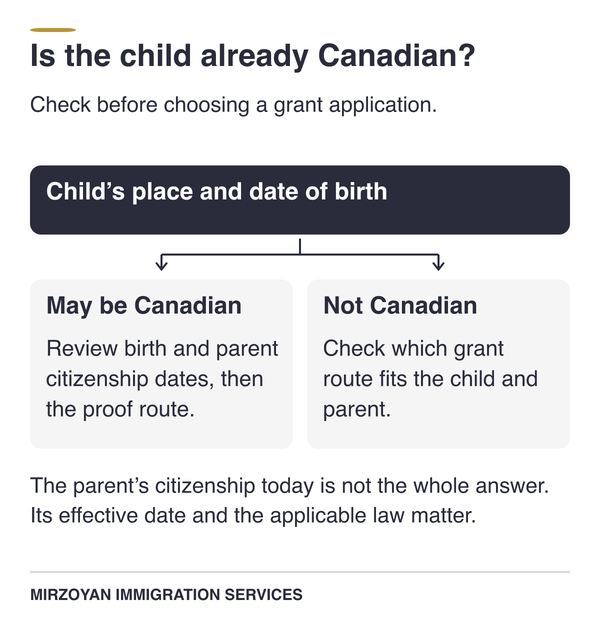
May be Canadian: Review birth and parent citizenship dates, then the proof route. Not Canadian: Check which grant route fits the child and parent. The parent’s citizenship today is not the whole answer. Its effective date and the applicable law matter.
Table of Contents
Check whether the child is already Canadian before starting a grant
Compare presence, tax, test, language, and oath requirements
A minor may apply alone only through the residence-based route
Use the application channel that matches the route and current instructions
Adoption can use a regular grant for a minor or a direct citizenship grant
Part 1 confirms the adoptive parent before Part 2 assesses the adopted person
Check whether the child is already Canadian before starting a grant
Some children are already Canadian by birth or descent and do not need a citizenship grant. Check where and when the child was born, then confirm when the parent became Canadian.
A Canadian parent does not automatically mean a grant is required
A child born abroad may already have Canadian citizenship through a parent. The answer depends on whether the parent was Canadian on the child's birth date and the citizenship rules that apply. A parent who is Canadian today may have acquired that status after the birth. Check the effective citizenship date before deciding whether the child needs a grant or proof of existing status. Where citizenship may already have passed to the child, complete that assessment before preparing a permanent-resident grant application.
Existing status and proof are separate from naturalization
A citizenship certificate documents existing Canadian citizenship for passport and other official uses. It does not create citizenship for someone who does not qualify. A grant for a minor instead makes an eligible permanent resident Canadian. Before collecting grant evidence, establish which of those situations describes the child. If citizenship already exists, use the proof process rather than preparing an unnecessary naturalization application.
Choose the route from the parent's status and application
IRCC uses two regular application routes for minors, and the choice turns on the parent's citizenship and application status. However, adoption or existing citizenship can place the child on a different route.
Use the Canadian-parent route when the parent is Canadian or applying at the same time
The Canadian-parent route applies to a permanent resident under 18 with a Canadian parent or a parent applying at the same time. Under this route, the child does not need the 1,095-day calculation or tax-filing evidence required for the residence-based route. When I review this choice, I confirm the parent's citizenship evidence or linked application before comparing the remaining requirements. That record explains why the child qualifies for the Canadian-parent requirements. Include the required parent-status evidence rather than relying on the parent's name elsewhere in the package.
Use the residence-based route when that parent condition is absent
Use the residence-based route when no parent is Canadian or applying for citizenship at the same time. The child must then meet the physical-presence requirement and any applicable tax-filing obligation. This route is not interchangeable with the Canadian-parent route simply because one form seems easier to complete. Establish the parent's status before gathering the child's residence evidence. The selected application and its supporting documents should reflect the same family circumstances.
Adoption can create a separate direct-grant route
An adopted person may qualify for a direct grant under the Citizenship Act. Adoption alone does not make every child Canadian. The direct route has its own requirements concerning the adoption and the Canadian parent. Where the adopted child is already a permanent resident, a regular grant for a minor may also be relevant. Check both the adoption history and the child's present status before selecting the application.
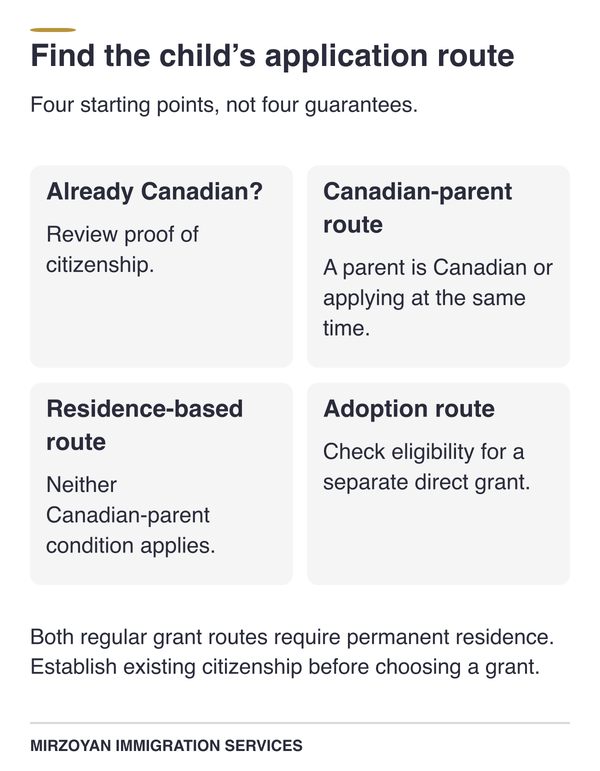
Already Canadian?: Review proof of citizenship. Canadian-parent route: A parent is Canadian or applying at the same time. Residence-based route: Neither Canadian-parent condition applies. Adoption route: Check eligibility for a separate direct grant. Both regular grant routes require permanent residence. Establish existing citizenship before choosing a grant.
The Canadian-parent route has fewer residence requirements
The Canadian-parent route requires permanent residence and the qualifying parent condition. However, it does not require 1,095 days, tax filing, language proof, or a citizenship test. Yet signatures remain necessary, and applicants aged 14 to 17 generally take the oath.
The child must still be a permanent resident
A Canadian parent does not remove the child's permanent-resident requirement for this route. Confirm that the child holds PR status and has no unfulfilled conditions affecting that status before filing. This is another reason to complete the status screen before preparing any forms or paying fees. A child who is already Canadian does not need PR-based naturalization. But a non-citizen child generally needs PR status for the Canadian-parent route.
Physical presence and tax filing do not apply to the Canadian-parent route
The Canadian-parent route does not require the child's three-years-in-five physical-presence calculation or income-tax filing history as grant requirements. This removes a significant part of the evidence needed for the residence-based route. It does not remove every request for passports or travel documents. Those records may still be needed to establish identity and history. Follow the Canadian-parent checklist rather than either adding the other route's requirements or omitting requested travel documents.
Parent or guardian authority must be documented
A parent or legal guardian having custody signs the Canadian-parent application. A child aged 14 to 17 also signs. The supporting records must establish why the adult has authority to act for that child. Where parents live separately, check the custody and guardianship evidence against IRCC's Canadian-parent instructions. Resolve the signing authority before treating the child's eligibility as sufficient to complete the package.
The residence-based route applies without a Canadian parent
The residence-based route applies when no parent is Canadian or applying simultaneously. The child must be a permanent resident and generally needs 1,095 days in Canada during the five-year eligibility period.
The residence-based route generally requires 1,095 days
For the residence-based route, calculate at least 1,095 qualifying days within the five-year eligibility period. Use the IRCC residence-based instructions to identify the records needed to support that timeline. Compare the entries with the child's travel and school history before relying on the final total. A missing trip can affect the calculation even when the displayed number appears sufficient. Resolve those differences before transferring the dates to the application.
Tax filing applies only if required under the Income Tax Act
The residence-based route requires tax compliance only where Canadian tax law required the child to file. A citizenship application does not itself create a tax-filing obligation. Review the applicable years rather than assuming every minor must have filed returns. Distinguish a year with no filing obligation from one where a required return was not filed. If the obligation is uncertain, obtain tax advice before answering the citizenship form.
The self-application waiver is not a convenience option
A child using the residence-based route may apply alone only when nobody can apply on their behalf. Being able to manage an online account does not establish that condition. The child must request the waiver and explain the absence of someone who can act. IRCC may approve or reject the request through the account. If rejected, processing stops until an eligible person can apply for the child.
Compare presence, tax, test, language, and oath requirements
The two regular routes for minors share test and language exemptions but differ on presence, tax, and who can apply. IRCC's current comparison confirms that neither route requires a test or language proof.
| Requirement | Canadian-parent route | Residence-based route | Adopted-person route |
|---|---|---|---|
| Permanent residence | Required | Required | Not the controlling requirement |
| Physical presence | No 1,095-day requirement | Generally 1,095 days in five years | A parent connection rule may apply to certain post-2025 adoptions |
| Tax filing | Not required for this route | Required only if tax law required filing | Not a regular route requirement |
| Language and test | Not required | Not required | Not a regular route requirement |
| Oath | Generally required at age 14 or older | Generally required at age 14 or older | Follow the decision and ceremony instructions issued for the file |
No minor under 18 takes the citizenship test
Neither regular route for a minor requires the citizenship test or language proof. That exemption does not remove every other requirement. A child using the residence-based route still needs the applicable presence and tax evidence. A parent applying at the same time may also have separate adult test obligations. Use the Canadian citizenship test guide for the parent's age rules and preparation rather than applying them to the child.
Oath rules are separate from test rules
Minors aged 14 to 17 generally take the Oath of Citizenship, while children under 14 are exempt. A waiver may be available in qualifying circumstances, but it is not automatic. However, the invitation controls the event instructions for the particular child. Use the citizenship oath ceremony guide for attendance and scheduling details. Mirzoyan Immigration Services provides Canadian citizenship application services when a family needs help identifying the correct route for the child. The review also identifies the evidence needed to document that choice.
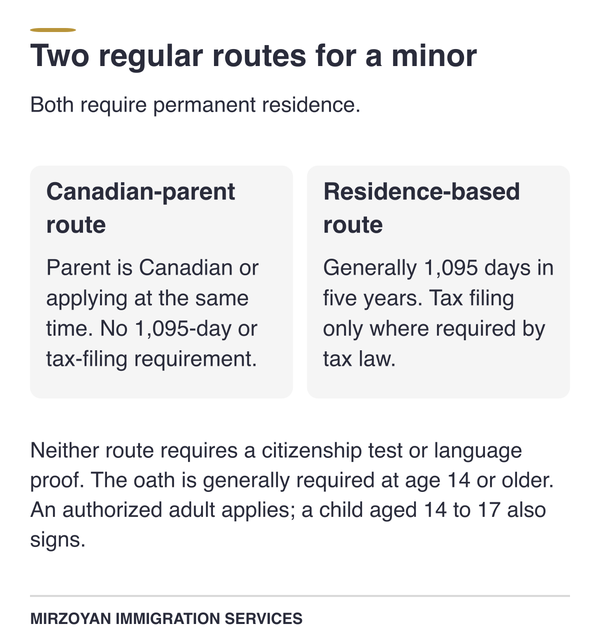
Canadian-parent route: Parent is Canadian or applying at the same time. No 1,095-day or tax-filing requirement. Residence-based route: Generally 1,095 days in five years. Tax filing only where required by tax law. Neither route requires a citizenship test or language proof. The oath is generally required at age 14 or older. An authorized adult applies; a child aged 14 to 17 also signs.
Who applies and who signs for the child?
The adult signing an application for a minor must have legal authority to act. And the child's age can add a second signature. Treat custody, guardianship, and authority records as route evidence rather than administrative attachments.
Authority to act must match the child's circumstances
For the Canadian-parent route, a parent or legal guardian having custody signs the application. The residence-based route also permits another person legally empowered to act for the child. When I review the signature page, I first match the signer to the custody or guardianship document. This establishes why that person can apply, rather than simply showing that an adult completed the form. Address any difference between the named guardian and the proposed signer before submitting the package.
Applicants aged 14 to 17 may also need to sign
A child aged 14 to 17 signs in addition to the authorized adult. The child's signature does not replace the adult's unless IRCC approves the self-application waiver. Check the child's age on the signing date. A birthday during preparation may change the signatures needed from those identified when the form was downloaded. Recheck the signature instructions before submitting a package prepared across that birthday.
Conflicting custody evidence must be resolved before filing
Court orders, guardianship records, consent documents, and the application should support the authority claimed by the signer. An unexplained conflict may lead to a return, a document request, or a more serious authority concern. Do not omit a record because it names a different decision-maker. Explain which document establishes the current authority and provide the necessary context. The application should reflect that authority before the adult signs.
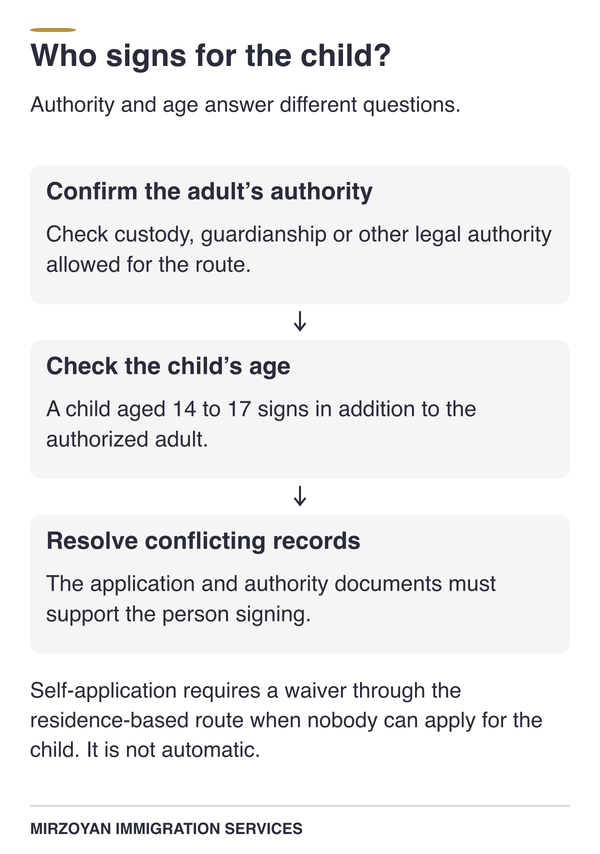
Confirm the adult’s authority: Check custody, guardianship or other legal authority allowed for the route. Check the child’s age: A child aged 14 to 17 signs in addition to the authorized adult. Resolve conflicting records: The application and authority documents must support the person signing. Self-application requires a waiver through the residence-based route when nobody can apply for the child. It is not automatic.
A minor may apply alone only through the residence-based route
IRCC allows self-application only through the residence-based route when nobody can apply for the child. But the waiver turns on legal authority, not the child's ability to complete forms.
Identify every adult who may have authority to apply
Start with the custody order, guardianship record, or other document identifying who can act for the child. A statement that nobody is available does not explain why a named guardian cannot apply. Address each person identified in those records. Explain why they cannot submit the application rather than leaving IRCC to infer the reason. The waiver explanation must account for the authority documents, including any adult named in an order.
Match the waiver explanation to the authority records
The self-application waiver explanation must account for the adults identified in the child's authority records. Match each custody or guardianship document to the reason the named person cannot apply. Entering the request in the online account does not resolve a contradictory record on its own. IRCC may request more evidence before deciding whether self-application can proceed. Answer through the stated channel and retain the explanation, supporting records, and submission confirmation together.
Unclear who can apply for the child?
Bring the relevant authority records and the application question to Mirzoyan Immigration Services.
Canadian citizenship application services can help assess what the file needs to establish.
Use the application channel that matches the route and current instructions
Most citizenship applications for minors can be filed online, while listed exceptions require paper. But the practical risk is mixing one channel's evidence controls with the other channel's package.
Match every online upload to its account question
The online account provides questions and upload fields for the child's selected route. Match each document to the question it supports before uploading it. A paper checklist does not replace an answer or upload required by the account. For a family or group application, confirm which adult account contains the child's application. Check the child's documents in that account rather than assuming the parent's uploads also complete the child's file.
Record the paper route and form number before gathering evidence
IRCC provides CIT 0003 for the Canadian-parent route and CIT 0403 for the residence-based route. Record the selected route and form number on your working checklist. Use the matching package to identify which evidence to gather. Download the current form directly from Canada.ca when ready to prepare the signed application. A correctly completed form for the wrong route may still leave the required evidence or answers missing.
Replace saved or third-party forms before signing
Check the form title and edition against Canada.ca when the application is ready for signing. Replace a saved copy if it no longer matches the current package. A third-party PDF mirror cannot establish which edition IRCC currently accepts. After transferring information to a new form, check every answer and signature again. Pay particular attention to the child's age, the parent condition, and the person authorized to sign.
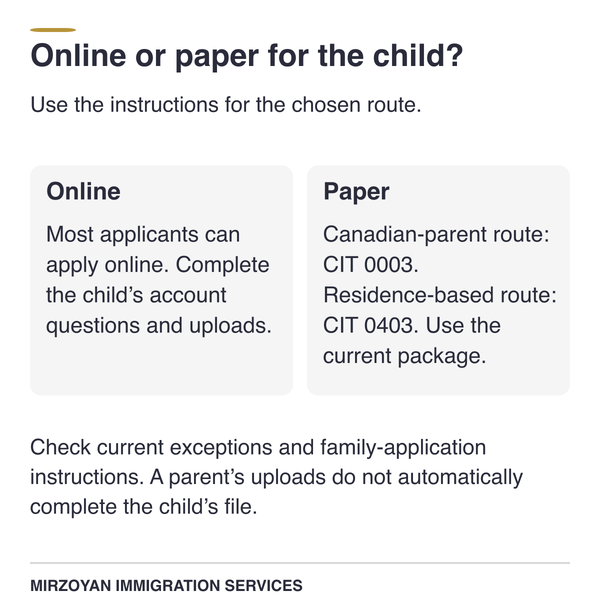
Online: Most applicants can apply online. Complete the child’s account questions and uploads. Paper: Canadian-parent route: CIT 0003. Residence-based route: CIT 0403. Use the current package. Check current exceptions and family-application instructions. A parent’s uploads do not automatically complete the child’s file.
Adoption can use a regular grant for a minor or a direct citizenship grant
An adopted permanent resident may qualify under a regular route for a minor. However, the Citizenship Act provides a separate direct adoption grant. The available route depends on citizenship, PR, parent, and adoption facts.
A regular grant for a minor requires permanent residence
Both regular grant routes require the adopted child to be a permanent resident. The adoptive parent's citizenship or application status then determines which regular route applies. This may be relevant where the child became a permanent resident before citizenship preparation began. The family must still establish the adoption and the adult's authority to act. Keep those records with the status evidence rather than assuming permanent residence answers the adoption and signing questions.
The direct adoption grant has its own legal requirements
A direct citizenship grant requires more than a finalized adoption and a Canadian adoptive parent. For an adoption while the child was a minor, the Act requires the adoption to serve the child's best interests. It must create a genuine parent-child relationship. The adoption must comply with applicable laws where it occurred and where the Canadian parent resides. The process must not bypass legal safeguards for international adoptions. It also must not have been arranged mainly to obtain an immigration or citizenship advantage.
These are separate questions when preparing the child's evidence. An adoption order can establish the legal decision, while the broader record must support the relationship and circumstances being assessed. Use the current application checklist and answer any case-specific requests rather than assuming one document proves every requirement. Where Quebec adoption law applies to an adoption decision made abroad, the Act provides a distinct assessment. The responsible Quebec authority must provide its written opinion on compliance with Quebec adoption law, and the immigration-purpose restriction still applies. Obtain appropriate adoption-law advice if recognition or legal validity remains disputed before relying on this citizenship route.
Adoption date and the parent's citizenship route can matter
For an adoption on or after December 15, 2025, a Canadian parent's own citizenship history can create an additional presence requirement. This generally affects a parent born abroad who became Canadian through descent or a direct grant for an adopted person. Where the restriction applies, a qualifying Canadian adoptive parent must have spent at least 1,095 days in Canada before the adoption. The Part 1 adoption guide explains which parental histories require that evidence and which exceptions apply. The child's age or finalized adoption does not answer that question by itself.
The relevant deadline is the adoption date, rather than the child's birth date used in ordinary descent cases. Days the parent spends in Canada after the adoption cannot complete the required pre-adoption total. If another Canadian adoptive parent can pass citizenship without this restriction, that parent's history may establish a different route. Qualifying Crown-service exceptions also need to be considered before concluding that parental presence evidence is required. Record both adoptive parents' citizenship histories and the adoption date before gathering the travel evidence requested for Part 1.
Part 1 confirms the adoptive parent before Part 2 assesses the adopted person
IRCC's direct adoption package has two parts. Part 1 examines the adoptive parent's citizenship and transmission position; Part 2 examines the adopted person and adoption evidence.
Part 1 does not grant the child citizenship
Part 1 uses CIT 0010 and its checklist to assess the adoptive parent's citizenship and ability to pass it on. Approval allows the adopted-person assessment to proceed. It does not grant the child citizenship or produce the child's certificate. I separate the parent's citizenship evidence from the adoption evidence at this stage. Keeping those records distinct helps the family see which question Part 1 has answered and which remains for Part 2.
Wait for Part 1 approval before submitting Part 2
IRCC instructs applicants to wait for Part 1 approval before submitting the adopted person's Part 2 package. Part 2 uses CIT 0012 with identity, adoption, and photograph evidence. Match those records to the adopted person being assessed rather than treating them as more proof of the parent's citizenship. Submitting Part 2 early does not accelerate the assessment and can complicate correspondence matching. Keep the Part 1 decision with the application record so the later submission follows the required sequence.
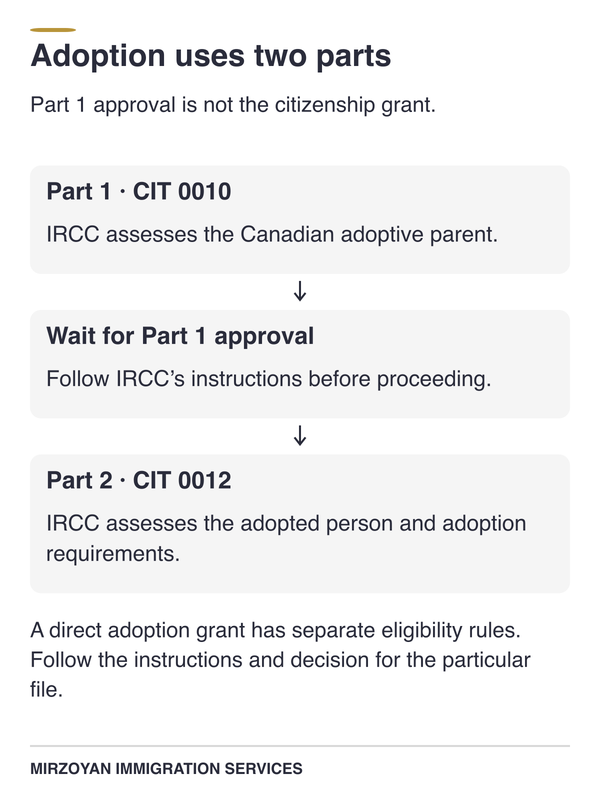
Part 1 · CIT 0010: IRCC assesses the Canadian adoptive parent. Wait for Part 1 approval: Follow IRCC’s instructions before proceeding. Part 2 · CIT 0012: IRCC assesses the adopted person and adoption requirements. A direct adoption grant has separate eligibility rules. Follow the instructions and decision for the particular file.
The Internal Logic of an IRCC Officer
An officer must resolve status before route, then authority, eligibility, and supporting evidence. Organizing the package in that order makes a wrong form, missing signature, or inconsistent relationship easier to identify before filing.
First determine whether the child is already Canadian
The officer must distinguish a child who already holds citizenship from one who needs a grant. The Citizenship Act's status rules determine that starting point. A parent's current certificate may not establish when the parent's citizenship began. Compare the effective status date with the child's birth before treating the grant route as settled. If citizenship already exists, the remaining work concerns documenting that status.
Then verify the parent condition and authority to apply
For the Canadian-parent route, the file must establish the parent's citizenship or simultaneous application. A residence-based application must instead match the absence of that parent condition. The officer also needs to establish who can act for the child. Custody and guardianship records explain the authority to sign and manage the child's application. Check those records independently of the parent's citizenship evidence because they answer a different question.
Match the evidence to the selected route for a minor or adopted person
Presence and tax evidence belong to the residence-based route. The Canadian-parent route instead requires evidence supporting the parent's citizenship or simultaneous application. Direct adoption applications separate the parent assessment from the adopted-person assessment through Parts 1 and 2. Organize records according to the requirement they support in the selected application. This makes an unproven authority, missing travel date, or conflicting adoption record easier to identify before submission.
Red Flags & Procedural Fairness Letters (PFL)
IRCC may return an incomplete package, request a missing document, or raise a fairness concern about contradictory evidence. But those events are different, and the response should match the exact notice received.
A returned application or document request is not automatically a PFL
IRCC returns an incomplete citizenship application before processing. An unsigned form, unreadable identity copy, missing fee receipt, or outdated paper package can cause that result. Yet a request for new documents or information may be routine, not an allegation about credibility. The letter identifies what IRCC needs, the submission method, and the response period. Read every page of the notice and note the deadline before drafting a response or uploading replacement documents. Let the deadline, submission channel, and identified deficiency determine the next step. Keep the notice, submitted response, and delivery confirmation together in the application record.
The child's age or adoption status is not itself a red flag
Being a minor or an adopted person does not itself create a credibility concern. A concern arises when identity, authority, chronology, or authenticity evidence conflicts with the application. Two adoption records with different finalization dates, for example, may affect which law applies. A custody order naming another decision-maker may instead call the signer's authority into question. IRCC's published adoption PFL template identifies the concern and provides an opportunity to submit additional information. Address each disputed fact separately, using the record that explains it rather than repeating the child's general eligibility.
Resolve the exact authority, identity, or chronology discrepancy
When I review a serious document concern, I map every response record to the officer's stated issue and deadline. A custody question needs evidence of authority; an adoption-date conflict needs records explaining the relevant dates. A general account of the family relationship may leave either issue unresolved. Use records from the original issuing authority where possible and explain unavoidable gaps directly. The citizenship PFL and information-request guide explains how to organize and submit the response.
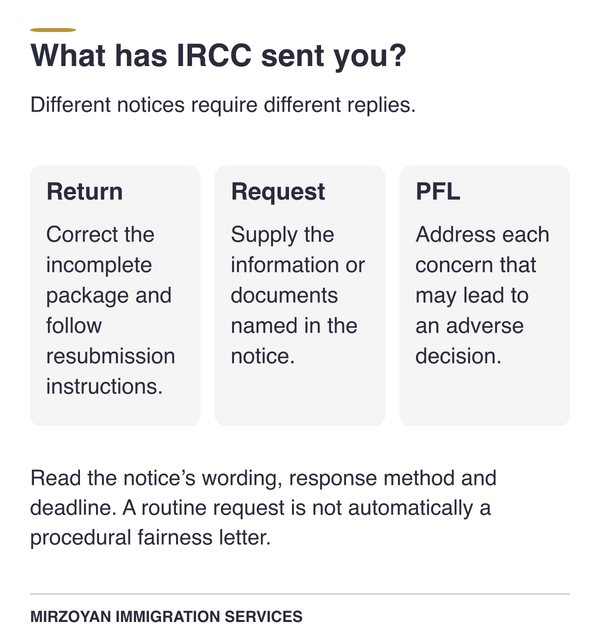
Return: Correct the incomplete package and follow resubmission instructions. Request: Supply the information or documents named in the notice. PFL: Address each concern that may lead to an adverse decision. Read the notice’s wording, response method and deadline. A routine request is not automatically a procedural fairness letter.
Strategic Trade-off Matrix
IRCC's rules for applications involving minors decide which regular route is legally available. However, the matrix compares evidence burdens, timing patterns, and review consequences after that initial screen.
| Decision dimension | Existing citizenship proof | Regular grant for a minor | Direct adoption grant |
|---|---|---|---|
| Main concern | A grant filing can obscure an existing-status question | Choosing the wrong parent or residence route creates requirement and evidence gaps | Parent status, adoption validity, or sequencing may remain unresolved |
| Appeal and review rights | Review options depend on the decision and process used | Assess any Federal Court review option immediately after refusal | Assess review based on the stated adoption or citizenship ground |
| Costs to plan for | Certificate and evidence costs follow the proof route | Government fee and document-preparation costs apply | Two-part evidence preparation can add translation, certification, and record costs |
| What happens next | Status and evidence are assessed before a certificate issues | Completeness, verification, and required events shape processing | Part 1 precedes Part 2 and adoption evidence review |
| Controlling fact | Citizenship already arose under the Act | PR status plus the applicable parent condition | Qualifying Canadian parent and statutory adoption requirements |
A citizenship judicial-review application generally requires Federal Court leave. The usual filing period is 30 days after notice or awareness of the matter.
When help can clarify a child's citizenship route
A clear application route and complete records may let you prepare a child's application using the official instructions. Advice can help when the child's existing citizenship, the parent's status or an adoption history leaves the route uncertain. Mirzoyan Immigration Services can review those facts before you choose the forms and supporting evidence. Checking who has authority to apply also helps identify whose documents and signatures the file needs.
Route questions under One on One Advisory go directly to Narek Mirzoyan, RCIC # R1005184, or Vahe Mirzoyan, RCIC # R514223. Their licences can be checked through the CICC public register. Canadian citizenship application services can address the route and evidence questions that remain unresolved. Advice does not remove the requirements of the applicable route or guarantee approval.
Key Takeaways
Check whether the child is already Canadian before starting any grant application.
The Canadian-parent route depends on a Canadian parent or a parent applying at the same time.
The residence-based route generally requires 1,095 days of physical presence and tax filing when legally required.
Neither regular route for a minor requires a citizenship test or language proof, but signature and oath rules can apply.
Adoption follows either an available regular grant or the sequenced direct route, and Mirzoyan Immigration Services can help identify the correct application.
Frequently Asked Questions
How to get citizenship for a minor child?
First determine whether the child is already Canadian. If not, use the Canadian-parent route when a parent is Canadian or applying simultaneously. Use the residence-based route when that condition is absent. Then follow the current IRCC online account or paper package for the selected route.
What documents are required for a minor to apply for citizenship?
A minor applying for Canadian citizenship needs identity, travel and relationship records, photos, payment proof and route-specific documents. Use the checklist for the correct route and application channel. Paper applications require two IDs showing the child's name and birth date, with a photo on at least one. If one ID is a PR card, the second must come from a Canadian government. The residence-based route also requires physical-presence and education records. If no education records exist, explain why as instructed.
Can a minor apply for Canadian citizenship on their own?
Only through the residence-based route when no authorized adult can apply for the child. The child must request a waiver through the current application process. IRCC can approve or reject that request; maturity or convenience alone does not establish eligibility to apply alone.
Can an adopted child get Canadian citizenship?
Yes, an adopted child may qualify for Canadian citizenship, but adoption alone does not grant it. An eligible child can receive a direct adoption grant. A permanent-resident child may instead qualify through a regular grant for a minor. Regular grants for minors normally require an oath from age 14; direct adoption grants do not. Parent citizenship, adoption facts, timing, and current transmission rules still affect eligibility.
How do I add a minor to my Canadian citizenship application?
If you and your child qualify to apply online together, create the minor's application in your own Canadian citizenship account. Follow the family or group application instructions and complete the child's separate application. A minor can be attached to only one adult account; another parent cannot add the same child to theirs. Children aged 14 to 17 must also sign and date their application. Check paper-only exceptions before starting.
Next steps
Start with four facts: the child's current citizenship, PR status, the parent's citizenship or application, and any adoption history. Those facts identify the applicable citizenship route for the child or show that a proof or adoption analysis comes first. Then confirm who has legal authority to apply and assemble evidence for the selected route. After that, follow the current online or paper instructions. Do not begin with a saved form or assume the shortest requirement list is legally available.
Mirzoyan Immigration Services offers Canadian citizenship application services for applications involving minors and adopted-person files. Families across Canada can meet in person, online, or by phone to discuss the child’s application.
Disclaimer
This article provides general information, not legal or immigration advice. Citizenship applications for minors and adoption outcomes depend on individual facts, current law, and current IRCC instructions.