Dual Citizenship in Canada: Rules, Passports and Travel
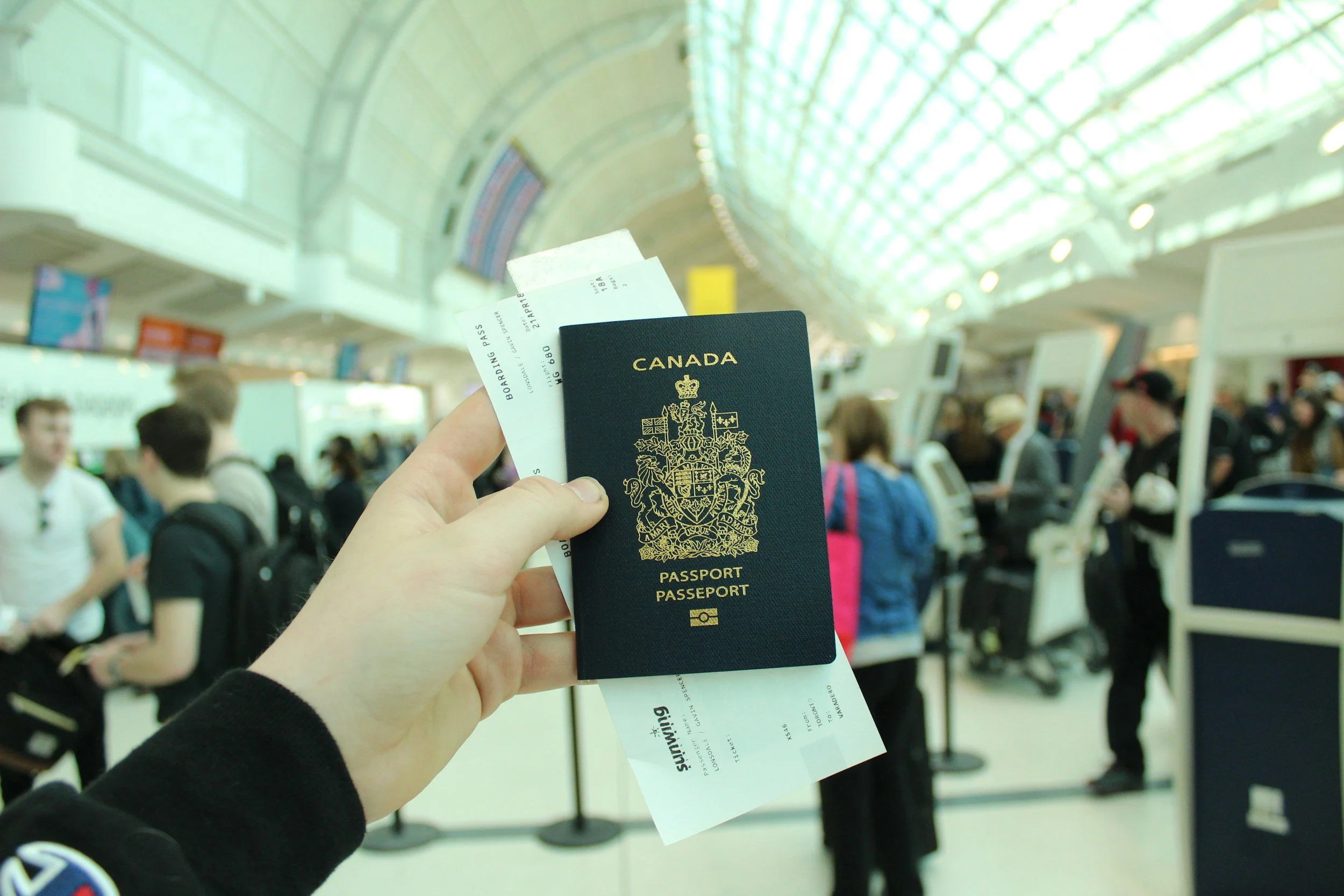
Dual citizenship in Canada allows you to keep another citizenship, although the other country may not permit you to hold both. But each country decides whom it recognizes as a citizen and what duties that status creates. If you are not yet Canadian, start with our guide to Canadian citizenship in Canada. Existing dual citizens should instead match each passport to the airline, departure point, transit stop, destination, and return to Canada. Using a foreign passport at Canada-bound airline check-in can cause denied boarding unless the Canadian-American exception applies.
By Narek Mirzoyan, RCIC # R1005184,. Verify this credential on the CICC public register.
Last reviewed by Narek Mirzoyan, RCIC # R1005184, on 2026-09-16.
TL;DR
Canada allows dual and multiple citizenship, but the other country must also recognize the arrangement under its law. There is no separate Canadian application or certificate for dual citizenship. Most dual Canadians need a valid Canadian passport for a Canada-bound flight. However, Canadian-American dual citizens may use a valid U.S. passport. Before travelling, confirm the passport, entry, exit, consular, tax, and other rules for every country on the itinerary.
Table of Contents
Canada does not maintain an approved-country list
Canada permits dual and multiple citizenship, but it does not approve foreign countries as citizenship partners. Canadian law answers only whether a person is or can become Canadian. But the other country decides whether it permits, restricts, disregards, or terminates its citizenship after another nationality is acquired. IRCC therefore cannot confirm whether a foreign nationality survives a Canadian citizenship grant. You must obtain that answer from the foreign country's responsible authority before relying on dual status.
Canada permits more than two citizenships
Canadian rules allow multiple citizenships rather than limiting a person to exactly two nationalities. A Canadian can therefore hold three or more citizenships without losing Canadian citizenship for that reason alone. However, each additional country applies its own citizenship law. One country may recognize every nationality, while another may prohibit multiple citizenships or treat the person only as its citizen. The number of citizenships Canada permits does not settle how those other countries will respond.
There is no Canadian dual-citizenship application
You do not file a separate Canadian application to become a dual citizen. You become Canadian through an ordinary citizenship route, such as citizenship by birth, descent, or grant. But another country decides separately whether you acquired or kept its citizenship. Canada also does not issue a dual-citizenship certificate. A Canadian citizenship certificate proves Canadian status only and says nothing about the validity of any foreign citizenship.
The other country's law still controls its citizenship
Ask the other country's embassy, consulate, or citizenship authority whether it considers you a citizen. Request current information about retaining that status, renunciation, national-passport use, and registration duties. Another traveller's account may suggest questions to ask, but cannot settle your citizenship. Obtain the answer before making a decision that could affect your foreign nationality. Citizenship application services address a Canadian grant application only after confirming you are not already Canadian.
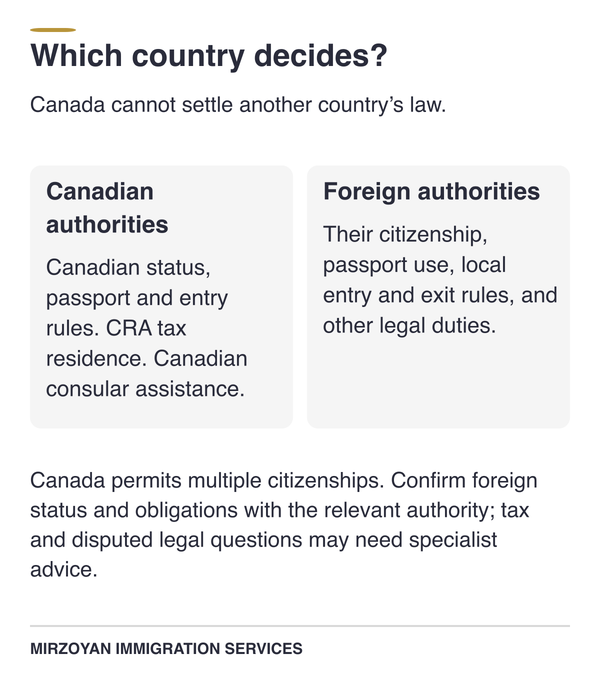
Canadian authorities: Canadian status, passport and entry rules. CRA tax residence. Canadian consular assistance. Foreign authorities: Their citizenship, passport use, local entry and exit rules, and other legal duties. Canada permits multiple citizenships. Confirm foreign status and obligations with the relevant authority; tax and disputed legal questions may need specialist advice.
Separate Canadian rules from the other country's rules
Place every dual-citizenship question with the authority that can legally answer it before making a status or travel decision. Canada decides Canadian citizenship, Canadian travel documents, Canadian entry rules, and Canadian tax residence. But the other country controls its citizenship, national-passport duties, entry and exit rules, national service, family law, and local recognition. The Government of Canada's dual-citizen guidance directs travellers to the foreign country's embassy and the current destination advisory. Complex foreign-law or cross-border tax questions may still require advice from a qualified professional in that jurisdiction.
| Issue | Canadian authority | Other-country authority | When specialist advice is needed |
|---|---|---|---|
| Citizenship status | IRCC decides Canadian status. | That country's citizenship authority decides its status. | Historic loss, parentage, adoption, or unclear effective dates. |
| Passport | Canada decides Canadian passport eligibility and use. | That country decides whether its national passport is mandatory. | Conflicting names, expired documents, or urgent travel. |
| Entry and exit | Canada controls entry by travel mode and airline-document rules. | Destination and transit states control their borders. | Exit visas, bans, prior offences, or disputed nationality. |
| Military or registration duties | Canada cannot waive a foreign duty. | Local law determines service and registration duties. | Any possible service, reserve, or reporting obligation. |
| Children and family law | Canadian law applies within Canadian jurisdiction. | Local law can govern registration, custody, or exit consent. | A child travels with one parent or faces registration duties. |
| Tax | CRA applies Canadian tax-residency rules. | That state applies its citizenship, residence, or source rules. | Dual residence, worldwide income, treaties, or foreign assets. |
| Renunciation | Canada controls renunciation of Canadian citizenship. | That country controls renunciation of its citizenship. | Status loss could affect travel, residence, children, or tax. |
| Consular help | Global Affairs explains assistance Canada may provide. | Local authorities decide whether Canadian access is recognized. | Detention, exit restrictions, custody disputes, or document seizure. |
You may hold another citizenship without realizing it
Another country may treat you as its citizen because of your birthplace, parentage, adoption, or another rule in its citizenship law. That status can exist long before you apply for a passport or receive formal confirmation. Travel.gc.ca warns that you may not know another country considers you its citizen. An unexpected citizenship can trigger national-passport, entry, exit, registration, or military-service requirements. Confirm possible status before travel instead of waiting for a border authority to raise it.
Citizenship can arise under another country's parentage law
Another country's law may give a child citizenship through a parent even if the family never registered the birth abroad. Canadian records may establish the relationship without determining that foreign legal result. Ask the responsible foreign authority whether citizenship arose and whether registration is required. For a possible Canadian claim, use the citizenship by descent guide to assess the family history. The Canadian birthright and transmission guide explains the general framework; neither guide determines another country's citizenship law.
A passport is evidence, not always the event that created status
Receiving a passport often documents citizenship that already existed under the country's law. But the passport's issue date does not necessarily show when the person first became a citizen. This can feel counterintuitive when nobody in the family discussed the second nationality. A passport application may simply confirm a status acquired automatically at birth or through a parent. Ask the foreign authority whether citizenship exists and when it took effect before booking travel.
Which passport should a dual citizen use at each travel checkpoint?
Match your passports to the document rules for airline check-in, departure, transit, destination entry, and return. Different authorities may check different documents during the same trip. I map each passport to those checkpoints before treating an itinerary as workable. Acceptance by the destination does not establish that the same passport satisfies a Canada-bound airline check. Review the outward and return journeys together so a missing or expired document is identified before departure.
Airline document checks and border entry are different
The airline checks the documents needed to board a particular flight. A border officer then makes a separate entry decision after arrival. Passing the first check does not guarantee admission at the destination. Conversely, a Canadian's right to enter Canada does not necessarily supply the document an airline must verify before boarding. Confirm the carrier's boarding requirements as well as the destination's entry rules when preparing the itinerary.
The other country may require its passport for entry or exit
Some countries require their citizens to use a national passport when entering or leaving. So presenting only a Canadian passport can cause additional screening, delay, or an exit problem. The rule may apply even if the traveller entered easily on a previous visit. Check the destination's Travel Advice and Advisories and contact its embassy before departure. Current official guidance should control the travel plan because entry and document systems can change.
Carry both when both countries' rules may apply
Carrying both valid passports is usually prudent when travelling between countries of citizenship. And present the document requested at each checkpoint while keeping names, dates, and itinerary details consistent across both. Carrying two passports is not itself suspicious or improper. But problems are more likely when a required passport is expired, missing, or inconsistent with the airline booking. Confirm both documents before departure so the correct passport is available when each authority asks for it.
| Checkpoint | Who controls the document check | Common risk | Action before travel |
|---|---|---|---|
| Airline check-in | Carrier systems apply destination and Canadian boarding rules. | The passport presented does not establish authority to board. | Confirm the passport in the booking and carry both valid documents. |
| Departure control | The country being left applies its exit law. | A citizen must use its national passport or obtain an exit visa. | Check that country's embassy and current advisory. |
| Transit | The transit country and carrier apply transit-document rules. | A connection requires a visa or passport not used at origin. | Check every transit point, including airport changes. |
| Destination entry | The destination border authority decides entry. | Local law treats the traveller only as its citizen. | Use the required national passport and meet local entry rules. |
| Return to Canada | Carrier and Canadian authorities apply mode-specific rules. | A foreign passport does not satisfy Canada-bound air boarding. | Use a valid Canadian passport unless an official exception applies. |
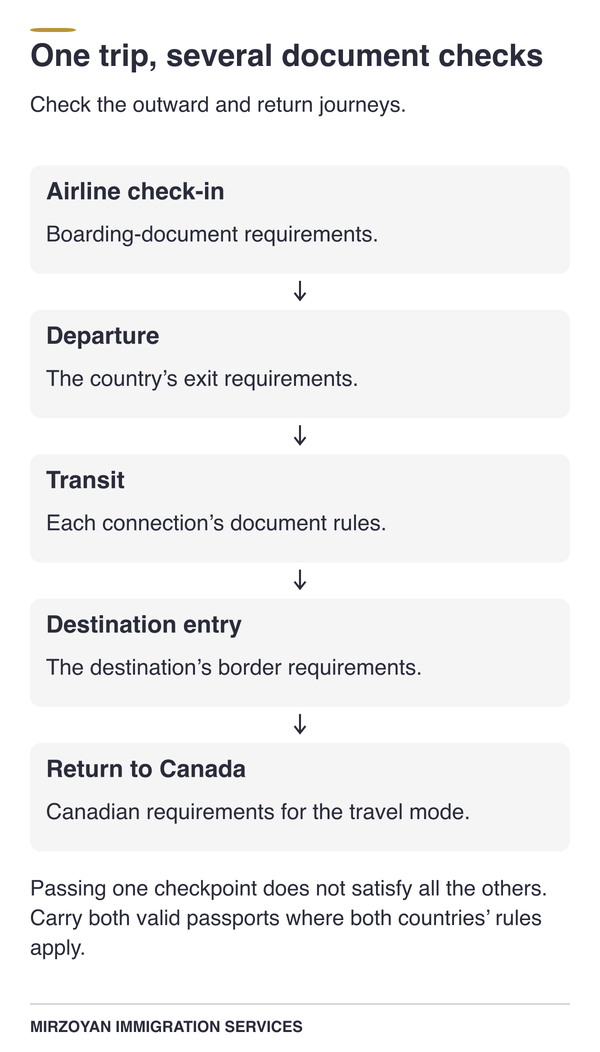
Airline check-in: Boarding-document requirements. Departure: The country’s exit requirements. Transit: Each connection’s document rules. Destination entry: The destination’s border requirements. Return to Canada: Canadian requirements for the travel mode. Passing one checkpoint does not satisfy all the others. Carry both valid passports where both countries’ rules apply.
The Canada-bound air rule has a Canadian-American exception
Most dual Canadian citizens need a valid Canadian passport to fly to or transit through Canada. But a Canadian-American dual citizen may use a valid U.S. passport if the basic entry requirements are met. IRCC places that exception beside the general rule on its dual-citizen travel page. The exception does not turn every foreign passport into an acceptable boarding document. So identify the traveller's exact citizenships before choosing the passport for a Canada-bound flight.
Most dual Canadian citizens need the Canadian passport to board a flight to Canada
Most dual Canadians need a valid Canadian passport to fly to Canada, including for transit. If your flight is imminent and you lack one, special authorization may be available under narrow conditions. Your flight must leave in fewer than ten days, and you must hold a valid passport from a visa-exempt country. You must also have no Canadian passport valid for travel that day and not be a Canadian-American dual citizen. These conditions apply together; an urgent flight alone does not qualify you.
You also need a previous Canadian citizenship certificate, a previously held Canadian passport, or a citizenship grant after permanent residence. IRCC checks its records to confirm your citizenship before granting authorization. An approval lasts four days from the travel date selected in the request. At boarding, show the approval email electronically or on paper, with Canadian citizenship proof if available. If you do not qualify, contact the nearest Canadian government office abroad about your options rather than assuming an airport exception.
Canadian-American dual citizens may use a valid U.S. passport
A Canadian-American dual citizen may fly to Canada using either a valid Canadian passport or a valid U.S. passport. But when travelling only with the U.S. passport, the person must carry identification showing Canadian citizenship. IRCC also recommends carrying both passports because they help establish the right to enter both countries. A traveller who presents only the U.S. passport may still be sent for immigration screening. So carrying both valid documents usually makes the Canada-U.S. journey easier.
Land, sea and air rules must not be collapsed
Canadian citizens returning by land or sea have identification options that do not apply in the same way to airline boarding. Start with the Canadian-citizen section of CBSA's travel and identification guidance, not its rules for foreign visitors or permanent residents. Check whether your documents establish both your identity and Canadian citizenship. A document that identifies you is not necessarily evidence that you are Canadian. If you plan to travel without a Canadian passport, confirm that your particular documents meet the listed requirements before departure.
A land or sea journey may also involve a commercial carrier with its own boarding requirements. A cruise itinerary, for example, can include entry into other countries as well as return to Canada. Check those countries and the carrier separately rather than treating Canada's border rules as the complete travel checklist. If the trip includes a flight to Canada, revisit the air-travel requirement for that leg. Changing the first part of the journey does not remove a document requirement applying later.
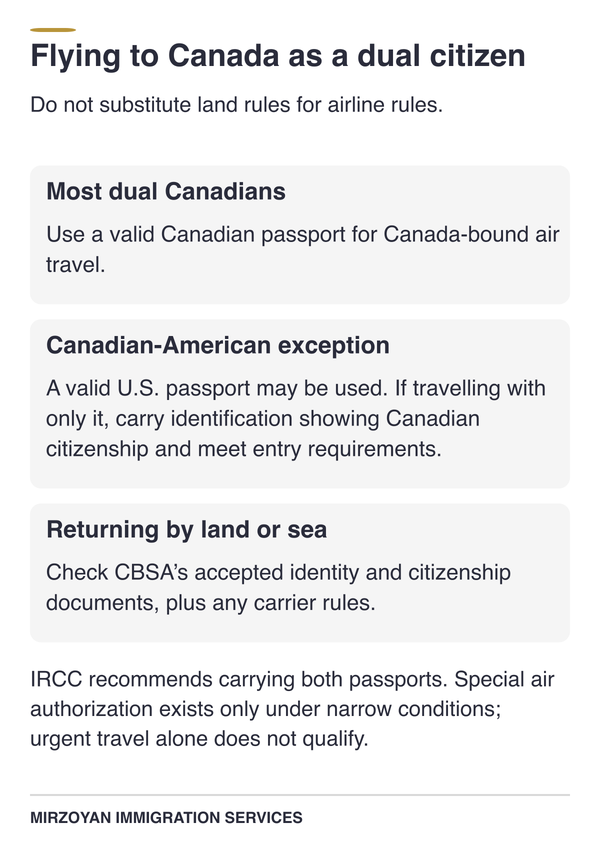
Most dual Canadians: Use a valid Canadian passport for Canada-bound air travel. Canadian-American exception: A valid U.S. passport may be used. If travelling with only it, carry identification showing Canadian citizenship and meet entry requirements. Returning by land or sea: Check CBSA’s accepted identity and citizenship documents, plus any carrier rules. IRCC recommends carrying both passports. Special air authorization exists only under narrow conditions; urgent travel alone does not qualify.
Canadian consular help may be limited in the other country of citizenship
When you are in the country of your other citizenship, local authorities may treat you only as their citizen. And they may refuse access to Canadian consular services or restrict what Canadian officials can do. The Canadian Consular Services Charter expressly identifies this limitation. Canadian officials may request access, provide information, or offer help that local law permits. But Canadian citizenship does not displace the other country's laws or guarantee Canadian intervention.
Canadian citizenship does not override local recognition
Consider a dual citizen who is detained while visiting the country of their other citizenship. The traveller asks immediately for Canadian consular help. But the local authority may treat that person solely as its citizen and refuse Canadian access. Canadian officials can request access and explain available assistance, but they cannot compel local recognition. And they cannot cancel a lawful detention, court order, or exit restriction imposed by that country.
Register contacts and review the destination advisory before travel
Save contact details for the nearest Canadian office abroad and the Emergency Watch and Response Centre before departure. Read the destination advisory for information about detention, documents, dual citizenship, and local law. The Canadian Consular Services Charter recommends checking the advisory again shortly before travel. Those preparations make it easier to contact the appropriate office if a problem arises. They cannot guarantee access or intervention where the other country restricts Canadian assistance.
Foreign-country obligations to check before travel
Review the foreign rules most capable of disrupting the trip before making non-refundable bookings. Travel.gc.ca lists national-passport duties, exit visas, exit bans, military service, tax obligations, and child registration as possible consequences of another citizenship. But these issues do not apply in the same way to every country or traveller. Some arise on entry, while others appear only when the person tries to leave. So a country-specific check is more useful than a general list of dual-citizenship risks.
Check the destination advisory and the country's embassy
Start with the Travel Advice and Advisories, then ask the relevant embassy or consulate about dual-citizen rules. And record the authority contacted, the date, and the answer received. Ask about both entry and exit because those requirements may differ. But embassy information may explain administrative rules without resolving a disputed legal status. Obtain advice from a qualified professional in that country if the issue involves renunciation, criminal exposure, military service, or an exit ban.
Confirm child and exit requirements before departure
Check whether a child must be registered, carry a national passport, or have parental consent to leave. But foreign exit requirements may not be resolved by a custody order that is valid in Canada. The other country may apply its own family, nationality, and document rules to the child. And an exit visa, registration requirement, or parental-consent issue may arise only at departure. Review the entire return leg before committing to non-refundable international travel with a child.
Foreign-law advice stays with a qualified local professional
Use the foreign embassy or consulate for information about its passports, forms, and administrative requirements. Where the question concerns disputed citizenship or personal legal exposure, consult a qualified professional in that country. Canadian immigration advice cannot determine foreign criminal, military, family, or tax consequences. A forum account may help identify a question but may describe different facts or outdated rules. Give the local professional the relevant citizenship history and proposed itinerary so the advice addresses your circumstances.
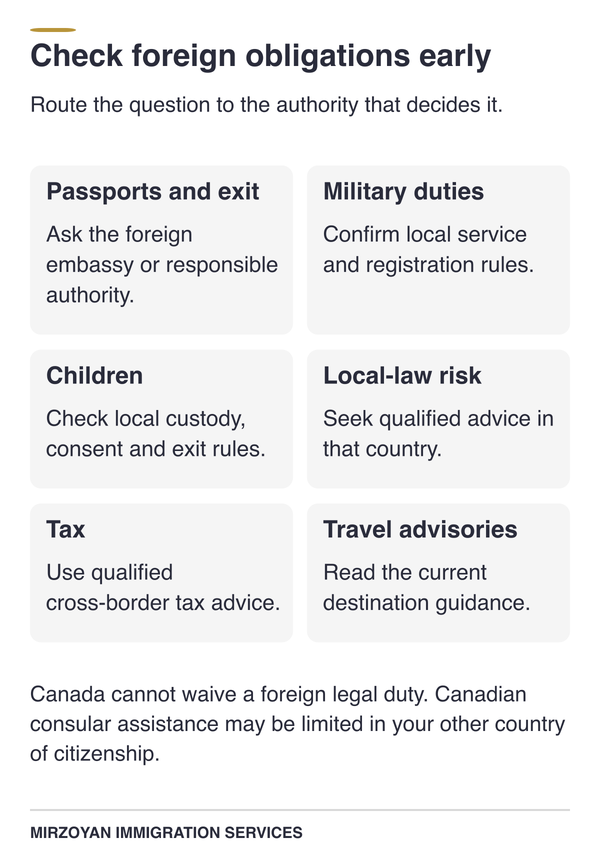
Passports and exit: Ask the foreign embassy or responsible authority. Military duties: Confirm local service and registration rules. Children: Check local custody, consent and exit rules. Local-law risk: Seek qualified advice in that country. Tax: Use qualified cross-border tax advice. Travel advisories: Read the current destination guidance. Canada cannot waive a foreign legal duty. Canadian consular assistance may be limited in your other country of citizenship.
Preparing to apply for Canadian citizenship?
Mirzoyan Immigration Services can review identity and passport-record questions affecting a proposed Canadian grant application.
Explore Canadian citizenship application services only if you are not already Canadian. Keep foreign-law and travel questions with the appropriate authority.
Canadian tax residency is not the same as Canadian citizenship
Canadian income-tax obligations are based on residency status, not citizenship or immigration status alone. So citizenship by itself neither creates nor removes Canadian filing obligations. The CRA states that residency status depends on the person's circumstances and relevant residential ties. A person can also be considered tax-resident in more than one country, with a treaty potentially affecting the result. Dual citizens should therefore separate citizenship questions from the annual tax-residency analysis.
Canadian citizenship alone does not decide Canadian tax residence
CRA examines significant residential ties, time in Canada, deemed-residence rules, and applicable tax treaties. So a Canadian citizen living abroad may have a different Canadian tax position from a resident living in Canada. Canadian residents generally report worldwide income. But that general rule does not decide whether a particular person is resident, non-resident, or deemed resident. Personal tax advice should begin with the facts relevant to residency, not with the passport held.
The other country may use a different connecting rule
Another country may connect tax obligations to citizenship, residence, income source, domicile, or a combination of factors. But Canada's residency framework cannot determine the foreign filing, reporting, or payment result. The foreign rules may apply even when Canada reaches a different residency conclusion. A tax treaty may help address dual residence or overlapping taxation, but its application is fact-specific. So consult a cross-border tax professional when both systems may apply because this article cannot provide a personal tax or treaty conclusion.
The Internal Logic of an IRCC Officer
Multiple citizenship is permitted in Canada and is not itself an adverse factor in a Canadian citizenship matter. But an officer still has to confirm identity, eligibility, and the accuracy of the information provided. Questions may arise when an application contains different names, citizenships, passport histories, travel dates, or parentage details. So those facts should align with the Canadian and foreign records submitted. A clear documentary connection helps the officer understand that the records relate to the same person and history.
Multiple citizenship is not itself a disqualifier
IRCC confirms Canadians may retain Canadian citizenship after acquiring another nationality. A lawful second citizenship therefore does not, by itself, disqualify a person from Canadian citizenship. But the application must still disclose every citizenship and passport requested by the current form. An incomplete answer can create a concern even when the underlying dual status is lawful. So read the exact wording of the form being filed and answer it fully with consistent supporting records.
Names, birth details and passport histories must still align
I compare names, birth dates, birthplaces, citizenships, and passport numbers across the current adult citizenship application and its supporting documents. Different versions of a name do not automatically establish a problem. A marriage certificate, legal name-change record, or corrected civil record may explain the difference. Transliteration differences may instead need an explanation supported by consistent translations. Connect those records before submission so the officer can follow the same person's identity across both countries' documents.
Foreign passport histories must remain consistent with disclosed identity and travel facts
Passport issue dates, entry stamps, and travel dates can be compared with statements elsewhere in an active citizenship application. And a second passport may explain a trip that is not visible in the passport first reviewed. It may also reveal a date or identity detail that needs clarification. Explain genuine discrepancies with a dated chronology and supporting records before the inconsistency becomes the focus of the file. Keep both passports with the records used to explain the chronology.
Red Flags & Procedural Fairness Letters (PFL)
Dual citizenship is lawful in Canada, but a material contradiction in an active IRCC file may require an explanation. IRCC may first ask for a missing document or additional information needed to continue processing. But a Procedural Fairness Letter is more serious because it identifies a concern that could support an adverse decision. The response should address the exact issue raised instead of treating every request as interchangeable. So recognizing the type of letter helps determine the evidence and explanation the file now needs.
Dual citizenship is not the red flag; inconsistent declarations are
Three patterns deserve attention: undisclosed foreign passports, conflicting biographical details, and travel evidence that contradicts the form. So the problem is the inconsistency or omission, not the second citizenship. A PFL may identify a potentially adverse concern and provide an opportunity to respond before a decision. But the adult citizenship application requests passport details, and a document request is not automatically an allegation of concealment. Read the letter closely before deciding whether the file needs a missing record, a reconciliation, or a full fairness response.
Answer the exact discrepancy with documentary continuity
I start with the letter's exact question, the records it cites, the response deadline, and the possible consequence. Then I match each discrepancy to an issuing-authority record or a precise dated explanation. Different surnames may be connected through a marriage certificate or legal name-change record. And passport stamps can be reconciled with a travel chronology and supporting entry or booking records. A focused response is easier to assess than a large package of unrelated documents that leaves the original concern unanswered.
If an active citizenship application contains material inconsistencies, Mirzoyan Immigration Services can assess the Canadian file. And the review focuses on the concern IRCC raised, the records already submitted, and the evidence available for a response. It can also identify whether the issue belongs in a document reply, a detailed explanation, or a response to a PFL. But advice remains limited to the Canadian immigration and citizenship matter. The firm does not advise on foreign criminal, military, family, or tax law.
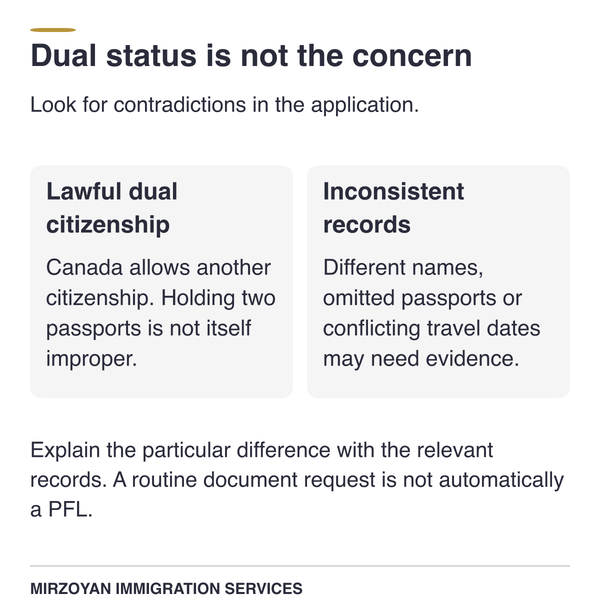
Lawful dual citizenship: Canada allows another citizenship. Holding two passports is not itself improper. Inconsistent records: Different names, omitted passports or conflicting travel dates may need evidence. Explain the particular difference with the relevant records. A routine document request is not automatically a PFL.
A pre-travel dual-citizen checklist
Dual citizens may need different documents for different parts of the same trip. The checkpoint and authority tables help identify which passport or official instruction applies at each point. Using one passport throughout may be unsuitable where the other country requires its own national passport. Carrying both still requires checking validity, names, and the carrier's requirements. Resolve any conflict between the itinerary and the required documents before departure rather than assuming one citizenship takes priority everywhere.
Work through the checklist using your actual itinerary and the citizenships each country may recognize. Check the passports you currently hold before reviewing departure, transit, entry, and return requirements. If advice from an embassy affects the plan, record the authority contacted, date, and answer. Recheck that advice if a destination, transit point, or travel mode changes. Keep the resulting document list with the itinerary so you can identify what is needed at each stage.
Confirm whether each country treats you as its citizen, using the relevant citizenship authority or embassy.
Check both passport expiry dates, names, birth details, and unused-page requirements.
Match the correct passport to airline check-in, departure, transit, destination entry, and Canada return.
Verify national-passport, entry, exit, visa, military, registration, and child-travel rules with the foreign authority.
Read the current destination advisory and save Canadian emergency contacts before departure.
Confirm travel insurance and disclose any facts the insurer asks about.
Obtain foreign legal advice when detention, exit, custody, military, or renunciation issues may arise.
Obtain cross-border tax advice when residence, worldwide income, treaties, or foreign reporting may be relevant.
Before a Canada-bound flight, recheck IRCC's dual-citizen passport rule. Confirm that the passport presented at check-in will still be valid on the travel date. Review the rule again if the route, transit point, or carrier changes. Keep both passports accessible when both countries' rules may apply. Use current official requirements rather than a saved forum post or an answer from an earlier trip.
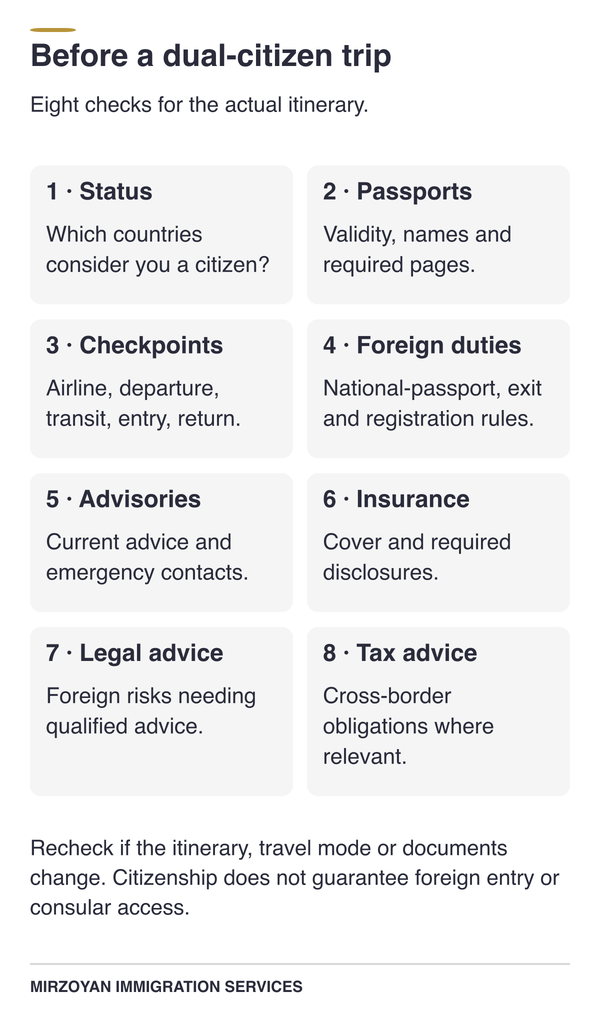
1 · Status: Which countries consider you a citizen? 2 · Passports: Validity, names and required pages. 3 · Checkpoints: Airline, departure, transit, entry, return. 4 · Foreign duties: National-passport, exit and registration rules. 5 · Advisories: Current advice and emergency contacts. 6 · Insurance: Cover and required disclosures. 7 · Legal advice: Foreign risks needing qualified advice. 8 · Tax advice: Cross-border obligations where relevant. Recheck if the itinerary, travel mode or documents change. Citizenship does not guarantee foreign entry or consular access.
When advice can help before adding Canadian citizenship
Official Canadian guidance and the other country's responsible authority may answer routine dual-citizenship and travel questions.
Canadian application advice is useful when conflicting identity or passport records affect a citizenship application you are preparing.
Mirzoyan Immigration Services can compare those records with the names, citizenships and travel history disclosed in the Canadian file.
That comparison helps identify differences that need supporting documents or an explanation.
With One on One Advisory, Narek Mirzoyan, RCIC # R1005184, or Vahe Mirzoyan, RCIC # R514223, answers your application questions directly.
Canadian citizenship application services apply to a grant only after confirming that you are not already Canadian.
Foreign nationality and tax questions require advice from the appropriate authority or qualified adviser.
This Canadian application review cannot guarantee foreign entry, passport acceptance or approval of a citizenship grant.
Key Takeaways
Canada permits multiple citizenships but maintains no approved-country partner list.
The other country controls its citizenship, national-passport, entry, exit, military, family, and tax rules.
Canada-bound air travel usually requires a valid Canadian passport, with a specific Canadian-American exception.
Canadian tax generally follows residency, and Canadian consular access may be limited in the other country of citizenship.
If the evidence confirms you are not Canadian, review Mirzoyan Immigration Services’ citizenship application services for the appropriate grant route.
Frequently Asked Questions
Who qualifies for dual citizenship in Canada?
You must qualify for Canadian citizenship through birth, descent, adoption, or a citizenship grant while another country also recognizes you. You do not apply for Canadian dual citizenship as a separate status. Someone who may already be Canadian should confirm that status before selecting an application. A permanent resident who is not already Canadian must meet the citizenship-grant requirements. Check the other country's rules before relying on dual status.
What countries does Canada allow dual citizenship with?
Canada does not maintain a list of approved dual-citizenship countries. Canada permits dual and multiple citizenship. However, each country decides whom it recognizes as a citizen. The other country may permit, restrict, disregard, or terminate its citizenship when another nationality is acquired. Confirm that country's position with its citizenship authority or embassy before relying on Canada's rules.
Is there a downside to dual citizenship with Canada?
Possible disadvantages usually arise from the other country's laws and travel rules. They may include national-passport duties, exit restrictions, military or registration obligations, child-travel issues, or foreign tax requirements. Canadian consular access may also be limited in the country of the other citizenship. These are possible consequences rather than disadvantages that affect every dual citizen. The actual risk depends on the countries involved, the itinerary, and the person's circumstances.
What are the new rules for dual Canadian citizenship?
Canada still permits citizens to hold more than one citizenship. Bill C-3 took effect on December 15, 2025 and changed who may be Canadian by descent. Some people born abroad before that date became Canadian automatically under the new rules. For certain births abroad on or after that date, the Canadian parent must show 1,095 days in Canada. Confirm possible status before applying for a citizenship grant.
How long can a dual citizen stay out of Canada?
A Canadian citizen can live outside Canada without losing citizenship merely because of time abroad. The permanent-resident residency obligation does not apply after a person becomes Canadian. Passport expiry does not end citizenship, although it can prevent boarding a flight to Canada. Time abroad may still affect tax residency, provincial benefits, or obligations in the other country. Review those separate rules before a long absence.
Conclusion
Dual-citizen travel becomes manageable when every authority and checkpoint is identified before departure. Verify Canadian rules with official Canadian sources. Confirm foreign passport, entry, exit, and status rules with the other country's responsible authority. Obtain qualified foreign or cross-border tax advice when the issue falls outside Canadian immigration law. This division of responsibility reduces the risk of relying on the right answer from the wrong authority.
For descent eligibility, read Canadian citizenship by descent. For general transmission, use Canadian citizenship birthright and transmission rules. A citizenship grant becomes relevant only after the evidence shows that you do not already hold Canadian status under current law. In that situation, explore Mirzoyan Immigration Services’ Canadian citizenship application services. Bring the relevant identity and citizenship records to discuss the appropriate Canadian application.
Disclaimer
This article provides general Canadian citizenship and travel information, not legal, tax, or foreign-law advice. Airline and border decisions depend on current rules and individual facts.