Canadian Citizenship Fees: Current Government Costs
Canadian citizenship fees are currently $653 for adults applying to become Canadian and $100 for children under 18. But IRCC places grants, certificates, records searches, resumption, and renunciation on one citizenship fee list. Each payment serves a different legal purpose. The broader Canadian citizenship guide explains grant eligibility and procedure. Government charges also remain separate from professional fees and document expenses.
By Narek Mirzoyan, RCIC # R1005184,. Verify this credential on the CICC public register.
Last reviewed by Narek Mirzoyan, RCIC # R1005184, on 2026-09-16.
TL;DR
An adult Canadian citizenship grant currently costs $653. And that total includes a $530 processing fee and a $123 right-of-citizenship fee. A citizenship grant for a minor costs $100. A citizenship certificate or citizenship-record search costs $75. Choose the application before paying because the same fee list covers several different legal purposes. These amounts were checked on August 31, 2026.
Table of Contents
Find the fee for the application you are making
Find your application on the citizenship fee list before making a payment. A grant asks IRCC to make an eligible person Canadian, while a certificate documents citizenship that may already exist. Grants for minors, records searches, resumption, and renunciation also have separate fee lines. Match the category to the application you are preparing rather than choosing an amount that looks familiar. The following sections explain those differences before setting out the full government schedule.
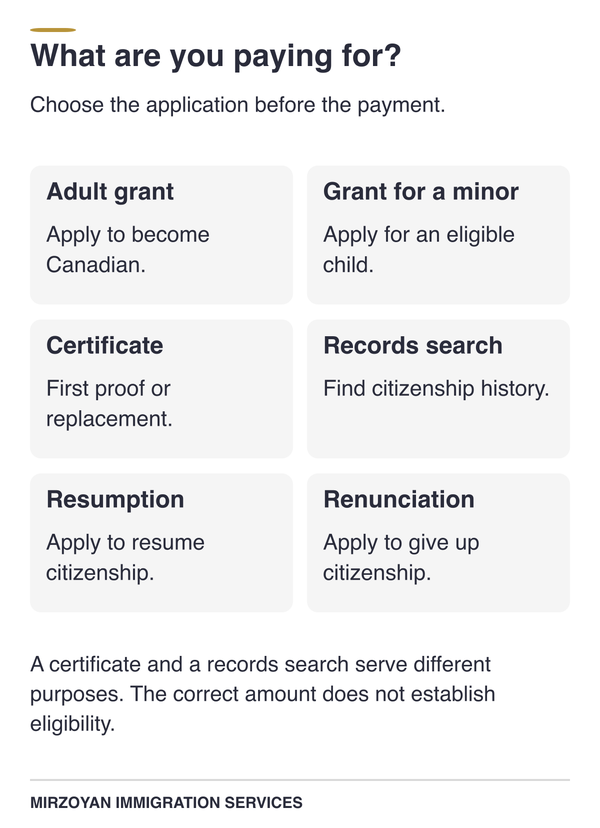
Adult grant: Apply to become Canadian. Grant for a minor: Apply for an eligible child. Certificate: First proof or replacement. Records search: Find citizenship history. Resumption: Apply to resume citizenship. Renunciation: Apply to give up citizenship. A certificate and a records search serve different purposes. The correct amount does not establish eligibility.
A grant fee is not a certificate fee
An adult grant application costs $653, while a citizenship certificate costs $75. But a grant asks IRCC to confer citizenship on an eligible person. A certificate application asks IRCC to document citizenship that may already exist. The certificate category covers first proof and replacement, but it does not grant citizenship. Use the proof of Canadian citizenship guide when the $75 certificate route fits your purpose.
Replacing a certificate still uses the $75 certificate fee
The $75 citizenship-certificate fee applies to replacement as well as first proof. The shared price does not mean the two applications need the same explanation. For replacement, identify the previously issued document and whether it was lost, damaged, incorrect, or unavailable. That history determines which information belongs in the application. The citizenship-certificate replacement service addresses those procedural questions when IRCC issued your proof before.
Other citizenship applications use different fees
Age alone does not identify every citizenship payment. For example, a stateless adult born to a Canadian parent has a $123 fee line. Resuming citizenship costs $530 for an adult and $100 for a person under 18. Yet a $75 records search produces historical information rather than proof of citizenship. Identify the legal purpose first, then confirm the amount on the current IRCC fee list.
Current Canadian citizenship fees by application type
The amounts below were checked against IRCC's fee list on August 31, 2026. All amounts are government charges in Canadian dollars. Find the row for the application you need, then check what the amount covers. The same price can appear for different services, such as a certificate and a records search. Before paying, use the linked guidance to distinguish obtaining citizenship from obtaining a document that proves existing status.
| Application purpose | IRCC amount | What the amount covers | Where to continue |
|---|---|---|---|
| Adult grant, age 18 or older | $653 | $530 processing plus $123 right of citizenship | Citizenship requirements or application services |
| Stateless adult born to a Canadian parent | $123 | Right-of-citizenship fee | Current IRCC application guide |
| Citizenship grant for a minor under age 18 | $100 | Processing fee | Citizenship for minors guide |
| Citizenship certificate or proof | $75 | First proof or certificate service | Proof guide or replacement service |
| Search for a citizenship record | $75 | Citizenship-record search | Proof and records guide |
| Resume citizenship, age 18 or older | $530 | Adult resumption processing | Current IRCC application guide |
| Resume citizenship, under age 18 | $100 | Minor resumption processing | Current IRCC application guide |
| Renounce citizenship | $100 | Renunciation processing | Current IRCC application guide |
| Right of citizenship alone | $123 | Refundable adult right component | IRCC payment instructions |
IRCC also displays these categories in its citizenship payment order. The $75 certificate amount can cover first proof or replacement. The reason for applying determines which instructions and evidence apply. A correct amount attached to the wrong application does not fix the route. If you need grant support beyond the schedule, consider Mirzoyan Immigration Services' Canadian citizenship application services.
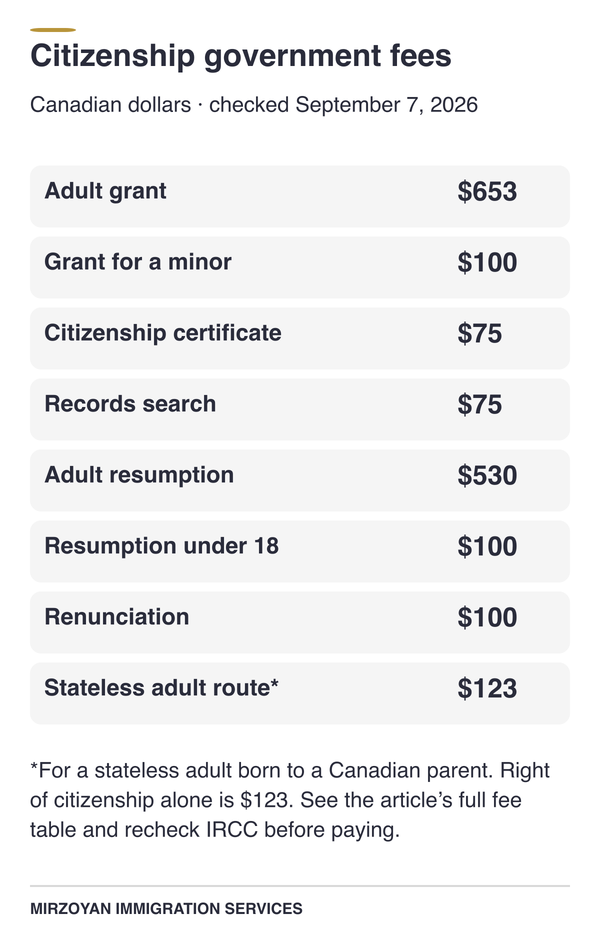
Adult grant: $653 Grant for a minor: $100 Citizenship certificate: $75 Records search: $75 Adult resumption: $530 Resumption under 18: $100 Renunciation: $100 Stateless adult route*: $123 *For a stateless adult born to a Canadian parent. Right of citizenship alone is $123. See the article’s full fee table and recheck IRCC before paying.
The adult grant total has two different fee components
The $653 adult grant fee contains two separate components. IRCC charges $530 to process the application. And the remaining $123 is the right-of-citizenship fee. Those components have different refund treatment after processing begins. Separating them explains why refusal does not normally produce a full $653 refund.
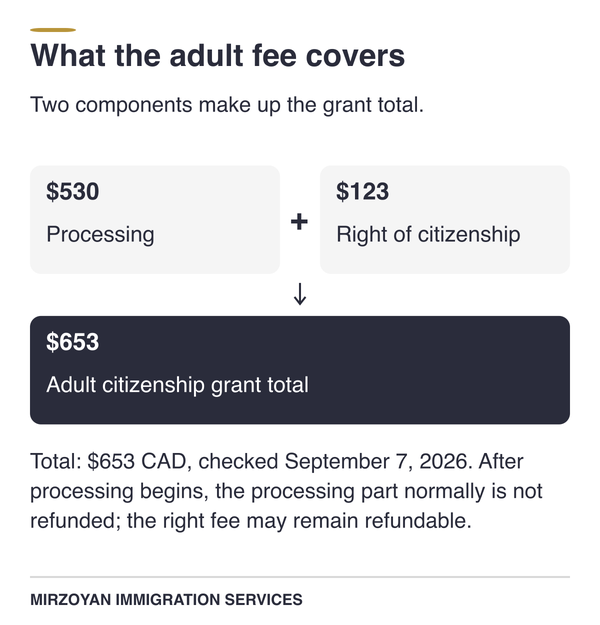
$530: Processing $123: Right of citizenship Total: $653 CAD, checked September 7, 2026. After processing begins, the processing part normally is not refunded; the right fee may remain refundable.
Why the processing fee is usually non-refundable
IRCC kept the adult processing component at $530 when the right fee changed in March 2026. This component pays for the assessment of the citizenship application. But it normally becomes non-refundable after IRCC begins processing. An acknowledgement of receipt indicates that IRCC has completed its initial completeness check and started processing. The current refund guidance separates the processing fee from the refundable right fee.
Why the adult citizenship fee increased in 2026
The right-of-citizenship fee increased from $119.75 to $123 on March 31, 2026. And the $3.25 change raised the adult total to $653. IRCC's March 2026 notice applied the new right fee to applications received on or after that date. The current fee list now displays $123 as the right component. Check the live amount again because this component can be adjusted under the Service Fees Act.
How much can IRCC refund?
Refundability depends on the component and the processing stage. Before processing begins, withdrawal may qualify for a full refund. But after processing starts, the $530 processing component normally remains non-refundable. IRCC may still return the $123 right-of-citizenship component after refusal, withdrawal, or certain closures. A citizenship grant for a minor has no comparable partial refund after processing begins.
Government, professional and third-party costs are separate
Your total cost may extend beyond the government fee. Professional fees cover the agreed advisory or representation service. And third-party expenses can include photographs, translations, certified copies, civil records, or courier charges. These expenses depend on the application and available records, so they should not be added automatically. The citizenship application service explains professional scope, while this article keeps the IRCC schedule separate.
Pay through the correct IRCC route
Your application instructions determine where to pay and whether you must attach a receipt. Grant applicants use IRCC's separate online payment service, selecting the appropriate fee and number of applicants. For an online citizenship-certificate application, payment is part of the guided application instead. IRCC's online proof guide says the application submits automatically after payment. Follow the instructions for your channel and keep the payment confirmation with your records.
Where to pay Canadian citizenship fees online
When the application instructions direct you to IRCC's online payment service, create or sign into its separate payment account. A valid email address is required, and the account records payments made through that service. Choose the applicable citizenship fee and check the total before authorizing payment. Save the emailed receipt, then upload or enclose it wherever your application instructions require. Online citizenship-certificate applicants should follow their application's payment step instead of assuming a separate payment is required.
How to pay fees for more than one applicant
IRCC's separate payment service allows payment for more than one applicant in the same transaction. Select each required citizenship fee and enter the number of people in that category. The service then calculates the combined amount in Canadian dollars. One family member may pay even when the receipt covers other applicants. Before confirming payment, compare the categories and quantities with the applications being submitted and IRCC's current payment instructions.
Follow the current application guide for where the receipt goes
After paying through the separate service, IRCC emails the official receipt. An online grant application may require you to upload it through the application account. But a paper application may require a printed copy inside the package. Families can sometimes use one combined receipt or separate receipts for each application. Follow the current citizenship instructions because the submission method determines where the receipt belongs.
Validate the official receipt before submission
If your application requires a separately paid receipt, check it before submitting the package. After paying, check your email or payment account for that receipt before completing the application. Confirm the amount, receipt number, payer details, and payment date. Keep the emailed copy with the final application record. Resolve the payment problem before submitting if IRCC did not issue the required receipt.
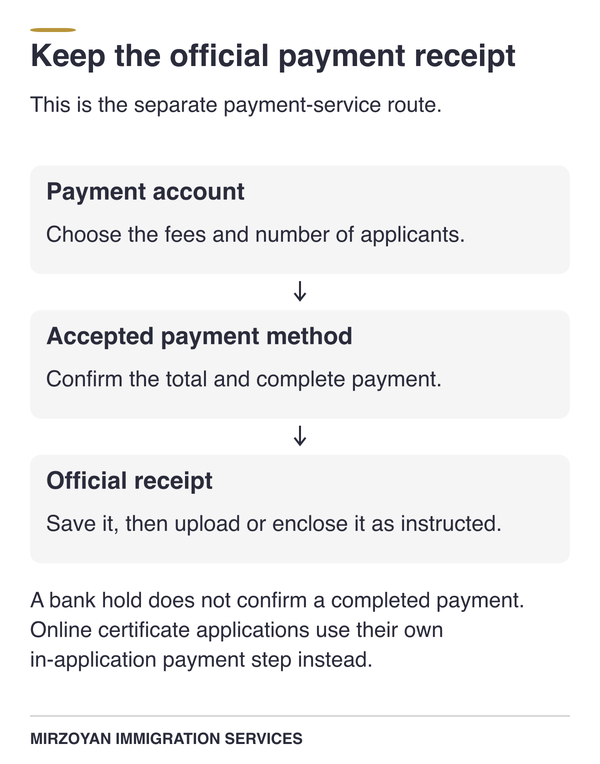
Payment account: Choose the fees and number of applicants. Accepted payment method: Confirm the total and complete payment. Official receipt: Save it, then upload or enclose it as instructed. A bank hold does not confirm a completed payment. Online certificate applications use their own in-application payment step instead.
What to do if your card was charged but IRCC did not issue a receipt
A failed payment may still appear as a pending authorization on your card. But first check your email and IRCC payment account for the official receipt. A pending authorization may disappear if the transaction did not settle. And if the charge settles without a receipt, follow IRCC's payment-problem guidance before paying again. This avoids duplicate charges and confirms whether IRCC recorded the original transaction.
Keep the receipt with the file record
I keep the payment email beside the final receipt because the receipt number may be needed later. Together, they identify the payer, amount, and transaction associated with the application. Save the exact receipt submitted rather than relying on a later account view to reconstruct the payment. IRCC payment-account users can also view their receipts through that service. If an additional payment corrects a shortfall, keep both receipts with the application record.
Does the payment problem involve the application itself?
Bring the application category, payment records and any IRCC notice to Mirzoyan Immigration Services.
Canadian citizenship application services can address grant-application questions beyond checking the fee amount.
Fix an underpayment at the right stage
The next step after an underpayment depends on whether you have submitted the application and what IRCC has sent you. Before submission, correct the amount and include the resulting receipts with the package. After a return, follow the return letter and current resubmission instructions. During processing, use the response method and deadline in IRCC's payment request. Keep the new receipt with the relevant application or notice so the additional payment can be identified.
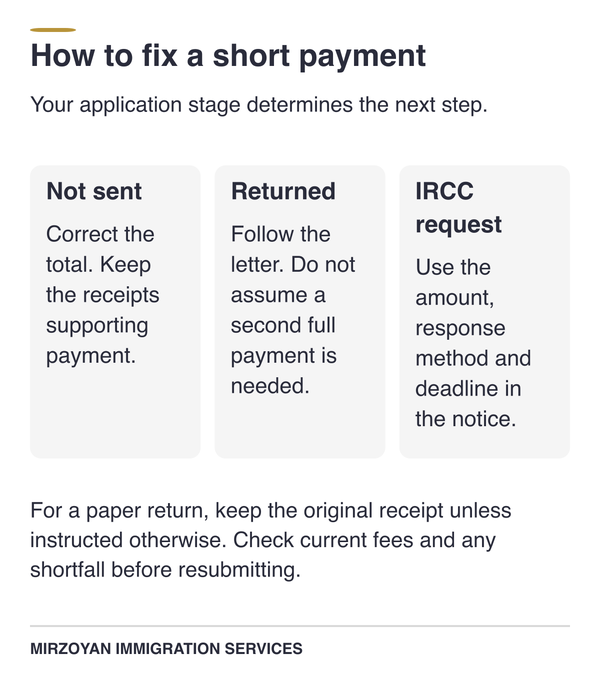
Not sent: Correct the total. Keep the receipts supporting payment. Returned: Follow the letter. Do not assume a second full payment is needed. IRCC request: Use the amount, response method and deadline in the notice. For a paper return, keep the original receipt unless instructed otherwise. Check current fees and any shortfall before resubmitting.
Before submission: correct the total and preserve both receipts
IRCC permits an additional online payment before final submission. Include both receipts when their combined value equals the required fee. Count every person included in the application package before calculating the difference. Alternatively, you may request a refund and make one correct payment. The underpayment guidance supports either correction when you preserve the resulting receipt record.
After return: follow the current resubmission instruction
If IRCC returns your application, read the fee instructions in the return letter before paying again. In a paper resubmission, keep the original payment receipt unless IRCC’s return letter tells you to replace it. If the fee was too low, follow the instructions for correcting the shortfall and submitting the required receipts. Online applicants should follow the resubmission message in their account. Recheck the applicable fee-change instructions alongside the letter, because a return does not automatically require a second full payment.
After an IRCC request: answer the notice, not a generic article
If IRCC sends a payment request, the notice controls the response method and deadline. Read the requested amount before making another transaction. I also check where IRCC instructs the applicant to submit the additional receipt. An unrelated web-form upload may not satisfy a notice that names another response channel. Match the payment, receipt, application number, and submission route before considering the request answered.
Which citizenship fees can be refunded?
A refusal does not determine the refund amount by itself. You must separate the processing component from the adult right-of-citizenship fee. Before processing begins, withdrawal may produce a full refund. But after processing starts, the adult right fee may remain refundable while the processing component normally does not. The table below organizes the usual result by stage and payment situation.
| Situation | Normal refund | What to do | Current source |
|---|---|---|---|
| Paid but did not submit | Eligible payment may be requested back | Use My Receipts in the payment account | IRCC refund page |
| Withdrawn before processing | Full refund may apply | Follow the withdrawal and refund route | IRCC refund page |
| Application returned | A return does not automatically require a refund or a new full payment | Follow the return letter. For paper applications, reuse the receipt unless a new one is requested. See how to correct and resubmit a returned citizenship application. | IRCC citizenship resubmission instructions |
| Refused or withdrawn after processing starts | $123 right fee only for an adult grant | Wait for automatic refund or use the receipt route | IRCC refusal answer |
| Overpayment | Difference refunded after IRCC confirms it | Keep the receipt; IRCC says the refund is automatic | IRCC overpayment answer |
Eligible refunds generally take two to eight weeks. The current refund page identifies the route by payment method and submission status. IRCC also refunds a confirmed overpayment difference without requiring a new application. A same-value receipt may sometimes support another application because receipts are not always tied to the selected service. That rule cannot cure the $578 difference between a $75 certificate payment and a $653 adult grant.
The Internal Logic of an IRCC Officer
At intake, IRCC must connect the payment evidence to the application being assessed. The receipt should show a successful transaction for the required amount. The number of paid fees should match the people included in the package. But a different cardholder name is not necessarily a problem. The complete payment record still needs to reconcile with the application type and current fee rule.
A receipt with the right amount may still work
IRCC may accept a receipt selected for another service when the required amount is identical. This can work because the receipt is not always linked to the fee name chosen during payment. Yet the amount must still equal the fee required for the application. The receipt must also be unused and submitted according to the application instructions. But a $75 receipt cannot satisfy a $653 adult-grant payment.
Receipts must reconcile to the application package
I check the exact amount, quantity, and official receipt before matching payment evidence to the package. And each person requiring a fee must be represented in the total. But the cardholder may differ from the applicant when the payment method permits it. The payer's name will still appear on the receipt and may receive any eligible refund. What matters is a successful payment used under the correct application instructions.
Fee-change dates control the amount due
The live IRCC schedule controls a payment made now. But IRCC's March 2026 notice used a received-date rule for the $123 right fee. Yet its current fee-change guidance bases a mailed citizenship fee on the application's signature date. Those statements address fee changes from different angles and should not be blended into a single assumption. Check the current instructions and any return letter before deciding whether an older payment remains sufficient.
Red Flags & Procedural Fairness Letters (PFL)
A routine short payment normally creates a payment deficiency, not an allegation of dishonesty. IRCC may return the application or request the missing amount. But a procedural fairness issue questions the truth or authenticity of submitted information. The response must address the exact document or explanation identified in the notice. Keeping these two situations separate prevents an ordinary payment correction from being treated like a fraud case.
Most underpayments are not PFL cases
An arithmetic shortfall usually produces a return or payment instruction. But it does not by itself establish dishonesty or altered evidence. The applicant should pay the required difference through IRCC's stated route. The additional receipt must then be submitted as directed. Describe the event as a payment deficiency unless IRCC's letter expressly raises a different concern.
Authenticity concerns are different from arithmetic mistakes
An altered receipt may create an authenticity concern when its amount or receipt number differs from IRCC's payment record. And a claimed confirmation may create another concern when no official receipt supports the transaction. Yet IRCC may also question an explanation that conflicts with the card issuer's record or an earlier response. Preserve the original receipt, payment email, and relevant card record if IRCC raises one of these discrepancies. Answer each stated concern directly instead of submitting unexplained replacement evidence.
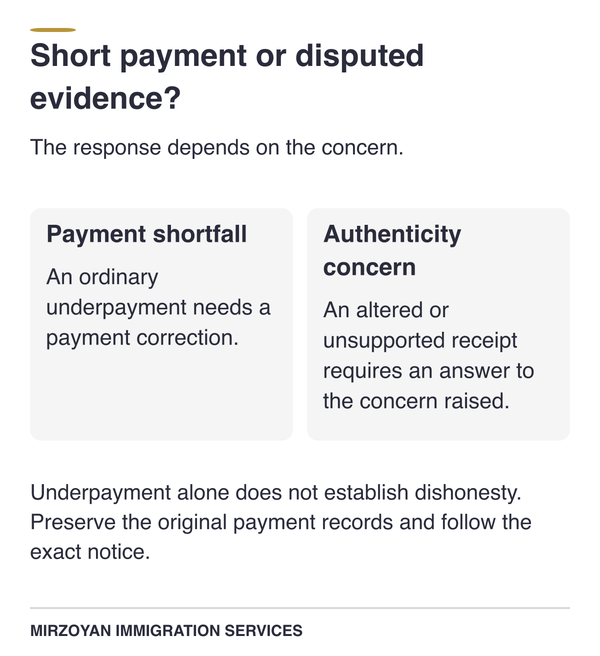
Payment shortfall: An ordinary underpayment needs a payment correction. Authenticity concern: An altered or unsupported receipt requires an answer to the concern raised. Underpayment alone does not establish dishonesty. Preserve the original payment records and follow the exact notice.
Recheck the fee before every payment or resubmission
Before submission, an underpayment may be corrected by paying the difference or requesting a refund and making one correct payment. Paying the difference means keeping both receipts and showing that their combined value meets the required fee. Starting again with one payment creates a separate refund to track. After a return or payment request, IRCC's instructions determine the correction you should make. Choose the correction that fits the application's stage, without confusing that decision with the citizenship route itself.
Citizenship fees can change while the IRCC page address stays the same. A saved screenshot or earlier receipt may therefore show an outdated amount. Check the live fee list before paying, correcting a return, or answering a request. The fee-change page explains recent increases and underpayment instructions. Use the current amount rather than relying on the price shown when you first started preparing the application.
When a fee question needs an application review
A straightforward payment question may be resolved by checking the current fee schedule and instructions for your application.
Professional help is more useful when an apparent fee problem also involves the wrong application category or an unresolved eligibility issue.
Mirzoyan Immigration Services can review the proposed grant application and any payment-related correspondence together.
Connecting the notice to the application helps identify whether you need a payment correction, further evidence or a separate eligibility review.
Through One on One Advisory, you discuss the application with Narek Mirzoyan, RCIC # R1005184, or Vahe Mirzoyan, RCIC # R514223.
Consider Canadian citizenship application services when that application review is the work you need. Professional fees remain separate from government charges.
Advice does not reduce the government fee, guarantee a refund or give the application processing priority.
Key Takeaways
Choose the application purpose before selecting a fee, especially when comparing a $653 grant with a $75 certificate.
The adult grant total contains a $530 processing fee and a $123 right-of-citizenship fee.
Where a separate receipt is required, save it and resolve payment problems before submitting.
Correct an underpayment before submission, or follow the exact return or IRCC request after filing.
Mirzoyan Immigration Services' professional fees and document expenses are separate from IRCC's government charges.
Frequently Asked Questions
What fees should I pay when applying for Canadian citizenship?
An adult applying for a citizenship grant pays $653: a $530 processing fee and a $123 right-of-citizenship fee. But a grant for a minor costs $100. A citizenship certificate costs $75, as does a citizenship-record search. Resumption, renunciation, and stateless-adult applications use separate fee lines. Choose the application first, then confirm its current amount on IRCC's fee list.
Will the citizenship fee increase in 2026?
The announced Canadian citizenship fee increase took effect on March 31, 2026. And IRCC raised the adult right-of-citizenship fee from $119.75 to $123. The $530 processing fee did not change, so the adult total became $653. But no later citizenship increase appeared during our August 31 review. Check IRCC's fee-change page again before paying because a later notice could change the amount.
How much does it cost for proof of citizenship?
Proof of Canadian citizenship currently costs $75 in Canadian dollars. The fee applies to a citizenship-certificate application for first proof or replacement. It does not cover an adult citizenship grant, which costs $653. A citizenship-record search also costs $75 but produces a different result. Confirm whether you need proof, replacement, or a records search before paying.
Can I pay my Canadian citizenship application fees online?
Yes, you can pay Canadian citizenship application fees online, but the payment process depends on the application. Grant applicants use IRCC's separate online payment service and include the receipt as instructed. For an online citizenship certificate, you pay within the guided application, which submits automatically after payment. Check your application guide before making a separate payment, and keep the payment confirmation.
How long does IRCC take to refund your money?
IRCC states that eligible refunds can take up to eight weeks to process. The time starts after IRCC receives the refund request or determines that a refund is due. The money usually returns to the original payment method, although some refunds arrive by cheque. Processing fees may remain non-refundable after processing begins. Check which fee component qualifies before estimating the amount you will receive.
Conclusion
Before paying, match the application category and number of applicants to the current fee schedule. Keep your payment confirmation and attach a separate receipt only where the application instructions require it. If IRCC requests more money, keep the notice with the additional receipt and respond by the stated deadline. If the unresolved question concerns eligibility or physical presence, settle that before making another payment. Mirzoyan Immigration Services can discuss Canadian citizenship application services when the application itself needs professional review.
Disclaimer
This article provides general information, not legal or immigration advice. Government fees and payment instructions can change, so confirm the current requirements before acting.