Birthright Citizenship in Canada and First-Generation Rules
Birthright citizenship in Canada generally means a child born here is Canadian, regardless of the parents’ citizenship or immigration status. A narrow exception applies to certain children of foreign diplomats and other protected officials. But children born abroad follow different rules, even when a parent is Canadian. Your child’s birth date and your citizenship history help determine which rules apply. The changes effective December 15, 2025 removed the former first-generation limit in some situations, while retaining conditions for later births.
By Narek Mirzoyan, RCIC # R1005184,. Verify this credential on the CICC public register.
Last reviewed by Narek Mirzoyan, RCIC # R1005184, on 2026-09-16.
TL;DR
Birthright Citizenship in Canada and First-Generation Rules determine whether a child is Canadian from birth. A child born here is generally Canadian, subject to one narrow exception. The child's citizenship does not give either parent citizenship or immigration status. A child born abroad requires a separate review of the parent, birth date, generation, and physical presence. For some later-generation births, the parent needs 1,095 days in Canada before the child is born. So use the Canadian citizenship in Canada guide for the broad rules and the descent guide for an individual family line.
Table of Contents
Start with the child's place and date of birth
Birthright citizenship in Canada means most children born here are Canadian citizens, regardless of their parents' citizenship or immigration status. The phrase "birthright citizenship" often combines several different questions. One question concerns a child born in Canada, while another concerns citizenship passed to a child born abroad. And the parents' status can differ from the child's status after the same birth. A birth certificate may not show the parents' status or protected role on that date. So the matrix separates the child's birth, the parents' status, and the possible next step before you collect documents.
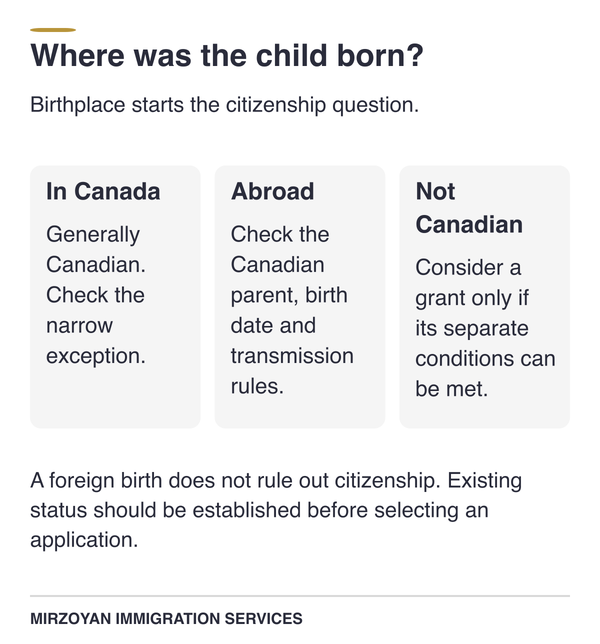
In Canada: Generally Canadian. Check the narrow exception. Abroad: Check the Canadian parent, birth date and transmission rules. Not Canadian: Consider a grant only if its separate conditions can be met. A foreign birth does not rule out citizenship. Existing status should be established before selecting an application.
| Child's situation | First legal question | Critical fact | Where to continue |
|---|---|---|---|
| Born in Canada | Does the protected-official exception apply? | Each parent's status and exact role when the child was born | Continue with the Canada-born sections below |
| Born abroad to a Canadian parent | Could citizenship pass through that parent? | Birth date, parent's citizenship route, generation, and pre-birth presence | Canadian citizenship by descent |
| Not already a citizen | Does a citizenship grant route exist? | Current immigration status, age, and the applicable grant provision | Canadian citizenship requirements |
Born in Canada
A child born in Canada is generally Canadian under the Citizenship Act. The exact place and date of birth anchor this part of the review. You must then check each parent's citizenship or permanent-resident status when the child was born. Nationality alone is insufficient because a foreign national may also hold Canadian permanent residence. So those facts determine whether the protected-official exception requires a separate review under the current Act.
Born abroad to a Canadian parent
A child born abroad follows the citizenship-transmission rules rather than the ordinary Canada-born rule. The Canadian parent must have held citizenship when the child was born. And how that parent became Canadian can affect the analysis. The child's birth date, generation, and the parent's earlier physical presence may all matter. Establish the parent's citizenship history before treating a passport or certificate as a complete answer.
Not already a citizen
If the child is not already Canadian, consider whether a citizenship grant may be available. A grant has different requirements from an application proving citizenship that already exists. The child's age, immigration status, and the parent's circumstances become relevant to that assessment. Resolve the existing-citizenship question before preparing grant forms or paying a grant fee. Otherwise, the family may collect residence evidence when the actual need is to document citizenship acquired at birth.
A child born in Canada is generally a Canadian citizen
The Canada-born rule generally covers a person born in Canada after February 14, 1977. This federal rule applies across every province and territory. The parents do not need Canadian citizenship for the general rule to operate. However, the Act contains a narrow exception involving both parents' status and one parent's protected role. So the next two sections explain what the birth record establishes and what still needs to be checked.
Place of birth usually controls this branch
For the Canada-born rule, establish where the child was born before considering the parents' nationality. The federal rule applies in Ontario as it does in every other province and territory. Provinces and territories register births; they do not create separate Canadian citizenship rules. A Canadian birthplace therefore identifies the applicable federal rule. Where a parent held a protected official role, continue with the exception below before relying on birthplace alone.
A birth certificate documents the Canadian birth
A provincial or territorial birth certificate usually records the child's birthplace and parent information. It is often the first document used to establish the Canadian birth. However, the certificate does not override an exception written into the Citizenship Act. It may also omit the parents' complete status or employment details at the time of birth. Treat the certificate as evidence of the birth, then apply the legal rule to the remaining facts.
The protected-official exception requires both conditions
The shorthand "diplomat's child" is incomplete because the statutory exception contains two conditions. First, neither parent can have been Canadian or a permanent resident. Second, at least one parent must have held a listed protected role. Both conditions must exist when the child is born. But if either condition is missing, this exception does not remove citizenship under the Canada-born rule.
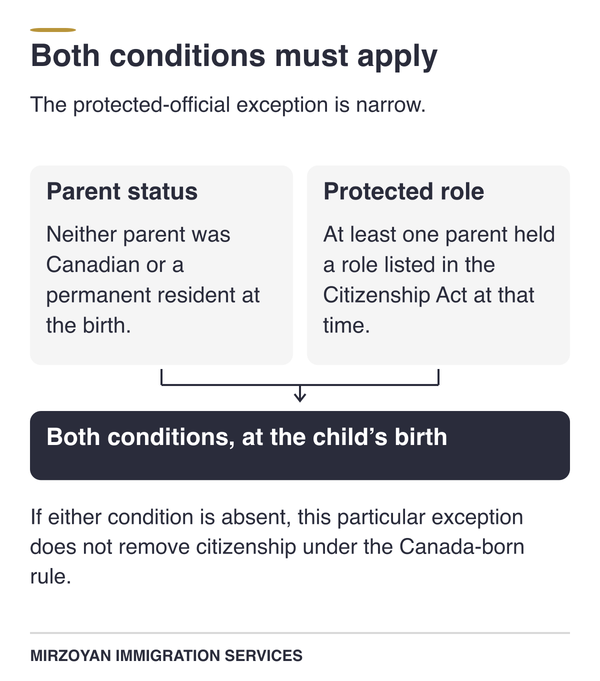
Parent status: Neither parent was Canadian or a permanent resident at the birth. Protected role: At least one parent held a role listed in the Citizenship Act at that time. If either condition is absent, this particular exception does not remove citizenship under the Canada-born rule.
A citizen or permanent-resident parent changes the result
The first condition requires a status check for both parents at the time of birth. If either parent was Canadian, this particular exception does not apply. The same result follows if either parent was a Canadian permanent resident. Yet status obtained after the birth cannot change what was true on the birth date. The review must therefore use records that show each parent's status at that specific time.
The parent's exact role must fit the statutory list
The second condition concerns at least one parent's position when the child was born. The list includes certain diplomatic, consular, foreign-government, service, and qualifying international-organization roles. It can also cover employees serving some protected officials. But every embassy or foreign-government job does not fit the same category. Use Global Affairs Canada's protocol guidance to understand accreditation, while applying the Citizenship Act as the controlling legal test.
A Canadian-born child does not give the parent Canadian status
When the Canada-born rule applies, the resulting citizenship belongs to the child. It does not make either parent a Canadian citizen. And it creates no permanent residence, temporary status, or work authorization for a parent. Each parent must continue relying on that parent's own immigration or citizenship status. This separation becomes especially important when a parent's permit or authorized stay is approaching its expiry date.
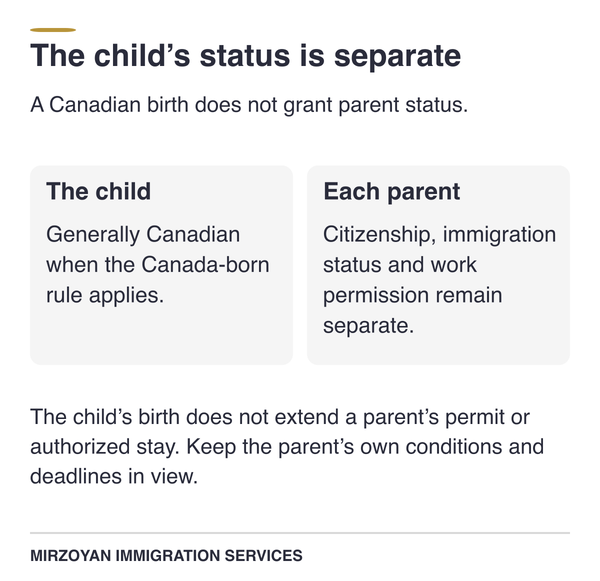
The child: Generally Canadian when the Canada-born rule applies. Each parent: Citizenship, immigration status and work permission remain separate. The child’s birth does not extend a parent’s permit or authorized stay. Keep the parent’s own conditions and deadlines in view.
The child's status and the parent's status are separate
A child's Canadian birth certificate does not establish either parent's citizenship or immigration status. A parent with a temporary permit must still observe that permit's conditions and expiry date. The child's birth does not replace the parent's document or authorize employment. Keep the parent's permit, restoration, and application deadlines in a separate record from the child's citizenship documents. This allows the family to address an approaching deadline without mistaking the child's citizenship for an extension of the parent's stay.
A future family route is not an immediate status grant
A Canadian child may be relevant to a future family immigration assessment. That possibility does not grant a parent immediate status or extend an existing permit. It also does not pause removal, restoration, or application deadlines. Any proposed route must be assessed under its own requirements and timing. Citizenship application services may address an eligible non-citizen parent's grant application; the child's birth alone does not establish eligibility.
A child born abroad follows a parent-and-date analysis
A Canadian parent is the starting fact for a child born abroad, but it is not the final answer. The parent must have been Canadian on the child's birth date. The parent's own path to citizenship may also affect transmission. The child's generation and birth date determine which version of the rules applies. So reviewing those facts together prevents a passport or family label from being treated as conclusive.
The parent needed citizenship on the child's birth date
Citizenship can pass at birth only through a parent who was already Canadian on the child's birth date. But a parent's later naturalization does not retroactively satisfy that condition. Compare the child's birth certificate with the effective date on the parent's citizenship record. If the parent became Canadian later, the child may still have another route. That route requires a separate assessment of any grant or immigration option available after the parent's naturalization.
How the parent became Canadian can matter
How the parent became Canadian can determine whether another transmission condition applies. A Canadian-born or naturalized parent presents a different history from a parent who was also born abroad. So the current Act can impose an additional connection test on some later-generation births. I start with the child's birth record and the parent's first citizenship document. Those dates usually identify the correct rule and the documents needed for the child's transmission question.
Do not infer the answer from generation labels alone
"First generation" generally describes the first person born or adopted abroad to a Canadian citizen. The current rules may place that person's foreign-born child in a later generation. However, the label does not account for the child's birth date or the parent's physical presence. It also does not account for restoration provisions or statutory exceptions. Use the Canadian citizenship by descent analysis when the family history extends beyond this general framework.
Unsure whether a grant is appropriate?
Mirzoyan Immigration Services can discuss the citizenship facts before you choose an application.
Citizenship application services apply only if the person is not already Canadian and a grant route is available.
December 15, 2025 determines which transmission rules apply
The Bill C-3 amendments took effect on December 15, 2025. So that date separates historical cases from the rules governing later-generation births after the amendments. A birth before the effective date may require a review of restoration and earlier legislative provisions. A later-generation birth on or after that date may engage the 1,095-day connection test. Always place the child's birth date on the timeline before deciding which rule to apply.
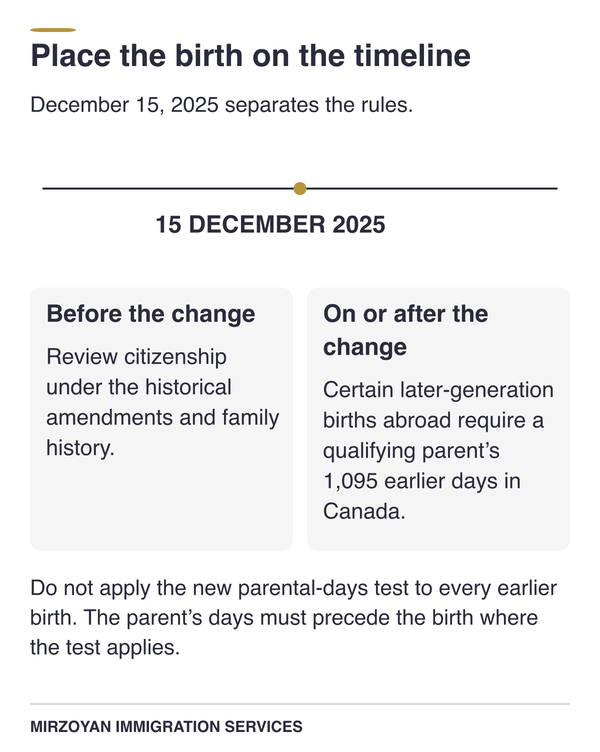
Before the change: Review citizenship under the historical amendments and family history. On or after the change: Certain later-generation births abroad require a qualifying parent’s 1,095 earlier days in Canada. Do not apply the new parental-days test to every earlier birth. The parent’s days must precede the birth where the test applies.
Births before December 15, 2025 require a historical-law review
Bill C-3 made many people affected by the former limit Canadian when the changes took effect. But these cases require family-specific history rather than the new pre-birth presence test copied backward. The relevant facts may cross several versions of the Citizenship Act. The citizenship by descent guide addresses individual status, while the Bill C-3 guide explains the legislative transition. Keep the historical analysis separate from the test for a later-generation birth after the effective date.
Later-generation future births use the current 1,095-day rule
For some later-generation overseas births from December 15, 2025 onward, a connection test applies to the Canadian parent. The threshold is reached after 1,095 cumulative days of physical presence before the birth. And the days need not form one uninterrupted three-year period. If both parents are Canadian, either qualifying parent may be able to meet the threshold. The count must still be supported by dates rather than a general statement about living in Canada.
The days must be accumulated before the child's birth
For this citizenship-at-birth test, the Canadian parent's qualifying days must precede the child's birth. Later time in Canada cannot make up a shortfall at that earlier date. I compare the claimed days with the dated travel chronology before accepting the total. A rounded statement that the parent lived in Canada for three years may overlook absences. Reconstruct the relevant dates rather than carrying a general residence estimate into the child's status assessment.
Crown service abroad can create a narrow exception
The current Act preserves a narrow service-abroad exception for certain citizenship-transmission cases. The exception depends on the family relationship in the relevant generation. It also depends on the institution and legal category of the service abroad. Yet locally engaged employment is expressly excluded. A government connection or overseas job title therefore cannot establish the exception for the specific generation being assessed.
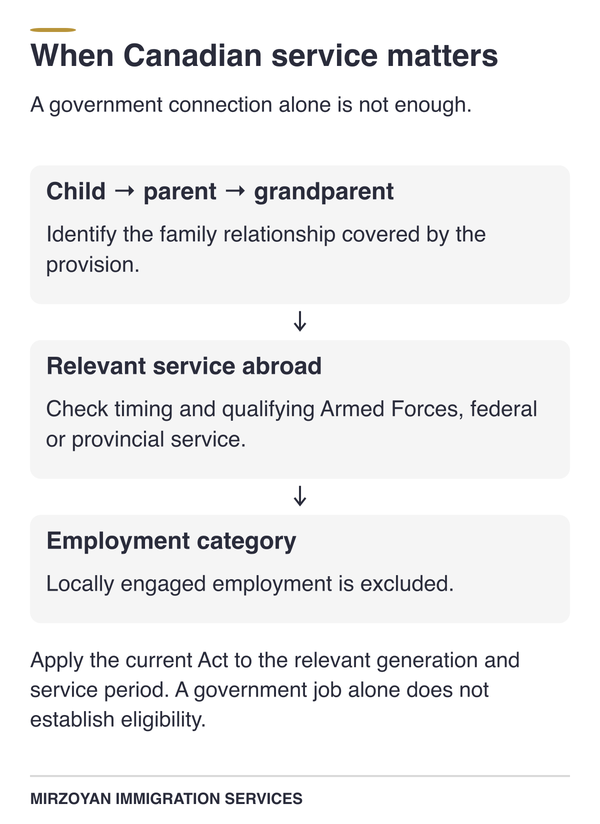
Child → parent → grandparent: Identify the family relationship covered by the provision. Relevant service abroad: Check timing and qualifying Armed Forces, federal or provincial service. Employment category: Locally engaged employment is excluded. Apply the current Act to the relevant generation and service period. A government job alone does not establish eligibility.
The relationship and service category both matter
The exception can examine a parent serving abroad when the child was born. And in some cases, it can examine the service of that parent's parent. The service must connect to the relevant person at the legally required time. It must also fall within the Canadian Armed Forces, federal public administration, or a provincial public service. Establish both the family relationship and service category before relying on this exception.
Locally engaged service is excluded
Locally engaged employment is excluded from this service exception. Working at a Canadian mission abroad does not, by itself, establish whether the employee falls within that exclusion. The appointment terms and engagement status need to support the category claimed. An overseas job title may identify the workplace without answering that employment question. Review the employment terms for the person in the relevant generation before relying on the service exception.
Confirm the facts against the current Act
Apply the current Act to the particular relationship, service period, and employment category involved. Evidence that a relative worked for the government may still leave the relevant dates unresolved. Likewise, proof of an overseas posting may not establish whether the employment was locally engaged. Identify which condition each record supports and which condition remains uncertain. If the evidence does not establish the exception, do not treat a government connection as a substitute for the ordinary transmission assessment.
The Internal Logic of an IRCC Officer
IRCC assesses citizenship by matching the legal route to the supporting records. A family's preferred label does not decide which provision applies. But the IRCC status screen is only a starting point for identifying the possible category. The officer still needs a coherent chronology connecting the child, parent, and claimed citizenship event. The strongest file makes each fact easy to verify without forcing the officer to reconstruct the family's history.
Route first, then chronology, then documentary continuity
The review begins by identifying whether the claim concerns birth in Canada, descent, restoration, or a grant. The child's birth and the parent's citizenship events are then placed in date order. And civil-status records must connect the correct parent to the correct child. Names, dates, and places should remain consistent across the documents. Any unexplained gap can prevent the officer from following the claimed family line across several generations of records.
The parent's certificate does not prove every transmission condition
A certificate or passport may establish that the parent is Canadian, while leaving other transmission questions unanswered. The document may not show how or when citizenship began. It also does not establish the parent's 1,095 days in Canada before the child's birth. Citizenship history and physical-presence records therefore serve different purposes in the same claim. Connect each record to the condition it supports so the remaining evidence gaps are clear.
Similar family histories can produce different results
Two families with similar stories can have different citizenship results. Yet a different birth date may place the child under another version of the law. A different citizenship date may show that the parent became Canadian only after the child was born. A different service category may determine whether a statutory exception applies. The final answer must follow the verified chronology rather than the family's general description of how citizenship arose.
Status is not the same as proof of status
A person may already be Canadian yet lack the document needed to prove that status. And existing citizenship comes from the Citizenship Act, not from the later issuance of a certificate. A proof application asks IRCC to document status that may already exist. A grant application asks IRCC to confer citizenship on someone who is not already Canadian. IRCC's citizenship-status guidance separates those starting points before the person chooses a certificate or grant application.
First identify the legal route
Start by identifying the legal event that may have created citizenship. That event may be birth in Canada, descent, restoration, naturalization, or another statutory provision. The relevant date and family relationship depend on the route being claimed. But a preferred form or document cannot correct an incorrect legal theory. Identify the route first, then decide what proof or application may be required for the person and family line.
Then trace the parent-child records through the family line
Use civil-status records from the proper issuing authority to connect each parent to the child in the claim. Citizenship records establish how and when the relevant parent became Canadian. Compare those events in date order before deciding what personal proof the child needs. The Canadian citizenship by descent guide explains the individual family-line and historical-law assessment. Once that assessment identifies possible citizenship, the family can assemble the records needed to document it.
Red Flags & Procedural Fairness Letters (PFL)
Complex citizenship facts do not automatically create a credibility concern. However, IRCC may send an ordinary request for a missing or unclear record. A procedural fairness letter is different because it identifies a concern that may lead to an adverse decision. The wording, deadline, and stated concern determine how the response should be organized. Read the notice carefully before deciding whether it is a routine request or a fairness process requiring a complete response.
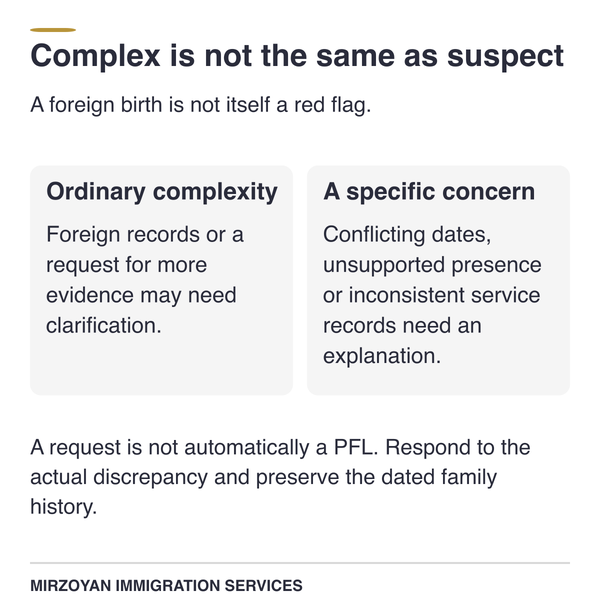
Ordinary complexity: Foreign records or a request for more evidence may need clarification. A specific concern: Conflicting dates, unsupported presence or inconsistent service records need an explanation. A request is not automatically a PFL. Respond to the actual discrepancy and preserve the dated family history.
Birth abroad or a foreign parent is not itself a red flag
A foreign birth or foreign parent is a normal feature of many citizenship claims. So those facts identify the applicable route and do not establish dishonesty. A concern can arise when documents give conflicting birthplaces, parent names, or citizenship dates. The response should identify why the records differ and which evidence establishes the correct fact. Addressing the specific inconsistency is more useful than repeating the family's preferred conclusion.
A request for more records is not automatically a PFL
IRCC may request more records because the existing package does not establish a required fact. But that request does not necessarily allege misrepresentation or invite a fairness response. It still carries a deadline and may specify the type of evidence IRCC expects. The reply should identify the requested fact, provide the available record, and explain any unavailable evidence. Treat the notice according to its wording rather than assuming every request is a PFL.
Answer the precise discrepancy and preserve the chronology
A focused response matches each concern to a dated record and a concise explanation. But it should not bury the disputed fact inside unrelated family history. If travel records contradict the 1,095-day claim, correct the chronology openly. If employment records show locally engaged service, address that fact before relying on the service exception. A clear issue-by-issue response lets the officer see exactly how each concern has been answered.
When advice can clarify birthright and a possible grant
Official guidance may answer a straightforward question about a child's birthplace and the parents' status.
Advice becomes useful when those facts leave uncertainty about existing citizenship or a possible grant application.
Mirzoyan Immigration Services can review the relevant birth and citizenship records before discussing an application.
That review helps separate a child's status question from a parent's own eligibility.
Under One on One Advisory, Narek Mirzoyan, RCIC # R1005184, or Vahe Mirzoyan, RCIC # R514223, answers your questions directly.
Citizenship application services become relevant only if the person is not already Canadian and a grant route is available.
The child's birth does not, by itself, establish a parent's eligibility for that service. A consultation cannot confer citizenship or guarantee a grant.
Key Takeaways
A child born in Canada is generally Canadian, subject to a narrow statutory exception.
The protected-official exception requires both parents' status and one parent's listed role to meet its conditions.
A Canadian child's status gives neither parent citizenship, immigration status, nor work authorization.
December 15, 2025 separates later-generation future births from historical cases; the future test generally uses 1,095 pre-birth days.
Use Canadian citizenship by descent for family-line questions. Mirzoyan Immigration Services can help with a grant only after confirming the person is not already Canadian.
Frequently Asked Questions
What is the first-generation limit for Canadian citizenship?
The former first-generation limit generally restricted citizenship by descent to the first generation born abroad. The rules changed on December 15, 2025. For later-generation births from that date, a qualifying Canadian parent may need 1,095 days in Canada before the child's birth. A regular citizenship grant does not itself trigger that parental-presence requirement. Earlier births need a historical status review, not an assumption that the new presence condition applies.
Do babies born in Canada automatically get citizenship?
Generally, a baby born in Canada is a citizen under the Citizenship Act. However, the exception applies only if neither parent held Canadian citizenship or permanent residence. It also requires one parent to have held a listed protected role. Both conditions must exist when the child is born. If either parent was Canadian or a permanent resident, this particular exception does not remove the child's citizenship.
Do I get citizenship if I give birth in Canada?
No, the child's Canadian citizenship does not give the parent Canadian citizenship or immigration status. But your status continues under the immigration or citizenship document you hold. The child's birth certificate does not extend a permit or authorize employment. Any permanent-residence or temporary-status route has its own requirements. Review the parent's status and deadlines separately from the child's citizenship.
Does the first-generation limit apply if my parent or grandparent was a Canadian Crown servant?
Possibly, because the Act contains a specific exception for qualifying service abroad. But the family relationship and timing must fit the provision. Qualifying service can involve the Canadian Armed Forces, federal public administration, or a provincial public service. Locally engaged employment is excluded. A government job title alone does not establish whether the exception applies.
Do children of Canadian citizens automatically get citizenship?
Not always, because a child born in Canada and a child born abroad follow different rules. A child born in Canada is generally Canadian, subject to the protected-official exception. But a child born abroad requires a separate review under the transmission rules. The parent's status, citizenship route, physical presence, and the child's birth date may all matter. Confirm the legal route before choosing a proof or grant application.
What to do next
Begin with the child's birthplace and birth date, then identify the parent's status on that date. Use the citizenship by descent guide for an individual family line and the dual citizenship guide for nationality consequences. If screening shows the person is not already Canadian, our citizenship application services may help with an available grant route. Discuss the unresolved status question before choosing an application.
Disclaimer
This article provides general information, not legal advice; citizenship outcomes depend on current law and each family's verified facts.