Express Entry Processing Times in 2026: Full Step-by-Step Guide
Last updated: May 16, 2026 | Written by Narek Mirzoyan RCIC#R1005184 | Reviewed by Vahe Mirzoyan RCIC#R514223 at Mirzoyan Immigration
Table of Contents
Key Takeaways
TL;DR
What Is the Service Standard?
How Long Does the Pool-to-ITA Stage Take?
How Do You Submit the e-APR and Receive AOR?
What Happens at the Biometrics and Medicals Stage?
Why Do Background Checks Sometimes Take Months?
What Is a Passport Request and How Soon Does It Arrive?
What Happens at the Landing Stage?
What Actually Causes Delay?
How Do I Check My Application Status?
Frequently Asked Questions
Key Takeaways
IRCC’s service standard is six (6) months for 80% of complete Express Entry applications after AOR.
CEC files typically clear in 4 to 6 months. FSW and FST files often take 6 to 9 months because of foreign document verification.
The biggest delays come from missing documents, security background checks, medical reviews, QC holds, and peak submission volume.
Webform inquiries about the status of your application before six (6) months have passed can at times negatively impact on your case.
Mirzoyan Immigration, led by RCIC Narek Mirzoyan (RCIC # R1005184), reviews every client’s e-APR submission. We remove the document and format issues that cause most delays. A clean submission is the only real accelerator.
TL;DR
IRCC aims to process 80% of complete Express Entry applications within six (6) months of e-APR submission. Most CEC files clear in 4 to 6 months. FSW and FST files often take 6 to 9 months because of foreign document verification. The biggest delays come from security background checks, medical holds, and missing documents. There is no formal process to expedite an application. An application that is organized from the start is the only real way you can ensure your application is processed quicker.
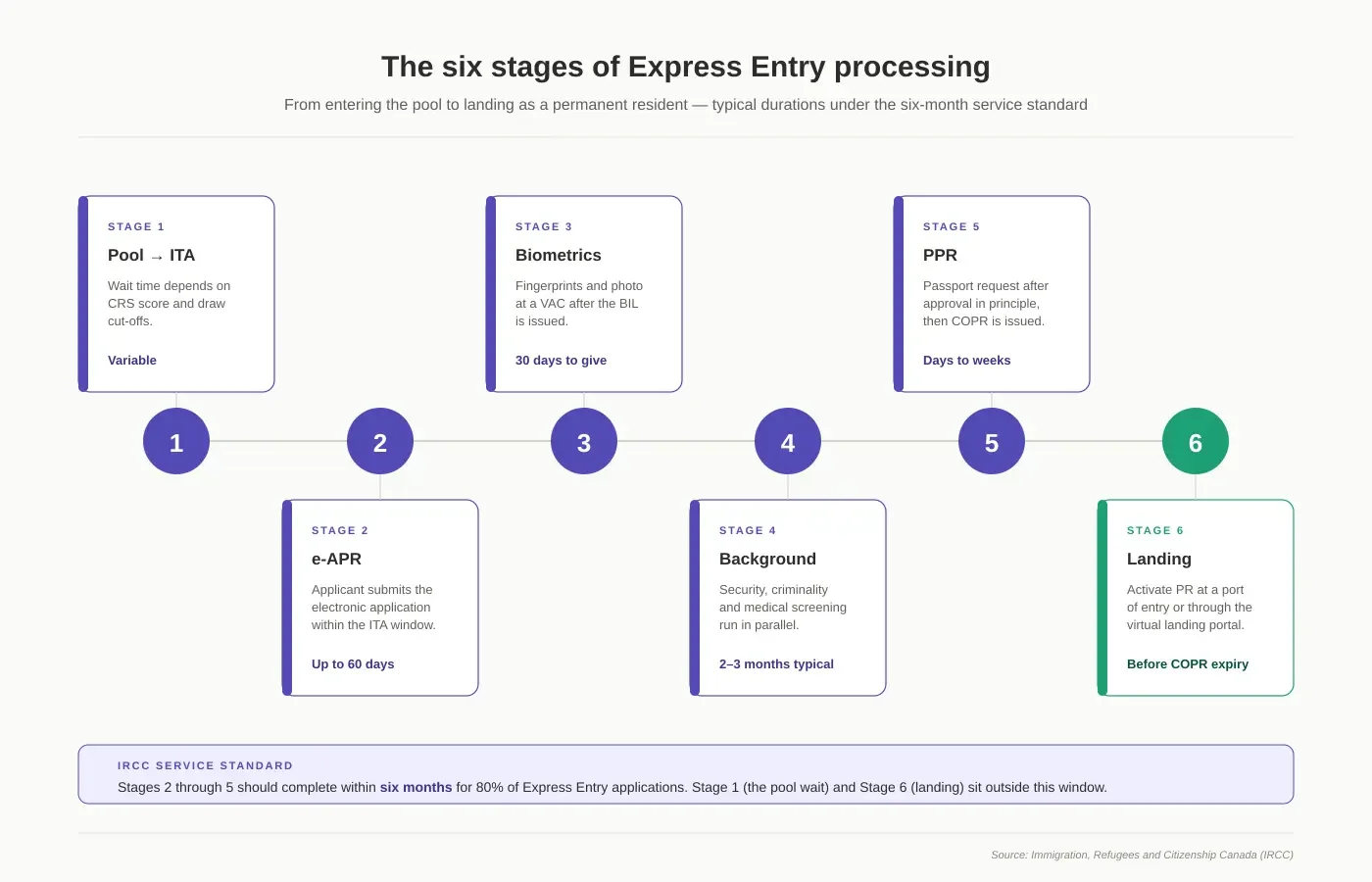
You submitted your e-APR three (3) weeks ago and the status bar has not moved. That feeling is normal, and the answer to “how long will this actually take” is more layered than the six (6) month figure on the IRCC website. IRCC’s published service standard is six (6) months for 80% of complete Express Entry applications after the e-APR is submitted. But that single number hides real variance that takes place at each stage, and most of the variance is predictable once you know where to look.
This guide walks you through every stage from ITA to COPR or eCOPR. For broader process context, read the Express Entry pillar guide. For the documents that cause the most delays, see the post-ITA document preparation guide.

What Is the Service Standard?
IRCC’s published service standard is six (6) months processing for 80% of complete Express Entry applications. (IRCC processing times) The six (6) month clock starts when IRCC sends the Acknowledgment of Receipt (AOR), not when you click submit.
That 80% number matters. One in five (5) complete applications takes longer than six (6) months, often for reasons no applicant can control. The service standard is a target IRCC publishes. It is not a guarantee.
Different program streams move at different paces. CEC is usually fastest because IRCC can verify Canadian work history and education through domestic systems. FSW and FST often run longer because foreign documents and ECAs need outside verification. Our FSW vs CEC vs FST comparison article covers this split in more detail.
How Long Does the EE Pool-to-ITA Stage Take?
This stage runs before your e-APR. Your profile sits in the pool waiting for a draw that includes you. How long it takes depends entirely on your CRS score against current draw cut-offs. Your EE profile expires 12 months from the profile creation date. Once it expires, you will have to create the profile again.
Typical timing
If your CRS is inside the current cut-offs, an ITA typically arrives within 2 to 4 weeks. Candidates at 20 to 40 points below cut-offs may wait 2 to 6 months for the right category draw. Candidates more than 40 points below usually wait longer. And many never receive an ITA at all unless they raise their score.
The 12-month profile limit
Your Express Entry profile is valid for 12 months. (IRCC Express Entry profile guidance) If you do not receive an ITA in that window, you can create a new profile. Updating your scores (a new language test, new work experience) does not reset the 12-month clock. What this means is that profile freshness has a hard ceiling, and you should plan score improvements accordingly.
For more on how draws actually work, read the IRCC guide to Express Entry rounds of invitations.
How Do You Submit the e-APR and Receive AOR?
After receiving an ITA you have exactly 60 days to submit your electronic Application for Permanent Residence (e-APR), which is your full PR application package uploaded through the IRCC online account. The clock starts the moment the ITA lands in your account. AOR usually arrives within 30 minutes of submission and officially starts the six (6) month processing standard.
Document upload and payment
Your documents are uploaded inside the IRCC portal. Payment of CAD $1,590 (principal plus spouse) and CAD $270 per dependent child happens at submission. (IRCC fee schedule)
Acknowledgment of Receipt
AOR usually arrives within 30 minutes of submission. Anything longer than 48 hours is unusual. Check your IRCC online account inbox first, then your email’s spam folder. AOR is the official start of the six (6) month service-standard clock. Save that email. You will reference its date for every status check that follows.
What Happens at the Biometrics and Medicals Stage?
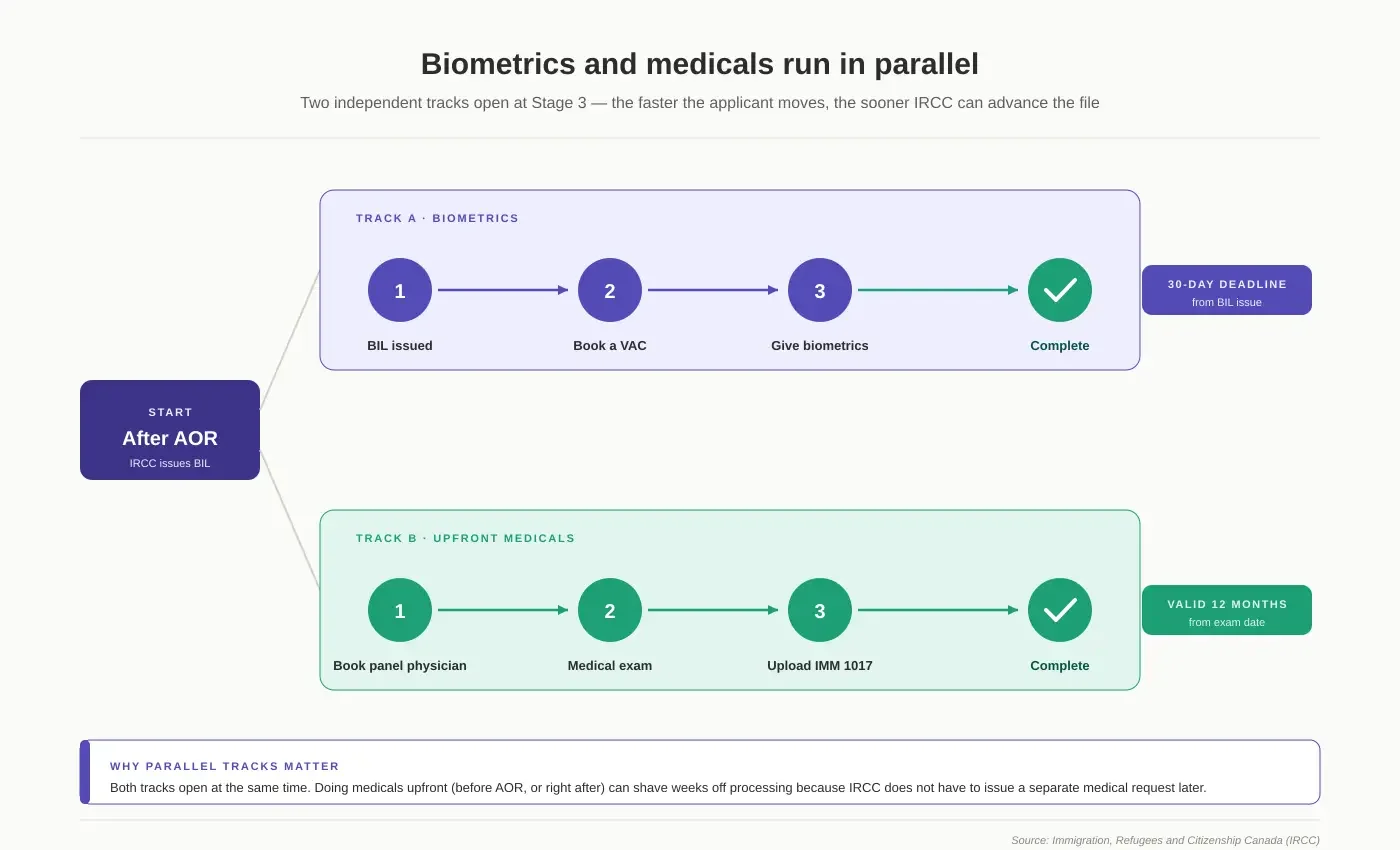
After AOR, IRCC issues a Biometrics Instruction Letter (BIL), the formal request for your fingerprints and photograph. You have 30 days to visit a Visa Application Centre or Service Canada location. Medicals are typically done upfront through an IRCC-approved panel physician. Upfront medicals save weeks of processing compared to waiting for IRCC to request them. (IRCC biometrics overview)
Biometrics timing
Booking an appointment takes 1 to 7 days depending on location. Results upload to IRCC within 24 to 48 hours after collection. The biometrics fee is CAD $85 per adult and $170 per family. (IRCC biometrics fee schedule)
Upfront medicals
You can (and should) complete medicals before IRCC requests them. Visit an IRCC-approved panel physician. Results go directly to IRCC. In my consultations, the candidates who book medicals the same week they submit their e-APR almost always shave 4 to 8 weeks off typical processing. Do not wait for the request letter.
Submitted your e-APR but unsure whether to chase the next step yourself? Book a post-ITA file review with Mirzoyan Immigration. An RCIC will flag any stage-specific risk in your file and map out realistic timing.
Why Do Background Checks Sometimes Take Months?
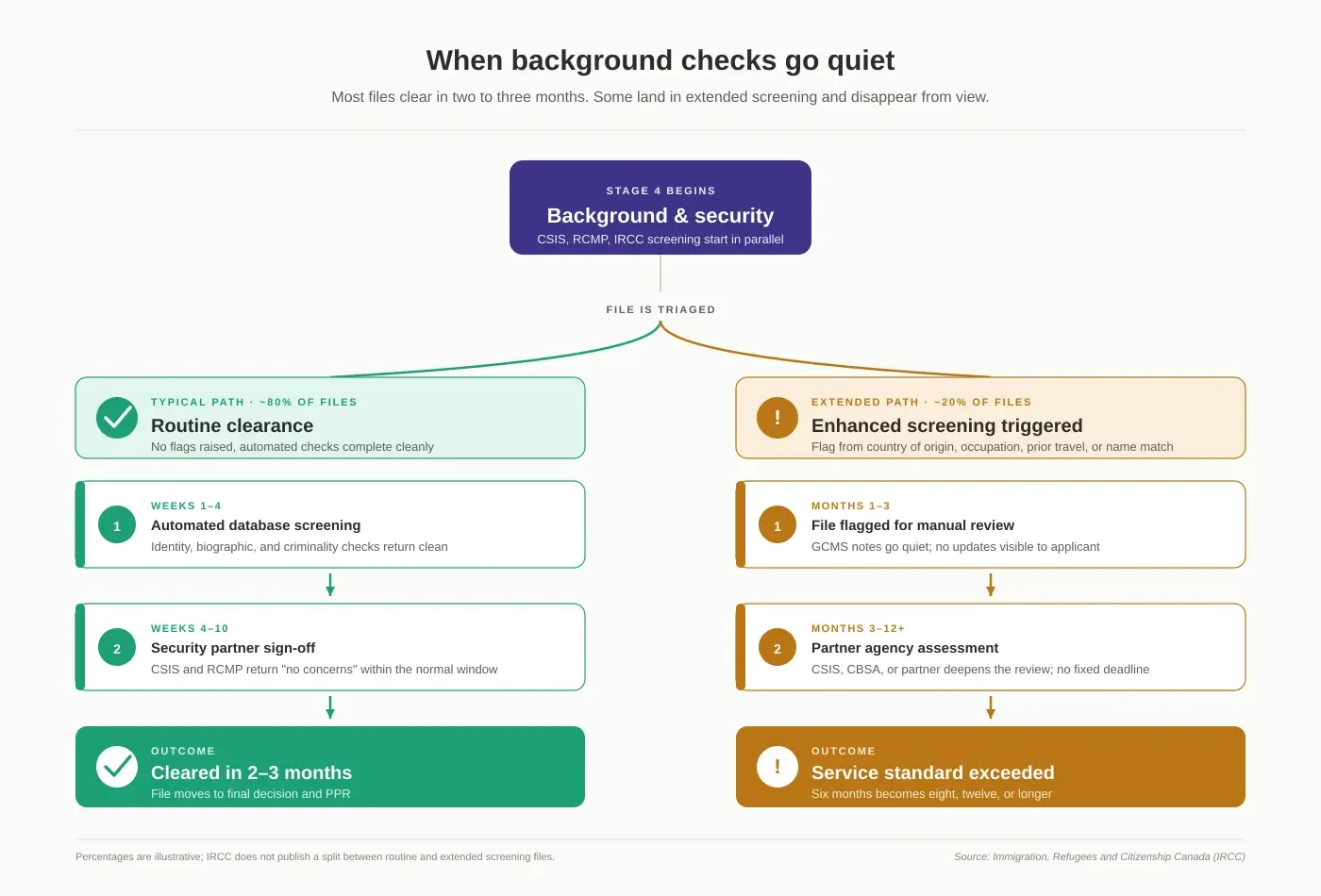
IRCC runs criminal background and security checks against Canadian and international databases. Most candidates clear this in 2 to 4 weeks. But extended screening kicks in for applicants with complex travel histories, certain occupations, or nationalities subject to additional review. In those cases the stage can take 3 to 6 months. (IRCC security screening guidance)
Typical background check times
Most candidates clear background checks in 2 to 4 weeks. Canadian-resident CEC applicants often clear in under two (2) weeks. The reason is simple. IRCC already has fresh RCMP data on file.
When screening takes longer
Extra screening kicks in for three groups. First, candidates with significant travel to countries under sanctions. Second, candidates from countries flagged for extended review. Third, candidates in certain occupations such as military, nuclear, or aerospace. For these candidates, 3 to 6 months at this stage is not unusual, and in my experience it is the single biggest cause of “stuck file” anxiety.
What you cannot do during this stage
You cannot accelerate a security check. And submitting a webform inquiry before six (6) months have passed can slow things down. It triggers a review acknowledgment that resets some internal timers. Wait the full six (6) months before inquiring.
What Is a Passport Request and How Soon Does It Arrive?
Once background check, medical, and document review all clear, IRCC issues a Passport Request (PPR) email. Overseas applicants mail in their passport for visa issuance and COPR. Inside-Canada applicants upload a passport page scan and await for eCOPR. PPR usually arrives 4 to 6 months after AOR for CEC files, and 6 to 9 months for FSW or FST files. (IRCC application status guidance)
Typical PPR timing
PPR usually arrives 4 to 6 months after AOR for CEC files. FSW and FST files typically see PPR at 6 to 9 months. Some candidates receive it sooner. A small percentage wait longer for the reasons covered earlier.
What PPR means
PPR is IRCC’s signal that your application is approved in principle. Barring a last-minute security alert or a passport-validity issue, you will receive Confirmation of Permanent Residence (COPR) shortly after.
COPR validity
The COPR document has a validity date tied to your medical or passport expiry, whichever is earlier. Typical validity is 6 to 12 months from issue. You must land before COPR expires. (IRCC COPR guidance)
What Happens at the Landing Stage?
You become a permanent resident when a Canada Border Services Agency (CBSA) officer completes the landing interview at a port of entry. Landing can happen at any airport with CBSA presence or at a land border. The officer verifies your COPR and passport, and the interview typically takes 10 to 30 minutes. (CBSA landing procedures)
Landing interview
The officer verifies your COPR, passport, and (for overseas candidates) IM-1 entry visa. You sign the COPR at landing, and that signature is the official PR confirmation. The signed COPR is proof of PR status until your card arrives. If you are inside Canada, typically this interview happens over the phone and afterwards you receive your eCOPR by email.
PR card after landing
Your PR card is mailed to your Canadian address within 6 to 8 weeks of landing. You are a permanent resident from the landing date, not from the card-arrival date. The card itself is proof of status for international travel. (IRCC PR card delivery)

What Actually Causes Delay?
Five causes account for nearly all Express Entry delays. Knowing them in advance lets you plan around the ones you can control.
Missing or unclear documents
This is the number one cause. A reference letter missing “paid hours per week” can trigger a procedural fairness letter, which adds 4 to 12 weeks to your timeline. (IRCC procedural fairness overview) I have helped hundreds of clients audit their packages before submission, and a clean document pack at the e-APR stage prevents this category of delay entirely.
Security background check
The second most common cause. It is outside applicant control, but predictable for candidates with specific travel or occupation profiles.
Medical review
Some diagnoses trigger a medical officer review that can add weeks to the file. This is most common for conditions with possible excessive-demand implications. Tuberculosis and certain chronic conditions also trigger review. (IRCC medical inadmissibility guidance)
Quality Control (QC) holds
A small percentage of files get pulled for QC review. No reason is provided. Files typically clear within 2 to 6 weeks.
Peak submission volume
After large draws, IRCC officers face a temporary backlog. Submitting right after a 5,000-ITA draw can mean your file sits longer before its first review.
How Do I Check My Application Status?
You have two tools, and you should use both.
IRCC online account (GCKey or sign-in partner)
This is your primary status source. Log in to your Express Entry account. The “Application status” tab shows high-level stages: submitted, biometrics, medical, background, decision. Updates can lag by a few days, so do not panic if the bar moves slowly.
Personalised processing time estimate
IRCC publishes a personalised processing time estimate inside your account, usually after AOR. The estimate updates weekly based on similar-file data. Treat it as an approximation, not a guarantee. The good news is that it tracks reality more closely than the headline service standard.
Has your application been “in progress” for more than six months? You may be wondering whether a webform inquiry is the right move. Book a status review with Mirzoyan Immigration. An RCIC will read your file’s current stage and advise whether to wait, inquire, or escalate.
Conclusion
Express Entry timing is mostly within your control at submission, and mostly out of your control after. Put your energy into the parts you can influence. Complete documents, upfront medicals, and fast responses to IRCC requests. Everything else is waiting with good information, and that is genuinely the hardest part.
Book a post-ITA file review with Mirzoyan Immigration before your 60-day window closes. Narek Mirzoyan, RCIC # R1005184, will audit your e-APR for delay risks and map realistic timing for your specific profile. You can verify both Narek (R1005184) and Vahe Mirzoyan (R514223) on the CICC public register.
frequently asked questions
What is the current Express Entry processing time after ITA?
IRCC’s service standard is six months for 80% of complete applications after e-APR submission. Most 2025-2026 CEC files have cleared in 4 to 6 months. FSW and FST files have often taken 6 to 9 months because of ECA and foreign-document verification. One in five complete applications takes longer for reasons outside applicant control.
Why is my application stuck on “in progress” after months?
The most common causes are four. Security background checks for travel-heavy histories. Medical review for certain diagnoses. Missing documents still under review. Or a quality-control hold. “In progress” does not mean refused. Use the IRCC webform to inquire only after six months have passed.
Can I speed up my Express Entry application?
No formal expedite process exists. Here is what you can do. Submit a complete document pack at ITA stage. Complete upfront medicals and biometrics. Respond to any IRCC request within 24 hours. Avoid webform inquiries that restart review timers. A clean file moves faster than a patched one.
What does AOR mean and when do I get it?
AOR stands for Acknowledgment of Receipt. It is the email IRCC sends after you submit your e-APR, confirming receipt and starting the processing clock. Most candidates get AOR within 30 minutes of submission. Anything longer than 48 hours is unusual and worth checking the IRCC online account.
How long after COPR before I become a permanent resident?
COPR is your entry document. You become a permanent resident the moment a CBSA officer completes the landing interview at a port of entry. Landing can happen any time before the COPR expiry date. The PR card arrives by mail within 6 to 8 weeks of landing.
How Can We Help?