Immigrate to Canada in 2026: What You Need to Know
Last updated: April 20, 2026 | Written by Vahe Mirzoyan RCIC#R514223 | Reviewed by Narek Mirzoyan RCIC#R1005184 at Mirzoyan Immigration
Table of contents
TL;DR
Canada's 2026 Immigration Targets
Who Canada Is Looking For in 2026
The Main Pathways to Permanent Residence
Express Entry in 2026
Provincial Nominee Programs
Family Sponsorship
How to Choose the Right Pathway
FAQ
Key Takeaways
Canada could be right for you in 2026
Express Entry remains the primary economic immigration system, with draws held regularly and category-based rounds targeting specific occupations
Family sponsorship is available for spouses and children but processing times vary depending on the relationship category
We love Canada and we want to share it with you
No matter what you have heard or read in the news, Canada is still welcoming hundreds of thousands of new permanent residents in 2026. The federal government reduced the annual target number after years of uncontrolled growth which strained the housing and public services in major metropolitan areas. And let’s be honest, when we think about Canada, we are thinking about Toronto, Vancouver, Calgary, Montreal, and Ottawa. This has been an ongoing issue where the more rural areas need more bodies, but the people always gravitate towards places where it is most economically viable for them. Despite all that, major immigration pathways still remain open for skilled talent. Whether you are a skilled worker abroad, an international graduate already established in Canada, or planning to sponsor your family member, a pathway likely still exists for your specific situation.
This article breaks down why you should still choose to immigrate to Canada in 2026, what has changed in the last year, and where to start.

TL;DR
Canada's 2026 immigration target sits at approximately 380,000 new permanent residents. Express Entry remains the primary avenue for most applicants. Depending what your goal is in Canada other avenues are also available but processing times vary.
Canada’s 2026 Immigration targets
Canada's federal Immigration Levels Plan was already announced in 2025 which set out the annual targets across economic, family, and humanitarian categories. For 2026, the feds plan to reach a target of approximately 380,000 new permanent residents. This is lower than the 485,000 peak planned for earlier years, however this Liberal government under Mark Carney is finding different avenues to ensure Canada does not become stagnant. Fewer spots than before in the economic class applications means that there is more competition for every Express Entry draw which in turn increases the demand for provincial nominations.
Applicants who entered the Express Entry pool within the last 12 months who were expecting large draws have to rethink their options in Canada. This change is real, but Canada still ranks among the highest per-capita for immigration demand within the G7 nations and globally
Why Now, and Who is Canada Looking for in 2026?
Canada's labor market continues to need skilled talent in the most critical industries including healthcare, construction, skilled trades, and STEM. IRCC has used category-based Express Entry draws since 2023 to prioritize specific occupations directly, and it has worked as expected. It has been such a success that now the feds are expanding the category-based draws to include additional categories for 2026.
Other metropolitan cities continue to attract newcomers by offering lower housing costs than Toronto or Vancouver, and several provinces continue to actively recruit through their own PNP streams to meet the labor shortages.
The Main Pathways to Permanent Residence
Just like a decade ago, Canada issues PR in three different categories including economic immigration, family sponsorship, and humanitarian/asylum protection. Most of you reading this will relate more with the economic or family class options. H&C and asylum require more attention than this article. If you are interested, be sure to read up our newest article, how Bill C-12 changes the scope for asylum seekers.
The economic class includes Express Entry, Provincial Nominee Programs, and several smaller targeted programs such as RCIP. Each has different eligibility requirements, processing timelines, and selection criteria.

Express Entry in 2026
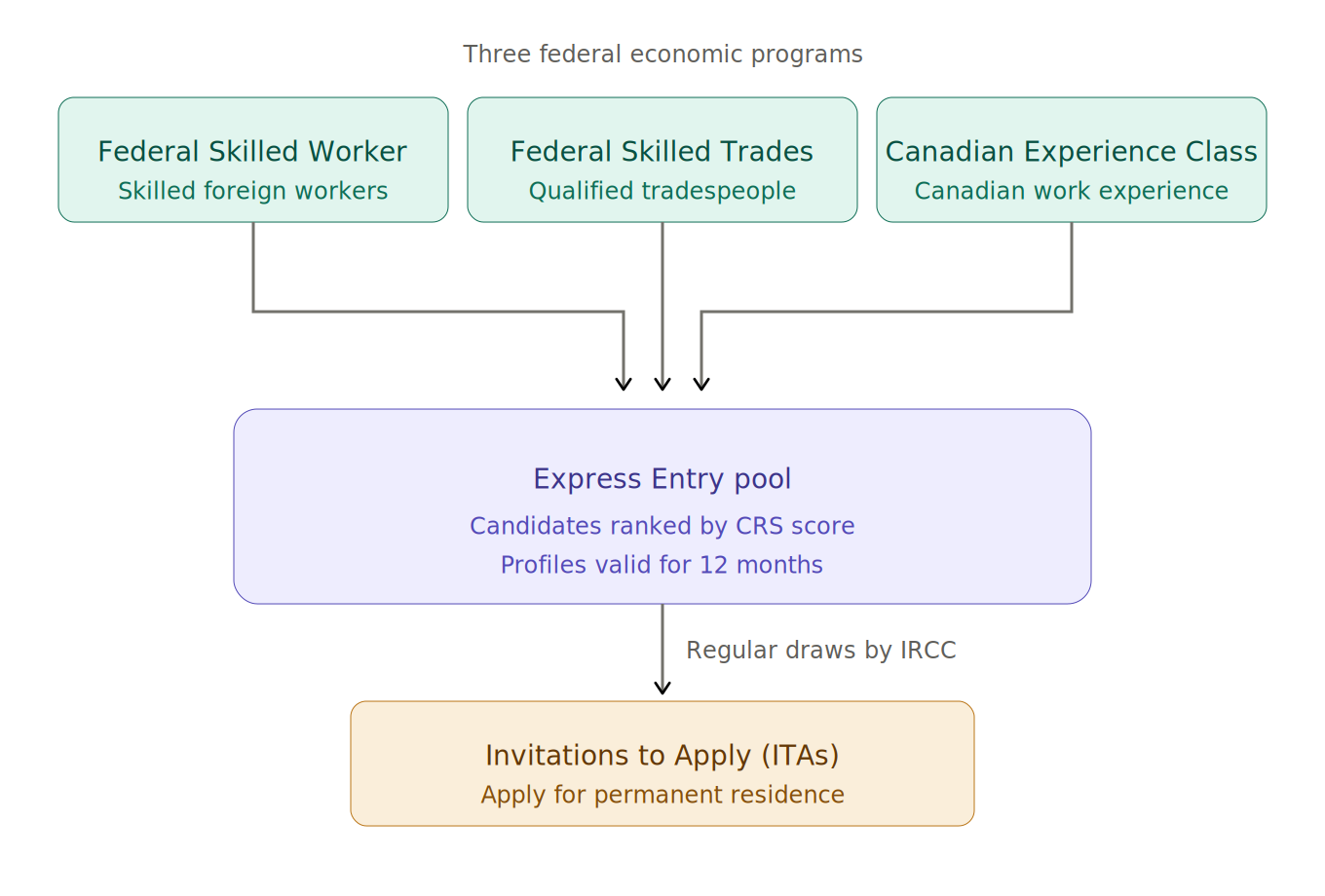
Express Entry is not a program. It is a portal for managing applications to three federal economic programs including, the Federal Skilled Worker (FSW), the Federal Skilled Trades (FST), and the Canadian Experience Class (CEC). Candidates are ranked using the Comprehensive Ranking System (CRS) and invited to apply through regular draws held throughout the year. IRCC publishes every round of invitations, including the cut-off score and number of invitations issued, on its official website.
Your CRS score is calculated based on your age, education, language test results (IELTS or CELPIP for English; TEF or TCF for French), and work experience. Provincial nominations add another 600 points. As of April 15, 2026, job offers do not provide additional points, however this may change in the future.
If your CRS score is below recent cut-offs, check whether a category-based draw targets your occupation before ruling out Express Entry.
Provincial Nominee Programs
A Provincial Nominee Program (PNP) allows a Canadian province or territory nominate you for PR based on that province's specific labor market and economic needs. The additional 600 points that are added to your CRS score from a PNP certificate is typically enough to receive an Express Entry invitation regardless of your base score.
Each province runs its own streams with different eligibility criteria. Ontario's Human Capital Priorities stream, British Columbia's Skills Immigration stream, and Alberta's Opportunity stream each target distinct profiles. Some PNP streams operate entirely outside Express Entry with their own processes. We are not going to go in depth here, however if you are interested, be sure to read our articles breaking down the PNPs.
The right province depends on your occupation, education, and whether you have connections (a job offer, a family member, or prior study) in that province. You should only apply for PNPs in provinces that you genuinely seek to reside in and not because it is the easiest path to obtain PR.
Family Sponsorship
Canadian citizens and permanent residents can sponsor members of the family class for permanent residence. Eligible relationships include spouses and common-law partners, dependent children, and parents or grandparents. In some rare cases, you may be able to sponsor a close family member who is a sibling. Be sure to read about the Lonely Canadian article blog post.
As per the IRCC's processing times tool the approximate processing time for outland spousal sponsorship applications currently take approximately 15 months. Inland you are looking at roughly 24 months of processing time (these figures are based on April 15, 2026 data).
If your spouse is a permanent resident rather than a citizen, eligibility rules differ slightly.
Parent and grandparent sponsorship operates through a limited annual intake. Spots fill quickly and the process takes several years from application to landing. The last intake was from 2020 and in 2026, given the current state of immigration, it is highly unlikely that this program will return as the focus has been economic immigration. Chances are, a variation of this program will return later with different rules and requirements. A really good alternative to this right now is Super Visa. Be sure to check out our Blog article on that.
How do I Choose the Right Pathway?
The best pathway for most may not be the best pathway for you. It all depends on several factors starting from what is your goal. If your profession is in high demand in Canada, your best option will be Express Entry. If you have a spouse who is a Canadian citizen or PR, the easiest and the path with least resistance would be Family Sponsorship.
Why Canada Over Any Other Country in 2026?
In 2026 Canada is not the only country looking for the cream of the crop talent. Australia, the United Kingdom, Germany, New Zealand, and several Gulf states all run active immigration programs. Each has advantages. But in 2026, Canada holds a combination of practical benefits that no other country can compete with.
Here is why I love Canada, and why you will fall in love with Canada too.
Canada or U.S.?
The U.S. immigration programs have been very stagnant since the beginning of time. These programs have generally stayed the same since I could first remember. There is no general skilled worker immigration stream outside of H-1B work visa, which is employer dependent. Recent changes with this stream has raised lots of concerns from large amount of employers where some are flat-out not participating anymore. The EB-2 and EB-3 green card backlogs for your priority date can be significant if you are from India and China.
Canada's Express Entry hits different. You meet the criteria, you build a score, and IRCC issues invitations based on your rank. It’s fair game for everyone from any country of origin. The timeline from ITA to PR varies, but IRCC aims to process these application within 6 months. And you do not need an employer to sponsor you.
If you want a reliability, a defined timeline, Canada does it best. Always.
Canada or Australia?
Australia is very similar, but not quite. Australia's SkillSelect system closely resembles Express Entry. Both use points-based ranking. But Australia tightened its occupation lists significantly after 2023. Many skilled trades and mid-tier professionals find it significantly harder to qualify.
Australia also has other requirements that you must meet before you can even enter the pool. This can take up to a year if not more depending on your occupation and who does the assessment.
Canada does not require a pre-entry skills assessment for most Express Entry programs. Your Educational Credential Assessment (ECA) gives you additional CRS points, and is not requirement for all programs under EE.
Canada is just simply better, and offers a faster entry point with fewer pre-qualifying steps.
Canada or U.K.?
The UK's Skilled Worker visa requires you to have a job offer from a licensed sponsor before you apply. There is no pool, no score, and no pathway to permanent residence without an employer attached at every step.
Canada does not require a job offer to enter the Express Entry pool or receive permanent residence.
Canada is also multicultural and it has been our strong selling point. No matter your color or creed, here you will feel right home.
Canada or Germany?
German programs are competitive however there is a language proficiency required at B1 level for most pathways to permanent residence, and the integration exam required for citizenship includes a German language component.
Canada requires English or French. If you already hold an IELTS, CELPIP, TEF, or TCF score, you qualify for the language component of Express Entry without any additional study. For the roughly 1.5 billion people globally who speak English at a working level, that is huge.
Canada or New Zealand?
New Zealand also has a pathway for skilled immigrants. But New Zealand's total population is 5 million. Its economy is concentrated in Auckland. Job markets outside major centers are few and far in between for applicants in many professional fields.
Canada's population is 40 million across 10 provinces and 3 territories. Labour shortages exist across the country, not just in one concentrated area. You have many options here. Each province also has its own unique weather.
Canada or GCC?
UAE, Qatar, and Saudi Arabia attract skilled workers with competitive salaries and virtually no tax rates. But permanent residence is exceptionally difficult to get. Most long-term residents hold renewable work visas which are tied to a specific employer. Citizenship is effectively unavailable for most nationalities.
In Canada, once you receive your COPR, you land in Canada, you are a permanent resident. You can change employers, start a business, or leave the workforce without losing your status. After 3 years as a PR, once you meet the required days you can apply for Canadian citizenship.
That path from skilled worker to citizen is simple, clear, and can be achieved in under 5 years. This is why Canada is the best.
Every country offers something real - higher wages, lower costs, warm weather, or a different quality of life. Canada is simply the best if you are looking for a balanced combination of everything. We have competitive wages, lower cost of living than U.S., you experience all four seasons. Canada just hits different.
If what you need is a clear, documented path from start to finish, with universal healthcare starting almost from the day you land, in an English-speaking country with a federal commitment to protecting immigrants' rights, no other country does it better than Canada in 2026.
And did I mention? I love Canada. It gave my family and I many opportunities and I will be forever grateful.
Conclusion
Canada's immigration system in 2026 is more selective than it was 2 years ago, but it is not closed. The pathways are real, the draws are ongoing, and the right strategy still gets people to PR.
What changes the outcome is preparation. Having a licensed professional like us in your corner will help you submit a complete, accurate application the first time.
We work with applicants at every stage, from initial profile review to submitting the final application package. Working with us could be life-changing for you. We get it, and we are here for you.
Frequently asked questions
Can I immigrate to Canada in 2026 without a job offer?
Yes, most Express Entry programs do not require a job offer to qualify. Thousands of candidates receive invitations each year without one. Your language scores, education level, and skilled work experience carry the most weight in your CRS total.
What is the minimum CRS score to immigrate to Canada in 2026?
There are no minimums. IRCC sets a cut-off score with each individual draw, and it changes every round. Category-based draws are key in 2026. Be sure to check IRCC's rounds of invitations page for the most recent cut-offs.
How long does it take to get permanent residence in Canada in 2026?
IRCC targets 6 months for most Express Entry applications following an ITA. Outland spousal sponsorship currently takes approximately 15 months. Provincial nominee applications add time at both the provincial stage and the subsequent federal stage. Your actual timeline depends on application completeness, document delays, and whether IRCC requests additional information.
Do I need to speak French to immigrate to Canada in 2026?
No, English proficiency alone qualifies you for most federal programs. But French proficiency gives you a real advantage. IRCC has run dedicated French-language and bilingual Express Entry draws with historically lower CRS scores than regular draws. Strong French also opens specific PNP streams designed to direct Francophone immigrants to communities outside Quebec.
Is it harder to immigrate to Canada in 2026 than in previous years?
Maybe, it’s all specific to your situation. Lower annual targets mean fewer invitations per draw. However, category-based draws specifically target occupations in demand, and applicants in healthcare, skilled trades, and STEM may find a draw designed for their profile. Difficulty varies significantly by occupation and whether you are applying from inside or outside Canada.