Bill C-3 and Canadian Citizenship by Descent: What Changed

The Bill C-3 transition may have made you Canadian even if the previous citizenship-by-descent rules excluded you. Since December 15, 2025, some people born abroad before that date have gained or regained citizenship automatically. This can include people whose parent became Canadian through the same changes, making the family’s citizenship history worth revisiting. A citizenship certificate application lets IRCC assess that history and provide proof if you qualify. Separately, Bill C-3 changed the conditions for passing citizenship to children born abroad on or after December 15, 2025. Compare those two situations with the current Canadian citizenship by descent rules before choosing an application.
A family tree can help you find records, but it cannot replace the evidence IRCC requires. The current proof guide says an application cannot rely solely on third-party records. Missing required documents or poor-quality copies may result in a return. If you cannot obtain an original-authority record, explain why and provide evidence of your attempts. Keep those gaps visible while checking whether the law made you Canadian.
By Narek Mirzoyan, RCIC # R1005184,. Verify this credential on the CICC public register.
Last reviewed by Narek Mirzoyan, RCIC # R1005184, on 2026-09-16.
TL;DR:
Bill C-3 expanded citizenship from December 15, 2025, including certain people excluded under the former first-generation limit. For certain overseas births from that date onward, the Canadian parent’s qualifying presence must total 1,095 pre-birth days in Canada. Automatic citizenship does not automatically produce a certificate, so you must apply to obtain official proof. People adopted abroad may need a separate citizenship grant application rather than a certificate application alone.
Table of Contents
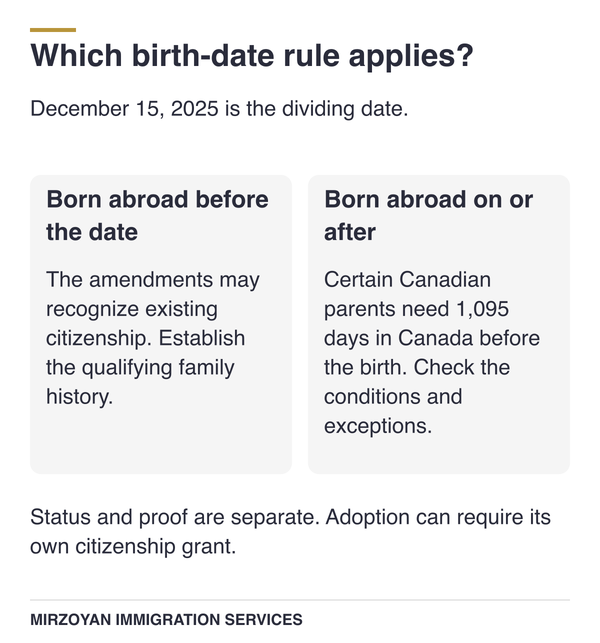
Date-based orientation, not an eligibility finding. Earlier births can fall within automatic recognition; certain later births require the qualifying parent’s pre-birth presence. A certificate application documents status. Adoption is a separate grant analysis.
Bill C-3 timeline from introduction to commencement
Bill C-3 was introduced, received Royal Assent, and came into force on three different dates in 2025. Those stages matter because an announcement did not immediately change anyone’s status. A June article may describe a proposal, while a November article may discuss the enacted legislation. The new citizenship rules took effect on December 15, 2025. Use Parliament’s legislative record alongside IRCC’s commencement announcement when comparing older advice with today’s position.
Introduced June 5, 2025
The government introduced Bill C-3 on June 5, 2025, proposing changes to citizenship by descent. At that point, the proposed provisions were not the rules already governing every application. Families following the debate therefore encountered conditional language about what the bill would do. Some also encountered separate interim measures addressing people affected by the existing first-generation limit. The introduction announcement explains that context, but the enacted law now controls the analysis.
If your application under the interim measure is still in progress, IRCC says it will process it using the new rules. You do not need to submit a new citizenship-certificate application for that situation. Keep the existing application number and follow any further instructions IRCC sends about that file. This instruction concerns an application still being processed under the interim measure. It should not be extended to an old refusal or closed file without checking the decision and applicable next steps.
Royal Assent November 20, 2025
Royal Assent made Bill C-3 law on November 20, 2025. However, Royal Assent and the commencement of its citizenship changes were separate events. Treating November 20 as the operative birth-date cutoff would place some applicants in the wrong group. The official parliamentary record records both the bill’s progress and its enacted status. A birth between those dates falls before the December 15 cutoff, even though Royal Assent had already occurred.
In force December 15, 2025
The citizenship changes took effect on December 15, 2025, according to IRCC’s commencement announcement. Births before that date and births on or after it follow different rules. A person born on December 15 belongs to the on-or-after group, not the before-date group. Adoption cases also require attention to the adoption date and the applicable grant provisions. Before comparing family histories, write down the exact dates rather than describing everyone simply as a second-generation Canadian.
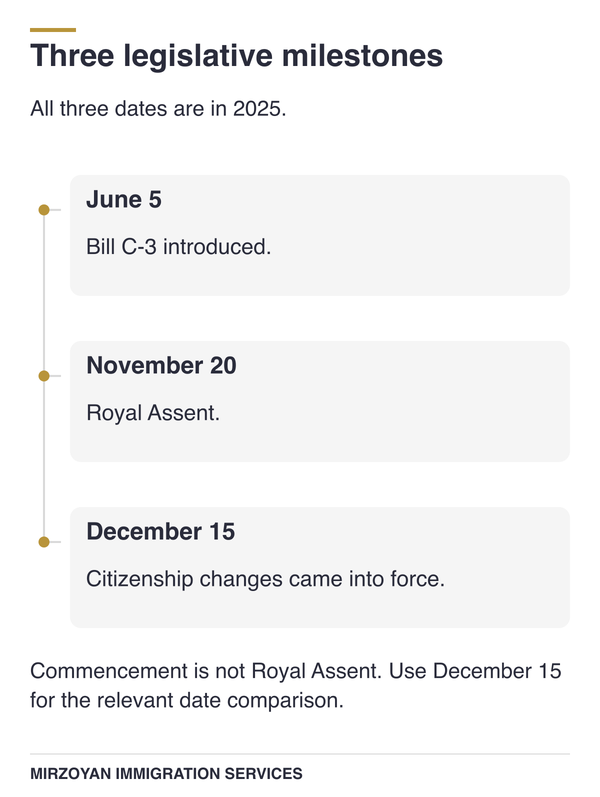
The introduction, Royal Assent and commencement are separate milestones. Proposal-era material should not be read as the final rules. This timeline is chronological, not a scale of elapsed time.
The two questions Bill C-3 changed
Bill C-3 changed both existing citizenship entitlements and the conditions for passing citizenship to some children abroad. Those questions can affect different people within the same family. A parent may have become Canadian through the amendments without their child’s position being identical. Their respective birth dates and the provisions applying to each person still matter. Start by separating your own status from a child’s eligibility under the amended Citizenship Act.
Who is recognized as a citizen under the amended Act?
The amendments automatically recognized citizenship for certain people born overseas before December 15, 2025 who were excluded under the former limit. The changes also address specified historical citizenship losses and exclusions. IRCC includes situations where a parent became Canadian through the same amendments. That means a missing parental certificate does not settle the family’s legal position by itself. Establish how each relevant person acquired citizenship before deciding whether the change reaches you.
When can a citizen born abroad transmit citizenship to a child born abroad?
For certain overseas births from December 15, 2025 onward, the qualifying Canadian parent’s presence becomes decisive. The relevant parent must have accumulated at least 1,095 days before the child’s birth. This condition concerns specified parents who were themselves born or adopted abroad. It is not a universal residence requirement for every Canadian parent having a child overseas. Check the statutory transmission conditions and exceptions before assuming either that the rule applies or that it does not.
Why proof of status remains a separate application task
Becoming Canadian automatically does not cause IRCC to send a certificate without an application. The legal entitlement and the document proving it serve different purposes. You provide evidence so IRCC can determine whether your circumstances meet the applicable citizenship provisions. If you qualify, the certificate records that status rather than creating it through ordinary naturalization. Our guide to proving Canadian citizenship explains that distinction before you choose a filing route.
How your birth or adoption date affects your citizenship
A birth or adoption before December 15, 2025, may have a different citizenship outcome from one on or after that date. However, the date alone cannot establish citizenship without the relevant family and status facts. A child born abroad and a person adopted abroad may also need different application routes. The comparison below separates those situations without treating every descendant as automatically Canadian. Use it as an orientation to the current rules, then examine the circumstances that apply to your family.
| Circumstances | Potential effect | Application direction |
|---|---|---|
| Born abroad before December 15, 2025; previously excluded by the former limit | Citizenship may arise automatically under the amended provisions. Several generations do not, by themselves, trigger the later-birth 1,095-day test. | Apply for a certificate if claiming existing citizenship; establish the qualifying family history. |
| Born abroad on or after December 15, 2025 | Certain Canadian parents born or adopted abroad must meet the 1,095-day requirement before the birth, subject to statutory exceptions. | Assess citizenship at birth and the qualifying parent's history before applying for proof. |
| Adopted abroad before December 15, 2025 | Removal of the former limit may open a grant route; adoption alone does not establish automatic citizenship. | Assess the adopted-person grant requirements if citizenship has not already been granted. |
| Adopted abroad on or after December 15, 2025 | Certain adopting Canadian parents must meet the substantial-connection condition before the adoption, alongside other grant requirements. | Use the appropriate adopted-person grant process, not a first certificate application alone. |
People born before December 15, 2025 affected by the former limit
If you were born abroad before December 15, 2025, the former first-generation limit may no longer prevent citizenship. That can matter even where a parent also needed the amendments to establish their Canadian status. The later-birth substantial-connection test should not simply be imposed on this earlier-birth group. You still need to establish the relevant parent-child relationships and citizenship history. Compare the change with the first-generation limit and citizenship-by-birth rules before assuming an earlier refusal remains decisive.
Children born or adopted on or after December 15, 2025
For later births abroad, check the Canadian parent’s citizenship basis before examining their physical presence. Where the substantial-connection requirement applies, the parent needs the required days before the birth. For an adoption abroad, the corresponding assessment concerns presence before the adoption and the separate grant requirements. An adoption does not automatically become a citizenship-by-birth case because the same numerical threshold appears. The adopted-person provisions require their own assessment, including the legal adoption and qualifying parent-child relationship.
Exceptions that may affect your family’s citizenship
Crown service abroad or a past loss of citizenship can change how the rules apply to your family. Qualifying Canadian Crown service abroad can affect how the transmission restrictions apply. Citizenship renunciation, revocation, or an earlier loss may also require examination of specific provisions. A general statement that an ancestor worked overseas is not enough to establish a Crown-service exception. Where one of these circumstances appears, identify the citizenship rule applying to your family before relying on the standard comparison.
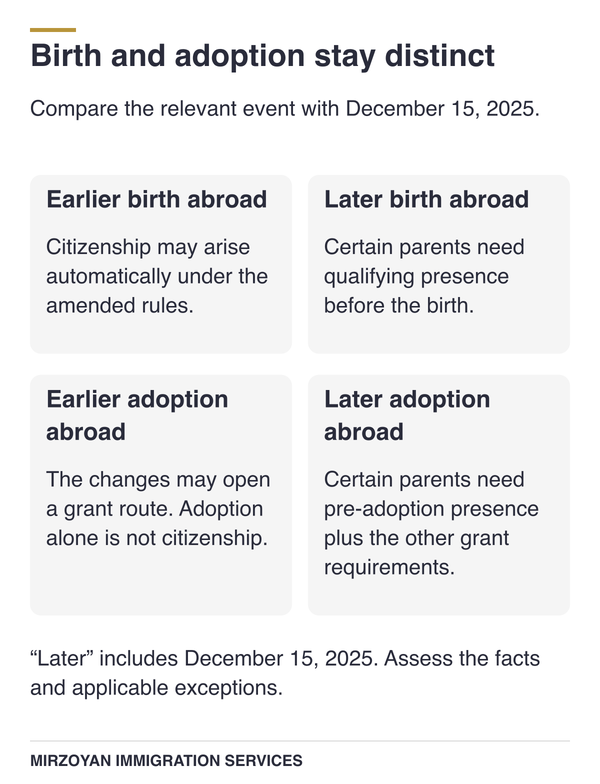
Four situations corresponding to the article’s accessible comparison table. Automatic citizenship from birth-related provisions is distinct from an adopted-person grant. The date alone does not establish eligibility.
Getting proof if Bill C-3 made you Canadian
You may have a legal claim to citizenship before you possess a Canadian citizenship certificate. If your family was told citizenship could not pass to another generation, discovering these changes can be confusing. An old family document can help establish the claim, but it does not replace your own proof. You can ask IRCC to assess a supported claim even when you are unsure whether you already qualify. Use the certificate assessment process to have the relevant evidence examined and, if you qualify, obtain official proof.
How Bill C-3 can make you Canadian automatically
Bill C-3 can make you Canadian through the law itself, without a citizenship-grant application or an oath ceremony. For affected births abroad before December 15, 2025, IRCC includes some people whose parent also became Canadian through the changes. Your parent’s lack of an earlier certificate therefore does not automatically exclude you. The current rules require examining the parent’s legal status, not merely when the family discovered it. A certificate application supplies the evidence IRCC needs to confirm that status.
Separate the date a law takes effect from the earlier citizenship date it may recognize. December 15, 2025 is the commencement date of these amendments, but it is not necessarily everyone’s effective citizenship date. That earlier recognition can affect whether a parent is treated as Canadian when their child was born. The restoration discussion below explains the difference from a parent who first became Canadian through ordinary naturalization after the birth.
What a citizenship certificate proves
A citizenship certificate gives you official evidence of Canadian citizenship for situations where that status must be established. Your family records support the application, while the resulting certificate concerns your own status. The certificate is not itself a travel document, and obtaining one does not complete a separate passport application. For a Bill C-3 claim, gather the records linking your own citizenship to the qualifying parent. For the document’s role and application options, consult IRCC’s proof-of-citizenship guidance.
Applying for proof is different from applying to become Canadian
Not having a certificate does not necessarily mean you need to become Canadian through a grant application. If the law already recognizes your citizenship, proof is the issue requiring attention. An ordinary grant application addresses a different question and cannot substitute for tracing an existing citizenship claim. Conversely, a person requiring an adopted-person grant cannot establish that grant simply by requesting a first certificate. Before paying for an application, separate the proof and grant routes using your actual circumstances.
If the distinction remains unclear, discuss your citizenship history through our proof-of-citizenship service.
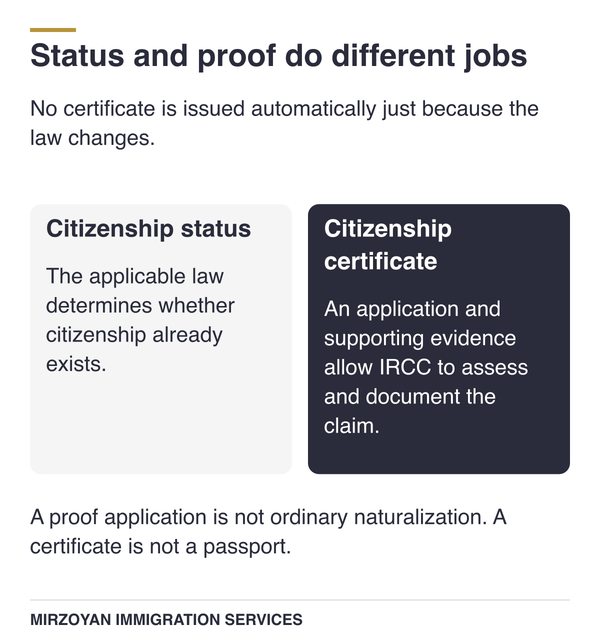
Conceptual distinction only, with no reproduced certificate or personal record. Legal citizenship and the official document proving it are different questions. A separate grant is necessary when citizenship has not already arisen.
The 1,095-day substantial-connection rule
The substantial-connection rule concerns a qualifying Canadian parent’s physical presence, not a child’s future plans to live in Canada. Where it applies, the parent needs at least 1,095 accumulated days before the relevant birth or adoption. The days do not have to form one continuous three-year stay. However, a connection through relatives, property, or frequent calls is not a substitute for physical presence. The statutory rule therefore requires a dated calculation supported by evidence, rather than a general description of family ties.
Whose physical presence matters
The relevant days belong to the Canadian parent through whom the child meets the applicable transmission conditions. A grandparent’s residence cannot simply replace that parent’s own physical presence. Nor should two parents combine incomplete totals and treat the sum as one qualifying parent’s 1,095 days. First establish which parental citizenship history engages the rule and whether an exception applies. Only then assemble that parent’s evidence against the conditions for passing citizenship to a child.
When the connection must exist
The required connection must exist before the child’s birth, or before the adoption under the applicable adopted-person provisions. Days accumulated afterwards do not move backwards into the earlier period. This timing matters when a family plans to return to Canada after a child is born abroad. It also distinguishes the rule from an applicant completing residence requirements before an ordinary citizenship grant. Compare the birth requirement with the separate adoption timing rule rather than treating the two events as interchangeable.
Evidence and calculation are fact-specific
A useful physical-presence record connects the parent’s claimed dates with documents that support actual time in Canada. Employment, education, travel, and other records may help when considered together. But a lease covering a year does not necessarily show uninterrupted presence throughout that year. IRCC’s current proof guide directs applicable applicants to its Canadian-parent calculation form, CIT 0555, and supporting evidence instructions. Do not import an ordinary adult-grant calculator’s assumptions into this different statutory test.
Unsure how the connection rule affects your claim?
Mirzoyan Immigration Services can review the relevant family dates and supporting records.
Consider first-time proof-of-citizenship assistance before preparing an application with an unresolved citizenship basis.
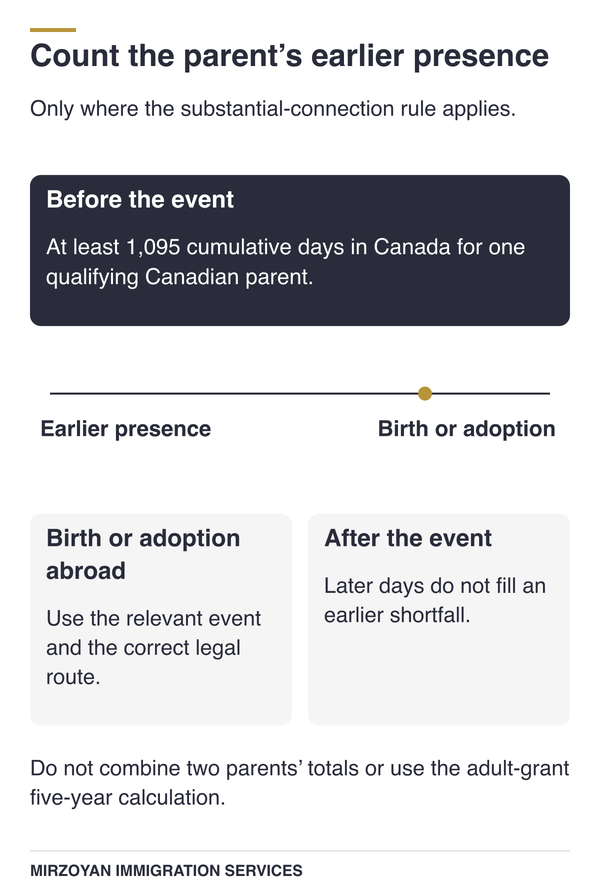
Parent-focused schematic, not a calculator or an individual total. Where required, the qualifying parent’s cumulative presence in Canada must precede the birth or adoption. Adoption has separate grant requirements, and statutory exceptions still need examination.
Restoration is different from a parent’s later citizenship grant
The date a parent received a document is not always the date their citizenship legally began. A certificate may confirm earlier status, while an ordinary naturalization grant usually creates status from its effective date. Bill C-3 also contains provisions recognizing or restoring citizenship with specific historical effects. These differences can determine whether the parent’s status supports a child’s claim. Compare the actual legal basis and effective dates, so you can explain whether the parent acquired citizenship later or already held it.
Statutory restoration or recognition may operate retrospectively
Retrospective recognition means the law treats citizenship as existing from an earlier date. For certain restored citizens, the Act recognizes citizenship from the time of the earlier loss. That can change the assessment of a child born during the apparent gap in the parent’s status. An old loss letter and a newly issued certificate therefore need to be read together with the restoration rule. The certificate’s recent issue date does not, by itself, mean the parent became Canadian only recently.
Compare that with ordinary naturalization after a child’s birth. In that situation, the later grant generally does not make the parent Canadian on the earlier birth date. Retrospective recognition can produce a different answer because the law expressly supplies an earlier status date. That effect is limited: it does not automatically create backdated entitlements under every other law. A family-specific review must establish which recognition rule applies before using it to support a descendant’s claim.
Ordinary naturalization after a child’s birth usually does not
A parent’s ordinary naturalization after a child’s birth does not, by itself, make that child Canadian at birth. Before choosing a route, I check whether the parent’s citizenship legally existed on the child’s birth date. A parent’s present-day passport therefore cannot answer the timing question without the underlying citizenship history. IRCC’s certificate guide asks about parental citizenship in relation to the applicant’s birth. Obtain the relevant dates before deciding whether the child’s case concerns descent, a separate grant, or another route.
Former section 8 histories require careful chronology
The former retention rule affected some second-generation and later-generation Canadians born abroad who had to retain citizenship before turning 28. The unresolved losses involved qualifying people with birth dates between February 15, 1977 and April 16, 1981, inclusive. Those people had already turned 28 before the April 17, 2009 repeal of the retention requirement. IRCC’s chronology explains why the repeal alone did not restore those earlier losses. A birthday within that range is a reason to examine the history, not proof that everyone born then lost citizenship.
Bill C-3 reinstated citizenship for those affected by the former age-28 loss rule. An earlier refusal or loss record may therefore no longer describe the person’s current status. Keep it in the evidence file because it helps explain what happened and when. The person’s birth record, retention correspondence and later citizenship evidence should be read as one sequence. For a descendant, the remaining question is how the current recognition provisions affect citizenship at the descendant’s birth.
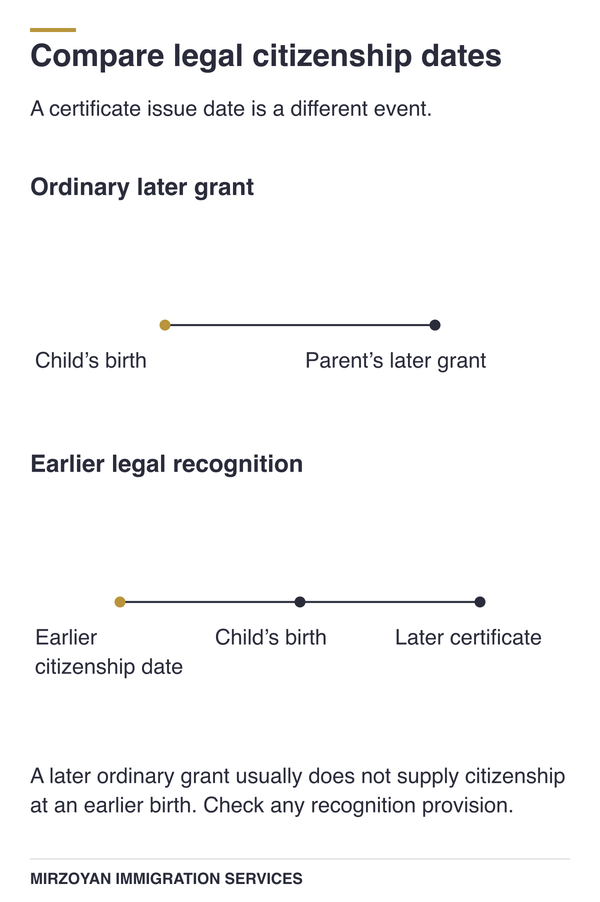
Conceptual chronologies, not real client histories or a finding of entitlement. A later certificate may document earlier legally recognized status; ordinary later naturalization usually does not operate that way. The applicable provision determines the effect.
What Bill C-3 did not change
Bill C-3 expanded citizenship entitlements without removing the need to establish an individual claim. Canadian ancestry remains different from a complete, legally supported citizenship history. The relevant relationships, dates, and citizenship provisions must still connect to the person applying. The changes also do not merge citizenship certificates with ordinary grants or adopted-person grants. Check the current citizenship conditions alongside the expansion, rather than relying on a headline that says every descendant now qualifies.
It did not make every descendant of a Canadian automatically eligible
A Canadian ancestor is a reason to investigate your history, not a complete eligibility finding. Each relevant generation must connect through the citizenship provisions that apply to that family. Dates, parentage, adoption, and particular exclusions may affect the result even where ancestry itself is clear. A genealogy chart alone cannot determine those legal questions. For deeper family histories, use the grandparent and multi-generation descent guide alongside this explanation of the legislative change.
It did not eliminate proof and parentage requirements
IRCC still requires evidence supporting the relationships and citizenship claims on which an application depends. Its current proof guide calls for authentic, reliable, verifiable records for every relevant generation. An application cannot rely solely on third-party records copied from a genealogy platform. Where original-authority documents cannot be obtained, the guide asks for an explanation and evidence of attempts to obtain them. For each generation, I check the claimed parent-child relationship against records from the authority that originally issued them.
It did not convert proof applications into citizenship grants
A certificate application asks IRCC to establish and document citizenship that the applicant claims already exists. A grant application asks for citizenship under a qualifying grant provision. Bill C-3 changed eligibility rules without making those requests interchangeable. IRCC specifically distinguishes adopted-person grants from the certificate route available to people already Canadian. Identify what legal outcome remains necessary before deciding which forms and supporting documents to prepare.
The Internal Logic of an IRCC Officer
Your application needs to connect the citizenship rule you rely on with records proving the required facts. The officer needs more than a conclusion that Bill C-3 applies to your family. Dates establish the relevant period, citizenship records address status, and parentage records connect the generations. Physical-presence evidence answers an additional question where the substantial-connection rule applies. This is a practical reading of the Act’s requirements, not a claim that every officer follows an identical internal sequence.
Which version of the Act applies to the event?
The relevant legal analysis starts with the person’s circumstances and the historical provisions affecting them. A birth before December 15, 2025, should not automatically be assessed as a later birth requiring substantial connection. Equally, present-day citizenship documents may need explanation when the claim depends on earlier deemed status. The amended Act contains both current conditions and provisions addressing historical situations. Make that chronology visible so the evidence supports the rule you are asking IRCC to apply.
Did status arise automatically or require another route?
The application should explain why the person already holds citizenship if proof is the requested outcome. That explanation might rely on citizenship at birth or a later statutory recognition provision. For an adoption, the evidence may instead show that a separate grant remains necessary. The adopted-person provisions cannot be replaced by a general assertion that Bill C-3 removed generational barriers. Resolve the route first so the supporting documents address the decision IRCC actually needs to make.
If future transmission is claimed, is the connection proven?
Where substantial connection is required, the calculation and supporting records must address the qualifying parent’s pre-event presence. A parent’s claim of several years in Canada needs records showing when they lived there. Absences, inconsistent addresses, or overlapping records may require an explanation rather than an optimistic total. Organizing those records by period makes any remaining uncertainty easier to identify before filing. Follow IRCC’s Canadian-parent physical-presence instructions without assuming that the officer can reconstruct an unsupported calculation.
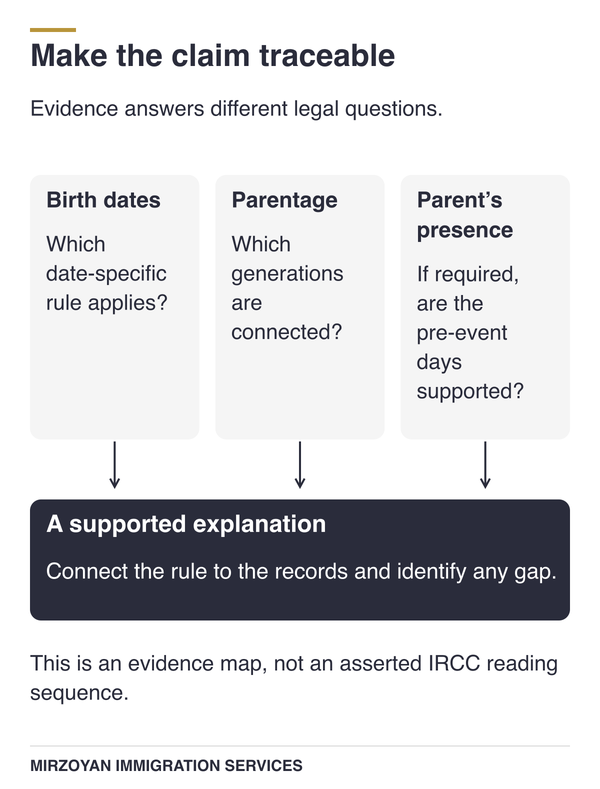
The three evidence inputs address dates, family relationships and conditional parental presence. A clear explanation connects them to the citizenship claim; it does not replace the underlying records or predict an officer’s workflow.
Red Flags & Procedural Fairness Letters (PFL)
A request for clearer evidence does not, by itself, mean IRCC has sent a procedural fairness letter. A routine request may seek a missing record or clarification needed to assess eligibility. A PFL identifies concerns requiring a meaningful response before a potentially adverse decision. Read the actual notice to understand what IRCC is asking and when the response is due. Our citizenship PFL and information-request guide explains response handling without assuming every file follows the same path.
Proposal-era assumptions after commencement
An explanation based on an early proposal may describe rules that do not match the enacted legislation. That creates avoidable confusion when the documents otherwise support a valid claim. For example, mixing the Royal Assent date with commencement can place a birth in the wrong category. Compare any old advice with Parliament’s enacted record and explain the actual date-based position. An outdated statement is something to correct, not proof that a PFL will necessarily follow.
Missing birth, parentage, or presence evidence
Missing evidence should be addressed in relation to the specific fact it was supposed to establish. A gap in parentage records presents a different problem from an incomplete physical-presence calculation. IRCC’s proof guide warns that missing documents or poor copies can result in a returned application. It also explains that additional information may be requested during processing. If a request arrives, match the response to its contents rather than assuming the same remedy fits every document issue.
Confusing later parental naturalization with statutory recognition
A response becomes difficult to assess when it treats later naturalization and earlier legally recognized citizenship as the same event. If IRCC questions the parent’s status at your birth, another current identity document may not resolve the concern. The response needs to explain the citizenship basis and the effective date supported by the records. Where retrospective recognition is claimed, connect that explanation to the citizenship rule applying to your family. Do not rely on the phrase ‘my parent is Canadian’ to answer a question about when that citizenship existed.
Strategic Trade-off Matrix
If your citizenship basis is clear and the necessary records are available, you can focus on preparing the proof application. Filing a complete claim can be appropriate without waiting for unnecessary family documents. But submitting before resolving a central contradiction can leave the same issue for IRCC to question later. Professional assistance can help assess that uncertainty, but it does not guarantee approval or faster processing. Compare the preparation choices below while keeping the actual proof requirements separate from the service you choose.
| Preparation choice | When it may fit | Main trade-off | Review rights |
|---|---|---|---|
| Prepare and file a supported claim | The citizenship basis and necessary relationships are clear, with supporting documents available. | Avoid unnecessary preparation delays, but check the current requirements before submission. | The same statutory judicial-review requirements apply; this preparation choice creates no additional appeal right. |
| Resolve an essential gap first | A missing relationship record, date conflict, or citizenship event affects the legal claim. | Additional preparation takes time but can address a problem that otherwise remains unresolved. | The same statutory judicial-review requirements apply; this preparation choice creates no additional appeal right. |
| Obtain an RCIC assessment | The history includes several generations, restoration, adoption, or an uncertain transmission rule. | Professional advice has a separate cost and defined scope; it cannot guarantee approval or priority. | The same statutory judicial-review requirements apply; this preparation choice creates no additional appeal right. |
These preparation choices do not create different citizenship programs or different rights to challenge a decision. Judicial review under the Citizenship Act requires the Court’s permission. Getting advice before filing does not remove that requirement or guarantee the result of a later challenge. Professional fees are a separate preparation cost and depend on the agreed scope of work. Choose the assistance you need without assuming it changes IRCC’s processing priority or the legal review process.
Apply for proof now or complete the chronology first
If your citizenship history is already supported, you do not need to delay filing just because it spans several generations. The important question is whether the relevant dates, relationships, and citizenship basis are documented clearly enough to assess. If one essential link is missing, focus the remaining work on that link rather than collecting records indiscriminately. The certificate guide explains what to provide when original-authority records cannot be obtained. Keep the explanation and your attempts to obtain the missing record together with the supporting evidence.
Use Article 11 for grandparent depth and Article 12 for filing mechanics
This page explains Bill C-3’s changes rather than reproducing every family scenario and application instruction. If your claim depends on several generations, the grandparent descent guide develops that family-chain analysis. Once the route is clear, the citizenship-by-descent application guide covers filing mechanics. That separation keeps legal eligibility questions from becoming buried inside form and photo instructions. Use the guide matching your unresolved question before moving to the next stage of preparation.
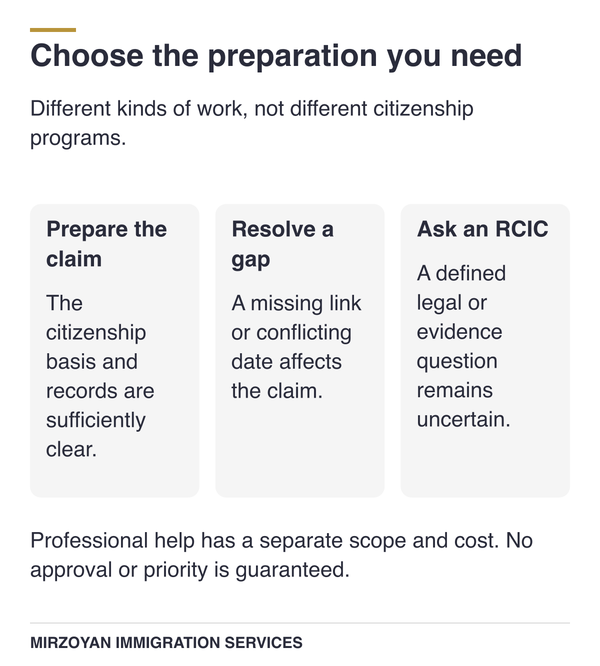
Preparation choices correspond to the article’s comparison. Target essential uncertainty rather than collecting unrelated records. The choices do not create new programs, processing priority or additional review rights.
When a review can clarify your Bill C-3 claim
You can prepare your own application if you understand the applicable route and can support the necessary facts.
An RCIC assessment may be useful where citizenship dates, historical losses, or several generations create uncertainty.
Through One on One Advisory, Narek Mirzoyan (RCIC # R1005184) or Vahe Mirzoyan (RCIC # R514223) answers your questions directly.
Client communications do not pass through intake staff, assistants or call routing.
The professional scope and fees should be confirmed before deciding whether advice alone or representation meets your needs.
Our proof-of-citizenship service addresses that choice without promising a particular decision or processing priority.
Mirzoyan Immigration Services can compare the family chronology with the citizenship basis and supporting records.
This helps identify which date or relationship needs clarification before you prepare a first proof application.
Key Takeaways
December 15, 2025, is the effective date for Bill C-3’s citizenship changes, not its Royal Assent date.
Some people born abroad before that date became Canadian automatically, but their family history still needs support.
The 1,095-day rule applies to specified later births or adoptions abroad, not every descent claim.
Citizenship status, a certificate proving it, and an adopted-person grant are different legal and application questions.
Mirzoyan Immigration Services’ proof-of-citizenship service can help assess uncertain citizenship histories before you select a filing route.
Frequently Asked Questions
Has Bill C-3 been passed?
Yes, the Royal Assent date for Bill C-3 is November 20, 2025. Its citizenship changes took effect on December 15, 2025. Those dates mark different stages of the legislation. December 15 is the dividing date used in the earlier-birth and later-birth rules discussed here. Advice written while the bill was proposed should be checked against the enacted provisions.
Why did Canada pass Bill C-3?
Bill C-3 addressed restrictions on citizenship by descent and remaining historical citizenship losses. IRCC’s introduction announcement links the legislation to the court ruling concerning the first-generation limit. The changes recognize additional people and establish conditions for certain later births abroad. They also address specified Lost Canadian histories. That purpose does not remove the need to establish each applicant’s eligibility.
What are the requirements to qualify for Canadian citizenship through Bill C-3?
Your birth or adoption date, parentage, and relevant citizenship history determine which requirements apply. The law automatically made some people Canadian whose overseas births occurred before December 15, 2025. Some later overseas births require a qualifying parent’s 1,095 days of Canadian presence before the child is born. Adoption cases have separate grant requirements. Compare your circumstances with the current rules before selecting an application.
How to get Canadian citizenship through Bill C-3?
First determine whether Bill C-3 already made you Canadian or whether another citizenship route is required. If citizenship arose automatically, apply for a certificate to obtain proof. Support the application with the relevant family and citizenship records. People needing an adopted-person grant must use that separate route. The application guide explains filing once your citizenship basis is established.
Do I really need my citizenship certificate?
If Bill C-3 made you Canadian, a certificate provides official evidence of that status. Automatic citizenship does not mean a certificate arrives automatically. You must apply and provide evidence so IRCC can assess the claim. The certificate documents citizenship but is not a travel document. See IRCC’s proof guidance before relying solely on an ancestor’s records as your own proof.
Conclusion
Start by comparing your family’s citizenship records with the Bill C-3 rules applying to each birth or adoption date. Identify any missing relationship or citizenship record before deciding which application to prepare. Separate existing status from the proof application, and examine any conditions affecting a child’s later birth or adoption abroad. If the chronology remains uncertain, Mirzoyan Immigration Services can assess the citizenship basis and discuss the appropriate scope of assistance. Bring the records supporting your first-time proof-of-citizenship application to that discussion.
Disclaimer
This article provides general information, not advice on an individual citizenship claim. Eligibility depends on your facts and the applicable legislation, and IRCC decides applications. Requirements can change; obtain advice suited to your circumstances before acting.