Applying for Canadian Citizenship
Canadian citizenship requirements for most adults include permanent resident status and 1,095 credited days within the five-year eligibility period. During that same five-year period, you must have filed income tax returns for three years if Canadian tax law required them. Applicants aged 18 through 54 normally also provide language evidence and take the citizenship test. But prohibitions and unresolved immigration status issues can prevent approval even when the day count is sufficient. Use your intended signing date to check the age rules and calculate the five-year physical presence period.
Preparing the application can feel confusing when the same dates appear in your travel records, tax history, and forms. Start with the current IRCC eligibility page, then compare those requirements with your records. An unexplained absence can affect the physical presence calculation even when every required document is included. Resolve that discrepancy before signing rather than leaving IRCC to work out which date is correct. The sections below explain which application fits your situation, what to prepare, and what happens after submission.
By Narek Mirzoyan, RCIC # R1005184,. Verify this credential on the CICC public register.
Last reviewed by Narek Mirzoyan, RCIC # R1005184, on 2026-09-16.
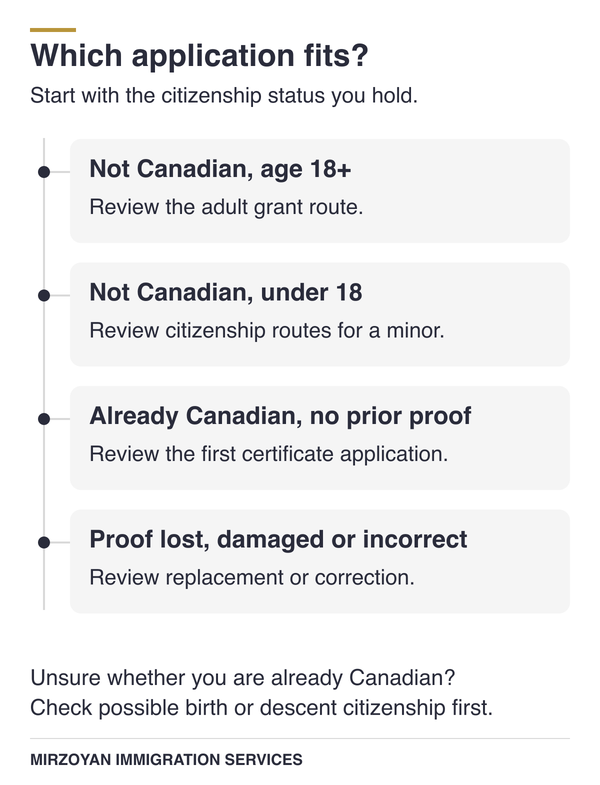
Identify existing citizenship before selecting an adult grant, a grant for a minor, first proof, or replacement. A Canadian relative alone does not establish the result.
First decide whether you need a grant, proof or replacement
A citizenship grant makes an eligible non-citizen Canadian. But proof of citizenship confirms a status that may already exist, while replacement provides another certificate to an existing citizen. These applications can produce similar-looking documents, but they answer different legal questions. And choosing the wrong one can waste a fee and delay the document you actually need. Start by identifying your present status, not the certificate you hope to receive.
If you hold permanent residence but not Canadian citizenship, this guide explains the regular grant route. IRCC's adult and minor application hub provides the corresponding eligibility and application instructions. Your first task is to establish whether you meet the requirements, including sufficient time in Canada. You then prepare the forms and evidence for the online or paper application that applies to you. Testing, a decision, and the oath come later when required, so they should not be confused with documents needed at submission.
If you were born abroad, a Canadian parent or grandparent may mean you need to establish existing citizenship instead. Start with the citizenship-by-descent guide to understand how your birth date and your parent's citizenship affect that question. Bill C-3 changed these rules on December 15, 2025, as the official rule-change page explains. The Bill C-3 guide addresses those changes, while the grandparent guide explains claims involving an earlier generation. For the distinction between citizenship by birth and the first-generation rules, use the birthright guide. If a descent claim may apply, the citizenship-by-descent application guide explains how to request a certificate and support the claim.
A lost, damaged, illegible, or incorrect certificate does not normally erase the citizenship behind it. IRCC treats a certificate as evidence of existing citizenship, not as the source of that status. An existing citizen may therefore need a replacement or correction rather than a grant. Mirzoyan Immigration Services assists with applications to replace a Canadian citizenship certificate. This distinction should be settled with reliable status evidence before any grant forms are prepared.
But citizenship for a minor also requires a separate route check because the parent's status and participation may change the applicable conditions. An independent application for a minor can involve different residence and tax requirements. And adopted people may qualify through a separate direct citizenship process. The facts of the adoption and the Canadian parent's status determine whether that process fits. Read Canadian citizenship for minors before relying on an adult checklist.
Canadian citizenship requirements by age and route
Age changes which citizenship requirements apply, but it does not create a single simplified application. Most adults aged 18 through 54 provide language evidence and take the citizenship test. Yet adults aged 55 or older still need to satisfy the applicable status, presence, tax, and prohibition requirements. Citizenship for a minor depends on the selected route and the child's relationship to the Canadian parent. The tables below are screening tools, so confirm the result against the current IRCC instructions.
| Age or route | PR status | Physical presence | Tax filing |
|---|---|---|---|
| Minor under the parent-linked provision | Required for this parent-linked citizenship application for a minor. | Not required for this parent-linked citizenship application for a minor. | Not a grant requirement under this minor provision. |
| Regular citizenship grant for a minor applying independently | Required. | 1,095 credited days in the five-year period. | Required for applicable years when Canadian tax law required filing. |
| Adult aged 18 to 54 | Required. | 1,095 credited days, including no more than 365 pre-PR credits. | Three years within the five-year period, if filing was required. |
| Adult aged 55 or older | Required. | 1,095 credited days, including no more than 365 pre-PR credits. | Three years within the five-year period, if filing was required. |
| Possible citizen seeking proof | Regular grant PR status does not determine an existing citizenship claim. | Regular grant presence does not apply. A separate parent-connection test may govern some transmissions. | Regular grant tax filing does not determine an existing citizenship claim. |
| Age or route | Language at filing | Test and oath later | Who applies |
|---|---|---|---|
| Parent-linked citizenship application for a minor under 14 | Not required. | No test and normally no oath. | A parent, guardian, or authorized person applies under current instructions. |
| Parent-linked citizenship application for a minor aged 14 to 17 | Not required. | No test. The oath normally follows approval unless waived. | A parent, guardian, or authorized person applies under current instructions. |
| Regular citizenship grant for a minor under 14 applying independently | Not required. | No test and normally no oath. | The current self-application and consent instructions control. |
| Regular citizenship grant for a minor aged 14 to 17 applying independently | Not required. | No test. The oath normally follows approval unless waived. | The current self-application and consent instructions control. |
| Adult aged 18 to 54 | Required evidence of adequate English or French, subject to an approved waiver. | IRCC administers the test after filing and the oath after approval when required. | The adult applies personally or appoints a representative under current channel rules. |
| Adult aged 55 or older | Not normally required. | No citizenship test. The oath follows approval when required. | The adult applies personally or appoints a representative under current channel rules. |
| Possible citizen seeking proof | Regular grant language proof does not apply. | The regular grant test and oath do not apply to a proof application. | The citizen, parent, or authorized applicant follows the current certificate instructions. |
Read the tables across the row that matches your circumstances rather than selecting individual exemptions from different rows. An adult aged 55 or older, for example, does not normally need language proof or the citizenship test. That adult still needs to meet the applicable permanent resident status, physical presence, tax, and prohibition requirements. A child may instead qualify under requirements that depend on the parent's citizenship or simultaneous application. Requests for an accommodation or waiver need separate consideration and should not be assumed to follow automatically from age.
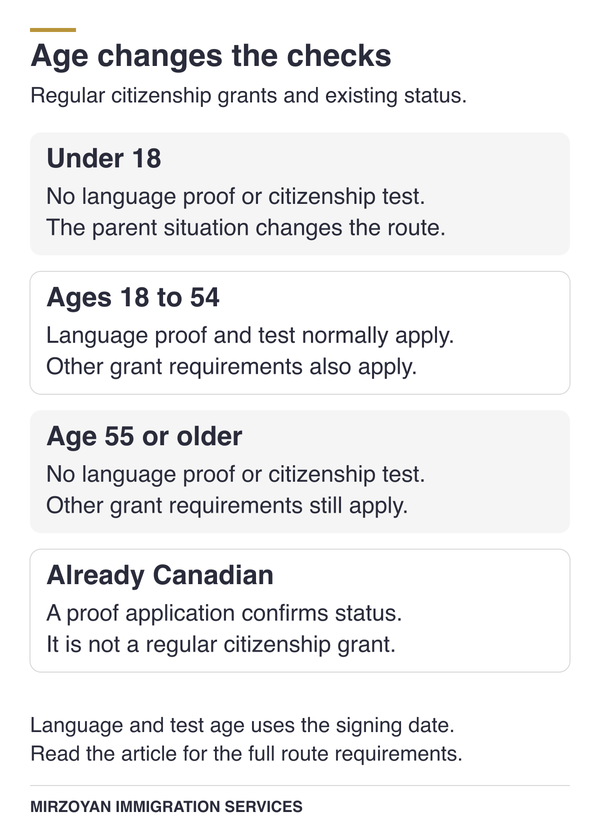
Language and test ages are assessed on the application signing date. Oath and signature rules are separate. Age exemptions do not remove other applicable grant requirements; waivers and adoption routes require separate consideration.
Confirm permanent resident status before calculating physical presence
Permanent resident status needs attention before you rely on a physical presence total. The citizenship eligibility rules identify removal orders and unfulfilled status conditions that may prevent a grant. An immigration or fraud review can also lead IRCC to suspend processing while the review remains unresolved. If you have correspondence about your status, review that issue separately from the number of days you have spent in Canada. Filing a citizenship application does not resolve the underlying immigration matter.
PR status and PR card validity are different questions
A PR card has an expiry date, but that date does not by itself end your permanent resident status. IRCC's PR status guidance explains the distinction between the document and the status it records. You can apply for citizenship with an expired card if you otherwise meet the requirements. However, a question about card validity is different from a letter concerning loss of status or an enforcement process. Check what the correspondence actually says before deciding that a card renewal is the only issue to address.
Physical presence uses the five years before signing
Most adult applicants need at least 1,095 credited days during the five years before signing. And eligible time in Canada before permanent residence counts as half-days, up to 365 credited days. At least 730 credited days must therefore come after permanent residence. The signature date fixes the five-year period and determines which travel falls inside it. But moving the signing date can add recent days while removing older days from the calculation.
Use IRCC's physical presence calculator, then compare its entries with passports, travel records, addresses, work, and study history. But same-day trips, missing stamps, or a second passport can create differences that need explanation. I would not finalize the calculation while an absence conflicts with another part of the chronology. And filing at exactly 1,095 days also leaves no room for a disputed travel day. The physical presence guide explains the detailed calculation and record-reconstruction process.
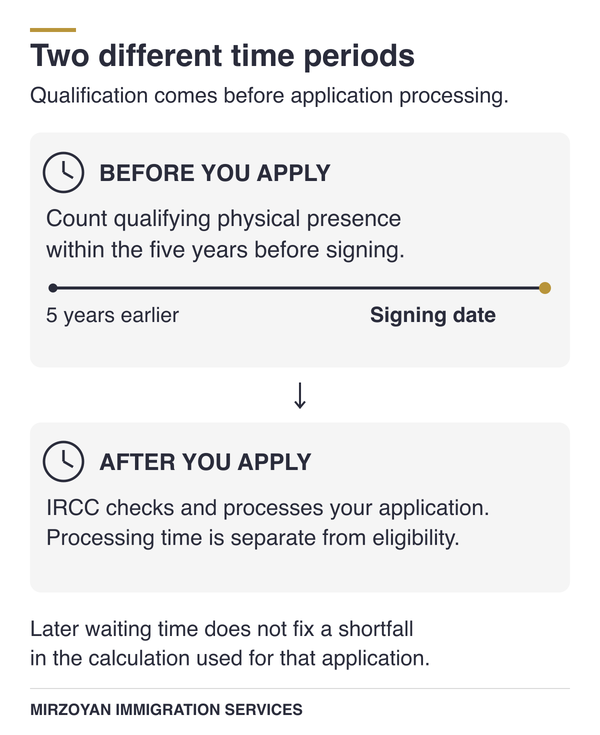
The pre-signing five-year eligibility window and post-submission processing period answer different questions. This diagram is not to scale and does not predict a decision date.
Tax, language, knowledge and prohibition rules interact
Once you have checked status and physical presence, review the requirements that depend on age, tax obligations, and personal history. Tax questions concern whether you needed to file returns and whether you did so. Language evidence concerns speaking and listening ability, while the citizenship test assesses knowledge about Canada. Criminal, security, or other prohibited circumstances require a separate assessment even if the language and test requirements do not apply. Keep these questions separate when reviewing your records so an exemption from one is not mistaken for an exemption from another.
Tax filing applies only if Canadian tax law required it
IRCC generally asks whether you met personal income tax filing obligations for three years within the relevant five-year period. The application distinguishes whether you were required to file from whether you actually filed. An unfiled return therefore needs a different explanation when filing was required than when no obligation existed. Compare your answers with your tax records rather than treating every year without a return as the same situation. If you are unsure whether filing was required, obtain tax advice before completing that answer.
Language and test rules normally apply from ages 18 through 54
If you are aged 18 through 54 when you sign, you normally need evidence of English or French speaking and listening ability. The minimum is level 4 of the Canadian Language Benchmarks (CLB) or their French equivalent, Niveaux de compétence linguistique canadien (NCLC). In practical terms, this means handling everyday conversations and understanding straightforward questions and directions. Reading and writing scores do not replace the required speaking and listening evidence, even if your test report includes them. Submit language proof with the application; the separate citizenship test normally follows later and covers knowledge about Canada.
IRCC accepts specified education records, government-funded language training, and qualifying third-party test results as language proof. Education evidence must show that the secondary or post-secondary program was conducted in English or French. Qualifying test results may remain acceptable after expiry, but the minimum score depends on the test and test date. IELTS Academic alone is not accepted because IRCC lists IELTS General Training for citizenship applications. Use IRCC's language-proof tool to match your document to the current instructions.
An accommodation changes how an applicant meets a requirement; an approved waiver removes the requirement itself. For example, IRCC may provide extra test time, an oral test, sign-language interpretation, or an accessible appointment. Applicants may request an accommodation in the application or later in the process. A waiver is different because the applicant asks IRCC to excuse the language, test, or oath requirement. IRCC applies separate criteria to a waiver or accommodation request, so neither should be treated as automatic.
Prohibitions require a fact-specific review
Certain criminal, security, misrepresentation and enforcement circumstances can prevent or delay a citizenship grant. The Citizenship Act prohibitions distinguish pending proceedings from convictions and sentences. For example, a qualifying charge can prevent a grant while the proceeding remains unresolved, even without a conviction. A qualifying conviction raises separate timing questions, including the four years before applying and the period before citizenship or the oath. Probation, parole and imprisonment can also prevent a grant while those circumstances continue.
A “criminal record” label therefore cannot tell you whether a prohibition applies or when it might end. For an individual assessment, gather the charging document, court outcome and sentencing or completion records relevant to the issue. If a charge was withdrawn or dismissed, include the record confirming that result rather than relying on a verbal account. Foreign proceedings may require assessment of how the offence compares with Canadian law. Review those documents before choosing a filing date; neither an old record nor a completed sentence establishes the answer alone.
Gather the current evidence before opening the application
The application should be assembled from one consistent account of your identity, status, travel, addresses, work, study, and tax history. And IRCC may compare the same date across several forms and supporting documents. But a correct answer in one field can still create a problem when another record gives a different date. Prepare the chronology before copying information into the portal or paper forms. Then collect documents against the checklist for the actual applicant and filing channel.
Use the checklist for the actual channel and applicant type
Do not begin with a general document list copied from another applicant's experience. Adult, child, adopted-person, proof, and representative-filed applications can require different forms and evidence. Paper applicants should use the current package identified on the CIT 0002 page. But eligible online applicants receive their forms and upload fields through the account. The forms and guides index is safer than a package saved months earlier. Confirm the live checklist again before submission because forms and instructions can change independently.
Match the citizenship photo to your application channel
Both online and paper citizenship grant applications require a recent photo that follows IRCC's citizenship specifications. The photo must measure 50 mm by 70 mm, with face height between 31 mm and 36 mm from chin to crown. It must show your current appearance, be no more than six months old, and remain unaltered. Your face and shoulders must face the camera directly, centred and square, against a plain light background. Keep your eyes open and visible, with your mouth closed and no smile or frown. The image must also be clear and evenly lit, with natural skin tones.
For an online application, upload one digital photo in JPG or JPEG format, preferably the original file from the commercial photographer. It must be at least 420 by 540 pixels and use minimal compression. IRCC lists approximately 240 kB as the target size, with a maximum of 4 MB. The public online-grant instructions do not list a separate upload for photographer information. Complete any additional photo fields your current online account displays before submitting the application.
For a paper application, provide two identical colour photos professionally printed on high-quality photographic paper. They must meet the dimensions, appearance, and recency requirements described above. The back must show your full name, the photographer or studio name, complete address, and date taken. Check the back as well as the image before enclosing the photos with your application. If IRCC has already returned the package because of a photo problem, follow the correction and resubmission guidance.
Glasses and head coverings need particular attention because your eyes and face must remain visible. Glasses must not obscure your eyes or create glare, and daily religious or medical head coverings must not cast facial shadows. Someone wearing medical headwear or a nasal cannula must keep their eyes visible and include a signed explanation. IRCC may request a supporting letter from the applicant's doctor. A wheelchair user may place a white blanket behind the head so the face and its edges remain clear. These are citizenship-application instructions; passport photos follow separate specifications.
Reconcile the chronology before completing the forms
Build one dated record for addresses, employment, studies, travel, and immigration status before entering those details into the application. Compare it with passports, permits, tax records, and the physical presence calculation, marking any dates that do not agree. I would resolve unexplained travel gaps before finalizing the day count or address history. Record the explanation beside the supporting document so you can distinguish a corrected entry from an unresolved question. Keep that chronology and the records used with your application copy for any later IRCC request.
Confirm the filing channel, current forms, and signatures
Most regular citizenship-grant applicants can apply online, but first check the exceptions on IRCC's adult and minor application page. Paper is required when the physical-presence calculation includes qualifying time abroad as a Crown servant or their family member. Paper is also required if you want your representative to complete and submit the application for you. A representative may help with an online application, but you must complete and submit it yourself under the current instructions. Decide which arrangement you need before starting an account or printing forms.
If applying online, use the forms and document requests provided in the citizenship account. If applying on paper, download the package for your applicant type from the current IRCC page rather than reusing a saved form. Follow that channel's signature instructions and confirm every required person has signed before submission. Access to an account does not establish eligibility, and choosing paper does not change the underlying citizenship requirements. Save the completed application, supporting records and receipt, then retain the submission confirmation or delivery record.
Verify the fee and receipt before submission
Use the official IRCC fee list to check the charge for your application on the day you pay. An adult grant, an application for a minor, and a certificate application have different charges. The adult grant total can contain more than one fee component, which affects how much may be refundable. Keep the official receipt and include it as directed by your online or paper application instructions. The Canadian citizenship fees guide explains payment, underpayments, and refunds; government charges are separate from Mirzoyan Immigration Services' professional fees.
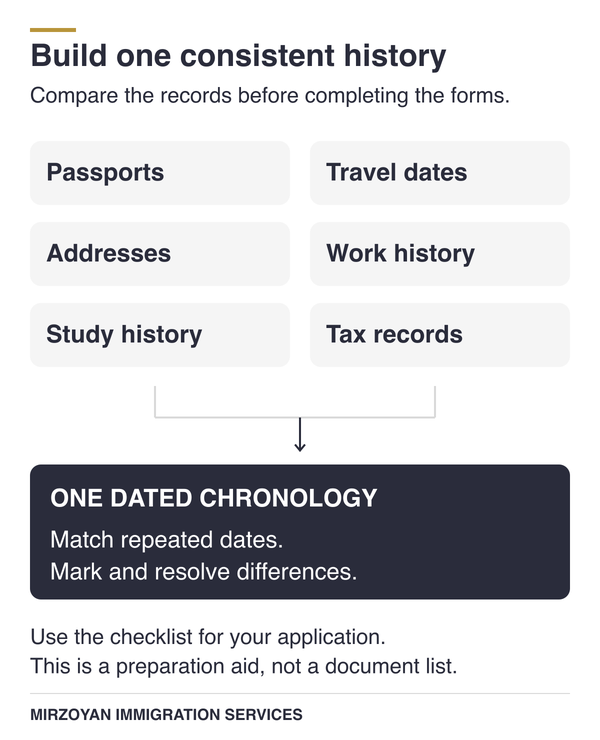
Records that repeat the same events should be reconciled before entries are copied into forms. Keep the underlying sources; the chronology does not replace the required evidence.
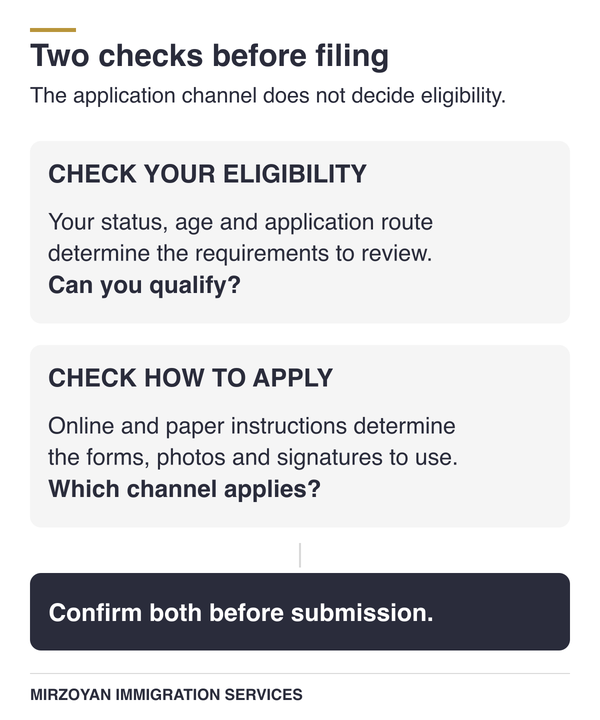
Substantive eligibility and online/paper filing instructions are separate checks. Opening an account does not establish eligibility or permission to use that channel.
Need a citizenship file review before submission?
Mirzoyan Immigration Services can assist with Canadian citizenship application services, including eligibility, presence, document, and consistency review.
What happens after submission
IRCC first checks whether the application is complete enough to enter processing. And a complete file may then move through background checks, testing, an interview, a decision, and the oath. But not every applicant completes each intermediate step because age, route, and file-specific concerns can change the sequence. A request for fingerprints or another document does not itself mean the application will be refused. IRCC's after-you-apply guide explains the current process.
Acknowledgement of receipt is not approval
An Acknowledgement of Receipt (AOR) means IRCC has accepted the application into processing. But it does not confirm that every citizenship requirement has been met. IRCC may still request fingerprints, documents, an interview, a hearing, or clarification. Each request can contain its own deadline and response method. Read the complete notice instead of relying on the short status label in the account.
Not every application has identical intermediate steps
Adults aged 18 through 54 normally complete the citizenship test after the application enters processing. Children and older adults may follow a different sequence because the same testing requirements do not apply. An interview may also be scheduled to assess identity, language, documents, physical presence, or another eligibility issue. Receiving that invitation can be worrying, but it does not by itself mean IRCC has decided to refuse your application. Read the invitation for the appointment arrangements and any documents you are asked to provide. The citizenship test guide covers test-related interviews and hearings; the PFL and information-request guide covers notices requiring evidence or a response.
The oath and ceremony complete most adult grant journeys
IRCC schedules the Oath of Citizenship after approval when the oath requirement applies. And the invitation identifies the ceremony format, either virtual or in person, and lists the documents to bring. Missing the ceremony without contacting IRCC can delay completion. The current ceremony instructions explain attendance and document requirements. The citizenship ceremony guide covers invitations, accommodations, certificates, and missed ceremonies in detail.
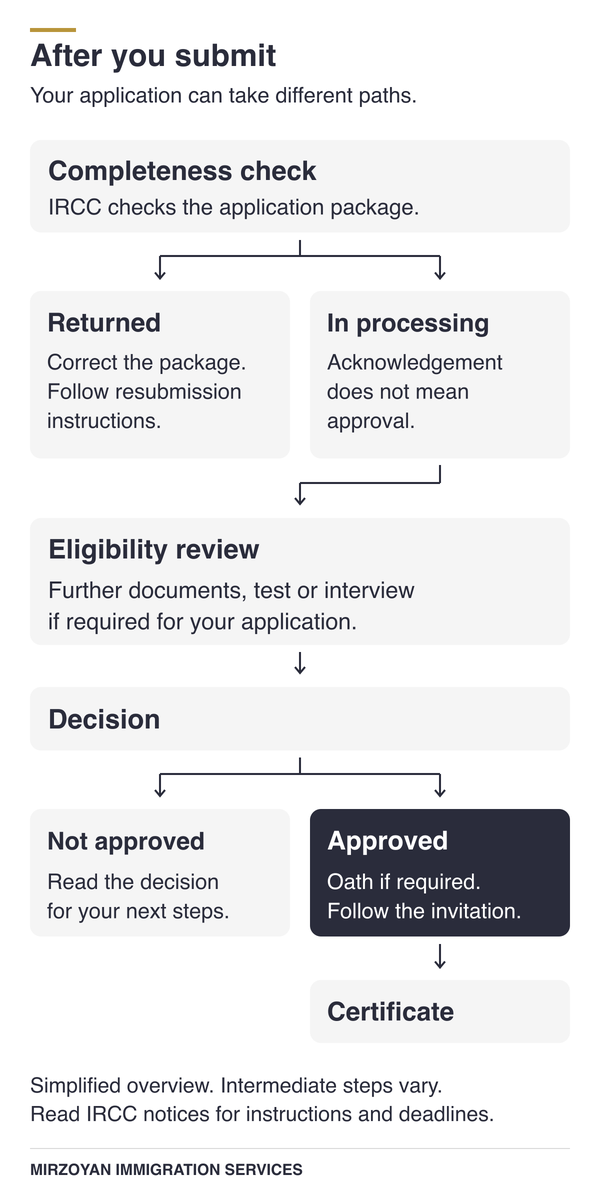
A returned package follows correction and resubmission, not processing. Acknowledgement does not settle eligibility. Further evidence, test or interview steps depend on the file. Only the approved branch leads to the oath when required and the certificate.
Status updates and processing estimates answer different questions
Use the application status page to follow events and messages connected to your file. Access may depend on receiving an AOR and creating or linking the appropriate account. The separate processing-time tool gives a general estimate based on IRCC's current inventory. That estimate cannot tell you when your particular application will be decided or whether further documents will be requested. Continue checking your file's correspondence for instructions and deadlines rather than treating the general estimate as your next appointment date.
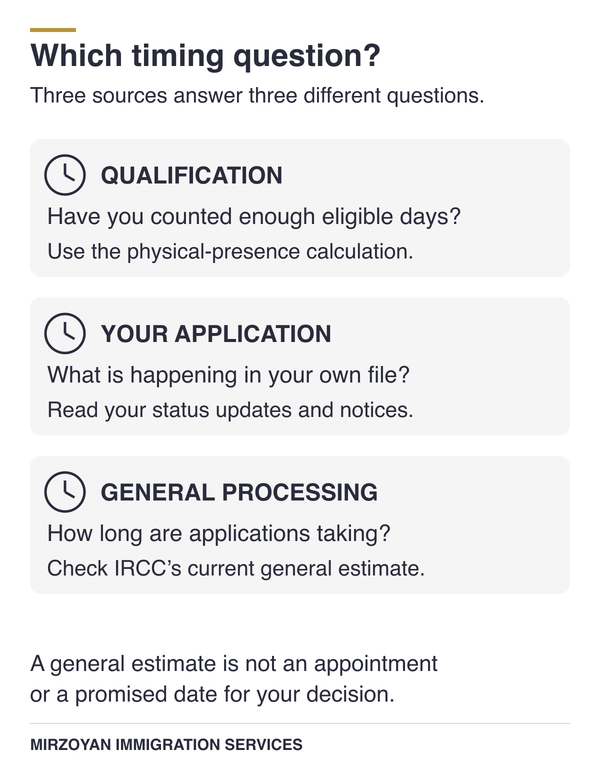
The eligibility calculation, personal file status and general processing estimate are not interchangeable. Read correspondence for actual instructions and deadlines.
The Internal Logic of an IRCC Officer
An officer does not assess each uploaded document in isolation. The application must establish the correct route, permanent resident status, physical presence, tax compliance, language, knowledge, and absence of prohibitions. And age determines whether some requirements apply, while the signing date fixes the physical presence period. The officer can compare one answer with several records covering the same event. But a complete upload list can therefore pass intake and still leave an eligibility concern.
Eligibility is assessed as a connected record
The officer assesses whether your evidence supports the requirements in the regular grant provision and IRCC instructions. Your age and application type determine which conditions need to be examined. A passport, for example, helps establish identity and travel history, but does not establish compliance with tax filing obligations. The officer therefore needs different records to support different parts of the application. Including every document on the checklist allows that assessment to proceed; it does not establish that every requirement has been met.
Dates and identities are checked across the file
Names, birth dates, passport numbers, addresses, employment, studies, travel, and tax periods can recur throughout the file. But a difference may be harmless when records use different formats or contain a documented correction. It becomes more serious when it changes identity, status, eligibility, or the physical presence total. My review starts with the presence calculation, passport chronology, and address history before final answers are copied. That comparison can expose a missing trip or overlapping address while the evidence can still be corrected.
A complete package can still raise a substantive concern
Completeness asks whether the required forms, answers, documents, photos, signatures, and payment evidence are present. But eligibility asks whether those materials prove the legal requirements. An application can pass the first review and fail the second. When records conflict, address the underlying fact rather than merely adding another unexplained document. A clear explanation should identify the difference and connect the reliable evidence to the corrected answer.
Red Flags & Procedural Fairness Letters (PFL)
A letter from IRCC should be read for what it asks you to do, not only for its title. A return usually identifies a problem with the submitted package, while an information request asks for specified material during processing. An interview notice sets an appointment where IRCC can examine identity, language, presence, or another issue. A Procedural Fairness Letter lets you answer concerns before IRCC reaches a potentially negative decision. Before preparing documents, identify the concern, deadline, and response method stated in your correspondence.
A returned application is not a PFL
IRCC may return an application when required forms, answers, documents, photos, signatures, or payment evidence are missing or invalid. But a returned application normally has not entered the same substantive process as an application with an AOR. Correct the package using the actual return letter and the instructions current on the new signing date. The returned citizenship application guide explains the correction and resubmission process. Do not answer a return as though IRCC has already made a negative credibility finding.
Three contradictions that can require a focused response
A difference between your declared absences and passport or border records may put the physical presence total in question. Address and employment histories can add to that concern if they conflict with the time claimed in Canada. A second concern involves identity or status, where government records show a different name, birth date, or immigration event. A third involves an inaccurate prohibition answer about an offence, sentence, or court result. Each needs evidence directed at the disputed fact, rather than a general statement that the application was completed honestly.
Respond to the specific contradiction and its evidence chain
Start with the concern stated in the letter and identify the disputed fact precisely. Explain why the records differ instead of asking the officer to infer the reason. Match each supporting document to the point it proves, using a chronology when several records cover the same dates. But follow the response method and deadline in the notice rather than assuming an extension will be granted. The citizenship PFL guide explains how post-submission requests and fairness concerns differ.
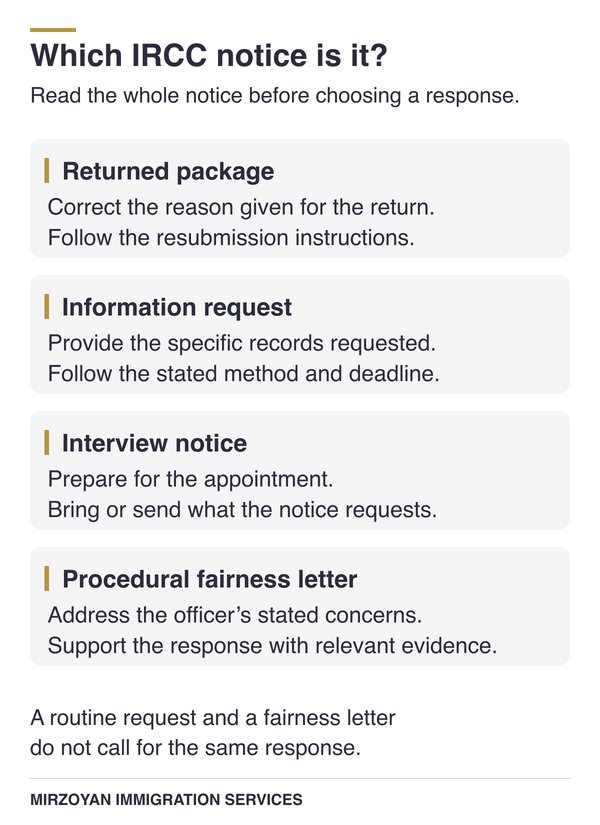
A return concerns the package; an information request seeks specific material; an interview notice sets an appointment; a PFL calls for a response to stated concerns. Follow the actual notice.
Strategic Trade-off Matrix
The correct citizenship application depends on present status, age, family history, and the document required. No route is preferable when its legal conditions do not match the applicant. The tables compare the main risks, evidence, processing path, and fee timing for each application. However, IRCC states that a refused citizenship application has no administrative appeal. Federal Court review may have a short deadline, but it is not a new assessment of the application.
| Route | Main risk | If the application is refused | Fees and other costs |
|---|---|---|---|
| Regular adult grant | Applying before all pre-filing status, presence, tax, language, or prohibition requirements are met. | No administrative appeal. Judicial review may be available; obtain route-specific legal advice within the deadline. | Grant fees are paid with the application. Check the current IRCC fee before paying. |
| Parent-linked citizenship application for a minor | Using the independent-minor requirements or applying without the required parent or guardian route facts. | No administrative appeal. Verify judicial-review applicability and obtain child-route legal advice. | The minor fee differs from the adult grant total. Check the current IRCC fee. |
| Independent citizenship grant for a minor | Assuming the parent-linked route removes presence and tax requirements from an independent application. | No administrative appeal. Verify judicial-review applicability and obtain child-route legal advice. | The minor fee applies, but evidence costs may differ. Check the current IRCC fee. |
| Proof or descent | Filing a grant when the person may already be Canadian, or failing to prove the lineage. | Verify whether the decision is reviewable and obtain status-specific legal advice. | Proof fees and evidence costs differ from grant fees. Check the current IRCC fee. |
| Adopted-person route | Treating the adoption as a routine grant application for a minor without checking the direct route. | Verify judicial-review applicability and obtain adoption-route legal advice. | Government fees and evidence costs depend on the route. Check the current IRCC fee. |
| Certificate replacement | Failing to identify whether the certificate is a first issue, replacement or correction. | Correction, replacement, and status findings require different responses. | First proof and replacement use the same citizenship-certificate fee category, separate from a grant application. Check the current IRCC fee. |
| Route | What happens next | Core evidence | Further guidance |
|---|---|---|---|
| Regular adult grant | Completeness, checks, test or interview where applicable, decision, then ceremony. | Status, presence, tax, language, identity, travel, and prohibition answers. | This guide and the linked articles on individual requirements. |
| Parent-linked citizenship application for a minor | IRCC assesses a parent-linked citizenship application for a minor without the physical-presence test used for an independent application. | Child identity, parent citizenship, relationship, custody or consent, and route-specific documents. | Canadian citizenship for minors. |
| Independent citizenship grant for a minor | IRCC assesses regular-grant presence and tax requirements without adult language or testing. | Child identity, PR status, presence, tax history when required, and current consent documents. | Canadian citizenship for minors. |
| Proof or descent | Status assessment and certificate decision, without the regular grant journey. | Birth, parentage, citizenship, historic status, and substantial-connection evidence where applicable. | Citizenship by descent and proof of citizenship guides. |
| Adopted-person route | Adoption and citizenship assessment under the applicable process. | Adoption validity, parent citizenship, relationship, and route-specific approvals. | Canadian citizenship for minors. |
| Certificate replacement | Existing status remains; IRCC assesses the replacement or correction request. | Identity, existing citizenship record, and reason for replacement or correction. | Citizenship certificate replacement service. |
Citizenship after the oath: benefits, dual status and proof
The oath completes the grant process and changes the applicant's legal status to Canadian citizen. IRCC's after-ceremony instructions explain how the certificate is issued and used. Yet the certificate proves citizenship without serving as a passport or travel document. Keep it secure because replacement requires a separate application. The proof-of-citizenship guide explains which documents can establish citizenship in different situations.
Canada permits dual citizenship, although another country may restrict or attach consequences to that status. But Canadian citizens normally need a valid Canadian passport to board a commercial flight to Canada, subject to current exceptions. Passport photos follow passport-program rules, not the citizenship-application photo specifications discussed above. The dual citizenship guide explains travel documents, consular limits, and foreign-country considerations. After receiving the certificate, follow the current first-passport instructions rather than citizenship-photo rules.
Citizenship can provide voting rights, secure status, passport eligibility, and access to some restricted employment. The practical steps for using those benefits differ, so receiving your certificate does not complete every related process. A passport still requires a separate application, and particular employment opportunities have their own qualifications. Keep citizenship evidence available when an application asks you to establish that status. The benefits of Canadian citizenship guide explains these changes and their practical conditions in more detail.
How Mirzoyan can help with a citizenship application
A straightforward application may be manageable using the official instructions when the required facts and records are clear. Mirzoyan Immigration Services can review a regular citizenship grant application before submission or assist when IRCC requests a response. The review can cover permanent resident status, physical presence, documents, forms, and correspondence. Comparing the presence calculation with travel and address records can identify inconsistencies that need to be resolved before filing. If the initial assessment identifies a different need, assistance may involve proof of citizenship, citizenship for a minor, or certificate replacement. Consultations are available in person, online, or by phone across Canada.
One on One Advisory gives you direct access to Narek Mirzoyan, RCIC # R1005184, or Vahe Mirzoyan, RCIC # R514223. Questions about your evidence go to the licensed consultant responsible for the review. You can discuss why a travel date needs clarification or how a document relates to an IRCC concern. An intake coordinator or assistant does not replace that direct advisory relationship. Learn more about Canadian citizenship application services if you need help preparing the application or addressing correspondence. A review can identify unanswered questions, but it cannot guarantee approval or faster IRCC processing.
Key Takeaways
Confirm whether you need a grant, proof of existing citizenship, citizenship for a minor, or certificate replacement.
Regular adult citizenship requirements usually include status, presence, tax, language, testing, prohibitions, and the oath where applicable.
Physical-presence qualification time is separate from IRCC's processing estimate and your individual application status.
Recheck the application channel, form edition, fee, package, and processing tool before submission.
Canadian citizenship application services at Mirzoyan Immigration Services include direct access to a licensed RCIC.
Frequently Asked Questions
What are the 5 requirements to become a Canadian citizen?
IRCC's five-item summary lists permanent resident status, 1,095 days of presence, taxes if required, the citizenship test, and language proof. But age and route change how these apply. Prohibitions are separate eligibility conditions, and the oath follows approval when required. Minor applications follow separate age and parent rules. No single five-item list applies identically to every citizenship application.
What is the new rule for citizenship in Canada?
Bill C-3 changed citizenship-by-descent rules on December 15, 2025, including the former first-generation limit and some future transmissions. But the change does not replace regular grant requirements for permanent residents. Check the birthright guide for the framework and the descent guide for individual eligibility. Use the proof guide once status is established. The applicant's birth date, the parent's status, and the generation remain central to that assessment.
How difficult is it to get a Canadian citizenship?
Canadian citizenship depends on meeting every applicable legal requirement and supporting the facts with consistent evidence. A straightforward file can still require careful work because the same dates appear across several records. Difficulty increases when presence is close to the minimum, travel records conflict, or permanent resident status is unresolved. But criminal or immigration history can require a separate prohibition analysis. A complete checklist does not cure an eligibility problem.
How can I check the status of my Canadian citizenship application?
Use IRCC's application status page for events and messages in your file. Use IRCC's separate processing-time tool for the latest general estimate. The estimate is not a deadline or guarantee. Your acknowledgement of receipt and account instructions determine access to file-specific tracking. Neither tool changes the physical presence calculation completed before the application was signed.
Can I become a Canadian citizen by marrying a Canadian citizen?
No. Marriage to a Canadian citizen does not transfer citizenship or remove the regular grant requirements. A permanent resident spouse must still meet the applicable status, physical-presence, tax, language, test, prohibition, and oath rules. But a different answer may apply if you already hold citizenship through a parent. Check possible citizenship by descent before beginning a grant application.
Conclusion
Before signing, resolve any question that could change your eligibility or an answer in the application. Start with unexplained travel dates, uncertain tax filing obligations, and any unresolved immigration or criminal matter. Check the current photo, form, and payment instructions once those substantive questions have been addressed. Keep a complete copy of the submitted application and supporting records so you can respond to later correspondence. For a citizenship application review, bring the unresolved questions and supporting records to Mirzoyan Immigration Services.
Disclaimer
This article provides general information, not legal or immigration advice. Citizenship rules and instructions can change, and individual circumstances require separate assessment.